Pearl Myth Meaning & Symbolism
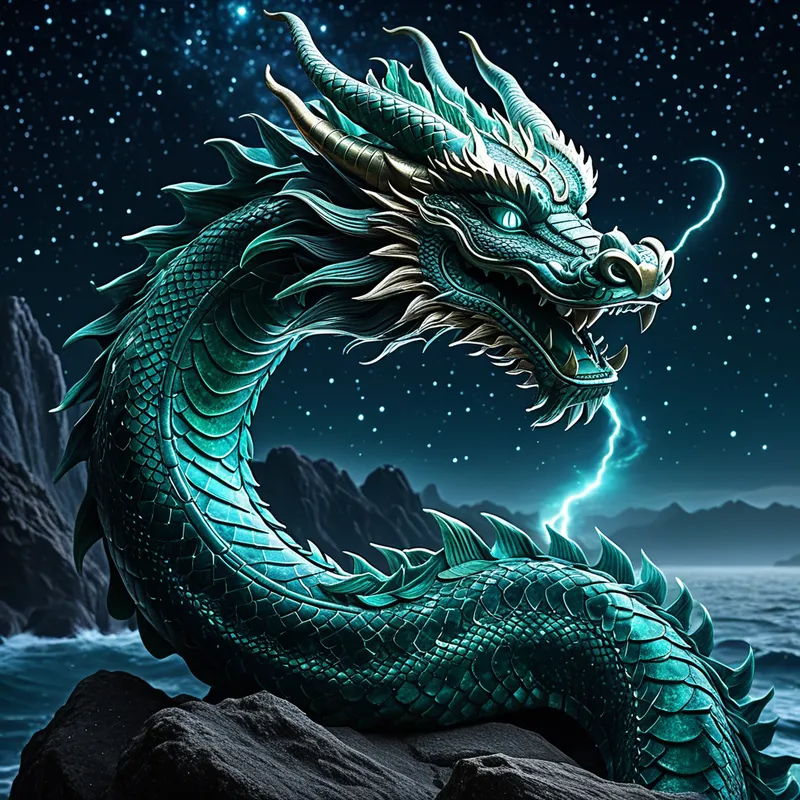
A celestial dragon's tear, shed in cosmic sacrifice, falls to earth and is forged by the sea into a luminous pearl of perfect wisdom and harmony.
The Tale of Pearl
In the time before time, when the sky was a fresh canvas and the earth still soft with newness, the great Celestial Dragon, Tianlong, kept watch from the vault of heaven. His body was the river of the Milky Way, his breath the shifting winds, and his eyes the distant, patient stars. He witnessed the birth of mountains and the carving of rivers, the dance of seasons on the young world below. Yet, in his cosmic heart, a profound melancholy stirred—a longing for the raw, chaotic beauty of the earthly realm he could observe but never truly touch.
One fateful cycle, as he watched the relentless, churning fury of the East Sea, a storm of unprecedented violence arose. It was not merely a weather event, but a rebellion of primordial chaos. The sea sought to swallow the fledgling land, and the sky wept torrents of despair. Tianlong saw the delicate balance of Yin and Yang threatening to unravel into void.
A great conflict tore through the dragon’s being. His duty was to uphold celestial order, to remain aloof and constant. Yet, his love for the struggling world below was a pain sharper than any celestial spear. This inner tempest mirrored the one below. Finally, with a sound that was both a sigh of infinite sorrow and a roar of decisive will, Tianlong made his choice. He bent his mighty head from the starry fields and gazed upon the raging ocean. From his vast, star-lit eye, a single tear welled—a distillation of his cosmic essence, his celestial power, and his profound earthly love.
The tear fell. It was not a drop of water, but a sphere of condensed moonlight and stellar fire. It pierced the chaotic atmosphere, a silent comet of sacrifice, and plunged into the heart of the tumultuous East Sea. The impact was not an explosion, but a sudden, profound silence. The chaotic waves stilled, drawn to the luminous intruder. For a hundred years, the sea worked upon it. The turbulent Yin energies of the dark abyss and the gentle Yang pressures of the sunlit shallows embraced the celestial gift. They smoothed its edges, layer upon layer, with the patience of eternity. They wrapped it in nacre—the very substance of the moon’s reflection on calm water.
And so, from the dragon’s sacrifice and the sea’s alchemy, the first Pearl was born. It washed ashore not with a crash, but with a whisper, onto a beach smoothed by the now-pacific waves. It lay there, glowing with a soft, inner luminescence, a perfect sphere of harmonious contradiction: hard yet born of liquid, earthly yet celestial, a child of sorrow that radiated perfect peace. It was the solidified tear of heaven, the perfected heart of the deep, a testament that true harmony is born from the conscious marriage of sacrifice and creative force.

Cultural Origins & Context
The myth of the Pearl’s origin is not contained in a single, canonical text but is woven into the fabric of Chinese folklore, Daoist allegory, and literary tradition. It is a myth told by sailors of the East China Sea, pondered by Daoist sages seeking the Wuji within the material world, and referenced in classical poetry as the ultimate symbol of precious beauty born from adversity. Its primary function was not historical but philosophical and aesthetic.
It served as a natural explanation for the pearl’s unmatched lustre and perfection, attributing it not to chance but to a cosmic process. More importantly, it modeled a core cosmological principle: value and beauty are forged through a dynamic process involving a descent from a higher state (the celestial), a struggle within a transformative medium (the chaotic sea), and a resulting synthesis that embodies a higher harmony. This narrative provided a template for understanding personal refinement, scholarly pursuit, and even political governance—the wise ruler, like the sea, must patiently cultivate and refine the celestial mandate (Tianming) into a state of peaceful order.
Symbolic Architecture
Psychologically, the myth maps the arduous journey of creating something whole, precious, and luminous from the raw material of experience and emotion. The Celestial Dragon represents the transcendent aspect of the Self—the spiritual longing, the ideal, the “higher” consciousness that observes the turmoil of the earthly psyche. Its tear is the moment this transcendent awareness consciously engages with the suffering and chaos of the embodied, emotional life. It is the sacrifice of pure, detached ideation for the messiness of real feeling.
The pearl is not found in the calm shallows; it is forged in the violent marriage of celestial longing and oceanic chaos.
The chaotic East Sea is the unconscious—the dark, turbulent, and fertile realm of instinct, emotion, memory, and shadow. It is the necessary crucible. The pearl’s century-long gestation symbolizes the slow, often unconscious, psychic process of integration. The layers of nacre are the successive experiences, reflections, and accommodations that slowly coat a core insight or wound, transforming it from a raw, painful “tear” into a structured, beautiful, and durable part of the personality. The perfect sphere signifies the achieved state of psychological wholeness and individuation—a self-contained microcosm where opposites (hard/soft, light/dark, heaven/earth) are perfectly balanced.
The Dreamer’s Resonance
When this mythic pattern stirs in the modern dreamer, it often manifests as dreams of diving into deep, dark water in search of a glowing object; of finding a rough, irritating grain of sand in a soft, vulnerable place that slowly becomes a source of light; or of weeping tears that transform into crystals or gems. Somatic sensations might include pressure around the chest or throat (the “grain of sand”) or a feeling of buoyancy and luminescence.
Psychologically, this signals that the dreamer is in the midst of, or is being called to, a profound alchemical process. The “tear” is a current emotional pain, a loss, or a piercing insight that feels alien and painful within the familiar self. The dream confirms that this irritant is not a mistake to be expelled, but the potential seed of a future strength. The process is one of “pearl-making”: the ego must learn to stop fighting the discomfort and instead allow the unconscious (the sea) to work upon it. This requires surrendering control, enduring the pressure of conflicting emotions, and trusting in a slow, organic timeline of healing and integration. The dream is an assurance from the deep psyche that the current suffering has a teleology—it is moving toward becoming a center of value and wisdom.

Alchemical Translation
The myth of the Pearl provides a complete model for the alchemical opus, the great work of individuation. The initial state is one of separation: the dragon in heaven, the sea in chaos. The nigredo, or blackening, is the dragon’s melancholy and the sea’s storm—the recognition of suffering and inner conflict. The sacrifice of the tear is the crucial mortificatio—a “killing” of the old, detached spiritual posture, allowing a piece of the transcendent Self to descend into the murk of the personal unconscious.
Individuation is the patient secretion of consciousness around the irreducible, painful core of experience until it becomes the organ of perception itself.
The century in the sea is the long albedo and citrinitas (whitening and yellowing), the slow work of analysis, reflection, and emotional processing. The ego must become like the sea, applying the gentle, persistent pressure of attention to the core complex. Finally, the pearl washing ashore is the rubedo, the reddening or culmination: the birth of the Self as a tangible, luminous reality within the conscious personality. The integrated individual carries this pearl within—a hard-won center of calm, a touchstone of wisdom born from their deepest sacrifice and struggle. They have, in effect, become the union of Tianlong and the East Sea, capable of holding celestial insight within the fluid reality of human life, radiating a harmony that was forged in the depths of their own being.
Associated Symbols
Explore related symbols from the CaleaDream lexicon: