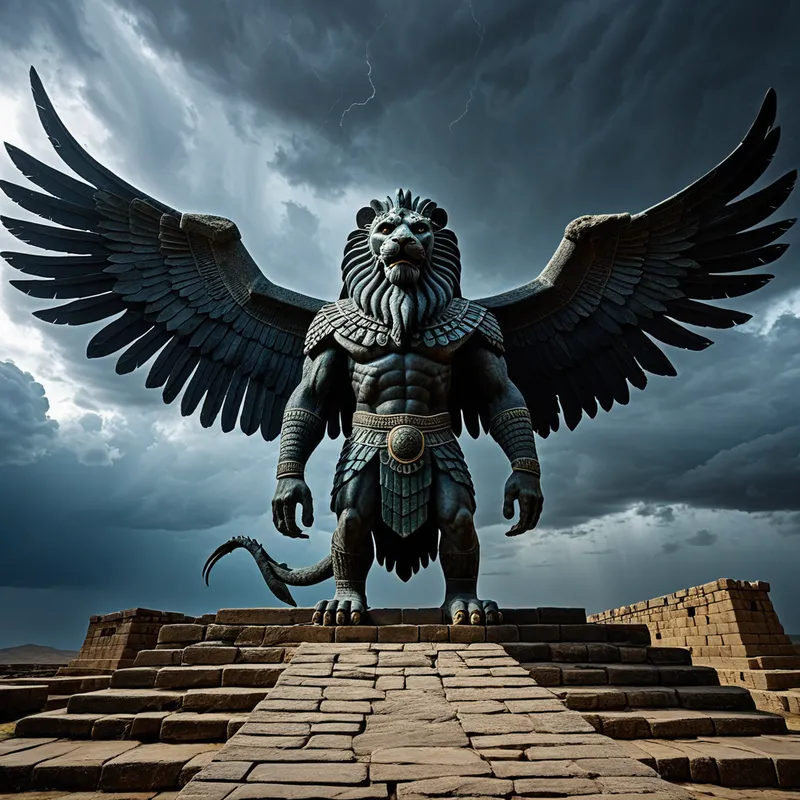
Pazuzu Myth Meaning & Symbolism
The Mesopotamian demon king of the winds, a terrifying figure invoked as a necessary evil to ward off greater malevolence and disease.
The Tale of Pazuzu
Hear now the whisper on the scorching wind, the tale that rides the dust-devils of the alluvial plain. It begins not in the temples of sweet incense, but in the howling emptiness of the western desert, the home of all things banished.
There, in the Ḫamriš, the formless waste, a presence stirred. It was the wind given teeth, the drought given a name: Pazuzu. He was not born of clay and divine breath like humanity, but shaped from the very essence of the sirocco—the hot, pestilent wind from the west. His form was a congress of terrors: the head of a ravening dog, lips drawn back from fangs in a perpetual snarl; the body of a man, yet scaled like a serpent and lean with famine; the paws of a lion, ready to rend; the talons of an eagle, curved for grasping; two pairs of vast, leathern wings that beat with the sound of coming storms; and a tail that ended not in flesh, but in the venomous barb of a scorpion.
His breath was the fever, his passage the blight. He would sweep into the land, and the barley would wither in the field. The newborn would cry with a strange, weak sound, and the mother’s milk would turn sour. He was the unseen cause of the wasting sickness, the demon of the southwest wind, king over a legion of lesser utukku and lilû.
Yet, the people of the Two Rivers were wise in the ways of terrible things. They knew that to fight a demon with pure light was to cast a shadow you could not see. They understood the older, deeper law: set a thief to catch a thief.
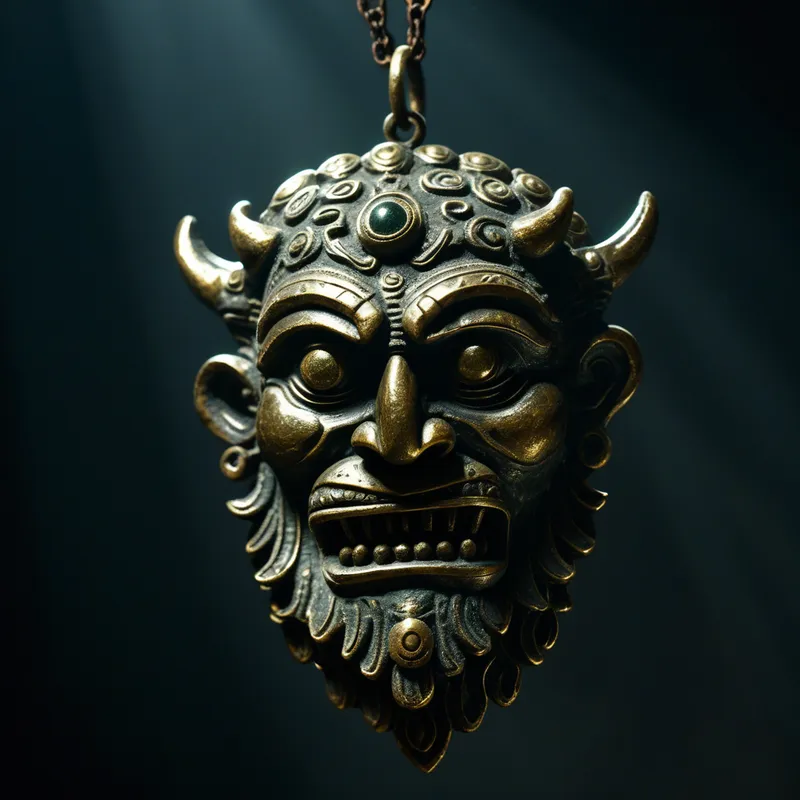
And so, the incantation priests, the āšipu, did not seek to destroy Pazuzu. Instead, they called to him. They crafted his likeness in bronze and stone, capturing every horrifying detail—the protruding tongue, the erect penis symbolizing raw, generative power, the watchful, malevolent eyes. They did not hide these amulets. They placed them in the rooms of women in childbirth. They hung them around the necks of children. They mounted them on the walls of homes, facing the west, the direction of his domain.
The invocation was not a plea, but a contract, a summoning of the necessary evil. “Oh Pazuzu,” the spell would intone, detailing his fearsome visage and dominion, “you are the son of Ḫanbi, king of the evil lilû-demons. With your fierce face, turn away. With your raging winds, stand guard. Let your breath, which brings the pestilence, now blow back the pestilence that comes from another. Let the Lamashtu flee before your gaze.”
And so, the greatest terror became the greatest shield. The demon whose wind stole life was beseeched to become a bulwark against the demoness who stole babies from the womb. Pazuzu, the king of plague winds, was made the sworn enemy of Lamashtu, and in that enmity, humanity found a sliver of safety. He stood on the threshold, a monstrous sentinel, his horror turned outward so that a lesser horror could not enter.
Cultural Origins & Context
The mythos of Pazuzu emerges from the heart of Mesopotamian existential anxiety, a culture profoundly intimate with forces beyond its control. This was not a narrative preserved in a single, canonical epic like the Epic of Gilgamesh, but a living, practical mythology embedded in the daily struggle for survival. His story is told not by bards in royal courts, but by the trembling hands of the āšipu—the scholar-exorcist-physician—as they copied incantations onto cuneiform tablets, and by the artisans who cast his apotropaic image.
First appearing prominently in the early 1st millennium BCE, Pazuzu’s prominence coincides with a period of intense medical and magical practice. His societal function was profoundly pragmatic: risk management of the invisible world. In a cosmology teeming with hostile spirits causing illness, miscarriage, and bad fortune, the Mesopotamians developed a complex spiritual ecology. One did not eradicate demons; one manipulated their hierarchies and rivalries. Pazuzu, as a king among demons, possessed the authority to command and repel lesser malignant entities. His myth was a tool, a psychological and spiritual technology for navigating a dangerous universe.
Symbolic Architecture
Pazuzu is the ultimate embodiment of the necessary shadow. He represents a profound psychological truth: that which is most terrifying within the psychic ecosystem may also hold the key to our protection.
The guardian at the gate must wear a face more terrible than the chaos it bars.
His hybrid, chimeric form is not arbitrary chaos, but a symbolic consolidation of power. The canine head signifies a voracious, guarding instinct; the scales, protection and otherworldliness; the lion’s paws, terrestrial dominion and strength; the eagle’s talons, celestial reach and swiftness; the wings, mastery over the spirit-winds; the scorpion tail, a lethal, defensive sting. He is totality through terror, an assemblage of sovereign attributes from all realms—earth, sky, and the animal world—forged into a single, dreadful purpose.
Most critically, Pazuzu symbolizes the principle of homeopathy in the soul’s medicine: similia similibus curantur (like cures like). The wind of illness becomes the wind that blows illness away. The raw, untamed, and demonic force is not integrated into the light of consciousness, but is consciously employed in its raw state. It is the recognition that to navigate a world containing darkness, one must sometimes enlist a darkness that knows the territory.
The Dreamer’s Resonance
When the archetype of Pazuzu stirs in the modern dreamer, it signals a profound engagement with the protective shadow. This is not the personal, repressed shadow of shameful desires, but a more archaic, transpersonal layer—the daimonic guardian.
To dream of such a monstrous, yet strangely focused entity often accompanies life thresholds of extreme vulnerability: childbirth (literal or symbolic, as in birthing a new creative project or life phase), grave illness, or entering a period of perceived spiritual or psychological attack. The somatic experience can be one of chilling dread mixed with a paradoxical sense of safety. The dream ego is terrified of the figure, yet the figure’s attention is directed away from the dreamer, toward an even greater unseen threat.
This dream pattern indicates the psyche’s innate wisdom in mobilizing its own most formidable, “unacceptable” resources for defense. It is the Self organizing a response from the depths, suggesting that the conscious attitude may be too “civilized,” too weak, to handle the current onslaught. The psyche summons its own inner “demon king” to do what polite consciousness cannot.
Alchemical Translation
The alchemical process modeled by the Pazuzu myth is not one of sublimation into gold, but of the strategic use of the Nigredo. It is the stage of acknowledgement and employment, not purification.
For the modern individual pursuing individuation, Pazuzu represents the courage to consciously “invoke your demon.” This means identifying that powerful, frightening, and socially-unacceptable complex within—perhaps a fierce rage, a predatory instinct, a capacity for ruthless discernment, or a raw will to power—and, instead of trying to dissolve it in the light of positive affirmation, giving it a specific, bounded, and protective function.
Individuation is not the eradication of one’s demons, but the promotion of the most capable one to the office of sentinel.
The “Lamashtu” in our lives are the soul-draining forces: the psychic vampires, the internalized critics that steal our nascent creativity, the depressive winds that wither our vitality. The alchemical act is to turn the face of our inner Pazuzu—our own potent, shadowy strength—toward those forces. We forge an “amulet” through ritual, journaling, or active imagination: a conscious agreement with this inner power. “You, my fierce capacity for no, my untamed anger at violation, my dark knowledge of survival—I acknowledge you. I give you a place on my threshold. Your job is not to rule me, but to guard the vulnerable, creative, loving life growing within from all that would prey upon it.”
In this translation, the demon becomes a daimon. The plague wind becomes the cleansing gale. We achieve not a sanitized wholeness, but a fortified integrity, where the shadow, consciously deputized, secures the space for the light to grow.
Associated Symbols
Explore related symbols from the CaleaDream lexicon: