
Paul's Thorn Myth Meaning & Symbolism
An apostle's plea for relief from a tormenting affliction is met not with removal, but with a paradoxical promise of strength perfected in weakness.
The Tale of Paul’s Thorn
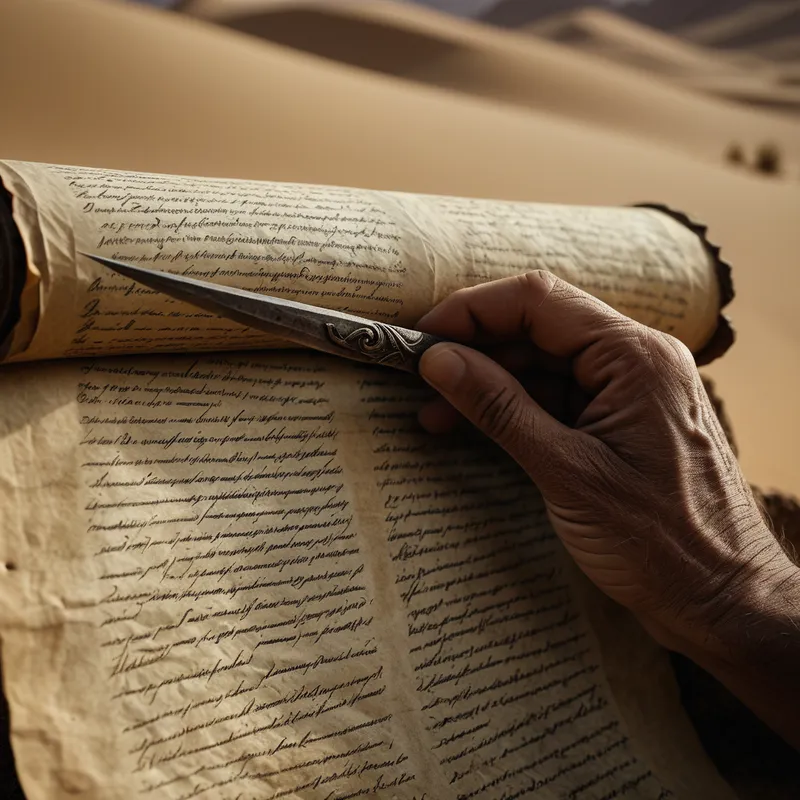
The road was dust and revelation. It was a road of fire, first seen on [the way](/myths/the-way “Myth from Taoist culture.”/) to Damascus, a light that struck a man named Saul blind and birthed in his ashes a new man: Paul. He became a vessel, a voice for a message that shook empires. He walked across the known world, his feet bleeding on Roman stones, his voice thundering in synagogues and market squares. He was lifted to the third heaven, he said, and heard unspeakable things.
But in his flesh, a messenger was sent. Not an angel of light, but an angel of the adversary—a thorn. It was not a metaphor. It was a physical, persistent, gouging presence. A weakness that would not yield. A pain that sat at his table, slept in his bed, walked with him on every missionary road. Some say it was a crippling ailment of the eyes, a veil over his vision. Others whisper of a tormenting spirit, a harassment that scraped at the edges of his soul. It was his constant companion, this thorn, a stark counterpoint to the sublime visions.
Three times, with the desperation of a drowning man, Paul pleaded. His prayers were not polite petitions. They were raw, guttural, born of a spirit stretched to its limit. “Take it away!” he cried into the silence. “Remove this thorn!” He argued his case before the divine court: I could be so much more effective without it. The message would flow clearer, my body would be stronger for the journey.
The answer did not come as a healing, but as a voice. A word that settled in the hollow place carved out by his pleading. It was a word that reordered the universe of his suffering.
“My grace is sufficient for you,” the voice said, a sound like deep waters. “For my power is made perfect in weakness.”
And in that moment, the thorn was not removed. It was transformed. It was no longer merely an enemy to be defeated, but the very socket into which a greater strength was fitted. Paul did not rejoice for the thorn, but in it. For when he was weak, stumbling, humbled by this fleshly messenger, then he was truly strong. The thorn became the seal of his authenticity, the proof that the power working through him was not his own. He would now boast gladly of his weaknesses, so that the power of [the Anointed](/myths/the-anointed “Myth from Biblical culture.”/) One might rest upon him. The road remained dust, but the man walking it carried a new and paradoxical secret in his scarred heart.
Cultural Origins & Context
This narrative is found in the [Pauline Epistles](/myths/pauline-epistles “Myth from Biblical culture.”/), specifically in 2 Corinthians 12:7-10. It is a rare and profound moment of autobiographical vulnerability from a figure whose writings are often theological and exhortatory. Paul is writing to a community in Corinth that is skeptical of his authority, with some questioning his apostolic credentials due to his sufferings and lack of conventional eloquence or presence.
In this cultural milieu, physical affliction was often viewed through a dual lens. Within the Hebraic tradition, suffering could be interpreted as divine discipline or the consequence of sin (as seen in the Book of Job). In the Greco-Roman world, bodily perfection and rhetorical prowess were highly valued; a suffering leader was a weak leader. Paul’s “thorn” placed him at odds with both cultural expectations.
By sharing this intimate struggle, Paul performs a radical act. He subverts the cultural script. His letter is the vehicle for this myth’s transmission—not as a polished legend, but as a lived, theological confession. Its societal function was apologetic (defending his paradoxical authority) and pastoral (teaching a fledgling community that divine power operates in a crucible of human limitation). It is a myth born not in [the temple](/myths/the-temple “Myth from Jewish culture.”/), but in the trenches of ministry and personal agony.
Symbolic Architecture
The [thorn](/symbols/thorn “Symbol: A symbol of pain, protection, and hidden beauty, representing obstacles that guard growth or cause suffering.”/) is the central, multifaceted [symbol](/symbols/symbol “Symbol: A symbol can represent an idea, concept, or belief, serving as a powerful tool for communication and understanding.”/). It is an angelos tou Satan, a “messenger of Satan.” This frames it not as a random misfortune, but as a purposeful, adversarial element within a cosmic [drama](/symbols/drama “Symbol: Drama signifies narratives, emotional expression, and the exploration of human experiences.”/). It represents the irreducible “other” in one’s own [life](/symbols/life “Symbol: The symbol of ‘Life’ represents a journey of growth, interconnectedness, and existential meaning, encompassing both the joys and challenges that define human experience.”/)—the persistent flaw, the chronic pain, the psychological complex, the limitation that will not be spiritualized away.
The thorn is the architect of humility. It digs the foundation into which the cornerstone of grace is laid.
Paul himself is the archetypal wounded [healer](/symbols/healer “Symbol: A figure representing restoration, transformation, and the integration of physical, emotional, or spiritual wounds. Often symbolizes a need for care or a latent ability to mend.”/). His [identity](/symbols/identity “Symbol: Identity represents the sense of self, encompassing personal beliefs, cultural background, and social roles.”/) is split between the man who was caught up to [paradise](/symbols/paradise “Symbol: A perfect, blissful place or state of being, often representing ultimate fulfillment, harmony, and transcendence beyond ordinary reality.”/) and the man bound by a debilitating weakness. This [tension](/symbols/tension “Symbol: A state of mental or emotional strain, often manifesting physically as tightness, pressure, or unease, signaling unresolved conflict or anticipation.”/) is the myth’s engine. The “third [heaven](/symbols/heaven “Symbol: A symbolic journey toward ultimate fulfillment, spiritual transcendence, or connection with the divine, often representing life’s highest aspirations.”/)” represents the peak experience, the spiritual [inflation](/symbols/inflation “Symbol: A dream symbol representing feelings of diminishing value, loss of control, or expansion beyond sustainable limits in one’s life or psyche.”/) of transcendent [knowledge](/symbols/knowledge “Symbol: Knowledge symbolizes learning, understanding, and wisdom, embodying the acquisition of information and enlightenment.”/). The thorn is the necessary grounding, the contra naturam force that prevents [the ego](/myths/the-ego “Myth from Jungian culture.”/) from claiming the [vision](/symbols/vision “Symbol: Vision reflects perception, insight, and clarity — often signifying the ability to foresee or understand deeper truths.”/) as its own possession.
The divine [response](/symbols/response “Symbol: Response in dreams symbolizes how one reacts to situations, often reflecting the subconscious mind’s processing of events.”/)—“My grace is sufficient”—introduces the alchemical agent. Grace here is not a passive [blanket](/symbols/blanket “Symbol: A blanket typically symbolizes protection, comfort, and the desire for warmth and security.”/) of [forgiveness](/symbols/forgiveness “Symbol: The act of releasing resentment or vengeance toward someone who has harmed you, often involving emotional healing and reconciliation.”/), but an active, sustaining power that finds its perfect operational [condition](/symbols/condition “Symbol: Condition reflects the state of being, often focusing on physical, emotional, or situational aspects of life.”/) in acknowledged weakness. The myth dismantles the heroic ideal of the flawless conqueror and installs in its place the model of the permeable [vessel](/symbols/vessel “Symbol: A container or structure that holds, transports, or protects something essential, representing the self, emotions, or life journey.”/). [Strength](/symbols/strength “Symbol: ‘Strength’ symbolizes resilience, courage, and the ability to overcome challenges.”/) is redefined not as the [absence](/symbols/absence “Symbol: The state of something missing, void, or not present. Often signifies loss, potential, or existential questioning.”/) of weakness, but as the [capacity](/symbols/capacity “Symbol: A measure of one’s potential, limits, or ability to contain, process, or achieve something, often reflecting self-assessment or external demands.”/) to contain the [paradox](/symbols/paradox “Symbol: A contradictory yet true concept that challenges logic and perception, often representing unresolved tensions or profound truths.”/).
The Dreamer’s Resonance
When this myth pattern stirs in the modern unconscious, it often manifests in dreams of frustrating impediments or chronic ailments within the dreamscape. The dreamer may be trying to deliver an important message or complete a vital task, but is perpetually hobbled—a leg that won’t run, a voice that won’t speak, a car that constantly breaks down. There may be a figure of authority or a radiant presence that is aware of the impediment but does not remove it.
Somatically, this can correlate with a felt sense of constriction in the chest or a literal pain that the dreamer carries into waking life. Psychologically, the dreamer is encountering what Carl Jung called the “reality of the [psyche](/myths/psyche “Myth from Greek culture.”/)“—those autonomous complexes and limitations that resist conscious will. The dream is not necessarily indicating a literal physical healing is needed, but rather that a profound integration is at hand.
The process is one of surrender to the fact. The ego’s project of perfecting itself, of removing all flaws to achieve a spiritual or professional ideal, is hitting its limit. The dream invites the dreamer to stop fighting the weakness as a mere enemy and to begin relating to it as a destined, if painful, part of their total architecture. The anguish of the plea (“remove this!”) is the first, necessary stage of the alchemy.

Alchemical Translation
The myth of Paul’s Thorn is a precise map of the individuation process, specifically the stage where the inflation of the [persona](/myths/persona “Myth from Greek culture.”/) or spiritual ego is punctured by the reality of [the shadow](/myths/the-shadow “Myth from Jungian culture.”/). The “thorn” is the shadow made flesh—the inferior function, the childhood wound, the moral failure that we cannot disown.
The alchemical vessel is not forged in the fire of success, but in the persistent, grating friction of the unhealable wound.
The first alchemical operation is supplicatio (pleading), the honest confrontation and desperate petition. This is the [nigredo](/myths/nigredo “Myth from Alchemical culture.”/), the dark night. The divine response initiates the [separatio](/myths/separatio “Myth from Alchemical culture.”/)—not a separation from the thorn, but a separation of the ego’s identity from its idea of perfection. The ego must die to its fantasy of a flawless, powerful self.
The core transmutation is the coniunctio oppositorum (union of opposites): strength/weakness, power/affliction, glory/humiliation. The thorn remains, but its function changes. It is no longer a defect to be hidden, but the very site of revelation. It becomes the crack where the light gets in. For the modern individual, this translates to the courageous act of “boasting in one’s weaknesses”—not in self-pity, but in radical self-acceptance. The chronic anxiety, the depression, the physical limitation, the past mistake: these are not merely obstacles on the path, they are revealed as the sacred, if painful, contours of the path itself. The power that then flows is authentic, grounded, and no longer the ego’s brittle achievement, but the grace of the whole Self.
Associated Symbols
Explore related symbols from the CaleaDream lexicon: