Paul's Conversion Myth Meaning & Symbolism
A zealous persecutor is blinded by a divine vision on the road, his identity shattered and remade into its opposite: the apostle of what he once sought to destroy.
The Tale of Paul’s Conversion
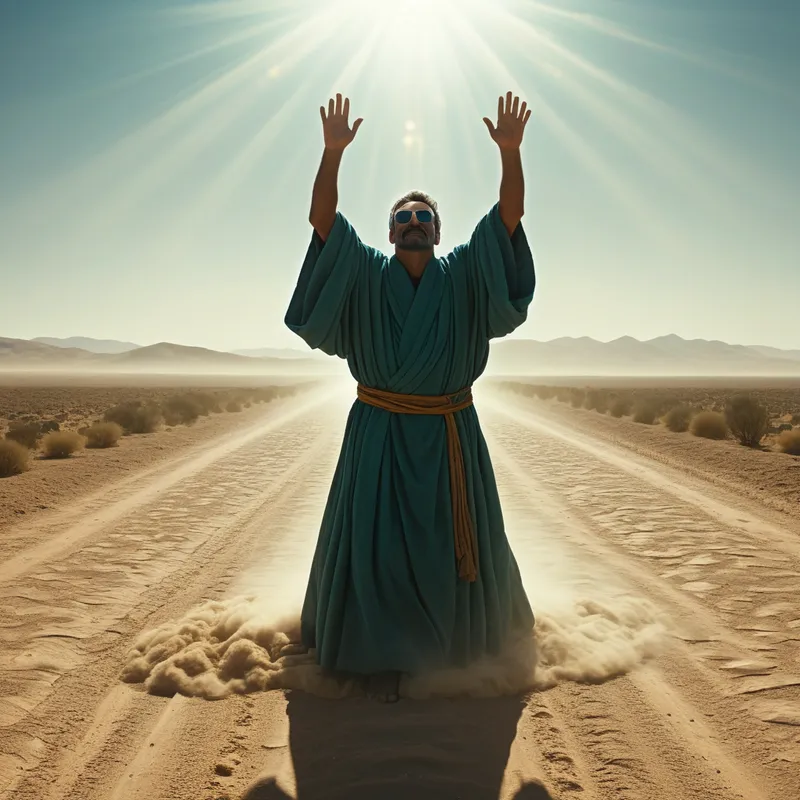
The sun was a hammer on the road to Damascus, beating the dust into a pale, hot haze. Saul of Tarsus moved through it like a blade—purposeful, sharp, and cold amidst the heat. His robes were the mark of his authority, his satchel heavy with the weight of sealed letters. They were warrants, permissions to hunt. His mission was a sacred purge: to root out the followers of The Way, to bind them and drag them back to Jerusalem for judgment. In his heart burned a zealous fire, a conviction so total it left no room for shadow. He was righteousness incarnate, and the world was neatly divided between the pure and the profane.
Then, the world cracked.
It began not as sound, but as a pressure—a sudden, silent vacuum that sucked the breath from the air. The light, already fierce, intensified beyond bearing. It did not shine from the sky; it became the sky, swallowing the blue, the road, the horizon in a searing, white-gold effulgence. It was a light that felt like being seen, utterly and completely, by a gaze that knew the very marrow of his bones. Saul was thrown from his feet, the ground rising to meet him not as earth, but as the only solid thing in a universe dissolving into radiance.
From within the light, a Voice spoke. It was not a sound heard by the ear, but a resonance felt in the teeth, the ribs, the core of the self.
“Saul, Saul, why do you persecute me?”
Blinded, crushed, he stammered into the dust, “Who are you, Lord?”
The Voice replied, and the words were both an answer and an annihilating revelation: “I am Jesus, whom you are persecuting.”
In that moment, the entire architecture of Saul’s reality collapsed. The heretics he hunted were not opposing God; they were one with the divine presence now overwhelming him. The enemy was the Lord. The persecutor was, in his very zeal, committing sacrilege. The foundation of his identity—the Pharisee of Pharisees, the defender of the law—shattered into a thousand contradictions. The light that blinded him was the truth he could no longer avoid seeing.
The vision passed, leaving not darkness, but a profound, impenetrable night within his own eyes. The physical sun still shone, but for Saul, the world had been extinguished. The mighty hunter was now helpless, led by the hand into Damascus, a prisoner of the revelation he had set out to crush. For three days, he sat in a rented room, seeing nothing of the city, seeing only the afterimage of the light and the terrifying, beautiful wreckage of his former life. He neither ate nor drank, fasting from the world as his soul underwent a silent, violent rebirth.
Cultural Origins & Context
This story is not a quiet parable but a foundational earthquake, recorded in the Acts of the Apostles and attested to in Paul’s own letters. It emerged from a first-century Judean context crackling with apocalyptic expectation and sectarian tension. The tale was told and retold by the early Christian communities, not merely as biography, but as legitimizing myth. Here was their most virulent enemy, transformed into their most powerful advocate by a direct, inarguable intervention of the divine.
Societally, it served multiple functions. It validated the persecuted movement: if God Himself had to strike down its chief opponent, the movement must be of supreme importance. It modeled radical grace: no one was beyond redemption, not even a persecutor. Most crucially, it established Paul’s authority. His teachings did not come from the original disciples; they came from a revelation rivaling theirs. The story thus bridges the Jewish roots of the movement and its explosive entry into the Hellenistic world, a transition Paul himself would engineer. It is the mythic birth certificate of a global faith, born from a confrontation on a desert road.
Symbolic Architecture
At its core, the myth is a masterclass in the psychology of total paradigm shift. Saul represents the rigid, conscious ego, utterly identified with a ideological structure—in his case, religious law and tribal purity. He is order, certainty, and directed violence in service of that order.
The road is the fixed path of the conscious will, a straight line from conviction to action. The divine light is the erupting unconscious, the Self that shatters the ego’s simplistic narrative.
The question, “Why do you persecute me?” is the pivotal symbolic moment. It reveals the profound psychic truth: when we persecute an external “other”—a belief, a group, an aspect of ourselves we deny—we are ultimately warring against a disowned part of our own wholeness. Saul was persecuting his own latent capacity for grace, love, and universality, which he had projected onto the followers of The Way.
His blindness is not a punishment, but a necessary incubation. He must be plunged into inner darkness so that the old world, seen with his old eyes, can die. The three days of fasting mirror the mythological descent, a gestational period in the womb of the unknown before a new consciousness can be born. He emerges not as Saul, the man of tribal law, but as Paul, the apostle to the nations. The ego is not destroyed, but its allegiance is utterly transferred from a man-made system to a transpersonal reality.
The Dreamer’s Resonance
When this mythic pattern stirs in the modern dreamer, it often manifests as dreams of shocking confrontation or sudden, disabling insight. One might dream of being pulled over by a police officer who, upon removing his sunglasses, has the dreamer’s own face. Or of giving a passionate speech only to have the microphone broadcast one’s most secret, self-critical thoughts to the entire audience.
Somatically, this is the psyche forcing a reckoning. The dreamer may be living a “road to Damascus”—a life path fueled by a rigid conviction (about career, relationship, self-image) that is, in fact, a form of self-persecution. The blinding light in the dream is the psyche’s immune response against this lie. The ensuing disorientation and “blindness” in waking life may feel like depression, paralysis, or a loss of all former meaning. It is the necessary, painful gap between the collapse of an old identity and the integration of a new, more authentic one. The dream is signaling that the conscious persona has become a prison, and the Self has initiated a jailbreak.

Alchemical Translation
The alchemical process mirrored here is the nigredo, followed by a direct infusion of the lumen dei. The base metal of Saul’s egoic certainty is first reduced to ash (his humiliation and blindness) so that the gold of his authentic calling can be revealed.
For the modern individual, the myth maps the journey from persona to Self. We are all, in some way, zealously traveling a road of our own making, armed with the warrants of our prejudices and the certainties of our past.
The “Damascus event” is that moment—often experienced as crisis, breakdown, or shocking failure—when the universe itself seems to confront us and ask, “Why are you persecuting you?” It calls us to surrender the tyranny of our old story. The subsequent period of blindness is the alchemical albedo, a mandatory purification in the dark. We must learn to navigate by inner touch, not by the old, familiar landmarks of status, approval, or habitual thought.
The rebirth as Paul is the stage of rubedo. The energy once used to suppress and persecute (inner doubts, creative urges, vulnerable feelings) is redeemed and now flows outward in service of a wholeness that includes what was once rejected. The individual becomes an apostle of their own rediscovered humanity, no longer fighting their shadow but speaking from a place that has integrated it. The myth thus promises that the most profound revolution begins not with a change of mind, but with a shattering of sight, forcing the soul to see in an entirely new way.
Associated Symbols
Explore related symbols from the CaleaDream lexicon: