
Parthenon Myth Meaning & Symbolism
The myth of the Parthenon is the story of the inviolable Virgin, a sovereign goddess whose wisdom and power protect the sacred heart of the city.
The Tale of Parthenon
Hear now, not of stones and mortar, but of a living presence. Before the first block was quarried from Mount Pentelicus, she was there. She was the breath held by the city, the unspoken vow between earth and sky.
Her name was Athena, born not of woman, but sprung fully armed from the split skull of Zeus, a flash of divine intellect made flesh. While other gods claimed mountains or seas, she yearned for a place of the mind, a citadel of order. She chose a rocky outcrop overlooking the sprawl of mortal striving—the Acropolis. This was to be her domain, the seat of her essence: the Parthenon, the chamber of the Parthenos, the Virgin.
But a virgin in the old tongue meant more than untouched. It meant belonging to oneself. Sovereign. Complete. Untethered from the claims of others. Her temple was not a house for a consort, but a declaration of self-containment. The air within its proposed colonnades would smell of olive wood and dry parchment, not incense of supplication. The light would fall in clean, geometric shafts, illuminating not an altar of sacrifice, but the idea of clarity itself.
The great conflict was not a battle of swords, but a contest of gifts. The lord of the seas, Poseidon</ab title>, coveted the city. He struck the rock with his trident, and a saltwater spring burst forth, a promise of naval power. But Athena knelt and planted a seed. From it grew the first olive tree—gnarled, resilient, offering food, oil, and wood. The citizens felt the sea’s brute force and shuddered. Then they touched the olive’s silver-green leaves, a gift that nurtured, protected, and illuminated. They chose the gift that fostered life, not dominance. The city was hers, and she named it Athens.
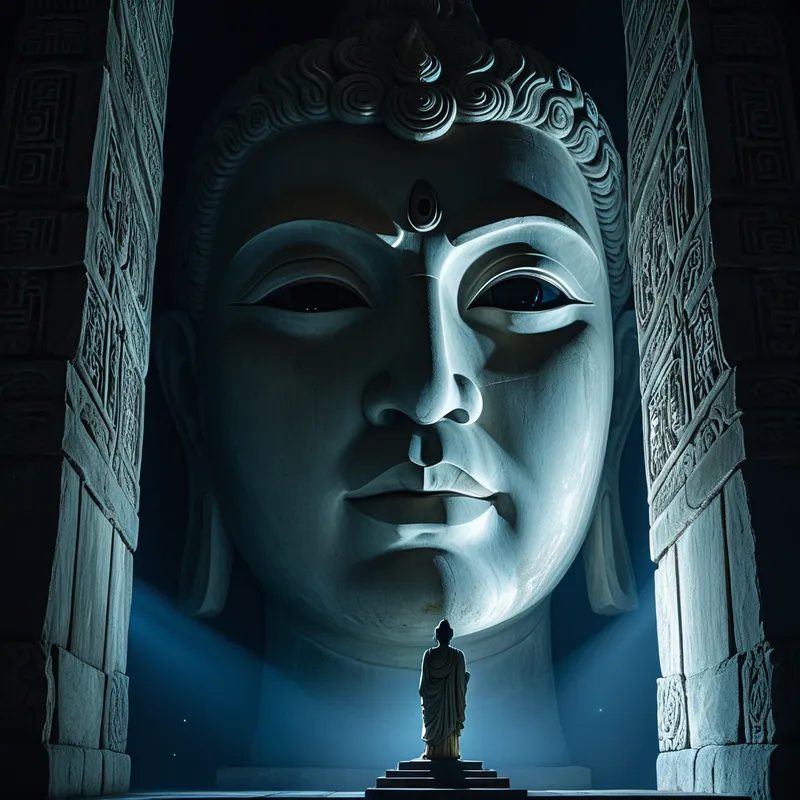
Her presence was made manifest not as a fleeting spirit, but in a form of terrifying serenity. The sculptor Pheidias was guided by vision to craft her effigy. Not of gold and ivory alone, but of potential. The statue of Athena Parthenos stood over thirty feet tall. In her palm rested a winged figure of Nike, not yet flown, victory held in reserve. Her shield, carved with scenes of chaos subdued, rested at her side, a warning and a promise. Her eyes, of polished gemstone, saw not just the city below, but the pattern behind it—the laws, the strategies, the woven fabric of a civilized soul. To stand in that shadow was to stand in the presence of a perfected intellect, a protected space where the chaos of the world broke against the Doric order of the mind.
Cultural Origins & Context
The myth of the Parthenon is the myth of Athenian identity, crystallized in the 5th century BCE during the city’s golden age under Pericles. It was not a folktale told by hearths, but a civic doctrine enacted in marble. The physical temple, built to celebrate victory over the Persians, was a political and theological statement: the city’s survival and supremacy were divinely ordained by its patroness.
The story was passed down through ritual, theater, and the very act of civic life. Every four years, the Panathenaic Festival culminated in a procession winding up the Acropolis. A new woven robe (peplos) was presented to the ancient olive-wood statue of Athena. This ritual re-enacted the bond between goddess and polis, reminding every citizen—from aristocrat to potter—that their collective identity, their laws (thesmos), and their wisdom (sophia) were under her aegis. The Parthenon’s frieze depicts this procession, eternally carving the myth of a unified, blessed people into the cultural memory.
Symbolic Architecture
The Parthenon is not merely a temple; it is a psychic blueprint. Athena Parthenos represents the archetype of the sovereign intellect, the part of the psyche that can observe, strategize, and create order without being hijacked by raw emotion or instinct (represented by Poseidon’s chaotic sea).
The Virgin is she who is sufficient unto herself. Her temple is the sanctum of the individuated Self, a psychic space where one’s core identity remains inviolate.
The olive tree versus the salt spring symbolizes the eternal human choice between creative, sustaining wisdom and reactive, domineering power. The myth advocates for a civilization built on the former. The goddess’s virginity is key—it symbolizes autonomy. She is not defined by relationship to another (mother, wife, daughter), but by her own essence. Her wisdom is born from the father (Zeus, principle of order), indicating that this form of consciousness is a structured, discerning faculty, not amorphous intuition.
The physical temple’s perfect proportions and optical refinements mirror this: it is the mind’s attempt to impose perfect, rational order on the natural world, creating a haven of measured harmony against life’s entropy.
The Dreamer's Resonance
When the Parthenon appears in modern dreams, it rarely manifests as a tourist site. It appears as an immaculate, empty building within the dreamer’s psyche—a pristine library, a sterile laboratory, a vast boardroom, or a perfectly organized but lifeless home. This is the dreamer encountering their own inner Parthenos.
The somatic feeling is often one of awe mixed with isolation. The space is beautiful but cold. This dream signals a process where the dreamer has perhaps over-invested in the Athena principle: intellect, control, strategic defense, and emotional self-containment. The “virgin” aspect has become a fortress, protecting but also isolating the Self. The dream asks: What have you walled off in your quest for order and self-sufficiency? Where has your wisdom become a defense against vulnerability? The dream may also call one to establish this sacred inner space for the first time, to claim sovereignty amidst life’s chaos.

Alchemical Translation
The alchemical journey modeled by the Parthenon myth is the opus of building the conscious ego (the temple) to house the transcendent Self (the goddess). It is the process of individuation where one moves from identification with the turbulent waters of the unconscious (Poseidon) to establishing a durable, reflective structure of consciousness.
The first stage is the contest. The psyche is torn between the chaotic, compelling forces of instinct and emotion (the salt spring) and the call to cultivate something enduring and nourishing from within (the olive tree). Choosing the olive is the commitment to consciousness, to building a life-sustaining inner order.
The alchemical gold is not found in the victory, but in the sacred space the victory makes possible—the temenos where transformation can occur.
The second stage is construction. This is the diligent work of therapy, introspection, and discipline—cutting and polishing the marble of one’s habits, thoughts, and values into a coherent structure. It is building the capacity for self-reflection (the cella) where the true Self can reside.
The final stage is inhabitation. This is not enshrinement, but integration. The statue of Athena within is not a dead idol, but a living symbol of active, protective wisdom. The winged Nike in her hand signifies that victory is dynamic, always potential, never finally won. The completed Parthenon in the soul means one can engage the world from a place of unassailable inner sovereignty, where the Self is both protected and connected, both wise and, ultimately, capable of a compassion that is chosen, not compelled. The virgin has integrated the world without being consumed by it.
Associated Symbols
Explore related symbols from the CaleaDream lexicon: