Park Hyeokgeose Founder of Silla Myth Meaning & Symbolism
A sacred child emerges from a cosmic egg, uniting six clans to found a kingdom, embodying the union of heaven and earth in Korean myth.
The Tale of Park Hyeokgeose Founder of Silla
Listen, and hear the tale of beginnings, when the world was still whispering its first names.
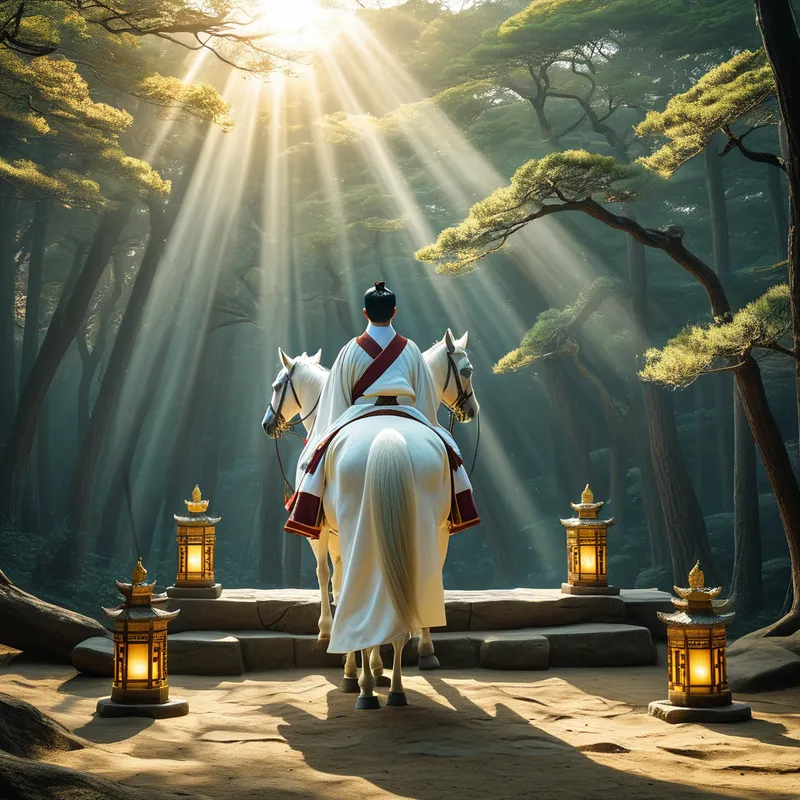
In the time when the land of Jinhan was a tapestry of six clans, each a proud thread yet woven in discord, a sign descended from heaven. The chieftain of Goheo village, Sobeol, ascended Yang-san. There, by a sacred well named Alji, he witnessed a strange and potent vision. The earth trembled not with fear, but with promise. A white horse, its coat like fallen moonlight, knelt and bowed low toward a singular spot. Drawing near, Sobeol found no steed, but instead, a great, purple egg resting upon the earth, pulsing with a soft, interior light.
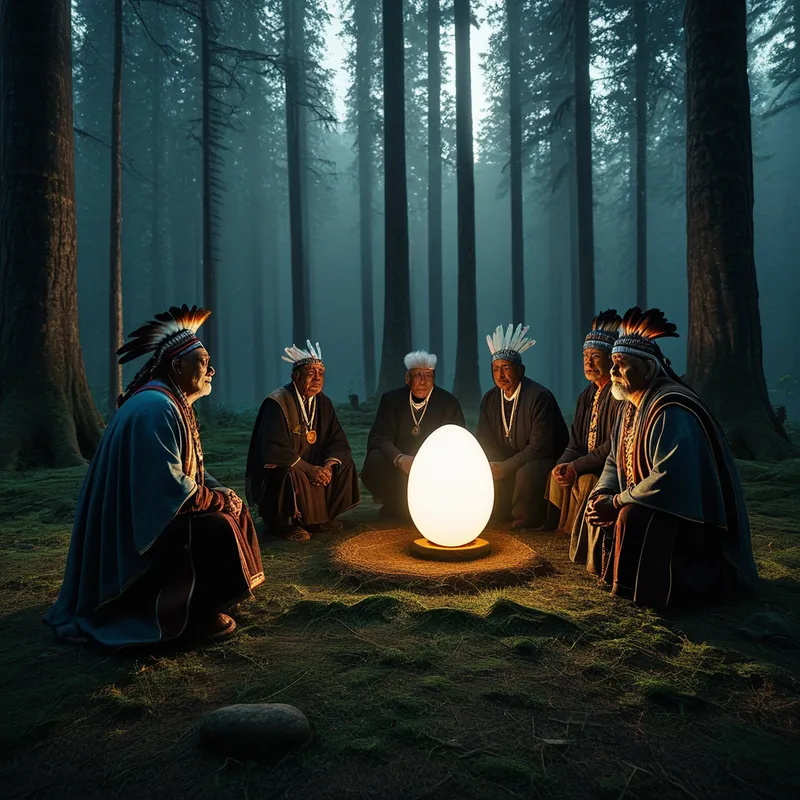
Awe held the chieftain. He returned to his people, gathering the leaders of all six villages. Together, they climbed the mountain, a procession of hope and trepidation. They encircled the egg, a perfect, mysterious vessel. As the first light of dawn touched its shell, it split with a sound like a sigh. From within emerged a radiant infant boy, his visage fair and full of a profound, knowing calm. The very heavens seemed to sing; birds circled, and a sweet fragrance filled the air. They named him Hyeokgeose, for he was brilliance incarnate.
The child grew not as children do. The sun seemed to linger on his path, and his height and wisdom increased daily. At the age of thirteen, a crowning moment arrived. The six chieftains, recognizing the celestial mandate within him, bowed as one. “The child is divine,” they proclaimed. “We have no sage ruler. Let this holy one found our city and be our king.” Thus, they named him Geoseogan, and the kingdom Seorabeol, which men later called Silla.
Yet a king cannot rule alone; heaven provides a counterpart. From the dragon’s abode of Gyeru village, another wonder was reported. A chicken-dragon—a creature of both earth and sky—lay coiled by a forest well named Aryeong. From its left rib, another purple egg was born. From this egg hatched a girl of exquisite beauty and grace, named Aryeong. She was brought to the young king, and their union was immediate and destined. He, born of a white horse’s prayer to the earth; she, born of a dragon’s mystery from the waters. Together, they were the sacred marriage: Cheon and Ji, sun and moon, the fundamental pillars upon which a thousand-year kingdom would stand.
Cultural Origins & Context
This foundational myth originates from the Samguk Sagi and the Samguk Yusa, texts that served to legitimize and sacralize the Silla dynasty long after its zenith. It is not merely a story of a man, but the charter myth for an entire civilization. Told by court historians and likely preserved in oral tradition by wangsa or similar custodians of lore, its function was profound. It answered the primal questions of identity and legitimacy: Why do we, the people of Silla, exist as a united entity? Why do our kings rule? The myth provides a divine answer, tracing royal lineage not to mere human conquest, but to a direct, miraculous intervention from the cosmos.
The narrative elegantly synthesizes indigenous Korean shamanic beliefs—where sacred mountains, wells, and animals are vessels for spirit—with the later need for centralized, kingly authority. The six clans represent the pre-existing social fabric; the egg-born king does not destroy them but unites them under a new, transcendent principle. This reflects the historical process of confederation that likely formed early Silla, sanctifying a political reality with supernatural poetry.
Symbolic Architecture
At its core, the myth of Park Hyeokgeose is a profound [allegory](/symbols/allegory “Symbol: A narrative device where characters, events, or settings represent abstract ideas or moral qualities, conveying deeper meanings through symbolic storytelling.”/) for the [emergence](/symbols/emergence “Symbol: A process of coming into being, rising from obscurity, or breaking through a barrier, often representing birth, transformation, or revelation.”/) of [consciousness](/symbols/consciousness “Symbol: Consciousness represents the state of awareness and perception, encompassing thoughts, feelings, and experiences.”/) and order from the primal, undifferentiated unity.
The egg is the primordial Chaos and the perfect Circle. It is the world before the world, the self before the self is known.
The white horse signifies a divine summons, a call from the numinous that directs [attention](/symbols/attention “Symbol: Attention in dreams signifies focus, awareness, and the priorities in one’s life, often indicating where the dreamer’s energy is invested.”/) to the [site](/symbols/site “Symbol: The concept of a ‘site’ in dreams often represents a specific location associated with personal memories, emotional experiences, or stages in one’s life.”/) of potential. It is the first stirring of [destiny](/symbols/destiny “Symbol: A predetermined course of events or ultimate purpose, often linked to spiritual forces or cosmic order, representing life’s inherent direction.”/), a psychic signal that something of immense importance is about to be born. The horse bows, showing that even the celestial serves this new [birth](/symbols/birth “Symbol: Birth symbolizes new beginnings, transformation, and the potential for growth and development.”/).
The two eggs—one linked to a heavenly steed, the other to an earthly-[dragon](/symbols/dragon “Symbol: Dragons are potent symbols of power, wisdom, and transformation, often embodying the duality of creation and destruction.”/)—represent the dual origins of sovereign power. Hyeokgeose embodies the heavenly, active, shining principle. Aryeong embodies the earthly, receptive, deep, and nurturing principle. Their union is not a romantic [subplot](/symbols/subplot “Symbol: A secondary narrative thread in a story, representing life’s complexities, hidden aspects, or unresolved matters.”/) but the central alchemical [operation](/symbols/operation “Symbol: An operation signifies a process of change or transformation that often requires deliberate effort and planning.”/) of the myth: the hieros gamos or sacred [marriage](/symbols/marriage “Symbol: Marriage symbolizes commitment, partnership, and the merging of two identities, often reflecting one’s feelings about relationships and social obligations.”/). This union creates a stable, fertile [vessel](/symbols/vessel “Symbol: A container or structure that holds, transports, or protects something essential, representing the self, emotions, or life journey.”/)—the [kingdom](/symbols/kingdom “Symbol: A kingdom symbolizes authority, belonging, and a sense of identity within a larger context or community.”/)—capable of enduring.
The six villages are more than historical entities; they symbolize the disparate, often conflicting, aspects of a [community](/symbols/community “Symbol: Community in dreams symbolizes connection, support, and the need for belonging.”/) or an individual’s psyche. The [king](/symbols/king “Symbol: A symbol of ultimate authority, leadership, and societal order, often representing the dreamer’s inner power or external control figures.”/)’s [role](/symbols/role “Symbol: The concept of ‘role’ in dreams often reflects one’s identity or how individuals perceive their place within various social structures.”/) is to integrate these into a functioning, harmonious whole, a process of psychic consolidation.
The Dreamer’s Resonance
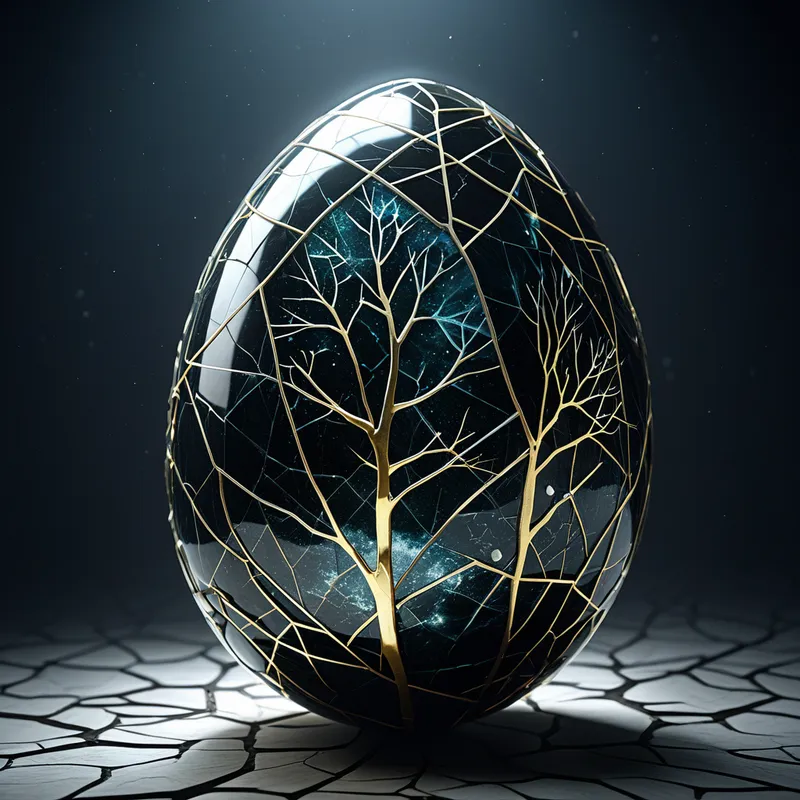
When this myth pattern stirs in the modern dream, it speaks to a profound moment of emergence and integration. To dream of a radiant egg in a sacred landscape is to sense a nascent Self preparing to be born. This is not a trivial birth, but the emergence of a central, organizing principle within one’s own psyche—what Jung might call the Self.
The somatic experience might be one of pressure, containment, and then release—a cracking open. Psychologically, the dreamer may be at a point where disparate parts of their life (the six clans) are in silent conflict or simple disarray. The appearance of the egg-born figure signals that a unifying, authoritative, and legitimate core identity is ready to manifest. It is the psyche’s solution to inner chaos: the creation of an inner “king” or “queen”—not a tyrant, but a legitimate ruler born of one’s own deepest, most sacred potential.
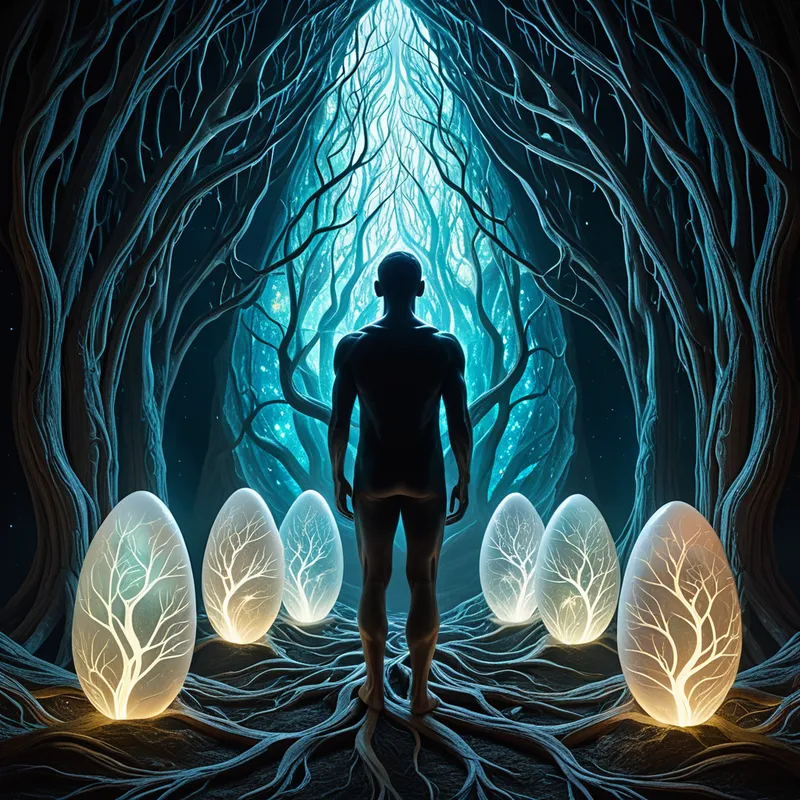
Dreaming of the two eggs, or the marriage of the king and queen, points directly to the need for inner union. It may indicate a conflict between one’s spiritual aspirations (heaven/horse) and one’s instinctual, emotional, or creative depths (earth/dragon). The dream urges a sacred marriage between these poles.
Alchemical Translation
The myth models the individuation process with stunning clarity. The journey begins in the unconscious (the forest, the mountain, the well). A call is felt (the white horse), directing the ego-consciousness (the chieftains) to attend to a profound potential (the egg).
The first stage is Coniunctio—not with another, but with one’s own latent totality. The egg must be incubated by collective acknowledgment and reverence; the psyche must grant permission for this new center to emerge.
The cracking of the egg is the nigerdo, the difficult first separation of the valuable content from its enclosing shell. It is the pain of birth, of leaving a state of perfect potential for the flawed but actualized reality of existence. The radiant child is the nascent Self, the “divine child” archetype, representing new, unifying life that promises to heal fragmentation.
The subsequent growth of the child-king is the albedo, the whitening, where this new principle gains clarity, strength, and recognition. Finally, the sacred marriage with Aryeong is the ultimate coniunctio oppositorum (union of opposites), the rubedo or reddening, which creates the Philosopher’s Stone—in psychological terms, a stable, enduring, and fertile psychic structure. The founded kingdom is the individuated personality: not a perfect, conflict-free state, but a resilient, legitimate, and self-governing entity, capable of weathering history’s storms because it is founded upon the marriage of its own deepest heaven and earth.
For the modern individual, the myth instructs: Your highest calling and unifying identity are not constructed through effort alone, but are born from the mysterious conjunction of the numinous and the earthly within you. Attend to the places where your inner “white horse” bows. Protect the “purple egg” of your potential until it is ready to hatch. And seek the sacred marriage within, for only from that union does a life of authentic sovereignty and lasting legacy flow.
Associated Symbols
Explore related symbols from the CaleaDream lexicon:
- Egg — The primordial vessel of potential, containing the unformed Self and the promise of a new, unified consciousness waiting to be born.
- Horse — The divine messenger and celestial force that signals the location of destiny, representing the call from the unconscious that guides toward transformation.
- Dragon — The chthonic, watery power of the deep unconscious and instinctual life, from which the complementary, grounding feminine principle (Aryeong) emerges.
- King — The archetype of inner order, legitimate authority, and the conscious organizing principle that unifies disparate parts of the psyche into a functioning whole.
- Queen — The archetype of receptive power, rooted wisdom, and the instinctual counterpart necessary to balance and complete the sovereign identity.
- Mountain — The sacred axis mundi, the place of revelation where the human world meets the divine, serving as the altar for the miraculous birth.
- Well — A portal to the underworld and the unconscious, a source of life and mystery where the raw materials of creation (the eggs) are presented.
- Forest — The untamed, fertile realm of nature and the unconscious, the nurturing ground where the miraculous event unfolds away from ordinary society.
- Light — The radiance of the divine child and the illuminating consciousness that emerges from the shell of potential, banishing psychic darkness.
- Circle — Represented by the egg and the united six clans, symbolizing wholeness, completion, and the cyclical nature of birth, death, and rebirth inherent in founding myths.
- Union — The sacred marriage of heaven and earth, the central alchemical act that creates a stable, fertile vessel for lasting creation and psychic integrity.
- Birth — The core action of the myth, representing the traumatic yet necessary emergence of a new, central psychic structure from the womb of the unconscious.