
Paper Boat Offerings Myth Meaning & Symbolism
A myth of releasing miniature vessels into sacred waters, carrying prayers and letting go, symbolizing the soul's journey and the acceptance of impermanence.
The Tale of Paper Boat Offerings
Listen, and let the scent of wet earth, night-blooming jasmine, and river silt fill your senses. The air is thick with the murmur of a thousand prayers, a hum that vibrates deeper than sound, in the space between heartbeats. This is the hour when the world of form softens, when the veil between the seen and the unseen grows thin as rice paper.
On the banks of the Ganga, the great mother of rivers, the people gather as twilight bleeds into indigo. They are not kings or warriors tonight, but pilgrims of the soul. In their hands, they do not hold swords, but paper. Simple, fragile sheets, colored with turmeric and vermilion. With a ritual born of instinct, they fold. A crease for a sorrow, a tuck for a hope, a final press for a name whispered on the breath—a name of a beloved who has stepped beyond the shore of the living.
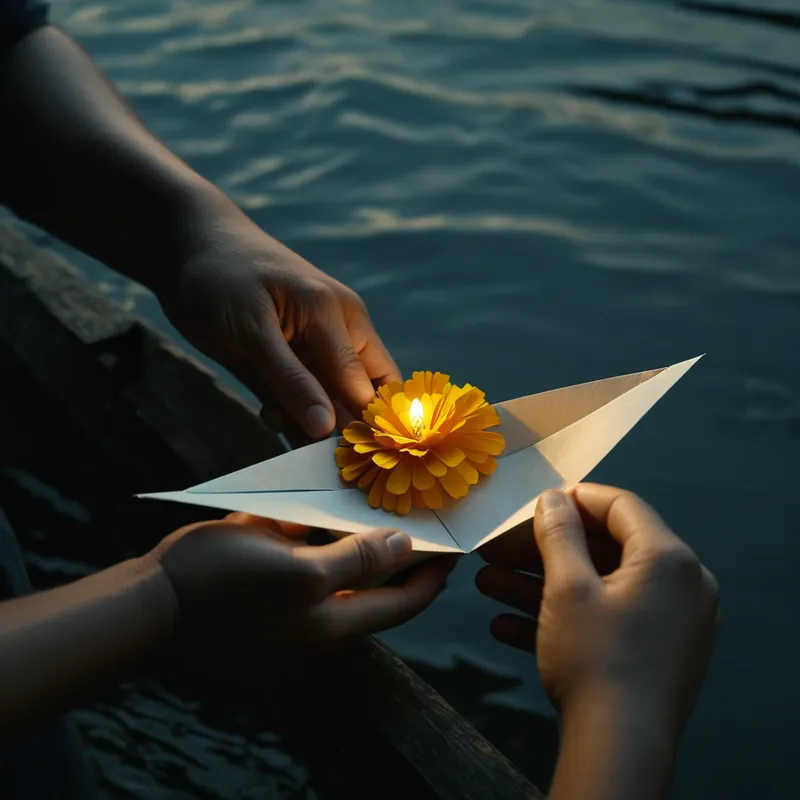
Into the hollow of each tiny vessel, they place an offering: a pinch of rice for sustenance, a marigold petal for the beauty of a life lived, and a wick nestled in a dab of ghee, a diya, waiting for its spark. Then, the moment of surrender. A match flares, a tiny sun is born in the palm of the boat. With a breath that is both a blessing and a release, they bend and set their creation upon the dark, flowing skin of the river.
The water, cold and ancient, accepts the fleet. A hundred, a thousand points of flame push off from the shore, a constellation cast loose upon the earth. They bob and weave, a dance of light on liquid darkness. Some huddle together, a community of flickering hopes. Others sail bravely alone into the vast unknown. The river carries them all, this silent, powerful guide. It does not promise safe passage. A wave may swallow a light whole. The paper may grow sodden and sink, the flame hissing its last into the water. Or, a boat may travel far, its light growing smaller and smaller until it is indistinguishable from a star reflected on the water, finally merging with the horizon where river meets sky.
The people on the bank do not weep for the sunken boats. They watch with a quiet awe, their faces illuminated by the departing lights. They understand they have not sent a cargo, but have performed an act of trust. They have given their grief, their love, their prayers to the journey itself, to the care of the great flowing Shakti of the river and the boundless Brahman into which it empties. The conflict is the human heart clinging to form; the resolution is the river’s eternal lesson of release. The story ends not with an ending, but with a continuation—the endless procession of little lights into the embracing dark, a visual hymn to letting go.
Cultural Origins & Context
This practice, woven into the spiritual fabric of the Indian subcontinent, transcends a single “myth” with a fixed author. It is a living, breathing ritual narrative, a myth-ritual complex found along the sacred geographies of rivers like the Ganga, Yamuna, and Saraswati, and in the Theravada Buddhist traditions of Southeast Asia during festivals like Loy Krathong. Its origins are folkloric and devotional, passed down not by bards in courts, but by grandmothers teaching grandchildren how to fold, by communities gathering on festival nights.
Its societal function is multifaceted. It is a rite of remembrance, connecting the living to the ancestors (Pitrs). It is an act of purification, symbolically carrying away one’s sins (papa) and negativities. In the Buddhist context, it honors the Sangha and the Buddha, while embodying the core doctrine of Anicca. It is a communal poetry of impermanence, a shared meditation on flow and transition that binds the community to the cycles of nature and the cosmos.
Symbolic Architecture
The myth’s power lies in its exquisite, minimalist symbolism. Each element is a profound psychological truth rendered in tangible form.
The Paper Boat is the fragile vessel of the individual ego, the constructed self (<abbr title=“The ego, the sense of “I” and “mine” in Hindu and Buddhist thought.”>Ahamkara). It is meticulously crafted, holds our most precious cargo, yet is fundamentally impermanent and at the mercy of elements greater than itself.
The ego is not a fortress, but a vessel. Its purpose is not to remain docked, but to make the crossing.
The Flame (Diya/Jyoti) is the immortal spark of consciousness, the true Self (Atman), or the light of awareness in Buddhism. It is what we truly are, distinct from the perishable vessel that carries it.
The Sacred River is the boundless flow of life, time, and the unconscious—the Dharma itself. It is the great matrix of reality, sometimes gentle, sometimes turbulent, always moving towards a vast, oceanic unity (Moksha/Nirvana).
The Act of Releasing is the central, transformative gesture. It represents surrender (Prapatti), the voluntary relinquishment of control, and the trust that the process of life (the river) carries our essence (the flame) towards its rightful destination, even if the vessel of our current identity dissolves along the way.
The Dreamer’s Resonance
When this myth surfaces in modern dreams, it signals a profound somatic and psychological process of release. To dream of carefully folding a paper boat is to be in a state of preparing to let go—perhaps of a relationship, an identity, a long-held grief, or a rigid plan. The dream ego is engaging in the sacred labor of constructing the very vehicle of its own surrender.
Dreaming of setting the boat afloat, especially with a feeling of anxiety or sorrow, mirrors the acute vulnerability of the release process. The dreamer is at the precipice, feeling the tension between the safety of the known shore and the call of the unknown current. Conversely, dreaming of watching one’s boat sail away peacefully indicates a successful internalization of the myth—a soul-level acceptance of impermanence and trust in the journey. A dream of a boat capsizing or sinking may not be a nightmare, but a powerful depiction of the ego’s dissolution, a necessary “death” for the flame of consciousness to be freed. The body may feel this as a deep sigh, a release of tension in the chest, or a somatic sense of weightlessness after the initial fear.

Alchemical Translation
For the modern individual navigating a world of constant change and identity flux, the Paper Boat Offering is a masterful model of psychic alchemy—the individuation process. Our contemporary struggle is often an obsessive, fear-driven maintenance of the “boat”: curating our persona, fortifying our status, clinging to fixed narratives of who we are.
The myth instructs us in a different art: the art of sacred shipbuilding followed by holy release. The “alchemical translation” is this: we must first consciously and lovingly build our ego-structure. We fold our experiences, our talents, our relationships into a vessel capable of holding our light. This is the necessary first stage—individuation requires an ego.
The goal of the journey is not for the boat to reach the other side intact, but for the flame to realize it was never truly in the boat at all.
The crucible of transformation is the moment we place that vessel upon the waters of life and let the current take it. This is the transmutation of attachment into devotion, of control into trust, of fear into awe. We learn to differentiate the eternal flame of our essential being from the temporary paper of our circumstances and self-concepts. The psychic triumph is not in arriving at a distant, fixed shore, but in achieving a state of graceful participation in the flow, understanding that we are both the fragile, folding hands on the bank and the undying flame traveling fearlessly into the dark. In this ritual of release, we perform the ultimate act of self-care: we free our true Self from the prison of our own small craft.
Associated Symbols
Explore related symbols from the CaleaDream lexicon: