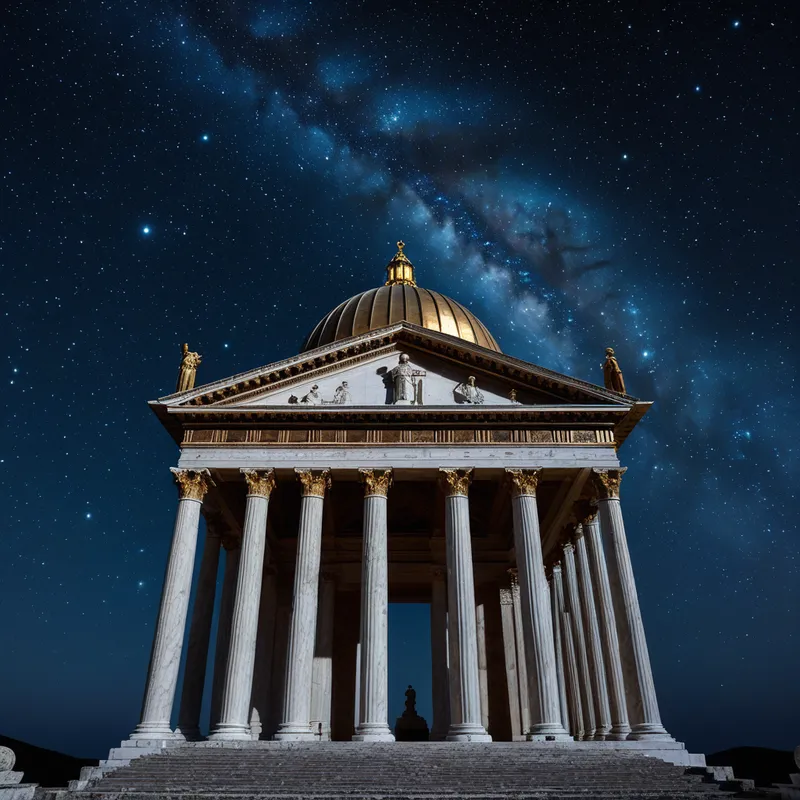
Pantheon Portico Myth Meaning & Symbolism
A myth of a celestial architect who builds a divine portico, uniting the gods and creating a sacred threshold between the cosmos and the human world.
The Tale of Pantheon Portico
Listen, and hear the tale not carved in stone, but sung into the space between stars and soil. In the age when the gods still walked the hills of Latium, their voices were a cacophony—a glorious, terrifying storm of separate wills. Jupiter thundered from the Capitol, Minerva wove strategies in silent groves, and [Janus](/myths/janus “Myth from Global/Universal culture.”/) gazed eternally into past and future, his two faces never meeting in a single now. [The world](/myths/the-world “Myth from Tarot culture.”/) below trembled under this fragmented majesty, yearning for a sign, a single point where the divine multitude could be perceived as a whole.
Into this discord came a mortal, yet not wholly of earth. He was Daedalion, named for the craftsman of old, whose soul was a plumb line and whose heart beat in the rhythm of perfect proportion. He was not a warrior, but a maker. He had wandered the empire, measuring the curve of an amphitheater, the lift of an aqueduct, the quiet strength of a lintel. In a dream, a vision seized him: not a temple to one god, but a portico for all. A threshold so grand it would not house divinity, but frame it; a place where [the pantheon](/myths/the-pantheon “Myth from Greek culture.”/) could gather not as rivals, but as facets of a single, incomprehensible light.
For forty days and nights, Daedalion fasted upon the Capitoline Hill. He drew his plans not with ink, but with sunlight on dew, and whispered his calculations to [the wind](/myths/the-wind “Myth from Various culture.”/). He called not for slaves, but for the essence of the world itself. [The earth](/myths/the-earth “Myth from Hindu culture.”/) offered its marble, not quarried, but rising in willing blocks of luminous white. The forests gave their cedar, fragrant and eternal. The rivers brought veins of gold and bronze. And Daedalion worked, his tools singing a hymn of geometry.
He raised columns that were not mere pillars, but frozen hymns—each one dedicated to a principle: [Justice](/myths/justice “Myth from Tarot culture.”/), Mercy, Wisdom, Power. Upon the vast pediment, he left not a scene of battle, but an empty space, a field of pure potential. This was his audacity: he would not sculpt the gods; he would invite them to sculpt themselves upon the consciousness of those who dared to look.
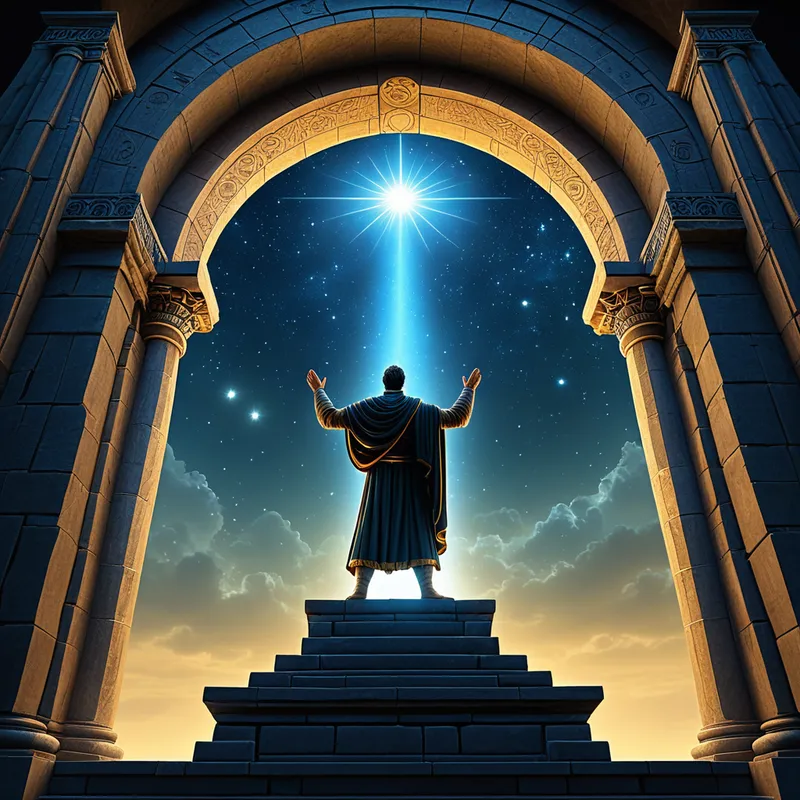
On the night of its completion, a silence fell over Rome deeper than any sleep. Then, a single star descended, landing upon the central keystone of the great arch. It was [Vesta](/myths/vesta “Myth from Roman culture.”/), the quiet heart of all things. Her gentle flame illuminated the empty portico. One by one, the gods arrived. Not with fanfare, but with the solemnity of a truth acknowledged. Jupiter laid down his thunderbolt at [the threshold](/myths/the-threshold “Myth from Folklore culture.”/). Mars rested his shield. [Venus](/myths/venus “Myth from Alchemical culture.”/) left her vanity at the first column. They passed under the arch, and as they did, their disparate lights merged, casting not a multitude of shadows, but a single, profound pattern upon the ground—a pattern that was the blueprint of the ordered world.
Daedalion stood to the side, a mere man once more. He did not enter. His work was the door, not the dwelling. As dawn broke, the first citizens of Rome approached. They saw no statues, heard no oracles. They saw only a magnificent, empty portico, open to [the sky](/myths/the-sky “Myth from Persian culture.”/). But in its perfect symmetry, in [the way](/myths/the-way “Myth from Taoist culture.”/) the morning light poured through its columns to paint the earth with lines of gold, they felt it. They felt the presence of the whole. They named it the [Pantheon](/myths/pantheon “Myth from Roman culture.”/) Portico—the porch of all the gods. It was not a place to worship any one of them, but a place to stand, and in standing, to comprehend the sacred architecture of the cosmos itself.
Cultural Origins & Context
The myth of the Pantheon Portico exists in the liminal space between state religion and philosophical speculation. It is not found in the canonical works of Vergil or Livy, but in the fragmentary commentaries of Stoic and Neo-Platonic thinkers, and in the oral traditions of the collegia fabrorum, the guilds of architects and builders. These artisans saw their craft as a sacred imitation of the cosmic order—the Cosmos itself meaning “beautiful order.” The myth served a crucial societal function in the late Republic and early Empire: it provided a metaphorical framework for understanding the burgeoning, diverse Roman world. Just as the Portico unified the gods, Rome sought to unify myriad peoples under a single Pax Romana and a common, overarching civic identity. The story was told not in public festivals, but in guildhalls and philosophical schools, a narrative for those who built the physical and ideological infrastructure of the world. It answered a deep cultural anxiety: how can many become one without losing their essence? The Portico offered an answer—not through conquest, but through the creation of a sacred, inclusive structure.
Symbolic Architecture
The [Portico](/symbols/portico “Symbol: A covered entrance or porch supported by columns, symbolizing transition, shelter, and the boundary between public and private realms.”/) is the ultimate [symbol](/symbols/symbol “Symbol: A symbol can represent an idea, concept, or belief, serving as a powerful tool for communication and understanding.”/) of the [Logos](/myths/logos “Myth from Christian culture.”/)—the rational, structuring principle of [reality](/symbols/reality “Symbol: Reality signifies the state of existence and perception, often reflecting one’s understanding of truth and life experiences.”/). It is not the divine, but the shape the divine assumes when perceived by the [human](/symbols/human “Symbol: The symbol of a human represents individuality, complexity of emotions, and social relationships.”/) mind seeking order.
The true temple is not the god within, but the threshold that makes the encounter possible.
Daedalion, the mortal architect, represents the human ego-[consciousness](/symbols/consciousness “Symbol: Consciousness represents the state of awareness and perception, encompassing thoughts, feelings, and experiences.”/) at its highest potential. He is not a passive supplicant, but an active co-[creator](/symbols/creator “Symbol: A figure representing ultimate origin, divine power, or profound authorship. Often embodies the source of existence, innovation, or personal destiny.”/). His fast and [vision](/symbols/vision “Symbol: Vision reflects perception, insight, and clarity — often signifying the ability to foresee or understand deeper truths.”/) signify the necessity of emptying the personal self to become a [vessel](/symbols/vessel “Symbol: A container or structure that holds, transports, or protects something essential, representing the self, emotions, or life journey.”/) for a transpersonal [pattern](/symbols/pattern “Symbol: A ‘Pattern’ in dreams often signifies the underlying structure of experiences and thoughts, representing both order and the repetitiveness of life’s situations.”/). The empty [pediment](/symbols/pediment “Symbol: A triangular gable crowning classical architecture, symbolizing structure, ideals, and the meeting of human aspiration with divine order.”/) is the myth’s most radical symbol. It represents the unknowable [nature](/symbols/nature “Symbol: Nature symbolizes growth, connectivity, and the primal forces of existence.”/) of the divine totality ([the Self](/myths/the-self “Myth from Jungian culture.”/) in Jungian terms), which can never be fully depicted or owned. It must remain a void, a receptive [space](/symbols/space “Symbol: Dreaming of ‘Space’ often symbolizes the vastness of potential, personal freedom, or feelings of isolation and exploration in one’s life.”/) that allows for [projection](/symbols/projection “Symbol: The unconscious act of attributing one’s own internal qualities, emotions, or shadow aspects onto external entities, people, or situations.”/), experience, and awe. Each [column](/symbols/column “Symbol: A vertical architectural support representing strength, stability, and connection between earth and sky. It symbolizes structure, tradition, and spiritual ascent.”/), dedicated to an abstract principle, signifies that the whole is supported by foundational virtues or archetypal forces. To pass under the arch is to undergo a symbolic [integration](/symbols/integration “Symbol: The process of unifying disparate parts of the self or experience into a cohesive whole, often representing psychological wholeness or resolution of internal conflict.”/), where one’s inner multiplicity (the pantheon of personal complexes, drives, and sub-personalities) is momentarily harmonized under the gaze of a conscious, structuring [awareness](/symbols/awareness “Symbol: Conscious perception of self, surroundings, or internal states. Often signifies awakening, insight, or heightened sensitivity.”/).
The Dreamer’s Resonance
When this myth stirs in the modern unconscious, it often manifests in dreams of architecture. To dream of a vast, classical portico—especially one that is incomplete, impossibly large, or hauntingly empty—signals a profound psychological process. The somatic experience is often one of both awe and anxiety: the chest may feel expanded yet tight, a somatic recognition of confronting something greater than the self.
This dream image emerges at life thresholds: career changes, philosophical awakenings, or during integrative therapy. The dreamer might be trying to enter the portico, repair it, or simply stand before it, overwhelmed. The empty space (the pediment) mirrors the dreamer’s confrontation with the unknown core of their own being—the Shadow and the Anima/Animus not yet integrated. The dream asks: Can you bear to stand before the empty center? Can you tolerate not having a fixed image of God, Purpose, or Self, but only the sacred structure that makes seeking them meaningful? It is the [psyche](/myths/psyche “Myth from Greek culture.”/) building its own container for wholeness.
Alchemical Translation
The myth of the Pantheon Portico is a precise blueprint for the alchemical process of individuation, the journey toward psychic wholeness. The initial state, the [prima materia](/myths/prima-materia “Myth from Alchemical culture.”/), is the cacophony of the unintegrated psyche—our conflicting desires, roles, and inner voices (the disparate gods).
The work is not to become a god, but to become the architect of the space where the divine within can assemble.
Daedalion’s fasting and vision represent the [nigredo](/myths/nigredo “Myth from Alchemical culture.”/), [the dark night of the soul](/myths/the-dark-night-of-the-soul “Myth from Christian Mysticism culture.”/) where one withdraws from worldly identifications to confront the inner blueprint. The gathering of materials from earth, forest, and river is the albedo, the conscious gathering and purification of one’s innate talents, experiences, and values into a usable form. The act of construction is the citrinitas, the application of conscious discipline (the tools of analysis, reflection, creative work) to give form to the vision.
The final act—the gods laying down their attributes and merging their light—is the [rubedo](/myths/rubedo “Myth from Alchemical culture.”/), the red dawn of integration. [The ego](/myths/the-ego “Myth from Jungian culture.”/) (Daedalion) does not claim the central glory; it steps aside. The conscious personality becomes the steward of the Portico, not its resident. The integrated Self (the unified pattern of light) now operates through the individual. The modern seeker’s [triumph](/myths/triumph “Myth from Roman culture.”/) is identical: to construct, through conscious effort and surrender, an inner [temenos](/myths/temenos “Myth from Greek culture.”/) (sacred space)—a stable, ordered consciousness—capable of holding life’s contradictions without fragmenting. One becomes not a chaotic battlefield for inner gods, but the sacred ground upon which they can finally meet.
Associated Symbols
Explore related symbols from the CaleaDream lexicon: