Pan's Syrinx Myth Meaning & Symbolism
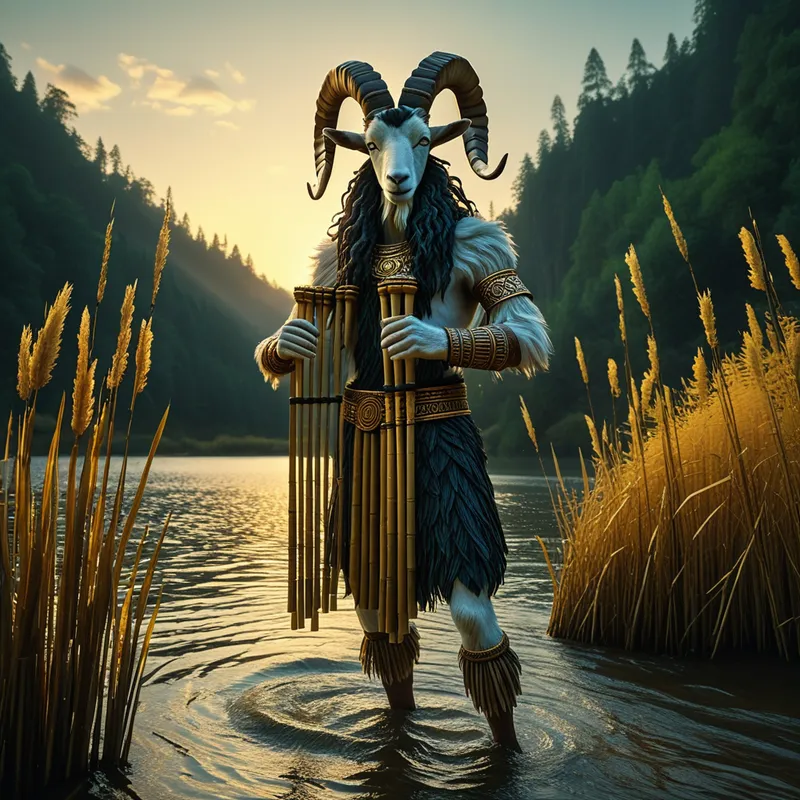
The god Pan pursues the nymph Syrinx, who is transformed into river reeds; from his grief, he fashions the first panpipes, turning loss into art.
The Tale of Pan’s Syrinx
Hear now the tale sung by [the wind](/myths/the-wind “Myth from Various culture.”/) in the hollow reeds, a story of desire, flight, and the birth of music from [the womb](/myths/the-womb “Myth from Various culture.”/) of loss.
In the deep, untamed heart of Arcadia, where the mountains wear cloaks of pine and the rivers sing older songs than the gods, there dwelt Pan. He was no polished Olympian, but a spirit of [the earth](/myths/the-earth “Myth from Hindu culture.”/) itself—shaggy and goat-legged, with eyes that held the mischief of the forest and a laugh that could seed panic in the hearts of men. He roamed the dells and groves, a force of raw, untethered appetite.
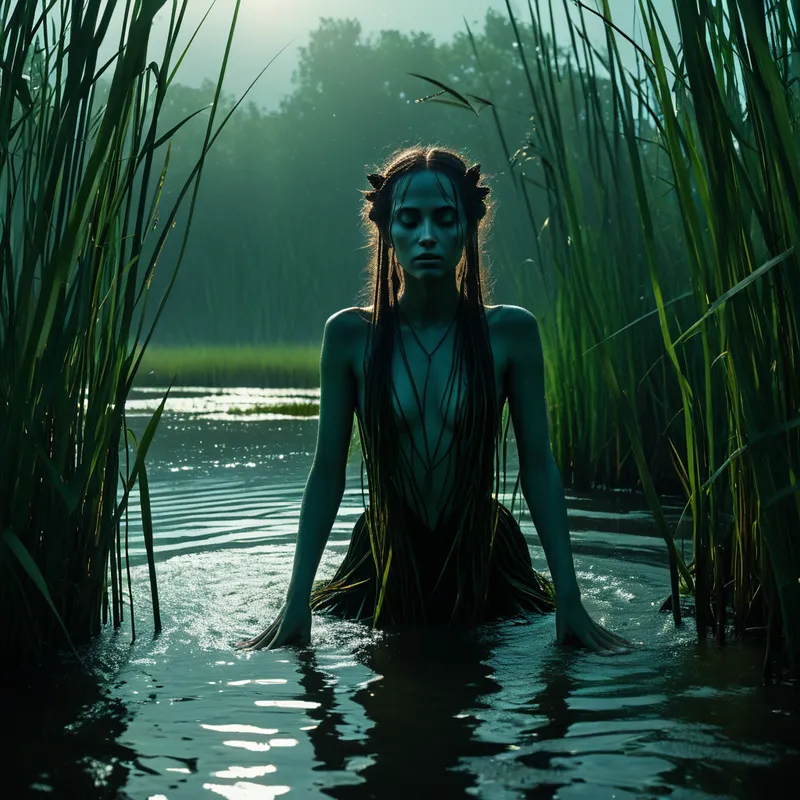
His eyes fell upon a nymph of [the river](/myths/the-river “Myth from Buddhist culture.”/), Syrinx. She was of the Naiads, her grace like the [water](/myths/water “Myth from Chinese culture.”/)‘s flow, her spirit as chaste and clear as a mountain spring. She spent her days with the huntress Artemis, running with the deer, valuing the freedom of the wild over the embraces of gods.
Pan saw her by the [Ladon](/myths/ladon “Myth from Greek culture.”/) river, and desire, hot and immediate as a summer storm, seized him. He called out, his voice a rough melody. But Syrinx knew his nature. She felt not attraction, but the primal fear of the prey. She fled. Through thickets that tore at her skin, across meadows where her feet barely touched the grass, she ran, the drumbeat of Pan’s hooves pounding behind her, his ardent calls turning to frustrated bellows.
Her breath came in ragged gasps as the riverbank rose before her, the deep, swift waters of the Ladon blocking her path. Trapped between the god and the river, she cried out in despair. Not to Zeus, not to Hera, but to her sister [nymphs](/myths/nymphs “Myth from Greek culture.”/), to the very spirit of the water that bore her. “Help me! Change me! Do not let him take me!”
As Pan’s shadow fell over her, his arms outstretched to grasp not a nymph, but a cluster of tall, hollow reeds. His embrace closed on empty air and the rustling of slender stalks. The river gods had heard her plea. Syrinx was gone, her essence translated, her terror transmuted into the very substance of the marsh.
Pan stood baffled, then heart-stricken. He sighed a gust of wind that stirred the reeds, and they emitted a soft, mournful whisper. In that sound, he heard her—not her form, but her spirit, captured in a new voice. His grief and his thwarted passion fused in that moment. With careful hands, he cut seven of the reeds of unequal length, bound them together with wax and willow, and brought them to his lips.
He blew. And from the pipes fashioned from the object of his loss came a sound [the world](/myths/the-world “Myth from Tarot culture.”/) had never known: music that was both lament and consolation, a melody born of longing that could soothe the very longing that created it. The wild god had, in his raw pursuit, accidentally given the world its first pastoral song. The panpipes, the syrinx, were born.
Cultural Origins & Context
This myth finds its roots in the pastoral poetry and religious practices of ancient Greece, particularly the bucolic tradition. Our primary sources are the Roman poet Ovid in his [Metamorphoses](/myths/metamorphoses “Myth from Greek culture.”/), and earlier Greek references that filtered into Hellenistic culture. It is a story told by shepherds, for whom Pan was a very real and present deity—a god to be propitiated at noon lest he cause sudden, irrational fear (panikos).
The myth functioned as an aetiology, a sacred “just-so” story explaining the origin of the panpipes, a fundamental instrument in rustic worship and celebration. But it served a deeper societal function: it articulated the complex relationship between civilization (represented by music, art) and the untamed wild (represented by Pan’s desire). It was a narrative heard in the fields, a reminder that the arts often spring from the soil of primal experience—loss, desire, and the negotiation with forces beyond human control. The tellers were likely rhapsodes and local priests of Pan, weaving a tale that validated both the fear of nature’s raw power and the beauty that could be coaxed from it.
Symbolic Architecture
At its core, the myth of Pan and Syrinx is a profound [allegory](/symbols/allegory “Symbol: A narrative device where characters, events, or settings represent abstract ideas or moral qualities, conveying deeper meanings through symbolic storytelling.”/) of transformation through encounter. It is not a love [story](/symbols/story “Symbol: The symbol of ‘Story’ represents the narrative woven through our lives, embodying experiences, lessons, and emotions that shape our identities.”/), but a story about the consequence of eros—[life](/symbols/life “Symbol: The symbol of ‘Life’ represents a journey of growth, interconnectedness, and existential meaning, encompassing both the joys and challenges that define human experience.”/)-force—meeting a [boundary](/symbols/boundary “Symbol: A conceptual or physical limit defining separation, protection, or identity between entities, spaces, or states of being.”/).
Syrinx represents the autonomous [soul](/symbols/soul “Symbol: The soul represents the essence of a person, encompassing their spirit, identity, and connection to the universe.”/), the [spirit](/symbols/spirit “Symbol: Spirit symbolizes the essence of life, vitality, and the spiritual journey of the individual.”/) of [nature](/symbols/nature “Symbol: Nature symbolizes growth, connectivity, and the primal forces of existence.”/) that refuses to be possessed. Her transformation is not a [punishment](/symbols/punishment “Symbol: A dream symbol representing consequences for actions, often tied to guilt, societal rules, or internal moral conflicts.”/), but a radical act of self-preservation. She chooses a different form of existence over violation. Pan represents the undifferentiated, instinctual drive—the “id” of the [wilderness](/symbols/wilderness “Symbol: Wilderness often symbolizes the untamed aspects of the self and the unconscious mind, representing a space for personal exploration and discovery.”/). His [pursuit](/symbols/pursuit “Symbol: A chase or being chased in dreams often reflects unresolved anxieties, unfulfilled desires, or internal conflicts demanding attention.”/) is not evil, but blind and consuming.
The artifact born from their encounter—the syrinx—symbolizes the alchemical vessel where raw impulse is refined into creative expression. The music is the child of both the pursuer and the pursued, a third thing born from their dynamic.
Psychologically, Syrinx is the [aspect](/symbols/aspect “Symbol: A distinct feature, quality, or perspective of something, often representing a partial view of a larger whole.”/) of the [psyche](/myths/psyche “Myth from Greek culture.”/) that, when faced with overwhelming, consuming [energy](/symbols/energy “Symbol: Energy symbolizes vitality, motivation, and the drive that fuels actions and ambitions.”/) (a complex, an [obsession](/symbols/obsession “Symbol: An overwhelming fixation on a person, idea, or object that consumes mental energy and disrupts balance.”/), a [trauma](/symbols/trauma “Symbol: A deeply distressing or disturbing experience that overwhelms the psyche, often manifesting in dreams as unresolved emotional wounds or psychological injury.”/)), dissociates or transforms to survive. Pan is that very [energy](/symbols/energy “Symbol: Energy symbolizes vitality, motivation, and the drive that fuels actions and ambitions.”/)—the compulsive drive that cannot be reasoned with, only ultimately channeled. The myth suggests that when the conscious ego (Syrinx) feels pursued to the point of annihilation by an unconscious content (Pan), a [metamorphosis](/symbols/metamorphosis “Symbol: A profound, often irreversible transformation of form, identity, or state, representing a complete journey from one condition to another.”/) occurs. The content is not integrated in its raw form; it is transmuted. The reeds are the new psychic [structure](/symbols/structure “Symbol: Structure in dreams often symbolizes stability, organization, and the framework of one’s life, reflecting how one perceives their environment and personal life.”/)—a medium through which the [energy](/symbols/energy “Symbol: Energy symbolizes vitality, motivation, and the drive that fuels actions and ambitions.”/) can now flow as creativity, [melancholy](/symbols/melancholy “Symbol: A deep, lingering sadness often associated with introspection and a sense of loss or longing.”/), or soulful [expression](/symbols/expression “Symbol: Expression represents the act of conveying thoughts, emotions, and individuality, emphasizing personal communication and creativity.”/), rather than as sheer, destructive pursuit.
The Dreamer’s Resonance
When this myth pattern stirs in the modern dreamer, it often signals a profound somatic and psychological process: the confrontation with an unconsummated longing or a creative impulse that feels both urgent and thwarted.
One might dream of chasing or being chased through a labyrinthine natural landscape. The pursuer or pursued may not be literal figures, but a felt sense of immense pressure, a haunting melody, or a quality of light just out of reach. The climax at the riverbank is key—it is the moment of existential crisis, the “somatic cul-de-sac,” where the body and psyche feel there is no way forward in the old pattern.
The transformation in the dream may be subtle: the dreamer reaching for a person only to grasp a handful of sand that slips through their fingers, or their own voice changing into the sound of wind or water. This is the psyche’s Syrinx-moment, initiating a necessary dissolution of an old identity or desire. The aftermath—often a sense of poignant sadness mixed with a strange new capacity, like finding you can make music from ordinary objects—points to the birth of the “pipes.” The dream is processing a deep loss or frustration and beginning the slow, often unconscious, work of fashioning it into a new form of expression or understanding.
Alchemical Translation
The individuation process modeled here is not one of heroic conquest or integration of [the shadow](/myths/the-shadow “Myth from Jungian culture.”/) in a straightforward manner. It is the alchemy of sublimation in its deepest sense.
The initial state is [nigredo](/myths/nigredo “Myth from Alchemical culture.”/)—the blackening. This is Pan’s dark, chaotic desire and Syrinx’s terror; it is the raw, suffering state of an unbearable psychic tension. The crisis at the river is the mortificatio—the death of the old form. Syrinx “dies” as a nymph. But in alchemy and depth psychology, death is always a prelude to transformation.
The binding of the reeds is the coagulatio—the bringing together of disparate elements into a new, solid form. Pan’s act is the crucial, conscious step in the unconscious process. Grief and acceptance become the wax that binds the fragments of the experience.
The final stage, the music itself, is the sublimatio—the elevation of base material into something spiritual and transcendent. The instinctual drive (Pan) is not eradicated; its breath now animates the pipes. The lost object (Syrinx) is not recovered; her essence becomes the instrument. The individual learns to breathe through the wound. The psychic energy that was once bound in futile pursuit or frozen fear is liberated as creativity, reflection, or a more nuanced relationship to longing itself. One becomes, like Pan, a player of the syrinx—no longer a slave to the raw impulse, but a musician who can articulate its melody, transforming personal loss into a song that connects one to the wider, sighing chorus of the world.
Associated Symbols
Explore related symbols from the CaleaDream lexicon: