
Pan's Pipes Myth Meaning & Symbolism
The god Pan transforms his grief for the lost nymph Syrinx into the first set of panpipes, creating haunting music from his sorrow.
The Tale of Pan’s Pipes
Hear now the song of the wild places, the music born not from joy, but from a god’s broken heart. In the deep, untamed valleys of Arcadia, where the pines whisper old secrets and the rivers run cold and clear, there dwelt Pan. He was no Olympian of polished marble, but a spirit of [the earth](/myths/the-earth “Myth from Hindu culture.”/) itself—shaggy of limb, with the keen horns of a goat and a laugh that could shake the leaves from the trees. His domain was the tangible world: the scent of damp soil, the rough bark of an oak, the startled flight of a bird.
One day, as the sun dappled the forest floor, Pan beheld the nymph Syrinx. She was of [the river](/myths/the-river “Myth from Buddhist culture.”/), slender and swift, with a grace that made the very air seem to dance. To Pan, she was the most beautiful creature in all [the world](/myths/the-world “Myth from Tarot culture.”/). His heart, wild and untutored, filled with a roaring desire. He called to her, his voice a rough melody of admiration.
But Syrinx knew the stories of Pan’s passions. She saw not a god, but a force of untamed nature, and fear, cold and sharp, lanced through her. She fled. Her feet, light as wind, carried her through the thickets, across mossy stones, with Pan in fervent pursuit. His hooves thudded against the earth, a relentless drumbeat of longing. The chase was a symphony of panic—her ragged breath, the crash of undergrowth, his ardent calls.
She ran until her strength failed, reaching the bank of her father’s river, the [Ladon](/myths/ladon “Myth from Greek culture.”/). With the god’s shadow falling upon her, she cried out in desperation to her sister [nymphs](/myths/nymphs “Myth from Greek culture.”/). “Save me from this fate!” In that moment of absolute need, the very world heeded her plea. As Pan’s arms reached out to embrace her, his hands closed not around warm flesh, but around a clump of hollow reeds. Syrinx was gone, transformed into the very marsh plants that lined the river’s edge.
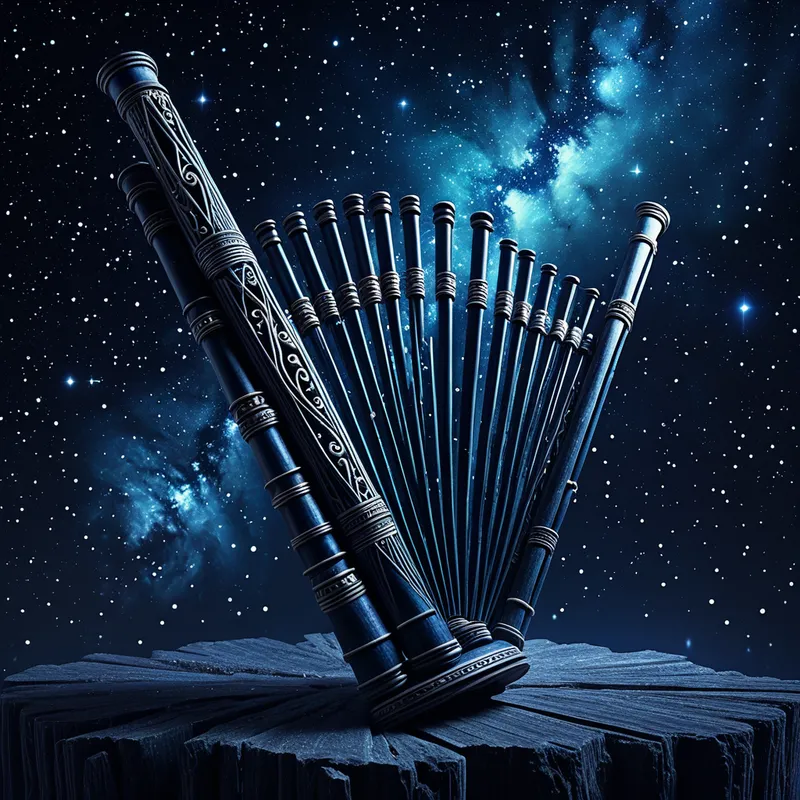
Pan stood there, his great chest heaving, his arms empty. A profound silence descended, broken only by the river’s sigh. In his grief, he sighed too, a deep, mournful breath that swept across the tops of the reeds. And from them issued a sound—a soft, plaintive, and unutterably beautiful whisper of a note. Startled, he looked down. He cut the reeds of varying lengths, bound them together with wax and river grass, and brought the bundle to his lips.
When he blew, it was not a sigh of frustration, but a breath of transformation. From the instrument came a music the world had never heard: haunting, melodic, filled with the loneliness of the mountains and the yearning of lost love. It was the sound of pursuit forever frozen into art, of desire transmuted into song. The god of the wild had, from his deepest loss, created his defining voice.

Cultural Origins & Context
The myth of Pan and Syrinx is a product of the Greek pastoral tradition, most famously recorded in the [Metamorphoses](/myths/metamorphoses “Myth from Greek culture.”/) of Ovid. However, its roots dig deep into the pre-Olympian soil of Greece. Pan was a god of the people—of shepherds, hunters, and those who lived directly by the rhythms of the natural world, far from the city-states and their civic deities. His myths were not tales of cosmic order but of immediate, visceral experience: lust, fear, sudden inspiration, and eerie music in the lonely places.
This story would have been told not in grand temples but in humble settings—around campfires, in shepherd’s huts, during festivals like the Bacchanalia. Its function was multifaceted. It was an aetiological myth, explaining the origin of the panpipes (syrinx), a common folk instrument. On a deeper level, it served as a cautionary tale about the wild, unpredictable power of nature (Pan) and the vulnerability of the delicate, ordered world (the nymph). It gave a narrative to the uncanny, beautiful, and sometimes frightening sounds heard in [the wilderness](/myths/the-wilderness “Myth from Biblical culture.”/)—[the wind](/myths/the-wind “Myth from Various culture.”/) through the reeds was Pan, forever playing his lament.
Symbolic Architecture
At its core, this is a myth of creative [alchemy](/symbols/alchemy “Symbol: A transformative process of purification and creation, often symbolizing personal or spiritual evolution through difficult stages.”/). It maps the process by which raw, often painful, experience is distilled into an [artifact](/symbols/artifact “Symbol: An object from the past carrying historical, cultural, or personal significance, often representing legacy, memory, or hidden knowledge.”/) of meaning and [beauty](/symbols/beauty “Symbol: This symbol embodies aesthetics, harmony, and the appreciation of life’s finer qualities.”/). Pan represents the untamed libido or [life](/symbols/life “Symbol: The symbol of ‘Life’ represents a journey of growth, interconnectedness, and existential meaning, encompassing both the joys and challenges that define human experience.”/) force—an [energy](/symbols/energy “Symbol: Energy symbolizes vitality, motivation, and the drive that fuels actions and ambitions.”/) that is potent, pursuing, and often frightening in its intensity. Syrinx symbolizes the object of desire, but also the fragile, evasive [aspect](/symbols/aspect “Symbol: A distinct feature, quality, or perspective of something, often representing a partial view of a larger whole.”/) of the [psyche](/myths/psyche “Myth from Greek culture.”/) or the world that resists mere possession.
The first art is born not from having, but from losing; the first true note is sounded on the instrument of absence.
The transformation of Syrinx into reeds is the pivotal [moment](/symbols/moment “Symbol: The symbol of a ‘moment’ embodies the significance of transient experiences that encapsulate emotional depth or pivotal transformations in life.”/). It signifies the failure of direct gratification. The desired “other” cannot be captured or consumed in its original form. Instead, it undergoes a [metamorphosis](/symbols/metamorphosis “Symbol: A profound, often irreversible transformation of form, identity, or state, representing a complete journey from one condition to another.”/) into a new medium—here, from [nymph](/symbols/nymph “Symbol: Nymphs are nature spirits embodying specific aspects of the natural world, often associated with beauty and allure.”/) to natural [material](/symbols/material “Symbol: Material signifies the tangible aspects of life, often representing physical resources, desires, and the physical world’s influence on our existence.”/). This is the archetypal [moment](/symbols/moment “Symbol: The symbol of a ‘moment’ embodies the significance of transient experiences that encapsulate emotional depth or pivotal transformations in life.”/) of [frustration](/symbols/frustration “Symbol: A feeling of being blocked or hindered from achieving a goal, often accompanied by irritation and powerlessness.”/) that becomes fertile. Pan’s subsequent [action](/symbols/action “Symbol: Action in dreams represents the drive for agency, motivation, and the ability to take control of situations in waking life.”/)—cutting, binding, breathing—is the act of the [creator](/symbols/creator “Symbol: A figure representing ultimate origin, divine power, or profound authorship. Often embodies the source of existence, innovation, or personal destiny.”/). He does not destroy the reeds in anger; he works with them. His [breath](/symbols/breath “Symbol: Breath symbolizes life, vitality, and the connection between the physical and spiritual realms.”/), the [symbol](/symbols/symbol “Symbol: A symbol can represent an idea, concept, or belief, serving as a powerful tool for communication and understanding.”/) of [spirit](/symbols/spirit “Symbol: Spirit symbolizes the essence of life, vitality, and the spiritual journey of the individual.”/) and life, animates the inert [material](/symbols/material “Symbol: Material signifies the tangible aspects of life, often representing physical resources, desires, and the physical world’s influence on our existence.”/), but the [music](/symbols/music “Symbol: Music in dreams often symbolizes the harmony between the conscious and unconscious mind, illustrating emotional expression and communication.”/) it produces is forever tinged with the [memory](/symbols/memory “Symbol: Memory symbolizes the past, lessons learned, and the narratives we construct about our identities.”/) of the [loss](/symbols/loss “Symbol: Loss often symbolizes change, grief, and transformation in dreams, representing the emotional or psychological detachment from something or someone significant.”/). The panpipes thus become a perfect [symbol](/symbols/symbol “Symbol: A symbol can represent an idea, concept, or belief, serving as a powerful tool for communication and understanding.”/) of [sublimation](/symbols/sublimation “Symbol: Transforming base impulses into creative or socially acceptable outlets, often seen in artistic expression.”/): the redirection of primal, potentially disruptive energy into a cultural, communicative form.
The Dreamer’s Resonance
When this myth pattern stirs in the modern unconscious, it often surfaces in dreams of pursuit, transformation, and the discovery of a unique voice or tool. To dream of being chased by a wild, earthy figure may reflect a confrontation with one’s own untamed instincts or passions—the inner “Pan” that society asks us to suppress. The dreamer may feel this energy as terrifying or overwhelming.
The transformation into reeds, trees, or other natural objects in a dream signals a critical defense mechanism of the psyche: a retreat from a direct, ego-driven confrontation into a state of symbolic being. It is a form of psychic dissolution for the purpose of preservation. The final act—the dreamer finding or crafting a musical instrument from the environment—points to the next stage. It suggests the unconscious is proposing a solution: the raw material of your anxiety, your longing, or your rejected instinct is waiting to be fashioned into something new. The music that follows, whether beautiful or discordant in the dream, represents the emerging expression of this integrated content.

Alchemical Translation
The journey of Pan models the individuation process for the modern soul. It begins in identification: Pan is pure instinct, acting without reflection. His pursuit is [the ego](/myths/the-ego “Myth from Jungian culture.”/)’s naive attempt to grasp what it desires directly. The failure of this attempt—the mortificatio or negation—is essential. Syrinx’s transformation is the alchemical [solutio](/myths/solutio “Myth from Alchemical culture.”/), a dissolving of the old form. Pan is forced to stop, to confront his loss, to move from doing to witnessing.
The god must become an artisan. The hunter must become a musician. This is the alchemy of the wound.
His grieving sigh across the reeds is the moment of imaginatio—the spark of connection between inner feeling and outer reality. He then engages in coagulatio, the act of concrete making: cutting, measuring, binding. He constructs a vessel (the pipes) that can channel his breath (spirit) in a new way. The final product, the music, is the [lapis philosophorum](/myths/lapis-philosophorum “Myth from Alchemical culture.”/)—the philosopher’s stone of this myth. It is not the possession of the beloved, but the creation of a beauty that contains and transcends the original longing. For the individual, this translates to the hard, creative work of taking a personal loss, a rejected part of [the self](/myths/the-self “Myth from Jungian culture.”/), or a searing desire, and consciously, patiently, crafting it into one’s unique “music”—be it art, a relationship dynamic, a career path, or a state of being. The wild god is not conquered; he is given a voice, and in doing so, becomes whole.
Associated Symbols
Explore related symbols from the CaleaDream lexicon: