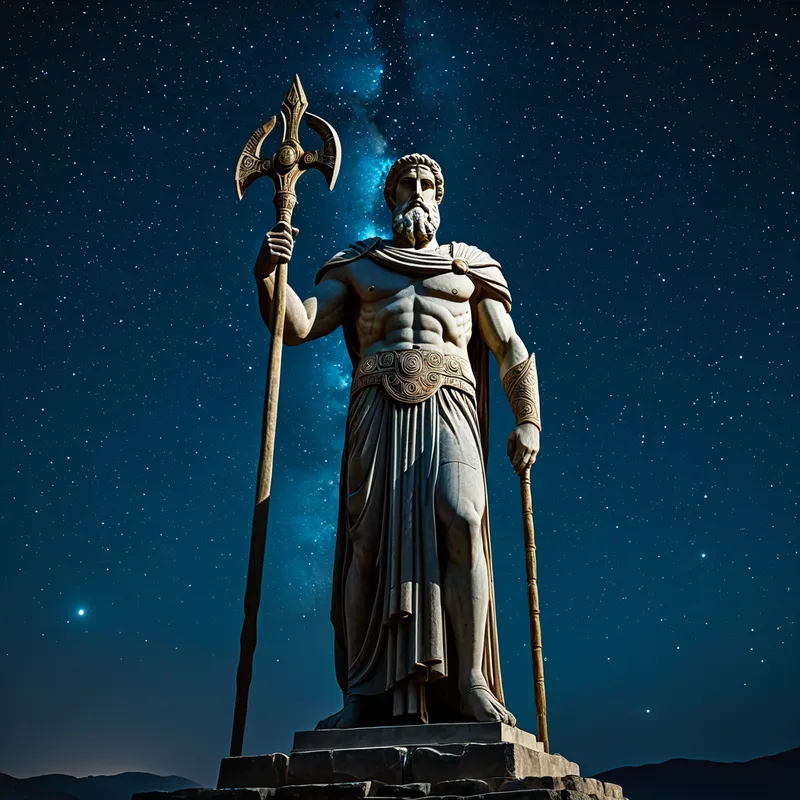
Panoptes Myth Meaning & Symbolism
The tale of Argus Panoptes, the hundred-eyed giant, a guardian slain by Hermes, whose eyes were placed in the peacock's tail as a cosmic memorial.
The Tale of Panoptes
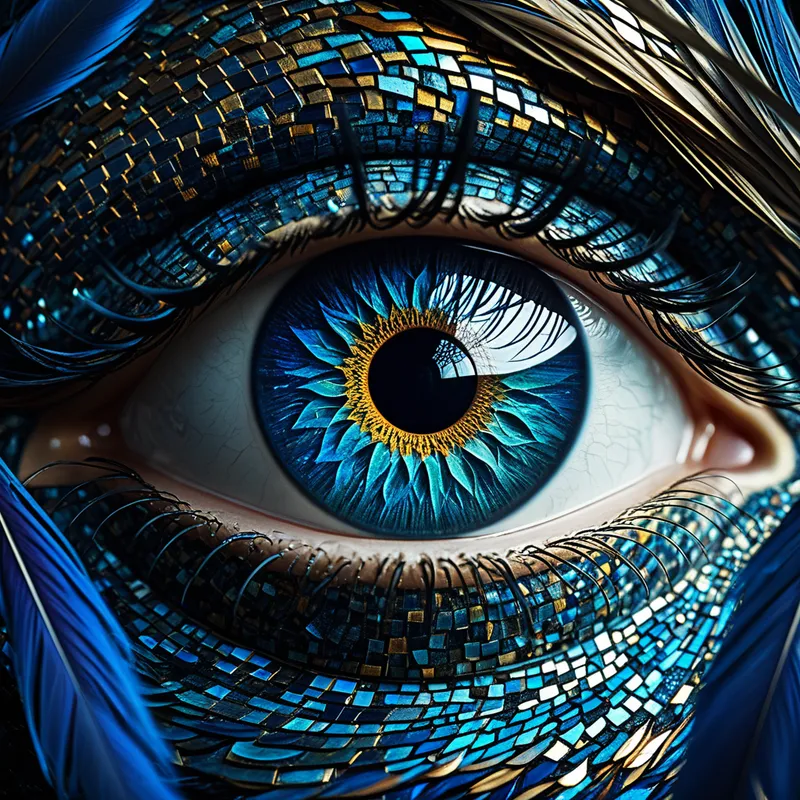
Hear now the tale of the Watcher, the one who never slept. In the age when gods walked with a heavier step and the breath of monsters still stirred the dust of the world, there lived a being named Argus Panoptes. He was a son of the earth, a giant, but not of the brutish kind that shook mountains. His power was in his gaze. From his head, his arms, his very flesh, one hundred eyes stared out, luminous and unblinking. While half slept, the other half remained awake, a sentinel without lapse, a perfect guardian.
His service was given to Hera, the great and jealous Queen of Olympus. And a service most fitting it was, for Hera’s heart was a fortress of suspicion, ever-watchful for the transgressions of her husband, Zeus. And Zeus, the Cloud-Gatherer, had transgressed once more. He had set his desire upon a nymph of surpassing beauty, Io, transforming her into a gleaming white heifer to hide his deed from his wife’s piercing sight.
But Hera’s vision was not so easily clouded. She descended from the high halls, a scent of ozone and wrath in her wake, and demanded the beautiful heifer as a gift. Trapped by his own ruse, Zeus could not refuse. And so, the heifer-Io passed into Hera’s possession. But the queen’s vengeance was not sated by possession alone. She would have security, an eternal prison of sight. To Argus Panoptes, the All-Seeing, she gave her command: “Guard this beast. Let no shape-shifting god, no pitying spirit, steal her away. Your eyes are my eyes. Watch.”
And so began Io’s torment. By day, she grazed on bitter grasses in a lonely meadow, the weight of a hundred eyes upon her hide. By night, she lay in the cool dew, and still the eyes watched—fifty, sixty, a constellation of unwavering stars fixed upon her bovine form. Her mournful lowing was the only voice she had left, a sound that carried her despair to the high heavens.
Her cry reached the ears of her father, the river god Inachus, and it stirred a dangerous pity in the heart of Zeus. The king of gods could not act directly, for Hera’s watch was upon him too. So he summoned his swiftest son, Hermes, the master of cunning. “Go,” Zeus commanded. “Slip past the watchful one. Free the heifer from her guard. Use not force, but the art that is your birthright.”
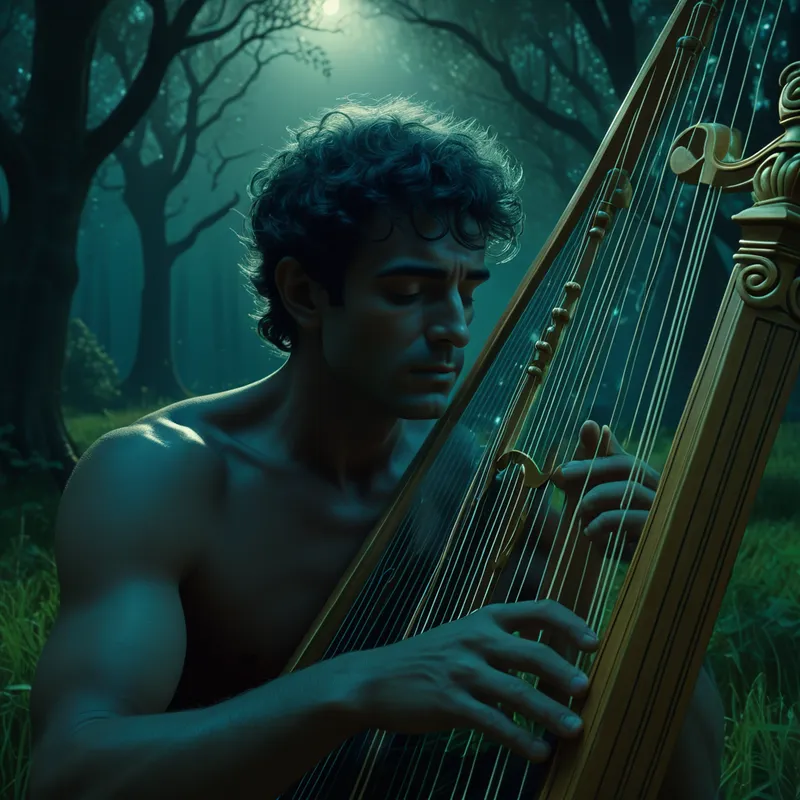
Hermes, the caduceus in hand, donned his traveler’s sandals and descended. He did not come as a warrior, but as a shepherd, a simple rustic with a lyre. He sat on a sun-warmed rock near where Argus kept his vigil, and he began to play. The music was not of Olympus, but of the earth—a drowsy, repetitive melody of reeds and whispering streams. He sang tales of Syrinx transformed into hollow reeds, of Pan’s sighing love. One by one, the luminous eyes of Argus began to dim. The lullaby was a gentle thief, stealing wakefulness. Eye after heavy eye closed in sleep.
But the guardian’s nature was profound. Even in slumber, some eyes flickered open, fighting the enchantment. Hermes, patient as time itself, continued his song, his voice a soft river washing over the giant’s consciousness. Finally, the last eye shuttered. The perfect watch was broken. In that moment of total vulnerability, Hermes, no longer the gentle shepherd, moved with divine speed. His blade, sharp as a thought, found its mark. The All-Seeing was seen no more.
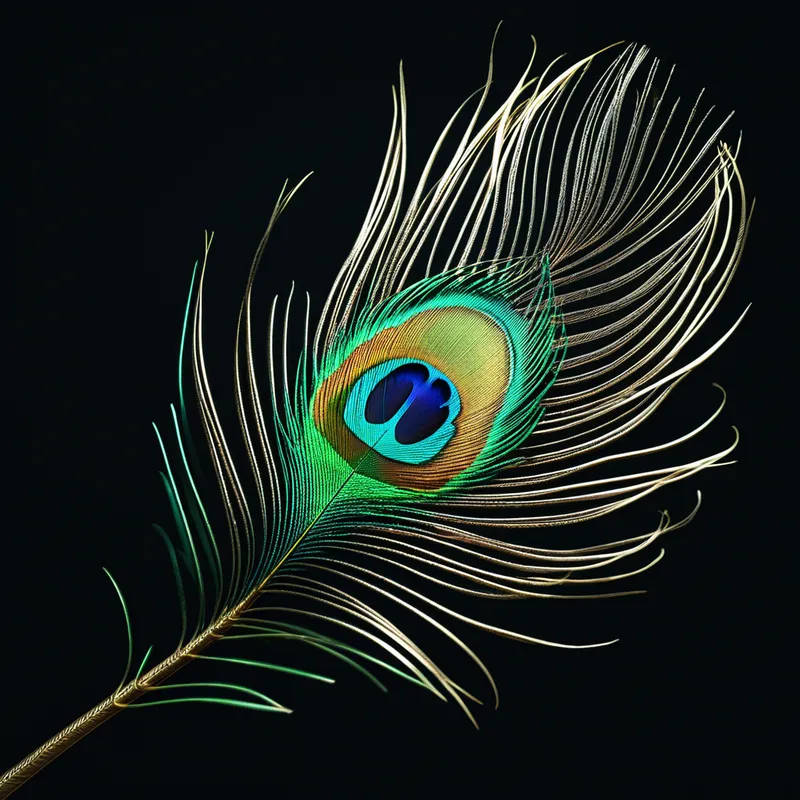
When Hera learned of this, her wrath was a cold and terrible thing. But from her wrath came a strange, beautiful memorial. She took the one hundred eyes of her faithful servant, plucked from the fallen giant, and set them, still glowing with the ghost of their vigilance, into the tail of her sacred bird, the peacock. There they remain to this day—a shimmering, watchful tapestry, a constellation of sacrificed sight adorning the world.
Cultural Origins & Context
The myth of Panoptes is woven from the oldest threads of Greek storytelling, likely originating in the oral traditions of the Archaic period before being crystallized by poets like Hesiod and later in the Bibliotheca of Pseudo-Apollodorus. It is a myth that functioned on multiple levels within the Greek worldview.
Primarily, it is an aetiological myth, answering the childlike yet profound question: “Why does the peacock have eyes on its tail?” The answer is rooted in divine drama, transforming a natural wonder into a relic of cosmic history. Furthermore, the tale served as a potent narrative within the complex family drama of the Olympian gods, illustrating Hera’s relentless vigilance and Zeus’s cunning evasion. It was a story told not just to explain, but to warn and to illustrate the immense, often tragic, power of loyalty and the inevitability of divine conflict. The figure of Argus himself may be a distant echo of older, pre-Olympian daimonic beings—primordial forces of earth and watchfulness co-opted into the service of the newer celestial order.
Symbolic Architecture
At its core, the myth of Panoptes is a profound meditation on the nature of consciousness, surveillance, and the paradox of perfect awareness. Argus is not merely a guard; he is the embodiment of total, undivided attention. His hundred eyes represent a consciousness that seeks to hold the entire field of reality in view simultaneously, leaving no shadow, no unconscious corner.
The ultimate guardian is also the ultimate prisoner, for to see all is to be bound to all that is seen.
He symbolizes the ego’s desperate attempt to maintain complete control, to eliminate all uncertainty and threat through perpetual vigilance. This is Hera’s psychological domain: the possessive, structuring principle that seeks to order, categorize, and secure, intolerant of the chaotic, creative, and transformative impulses represented by Zeus and Hermes. Io, the transformed nymph, is the innocent creative spark or instinctual life trapped and paralyzed by this overwhelming, scrutinizing consciousness.
The arrival of Hermes, the psychopomp, is crucial. He does not defeat Argus through superior force or vision, but through enchantment—through story, music, and trickery. He represents the function of the unconscious itself, which can only be approached indirectly. He lulls the hyper-vigilant ego to sleep, allowing for a necessary dissolution. The slaying of Argus is not a mere murder, but a symbolic death of a rigid, exhausting mode of consciousness. The transfer of the eyes to the peacock’s tail is the alchemical key: the sacrificed, focused, human (or giant) awareness is transmuted into a natural, decorative, and displayed pattern. The watchfulness is not destroyed; it is transformed from a burden of surveillance into a thing of beauty, a display for the cosmos.
The Dreamer’s Resonance
When the pattern of Panoptes stirs in the modern dreamer, it signals a profound engagement with the dynamics of observation and exposure. To dream of being watched by countless eyes—from walls, from the sky, from the patterns in the carpet—is to feel the weight of the Self’s own scrutiny. This is not necessarily paranoia of external surveillance, but more often the somatic experience of the inner critic, the super-ego, or the exhausting demand to be perpetually self-aware, accountable, and “on.”
Dreaming of being Argus, of having eyes all over one’s body, speaks to a state of hyper-vigilance, often born of anxiety or trauma, where the psyche feels it must monitor every internal and external stimulus to remain safe. The body in such dreams may feel heavy, stiff, or petrified—the somatic cost of eternal watchfulness.
Conversely, dreaming of the peacock’s tail, especially if its eyes seem to blink or follow, suggests the integration phase. The oppressive, focused vigilance has been broken apart and its essence has been reclaimed by a larger, more instinctual and beautiful order (the Self). The feeling is less of being watched and more of being seen in one’s totality, and of displaying one’s complex history (the “eyes” of past experiences) as an integrated part of one’s splendor.
Alchemical Translation
The myth provides a precise model for a critical stage of psychic transmutation, or individuation. We all have an inner Argus—a complex within the psyche tasked with guarding our most vulnerable, transformed, or instinctual parts (our Io) from the chaos of the unconscious or the demands of change. This guardian is born of necessity, often from early wounds, and its total vigilance is initially a protection.
The work of Hermes is the work of therapy, of art, of soul-making: to charm the rigid guardian into a necessary sleep, so that what is frozen may be freed.
The individuation process requires this “slaying.” The ego’s attempt at total conscious control must be relaxed, its unwavering gaze diverted, for deeper contents to move. This is often experienced as a crisis, a breakdown of old structures, a feeling of being “disarmed.” It feels like a defeat of the vigilant self. But the alchemy is in the retrieval. Hera’s act of placing the eyes in the peacock’s tail is the symbolic action of the Self. It reassures the psyche that the capacity for awareness, for discernment, is not lost. It is, instead, redeemed and repurposed.
The peacock is a symbol of integrity, immortality, and the beauty of the realized Self. The eyes are no longer tools of paranoid surveillance but become jewels in the display of one’s wholeness. Each “eye” represents a previously guarded complex, a watched-over trauma, a scrutinized flaw, now transformed into a point of luminous awareness integrated into a greater, magnificent pattern. The modern individual undergoing this process moves from the exhaustion of constant self-monitoring to a state where awareness becomes an ornament of the soul, a testament to a vigilance that has served its purpose and been released into beauty.
Associated Symbols
Explore related symbols from the CaleaDream lexicon: