Pandora's Box Myth Meaning & Symbolism
A divine punishment unleashes all evils upon humanity, with only hope remaining trapped inside the jar, questioning its nature.
The Tale of Pandora’s Box
In the beginning, after the great war of the Titans, the world was young and men walked the earth without women, without toil, and without sorrow. They lived in a golden age, their needs provided by the earth itself. But this peace was born of a theft. The clever Titan Prometheus had stolen the sacred fire from the very hearth of Zeus and given it to mortals, gifting them with craft, technology, and a spark of the divine.
On high Olympus, Zeus’s wrath was a storm that shook the foundations of the sky. The theft of fire was an insult that could not stand. A punishment was needed, not just for Prometheus, bound to a rock with an eagle to feast on his liver for eternity, but for all of humanity who had benefited from his crime. The king of gods summoned the divine artisans. To Hephaestus, he commanded, “Mix earth and water, and fashion a being with the voice and form of a goddess.” To Aphrodite, he said, “Shower her with golden grace and the cruel longing that breaks the mind.” Athena taught her weaving and clothed her in a shimmering silver robe. Hermes placed in her heart a shameless mind and a deceitful nature, and named her Pandora—“All-Gifted.”
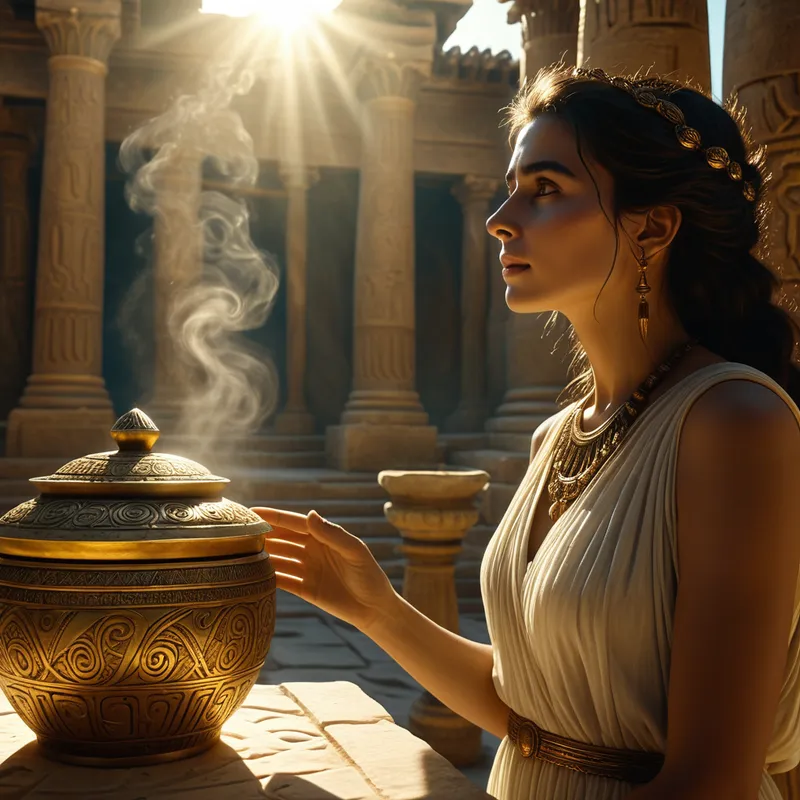
She was sent not to the gods, but to Epimetheus, the brother of Prometheus. Though warned to accept no gift from Zeus, Epimetheus was stunned by her beauty and took her as his wife. With her, Pandora brought a dowry: a great jar, some say a pithos, given by the gods. Its contents were unknown, but a solemn warning accompanied it: This must never, under any condition, be opened.
For a time, the jar sat in the corner of their home, a silent, beautiful monument. But the gifts of the gods are not inert. The curiosity planted by Hermes grew in Pandora’s heart like a vine, twisting around her thoughts by day and whispering in her dreams by night. What glorious treasure lay within? What divine secret was she guarding? The “must not” became an irresistible “what if.”
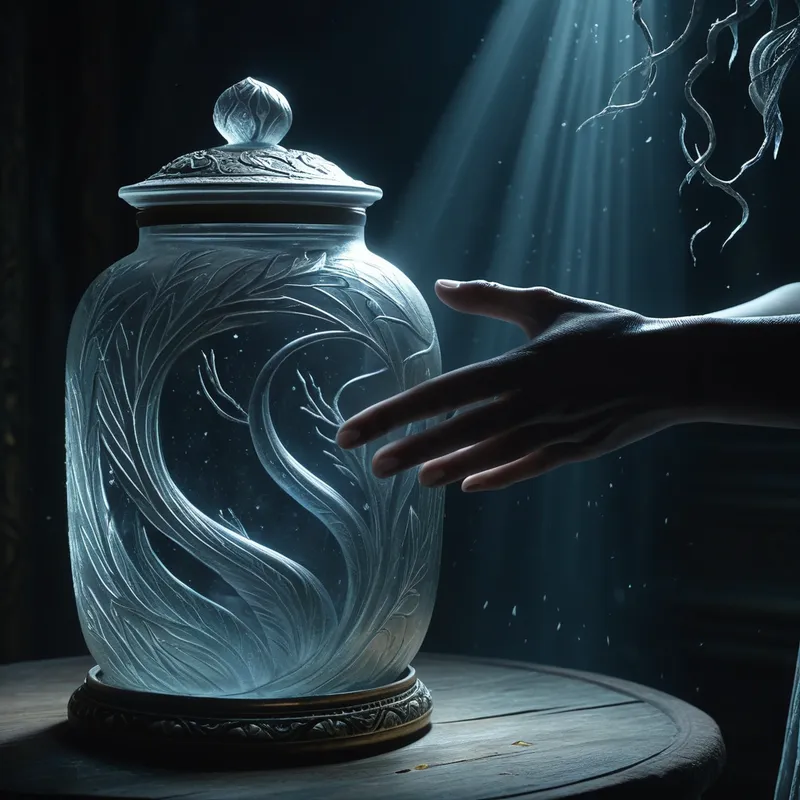
One day, the compulsion overcame her. The air grew still. With trembling hands, she approached the jar, its surface cool and smooth. The seal was not strong. A single, fateful lift of the heavy lid—just a crack—was all it took.
It was not treasure that emerged. It was a sigh, then a shriek, then a roaring, invisible torrent. From that once-sealed vessel poured every misery that now defines the human condition: Geras and Ponos, Nosos and Lyssa, bitter Eris and gnawing Lethe. They were shapeless yet specific, dark vapors that solidified into disease, into envy, into relentless labor and sorrow. They filled the room, then the house, then spilled out into the wide world, attaching themselves to humanity forever.
In terror, Pandora slammed the lid shut. But it was too late. The evils were abroad. All that remained inside, trapped beneath the now-fastened lid, was a single, fluttering thing: Elpis—Hope.
And so the golden age ended. Humanity knew pain, knew death, knew struggle. And forever after, they wondered: Was Hope left inside as the final, cruelest curse—a tantalizing illusion to make suffering bearable? Or was it the one saving grace, the single comfort the gods allowed to remain, sealed away for safekeeping until a wiser time?
Cultural Origins & Context
The tale of Pandora is a foundational narrative from the Greek mythological tradition, most famously articulated by the poet Hesiod in his 8th-century BCE works, Theogony and Works and Days. It is not a folk tale passed down by fireside, but a didactic poem, a “myth of origin” used to explain the harsh realities of agrarian life. Hesiod, a farmer himself, wrote to instruct his brother in justice and labor, framing Pandora’s story as the definitive answer to the question: “Why is life so hard?”
In this context, the myth served a clear societal function. It explained the presence of evil and toil in the world as a divine punishment for human overreach (Prometheus’s theft), reinforcing a worldview where the cosmos is governed by a capricious and powerful hierarchy. It also established a potent etiological narrative for the origin of women, casting them as a “beautiful evil,” a necessary companion for man that also brings hardship—a reflection of the poem’s deeply patriarchal setting. The jar (often mistranslated as a “box” in later traditions) is the pivotal symbol, a divine “gift” that is, in truth, a carefully engineered trap.
Symbolic Architecture
At its heart, Pandora’s Box is a myth about containment and catastrophic release. It maps the psyche’s relationship with the unknown, the forbidden, and the shadow contents of our own nature.
The jar itself is a symbol of the unconscious, the terra incognita of the psyche. It is given, fully formed and sealed, representing those inherited, archetypal potentials—both destructive and salvific—that we carry within us but do not understand. The divine command not to open it is the fragile ego’s agreement to ignore the depths, to live on the surface of a prescribed life.
The sealed vessel is the unexamined life. To open it is to initiate the perilous, necessary journey of becoming conscious.
Pandora is not merely a victim but the agent of awakening. Her “curiosity” is the emergent impulse of consciousness itself, the psychic energy that can no longer tolerate ignorance. She represents the human drive to know, even when that knowledge is destructive to one’s previous state of innocence. The evils released are not external monsters but the inherent sufferings of existence: mortality, grief, anxiety, and conflict. Their release signifies the end of psychic naivety and the beginning of conscious life with all its attendant pain.
Most profound is the trapped figure of Elpis. Is Hope a benevolent comfort or a deceptive palliative? Psychologically, this duality is essential. Hope can be the engine of perseverance, the light in the dark. But it can also be the thing that keeps us clinging to illusions, preventing us from accepting reality and dealing with what is actually before us. Its containment suggests that true hope may not be a quick-fix emotion, but something that must be consciously, carefully retrieved from the wreckage of our shattered innocence.

The Dreamer’s Resonance
When this myth stirs in the modern dreamer, it often manifests as dreams of forbidden rooms, locked containers, or overwhelming curiosity about a secret that feels both dangerous and vital. The dreamer might find themselves in a childhood home, drawn to a basement door they were never allowed to open. They may dream of a briefcase whose combination they suddenly know, or a digital file on their computer labeled “DO NOT OPEN.”
The somatic experience is one of intense ambivalence: a racing heart mixed with dread, a trembling hand reaching forward against the dream-ego’s will. This is the psyche signaling that a major complex—a bundled network of emotions, memories, and impulses—is demanding recognition. The “box” is a repressed trauma, a buried talent, a shadow aspect of the personality, or a truth about one’s life that has been consciously avoided.
The release in the dream may be chaotic: a flood of insects, a burst of black smoke, a cacophony of voices. This is the initial, often terrifying, confrontation with psychic material that has been bottled up for too long. The dreamer awakens with a sense of anxiety or profound unease. The therapeutic process mirrored here is the beginning of shadow-work—the acknowledgment that the sealed-off parts of the self exist and are now active, disrupting the previously ordered (but incomplete) conscious life.

Alchemical Translation
The alchemical journey is one of nigredo, the blackening, followed by a slow purification towards the gold of the integrated self. Pandora’s act is the catalyst for the nigredo. The opening of the jar is the irrevocable step into the nox profunda, where all one’s inner poisons are made conscious and released into the light of awareness. This is not a mistake, but a necessary felix culpa.
The modern individual’s “box” might be a repressed childhood wound, a denied addiction, a stifled creative passion, or a toxic relationship pattern. To live authentically, one must, like Pandora, confront the divine (or parental, or societal) injunction to “leave it sealed.” The act of opening is an act of radical self-honesty, which initially feels like a disaster—a release of pain, anger, and grief that floods one’s life.
The alchemical vessel is the conscious ego that must now contain and withstand the reaction it has initiated. The work is not to stuff the evils back in, but to learn to live with their presence, to name them, and to withdraw their autonomous, haunting power.
This is where Hope, still in the vessel, becomes crucial. After the initial catharsis, the task is to return to the vessel—the now-aware self—and carefully, deliberately, retrieve Elpis. This is not blind optimism, but the kind of hope that is forged in the fires of suffering: the determined, conscious decision to continue the work of integration, to find meaning in the struggle, and to believe in the possibility of a synthesis beyond the current chaos. The myth thus models the full arc of individuation: from enforced innocence, through catastrophic awakening and despair, to the hard-won, grounded hope that makes a complete human life possible. The box, once a prison for evils, becomes the crucible for the soul.
Associated Symbols
Explore related symbols from the CaleaDream lexicon:
- Box
- Boxes
- Lid
- Storage
- Crack
- Without
- Lack
- Bin
- Enclosed
- Spilled Sugar
- Chalcedony Box
- Insect Collection Case
- Treasure Chest
- Treasure Key
- Gift Box
- Gift Wrap
- Treasury Chest
- Gilded Book Cover
- Rustic Dresser
- Chest of Drawers
- Glass Cabinet
- Secret Compartment
- Secret Drawer
- Pantry Door
- Vintage Locket
- Mother-of-Pearl Jewelry Box
- Lock and Key Pendant
- Cascading App Icons
- Envelope Sealer
- File Folder
- Thumb Drive
- Toy Chest
- Treasure Box
- Music Box
- Buried Treasures Vault
- Boarded-Up Storefront
- Buried Treasure
- Secret Stash
- Unearthed Treasure
- Book of Secrets
- Conundrum Box
- Keyhole
- Nutcracker Tool
- Cybersecurity Threat
- Tech Glitch
- Dissonance
- Topological Defect
- Tense
- Glitch
- Cache
- Easteregg
- Suspense
- Deficit
- Stock
- Shortage
- Scarcity
- Offer
- Capacitance
- Caps
- Contagion
- Empty
- Compact
- Underflow
- Hope
- Geode
- Fissure
- Case
- Bottle
- Lock
- Casket
- Enigmatic App Icon