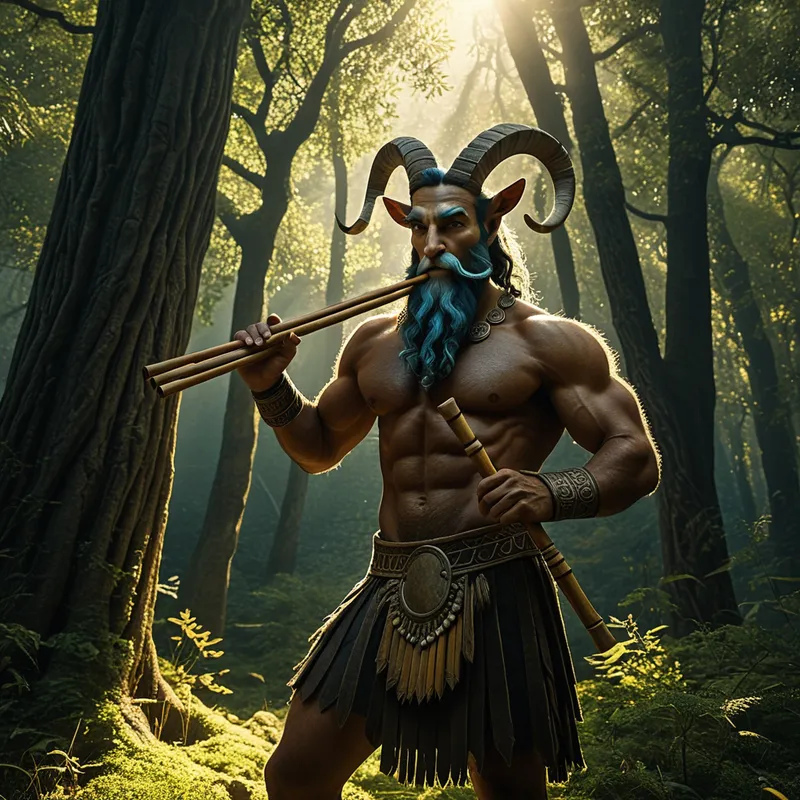
Pan Myth Meaning & Symbolism
The story of Pan, the goat-legged god of the wild, whose primal music and sudden terror reveal the untamed psyche beneath civilization's surface.
The Tale of Pan
Listen, and you will hear the sound that haunts the boundary between the village and the wood. It is not a sound born of the lyre’s golden order, nor the trumpet’s call to war. It is a breathy, whispering melody, a music that is half wind, half sigh. It comes from him—the one who was there before the first wall was built, before the first field was plowed.
He was born in the high, lonely passes of Arcadia, a child of surprise. His mother, the nymph Dryope, took one look at her newborn—his tiny horns, his wiggling goat legs, his laughing, bearded face—and fled in terror. But his father, [Hermes](/myths/hermes “Myth from Global/Universal culture.”/), wrapped him in a rabbit-skin blanket and carried him up to Olympus. The gods laughed with delight at this wild, earthy [thing](/myths/thing “Myth from Norse culture.”/). They named him Pan, which means “All,” for he brought joy to all their hearts.
Pan did not dwell on the polished marble floors of the divine halls. His home was the trackless forest, the sun-warmed rock, the secret spring. He was the companion of shepherds, guarding their flocks with a sharp eye. Yet his heart was a restless, hungry thing. He loved the [nymphs](/myths/nymphs “Myth from Greek culture.”/) who danced in the glades, but they feared his rough, untamed form.
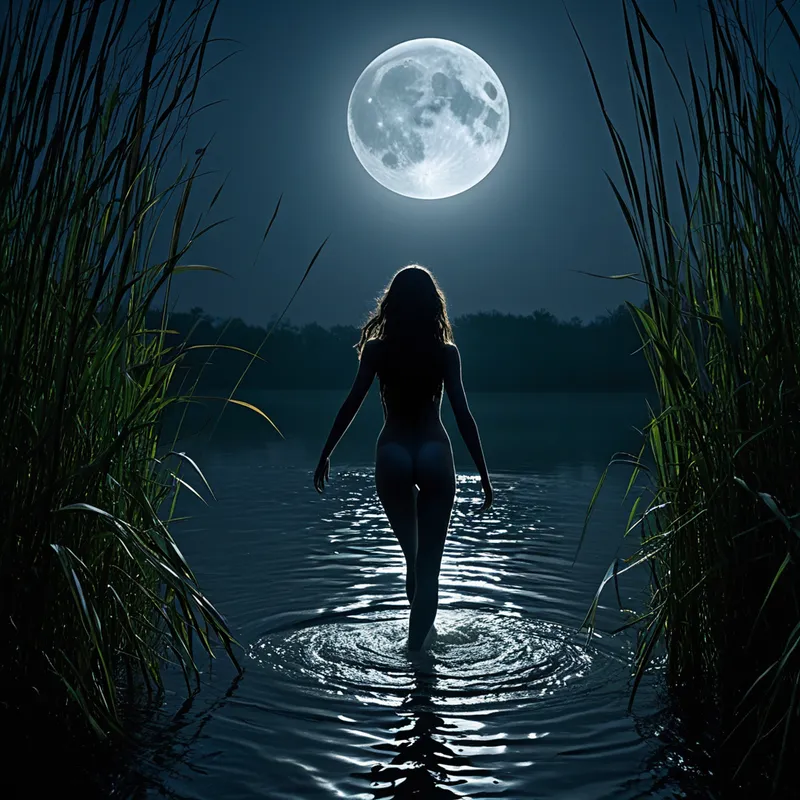
One afternoon, by the slow-moving river [Ladon](/myths/ladon “Myth from Greek culture.”/), he saw the nymph Syrinx. She was slender as a sapling, her hair the color of river rushes. Pan’s heart roared like a beast within his chest. He called to her, but she knew the stories of his pursuits and ran. He gave chase, his hooves pounding the soft earth. She fled until her strength failed, reaching [the river](/myths/the-river “Myth from Buddhist culture.”/)’s bank with no escape. In desperation, she cried out to her sister nymphs. As Pan’s arms closed around what he thought was her body, he found himself clutching only a stand of hollow reeds. The [river spirit](/myths/river-spirit “Myth from Native American culture.”/) had heard her plea and transformed her.
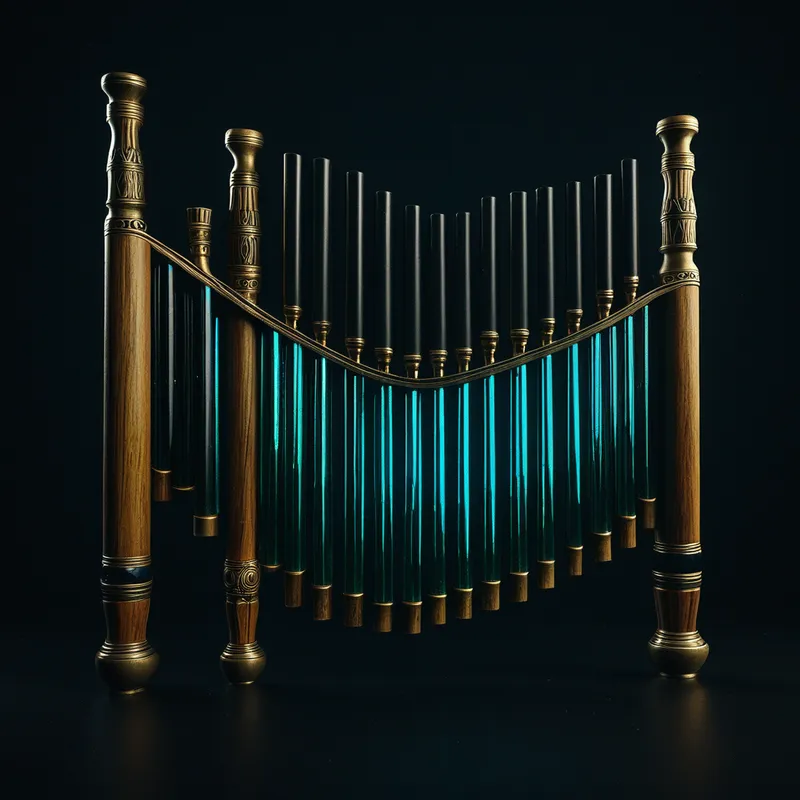
A great sorrow swept through the god. He stood there, breathing heavily, the sigh of his longing passing over the reeds. It produced a soft, mournful whistle. Enchanted, he cut the reeds of varying lengths, bound them with wax, and brought them to his lips. The first music, wild and sweet and aching with loss, flowed out. It was the sound of desire transformed, of the pursued becoming the pursuer’s voice. From that day, the lonely mountains were never silent, for Pan’s pipes sang of a beauty that could never be truly held.
And there is another sound he brings, one that chills the blood. When the heat of midday lies heavy and still upon [the world](/myths/the-world “Myth from Tarot culture.”/), or in the absolute dark of a forest at night, a sudden, causeless terror can seize the heart. Travelers would feel it—a dread so profound it scattered armies and sent men fleeing in blind, unreasoning fear. They named this, too, for him: panic, the god’s gift of remembering that the wild is never truly tamed.
Cultural Origins & Context
The figure of Pan is a deep, rumbling presence in the bedrock of Greek culture, older and more rustic than the Olympian [pantheon](/myths/pantheon “Myth from Roman culture.”/). His worship was not centered in grand urban temples but in the natural world: in sacred caves, groves, and mountain tops, particularly in Arcadia, which was seen as his primordial heartland. He was a god of the margins, of the liminal space where human cultivation met the untamed wild. Shepherds, who lived in this precarious boundary zone, were his primary devotees, offering simple gifts and prayers for the protection of their flocks.
His myths were not the epic tales of heroes but local stories, passed down by herdsmen and country folk. They explained the sudden, eerie noises in the woods (his pipes), the unexpected fertility of a goat, or the paralyzing fear that could strike in lonely places. Pan’s nature was ambivalent: he was a benevolent protector of those who respected the wild, yet the source of a terror that could unravel civilized order. This duality reflects the Greek understanding of nature itself—both nourishing and terrifyingly indifferent. His inclusion in the broader mythic canon, often as a humorous or lustful figure in the tales of other gods, represents the city-dwelling Greeks’ attempt to incorporate and perhaps domesticate this fundamentally undomesticatable force.
Symbolic Architecture
Pan is not merely a god of the woods; he is the archetypal embodiment of the untamed, instinctual [psyche](/myths/psyche “Myth from Greek culture.”/)—what Carl Jung would [term](/symbols/term “Symbol: The term often represents boundaries, defined concepts, or experiences that have a specific meaning in a given context.”/) the [Shadow](/symbols/shadow “Symbol: The ‘shadow’ embodies the unconscious, repressed aspects of the self and often represents fears or hidden emotions.”/) in its raw, natural form. He symbolizes everything civilization seeks to prune, control, or deny: primal sexuality, irrational fear, creative madness, and the sheer, amoral vitality of [life](/symbols/life “Symbol: The symbol of ‘Life’ represents a journey of growth, interconnectedness, and existential meaning, encompassing both the joys and challenges that define human experience.”/).
The pipes of Pan are the sound of the soul finding voice through its own fragmentation. The pursued becomes the instrument; loss is alchemized into art.
His hybrid form—[human](/symbols/human “Symbol: The symbol of a human represents individuality, complexity of emotions, and social relationships.”/) intelligence married to animal physicality—is a perfect [symbol](/symbols/symbol “Symbol: A symbol can represent an idea, concept, or belief, serving as a powerful tool for communication and understanding.”/) of our own dual [nature](/symbols/nature “Symbol: Nature symbolizes growth, connectivity, and the primal forces of existence.”/). We are thinking beings, yet we are driven by [blood](/symbols/blood “Symbol: Blood often symbolizes life force, vitality, and deep emotional connections, but it can also evoke themes of sacrifice, trauma, and mortality.”/), [breath](/symbols/breath “Symbol: Breath symbolizes life, vitality, and the connection between the physical and spiritual realms.”/), and instinct. Pan represents the part of us that never fully left the [forest](/symbols/forest “Symbol: The forest symbolizes a complex domain of the unconscious mind, representing both mystery and potential for personal growth.”/), that responds to the rhythms of the [moon](/symbols/moon “Symbol: The Moon symbolizes intuition, emotional depth, and the cyclical nature of life, often reflecting the inner self and subconscious desires.”/) and the pull of the [earth](/symbols/earth “Symbol: The symbol of Earth often represents grounding, stability, and the physical realm, embodying a connection to nature and the innate support it provides.”/). His “panic” is not just fear, but the shocking intrusion of this repressed psychic [material](/symbols/material “Symbol: Material signifies the tangible aspects of life, often representing physical resources, desires, and the physical world’s influence on our existence.”/) into the ordered daylight of the conscious mind. It is [the ego](/myths/the-ego “Myth from Jungian culture.”/)’s [terror](/symbols/terror “Symbol: An overwhelming, primal fear that paralyzes and signals extreme threat, often linked to survival instincts or deep psychological trauma.”/) when it realizes it is not the sole ruler of the inner [kingdom](/symbols/kingdom “Symbol: A kingdom symbolizes authority, belonging, and a sense of identity within a larger context or community.”/).
Furthermore, Pan is a god of [connection](/symbols/connection “Symbol: Connection symbolizes relationships, communication, and bonds among individuals.”/), not [isolation](/symbols/isolation “Symbol: A state of physical or emotional separation from others, often representing a need for introspection or signaling distress.”/). His name meaning “All” hints at a pantheistic [truth](/symbols/truth “Symbol: Truth represents authenticity, honesty, and the quest for knowledge beyond mere appearances.”/): the wild [soul](/symbols/soul “Symbol: The soul represents the essence of a person, encompassing their spirit, identity, and connection to the universe.”/) is not separate from nature but is a participatory [expression](/symbols/expression “Symbol: Expression represents the act of conveying thoughts, emotions, and individuality, emphasizing personal communication and creativity.”/) of it. His [music](/symbols/music “Symbol: Music in dreams often symbolizes the harmony between the conscious and unconscious mind, illustrating emotional expression and communication.”/) does not conquer the forest; it is the forest given [melody](/symbols/melody “Symbol: A melody symbolizes emotion, memory, and communication, often representing the subconscious expressing itself through sound.”/).
The Dreamer’s Resonance
When Pan stalks the landscapes of our modern dreams, he rarely appears in his classical form. The conscious mind, trained by civilization, often censors such direct imagery. Instead, his presence is felt somatically and through symbol.
You may dream of being chased through an endless, tangled wood by an unseen presence, your heart hammering with a pure, animal fear—this is the panic terror. You may dream of finding a strange, rustic musical instrument and feeling a compulsion to play it, producing sounds that are both beautiful and unsettling, stirring deep, forgotten emotions. You might dream of a city that is slowly being overgrown by wilderness, vines cracking concrete, or of a familiar room where the walls suddenly breathe like living flesh.
These dreams signal a confrontation with the instinctual self. The somatic feeling is key: a buzzing anxiety, a surging vitality, or a profound, earthy longing. Psychologically, the dreamer is likely at a point where their overly structured, perhaps sterile, conscious life is being challenged by the needs of the body and the deep psyche. Pan’s appearance—in whatever guise—is a call from the wild interior, a demand for recognition and integration.

Alchemical Translation
The individuation process, the journey toward psychic wholeness, requires not just cultivating the light of consciousness but also forging a relationship with the inner wilderness. Pan’s myth provides a potent model for this alchemical translation.
The process begins with the pursuit—the eruption of an untamed, often embarrassing or frightening, instinct (lust, rage, creativity) into our orderly lives. Like Syrinx, the conscious ego may try to flee, to spiritualize or rationalize away this raw energy. The first alchemical step is the transformation. Syrinx does not simply vanish; she changes state, from nymph to reed. Similarly, we cannot annihilate our primal nature, but we can, through conscious engagement, transform its expression.
Individuation is not the slaying of the inner beast, but the crafting of its cry into a song that the whole soul can hear.
This is the final, crucial act: creation. Pan does not mourn the lost nymph and remain silent. He takes the very substance of his loss and desire—the reeds—and fashions them into the syrinx, the panpipes. He gives his longing a voice. For the modern individual, this is the work of taking raw, chaotic psychic energy—anger, passion, fear, creativity—and finding a vessel for it. This vessel could be art, physical exertion, deep relationship, or any authentic form of expression. The “panic” becomes “music.” The fragmented self, acknowledged and worked with, becomes the instrument through which a more complete, more vibrant, and more authentic life is played. We integrate the goat-legged god, not as a master, but as a vital partner in the symphony of [the self](/myths/the-self “Myth from Jungian culture.”/).
Associated Symbols
Explore related symbols from the CaleaDream lexicon:
- Panic
- Goat
- Antelope Horn
- Rustling Grass
- Tapping Drums
- Whistling in the Wind
- Satyr Dance
- Faun Flute
- Flute of Harmony
- Saxophone
- Clarinet
- Trombone
- Accordion
- Sousaphone
- Pungi
- Bassoon
- Cowbell
- Recorder
- Carved Ocarina
- Dulcet Soprano Recorder
- Wavy Piccolo Trumpet
- Illuminated Kazoo
- Dreamy Ukulele
- Winding Didgeridoo
- Rustling Woodwinds
- Bamboo Flute
- Toy Drum
- Trombone Slide Toy
- Trombone Toy
- Drum Kit
- Banjo
- Echoing Didgeridoo
- Saxophonist
- Marimba Mirage
- Echoing Drumsticks
- Urban Wildlife
- River Reeds
- Grazing Flocks
- Carved Bone Whistle
- Bone Flute
- Pine Forest
- Musky Scent
- Acoustic Diffusion
- Interjection
- Pan