Palladium Myth Meaning & Symbolism
A sacred statue fell from heaven to protect Troy. Its theft by Odysseus and Diomedes sealed the city's fate, revealing that true security lies beyond the walls.
The Tale of Palladium
Hear now of the fall from heaven that built a kingdom, and the theft in darkness that unmade it.
In the age when gods walked closer to the earth, a grief-stricken father sought to console his beloved child. Hephaestus, the divine smith, labored not with hammer and anvil, but with a father’s sorrow. For Athena, sprung fully formed from the mind of Zeus, had no mother. In a gesture of profound, awkward love, Hephaestus pursued her. From that strained encounter, as Athena wiped the seed of Hephaestus from her thigh and cast it upon the rich soil of Gaea, a child was born: Erichthonius, half-mortal, serpent-legged.
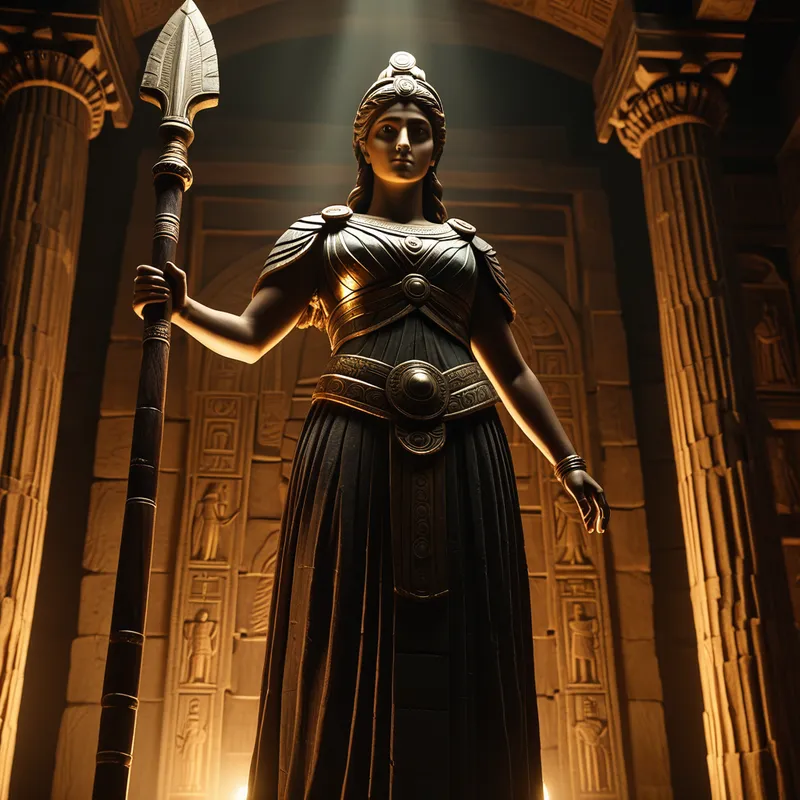
But the story does not begin with the king. It begins with the consolation. To honor her strange, fostered son, Athena fashioned an image. Not from mortal wood or stone, but from the essence of divine regard. Some say it was a statue of impeccable craftsmanship. Others whisper it fell from the sky itself, a thunderous gift, a piece of the celestial order given form. This was the Palladium: a xoanon, a crude yet potent wooden figure of the goddess herself, three cubits tall, spear and shield in hand.
It fell within the boundaries of the future Troy. The seers proclaimed its meaning: the city built around this heaven-sent token would be under the direct protection of Athena herself. So long as the Palladium remained within the walls, the walls would stand. Troy rose, magnificent and impregnable, its stones mortared with divine favor. For generations, the statue resided in the innermost temple, the cella, the sacred heart of the city’s power. Priests tended it; kings made offerings; the people slept soundly, wrapped in the certainty of Athena’s watchful gaze.
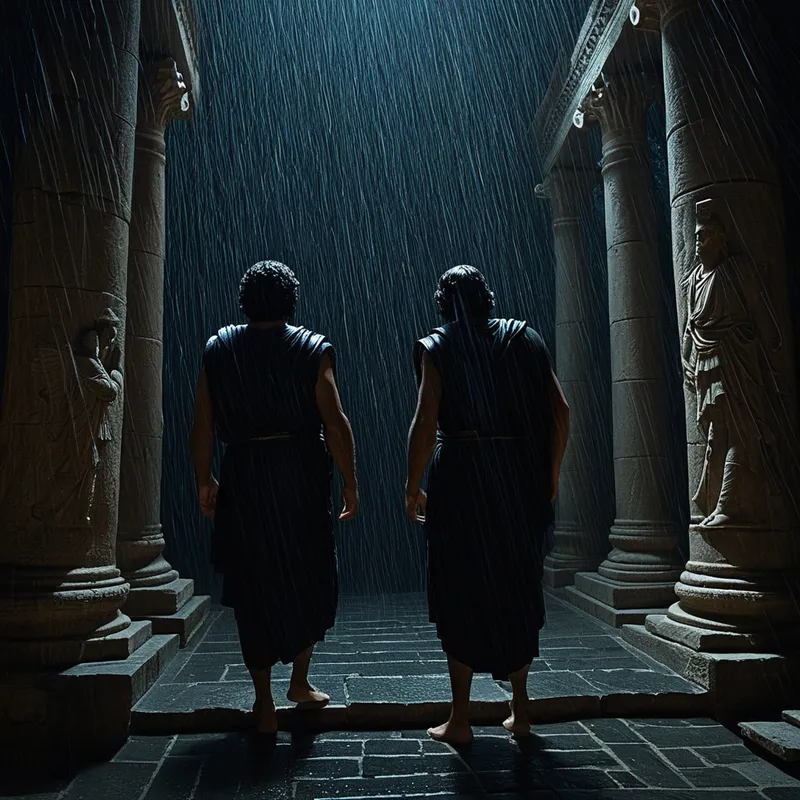
Then came the war. For ten long years, the Achaean host broke itself against Troy’s famed walls. Blood soaked the Scamander plain, but the gates held. The Palladium held. Desperation bred cunning. The wily Odysseus and the fierce Diomedes undertook a mission of sacrilege. On a night black as pitch, under a weeping sky, they slipped into the besieged city. Guided by fate or treachery, they found the temple. The air was thick with incense and ancient silence. There, in the dim flicker of an eternal flame, stood the sacred image.
This was no battle of clashing steel, but a silent, profound violation. To touch it was blasphemy. To remove it was to unravel the very fabric of Troy’s destiny. With grim hands, they took it. They carried the divine protector out of the city she was sworn to guard, back through the sleeping lines to the Greek camp. The next day, the walls did not crumble. But something had shifted. A vital cord had been cut. The soul of the city’s defense was gone. Soon after, the hollow horse would roll through gates left spiritually unguarded. The fall was now not a matter of if, but when. The protection had departed, and with it, the city’s fate was sealed.
Cultural Origins & Context
The myth of the Palladium is not a single, standardized tale but a resonant thread woven through the epic cycle, most notably in the fragments of the Iliupersis (The Sack of Troy) and later elaborated by Roman authors like Vergil. For the Greeks, it functioned as a crucial etiological myth, explaining not just how Troy fell, but offering a theological and strategic reason that satisfied the need for narrative logic. A city blessed by the gods could not fall by mortal strength alone; it required a divine loophole, a ritual undoing.
Its societal function was multifaceted. It reinforced the concept of eusebeia (piety) and its tangible rewards—and the catastrophic consequences of its loss. It also spoke to ancient anxieties about security and the fragility of civilization. A city’s might was not solely in its armies or its walls, but in its sacred covenant with the divine. The story was told by rhapsodes and later written by poets as a cautionary tale about the nature of protection itself—that it is a living relationship, not a static object, and can be stolen, lost, or transferred.
Symbolic Architecture
The Palladium is the ultimate symbol of conditional divine protection. It represents not omnipotent safety, but a pact. Its power is absolute yet perilously localized.
The fortress is most vulnerable at the point it believes itself to be invincible.
Psychologically, the Palladium represents the core complex or the central identity around which we build our psychic defenses. It is the cherished belief, the foundational trauma, the idealized self-image, or the central dogma that we believe protects us from chaos. We build the entire “city” of our personality—our habits, relationships, and worldview—around this inner statue. We believe, “So long as I hold to this belief, I am safe. So long as this memory remains entombed, I am whole.”
The theft by Odysseus and Diomedes symbolizes the necessary, violent incursion of the shadow and the trickster into this sanctum. Odysseus (cunning intelligence) and Diomedes (ruthless force) together represent the combined psychic forces that can, and eventually must, raid our inner sanctums. They are the unsettling insight, the painful truth, the midlife crisis, or the therapeutic breakthrough that “steals” our most cherished illusion of safety. This is not an act of evil, but of fate—a brutal step in the process of individuation.

The Dreamer’s Resonance
When this myth stirs in the modern unconscious, it often manifests in dreams of violated sanctums. The dreamer may find themselves in their childhood home, now unfamiliar and breached. They may be frantically hiding a precious, glowing object in a basement as intruders search upstairs. They may discover a secret, beautifully maintained room in their house they never knew existed, filled with ancient artifacts, and feel simultaneous awe and terror at its exposure.
Somatically, this process can feel like a sudden, groundless vulnerability—an anxiety attack that arises not from external threat, but from the chilling sense that an internal protection has vanished. The psychological process is one of de-identification. The ego, which identified with the “city” protected by the “statue,” is experiencing the theft of its central organizing principle. It is a crisis of meaning and security. The dreamer is undergoing the painful but necessary dissolution of a once-protective, now-limiting, complex.
Alchemical Translation
The alchemical journey modeled by the Palladium myth is the transmutation of security from external object to internal process.
The initial state (nigredo) is the besieged city: the ego, under constant stress, clinging desperately to its magical talisman, its fixed idea of itself. The theft of the Palladium is the crucial albedo—a terrifying whitening, a bleaching out of false color. It is the moment of stark realization: the protector is gone. The sacred object upon which everything depended has been removed. This is the essence of the dark night of the soul.
The true Palladium is not the statue that guards the city, but the understanding that the city and the statue were never separate.
The subsequent fall of Troy is not merely destruction, but a necessary citrinitas, a breaking open. The rigid walls of a personality built around a single, fragile truth must fall so that a more conscious, adaptable self can emerge. Finally, the myth’s continuation—where the Palladium is said to have been brought to Italy by Aeneas to found a new destiny—points to the rubedo. The stolen sacred core is not destroyed; it is translated. It becomes the founding principle of a new, more resilient psychic structure—not as a blind totem of protection, but as an integrated symbol of wisdom (Athena) earned through experience and loss.
For the modern individual, the myth asks: What is your Palladium? What cherished, hidden idol do you believe keeps you safe? And are you prepared for the cunning and force of your own psyche to one night steal it away, not to destroy you, but to force you to build a homeland less dependent on a stolen god, and more rooted in your own, hard-won sovereignty.
Associated Symbols
Explore related symbols from the CaleaDream lexicon: