Pagoda of Six Harmonies Myth Meaning & Symbolism
A monk builds a pagoda to subdue a chaotic river dragon, harmonizing the waters and the human world through spiritual discipline and cosmic alignment.
The Tale of the Pagoda of Six Harmonies
Listen, and hear the tale of the river that would not be tamed. In the days when the Qiantang River was a wild god, its waters did not flow—they roared. Each month, with the pull of the moon, it would summon a tidal bore, a wall of water like a moving mountain, crashing upon its banks. It was not mere water, but fury given form, a dragon of churning foam and deafening thunder. Boats were splinters, fields were salt marshes, and the people lived in the shadow of the flood.
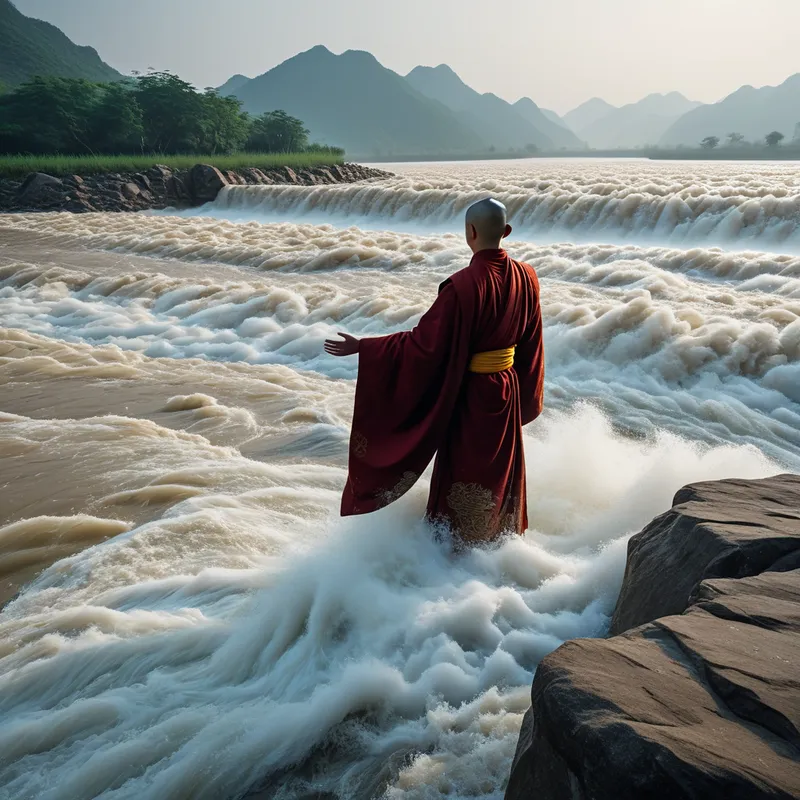
Into this chaos came a monk named Zhiyuan. He did not come with an army, nor with spells of binding. He came with a stillness that was deeper than the river’s rage. He walked the ravaged banks, feeling not just the water’s wrath, but the sorrow beneath it—the dragon’s spirit, lost and turbulent, a force of nature severed from the cosmos.
Zhiyuan saw the truth. The dragon was not evil; it was disordered. Its power, meant to be part of the great rhythm of heaven and earth, had become a solitary, destructive pulse. To calm it, one could not fight chaos with chaos. One must build order with order. He vowed to build a pagoda, but not as a mere monument. It would be a needle of harmony, stitching the rebellious water back into the fabric of the world.
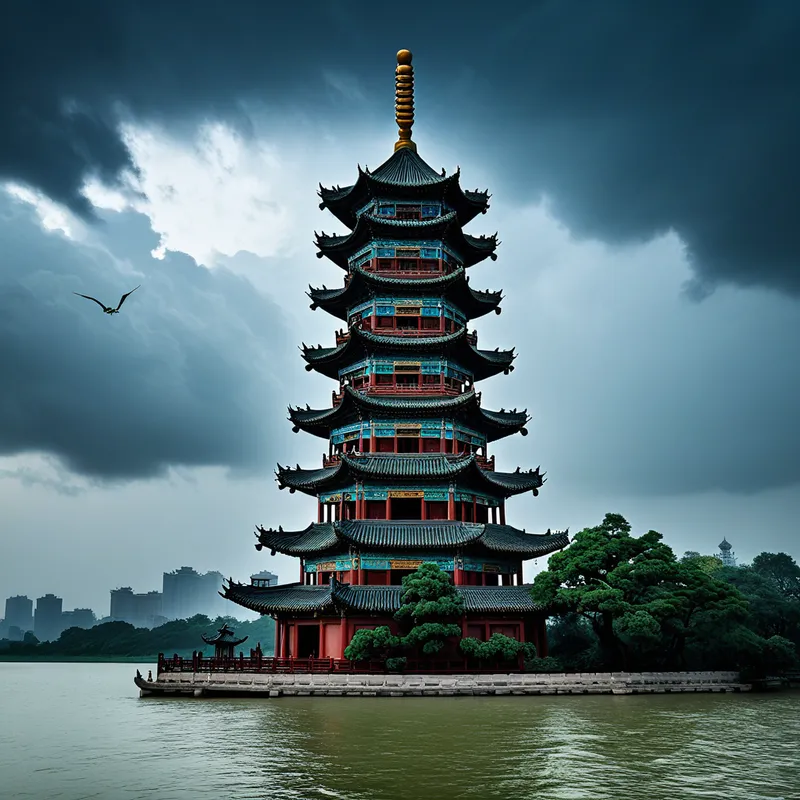
For years, under the watchful, stormy eye of the river, the pagoda rose. Stone upon stone, story upon story, until it stood thirteen levels tall on Yuelun Hill. On the day of its completion, the moon swelled, and the river began its dreadful rumble. The tidal bore gathered, higher and fiercer than ever, the dragon’s form visible in the cresting wave—a leviathan of liquid rage aimed at the heart of the land.
Zhiyuan climbed to the highest balcony. He did not raise a weapon. He raised his voice in sutra. He did not command the dragon; he addressed it. He spoke of the Six Harmonies: harmony in view, in conduct, in speech, in purpose, in rule, and in benefit. He spoke of the harmony between river and shore, between dragon and sky, between power and peace. As his words wove through the air, mingling with the sound of wind chimes hung from the pagoda’s eaves, a miracle unfolded.
The charging wall of water did not crash. It bowed. The raging dragon, feeling the resonant order of the pagoda—a model of the cosmic mountain, Sumeru—and hearing the truth of harmony, submitted. Its form dissolved from a destructive wave into a great, sinuous current that flowed with powerful grace, its tidal bore becoming a spectacular, yet orderly, natural procession. The river was healed. The dragon was not slain, but restored to its rightful, majestic place in the order of all things.
Cultural Origins & Context
The legend of the Pagoda of Six Harmonies is intrinsically linked to the real Liuhe Pagoda, first constructed in 970 AD during the Northern Song Dynasty. While the historical pagoda served as a lighthouse and navigational aid for the treacherous Qiantang River, its cultural memory quickly absorbed deeper, mythic significance. The story of Monk Zhiyuan taming the dragon is a classic example of a fengtu chuanshuo (local legend), born from the community’s profound and fearful relationship with a powerful natural phenomenon.
Told by riverside communities, Buddhist monks, and storytellers, the myth served multiple societal functions. It provided an etiological explanation for the pagoda’s existence and the (somewhat) tamed nature of the tidal bore. More importantly, it enacted a core tenet of traditional Chinese thought: the ideal of achieving harmony (he) between humanity and the natural world. The myth transformed a feat of engineering into a feat of spiritual ecology, teaching that true control comes not through domination, but through understanding and aligning with cosmic principles.
Symbolic Architecture
At its heart, the myth is a blueprint for the containment and transformation of raw, unconscious power. The chaotic River Dragon represents the untamed forces of nature—both external and internal. It is the flood of unchecked emotion, the tidal bore of psychic chaos, the raw libido or life force that, without structure, becomes destructive.
The pagoda is not a cage, but a tuning fork. It does not suppress energy; it resonates with a higher frequency, inviting chaos to remember its own inherent melody.
The Six Harmonies are the key. They move from the internal to the external: first, harmony of view (right understanding), then conduct and speech, leading to shared purpose and equitable rule, resulting in mutual benefit. This is a psychological sequence. One must first achieve internal coherence of perception and intent before one can effectively order one’s actions and relationships, which finally leads to a harmonious existence with the world. The pagoda, with its thirteen stories (symbolizing the lunar months, thus time itself), is the physical manifestation of this graduated, structured process applied to a formless force.
Monk Zhiyuan embodies the conscious ego aligned with the Self. He does not battle the dragon (the shadow/unconscious) with equal fury. He confronts it with the superior power of conscious structure and compassionate insight, offering it a place in a larger, more beautiful order.
The Dreamer’s Resonance
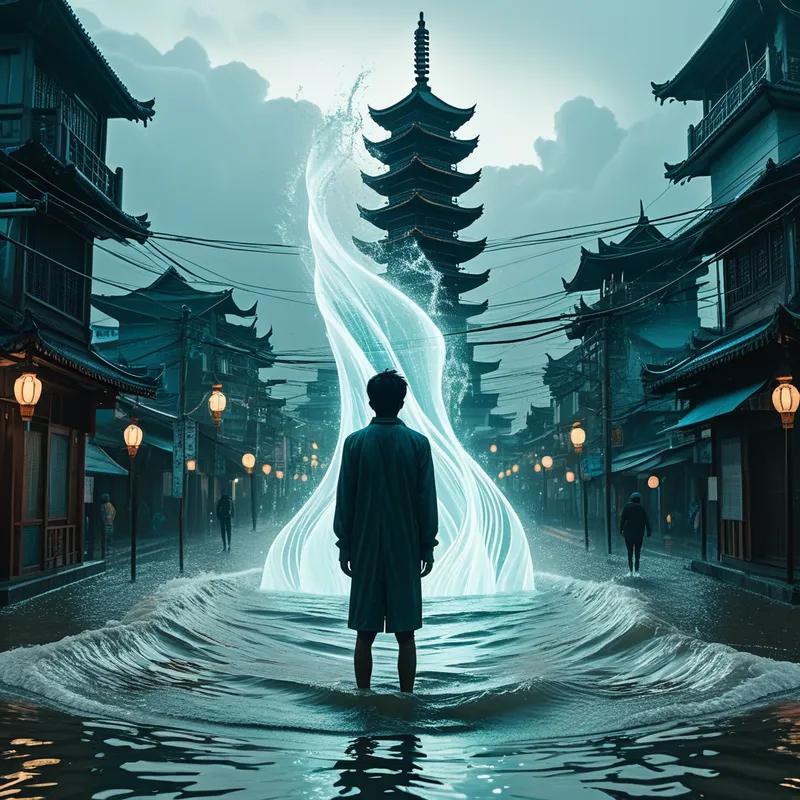
When this myth stirs in the modern psyche, it often surfaces in dreams of overwhelming, formless pressure. One may dream of tsunamis, of being trapped in a flood, of chaotic, rushing crowds, or of a powerful, frightening animal that cannot be controlled. These are the somatic echoes of the River Dragon—a feeling that some part of life (emotions, responsibilities, creative impulses) has become a destructive, autonomous force threatening to inundate the conscious world.
The dream may also feature attempts to build or find a tall, stable structure—a tower, a lighthouse, a pagoda. This is the psyche’s instinctive move toward the myth’s resolution. The dreamer is not seeking escape, but a viewpoint. They are trying to construct a perspective high enough and ordered enough to comprehend the chaos, to see its pattern and its place in the whole. The process feels urgent and somatic: a tightening in the chest (the rising flood) countered by a deep need to stand straight and breathe steadily (building the inner pagoda).
Alchemical Translation
The individuation process modeled here is the alchemical coagulatio: the bringing of a volatile, fluid substance into solid, lasting form. The chaotic waters of the unconscious (the prima materia) must be given shape and structure to become a usable part of the personality.
The goal is not to kill the dragon, but to invite it to guard the treasure. The transformed instinct becomes the protector of the newfound psychic order.
The modern individual faces their own “River Dragon”—perhaps a torrent of anger, a flood of grief, or the chaotic surge of a midlife awakening. The instinctive, flawed response is to build a dam (repression) or to flee to the hills (dissociation). The myth instructs a third way: to build a Pagoda of Six Harmonies within.
This means first establishing “harmony in view”—objectively observing the chaos without identifying with it. Then, through disciplines of “conduct and speech” (mindful action and authentic expression), one begins to channel the force. By finding a “purpose” for this energy and applying consistent “rule” (inner discipline), the raw power is gradually integrated. The final “harmony of benefit” is the realized state where what was once a destructive flood becomes a source of vitality, creativity, and resilience—a tamed dragon that adds its mighty strength to the totality of the Self. The pagoda stands within, a permanent inner structure that allows one to witness life’s turbulent tides not with fear, but with the serene understanding of the monk who knows the river’s true, harmonious name.
Associated Symbols
Explore related symbols from the CaleaDream lexicon: