Pachamama Myth Meaning & Symbolism
The living Earth is not a resource but a sacred, conscious mother who demands reciprocity and offers boundless nourishment to her children.
The Tale of Pachamama
Listen. Before the first stone of Cusco was laid, before the sun god Inti claimed the sky, there was the deep, dreaming hum. It was not a sound you hear with ears, but a vibration you feel in the marrow of your bones, in the first beat of a newborn’s heart, in the silent push of a root through stone. This was her breath. She was the dark, fertile void and the soaring peak. She was the patient bedrock and the trembling fault line. She was Pachamama.
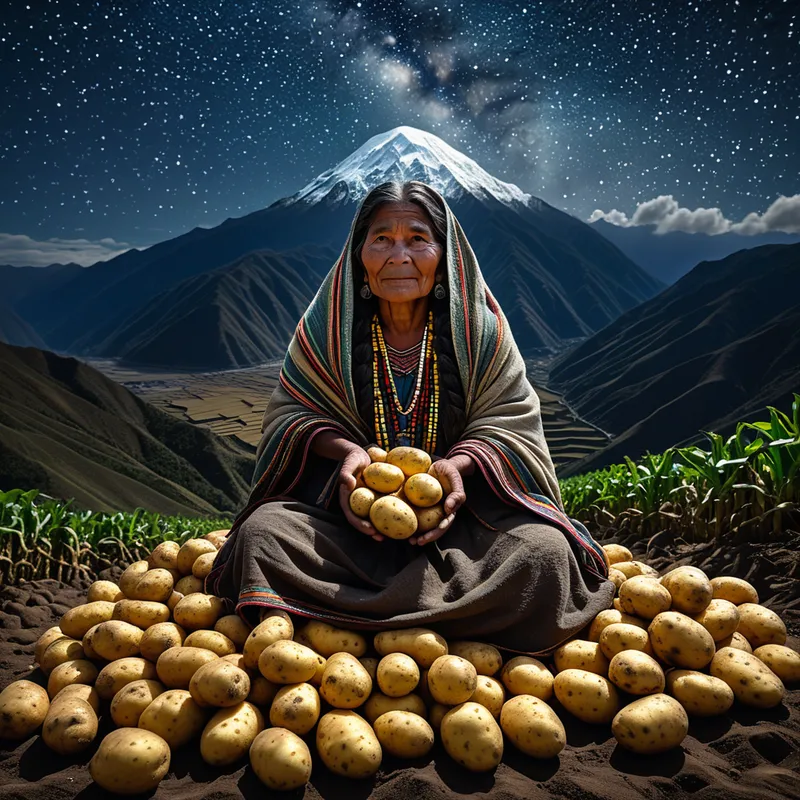
In the beginning of time, she slept, a vast, slumbering form of mountains and plains. From her dreams, life stirred. Grasses whispered against her sides. Rivers began to trace the paths of her thoughts. But she was alone in her abundance. Then came the first children—not born, but shaped. From the clay of her riverbanks, she formed the first people. She breathed into them the warmth of her lowland valleys and the resilience of her high puna. She did not speak in words, but in sensations: the nourishing taste of the first potato drawn from her soil, the quenching coolness of spring water, the sturdy shelter of a cave in her cliffs.
Yet, the children were forgetful. In their hunger, they took and took, digging deep into her flesh without thanks, cutting down the trees that were her hair. A coldness began to spread in her depths. The rivers ran thin. The soil turned hard and grey. The children shivered, their bellies empty, their hearts fearful. They had broken the unspoken law.
A great silence fell, heavier than any mountain. It was the silence of a mother turning her face away. Desperate, the wisest among them, an old woman with eyes like weathered stone, remembered. She gathered the people. “We have taken her breath as our own and given back only our shadow,” she said. “We must speak the language she understands.”
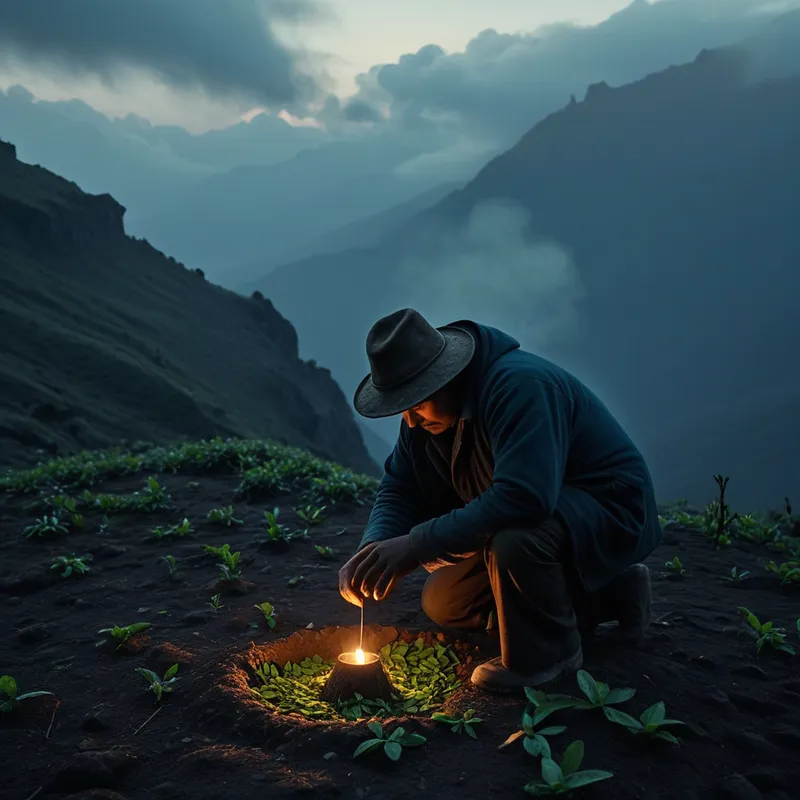
They went to a high place, where the wind carries prayers. With bare hands, they dug a small, careful hole—a womb in the earth. Into it, they placed the most perfect fruits of what little they had: the finest coca leaves, the sweetest oca, a sip of chicha. They poured their gratitude into the soil like water. They whispered their apologies into the wind.
For three days, they waited in the terrible silence. Then, on the fourth dawn, a warmth radiated from the ground. Where the offering lay, a green shoot, impossibly vibrant, pierced the soil. Then another, and another. A gentle rain fell, not from clouds, but from the very air, smelling of rich loam and blossoms. The hum returned, deeper and more forgiving than before. It was not a lesson of punishment, but a reminder written in the language of life itself: to receive, one must first give. The relationship was sealed not in conquest, but in sacred, perpetual exchange.
Cultural Origins & Context
The story of Pachamama is not a singular myth with a fixed canon, but the living, breathing substrate of Andean cosmology, predating and permeating the Inca Empire. She is a huaca of immeasurable scale, the ultimate source of all fertility and life. Unlike the state-sponsored, celestial hierarchy of gods like Inti, Pachamama’s worship was intimate, domestic, and agrarian. Her myth was passed down not in royal courts by professional poets, but in fields and homes by grandmothers, farmers, and paqos.
Her primary societal function was the maintenance of ayni, a foundational Andean principle of reciprocal exchange and cosmic balance. Every planting, every harvest, every drink, every meal began with a small offering to her—a libation of chicha poured onto the ground, a few coca leaves buried. The great state rituals of the Inca, like Inti Raymi, were grand political theater, but the daily pago a la tierra (payment to the earth) was the essential spiritual practice that sustained the community. She anchored the people in a worldview where humanity is not above nature, but a participatory thread within a conscious, sentient cosmos. To neglect reciprocity with Pachamama was to risk literal starvation—a direct, tangible consequence of spiritual rupture.
Symbolic Architecture
Pachamama is the archetype of the World as Nourishing Mother, but with a critical, active dimension. She is not a passive, endlessly giving figure. She embodies the full cycle of nature: creation, sustenance, and necessary dissolution.
The earth does not merely produce; she enters into a relationship. Her fertility is not an inert property but a responsive dialogue.
Psychologically, she represents the Ground of Being itself—the unconscious as a fertile, creative, and ultimately sustaining matrix. The soil is symbolic of the psychic substrate from which all consciousness, ideas, and life emerge. The myth’s central conflict—the withdrawal of nourishment—mirrors the psychological experience of aridity, depression, or creative block when we only extract from our inner depths (our instincts, our dreams, our vitality) without offering respect, attention, or “libations” of conscious engagement. The offering (despacho) is the symbol of conscious reciprocity with the unconscious. It is the act of giving something of our conscious world (our gratitude, our art, our focused attention) to the deep, instinctual self, thereby restoring the flow of psychic energy and creativity.

The Dreamer’s Resonance
When the pattern of the Pachamama myth stirs in the modern dreamer, it often manifests as a profound somatic call from the ground of one’s own being. Dreams of rich, dark soil; of planting seeds in unexpected places; of finding caves or cellars that lead to warm, earthy depths—all speak to an awakening relationship with this inner ground.
Conversely, dreams of barren landscapes, cracked earth, or feeling repelled by dirt may signal a state of psychological ch’aki (drought, a Quechua concept for spiritual dryness). The dreamer may be living in a state of relentless extraction from their own resources—burning through energy, ignoring physical needs, or exploiting their talents without reverence. The body itself may become the site of the myth, through feelings of chronic fatigue, a sense of being “ungrounded,” or a deep, inarticulate longing for connection to something elemental. The healing process initiated by such dreams is one of re-establishing ayni with oneself: learning to listen to the body’s needs, to offer it rest and nourishment, to honor the rhythms of energy and rest as sacred cycles.
Alchemical Translation
The alchemical journey modeled by Pachamama is the transmutation of taking into participating, and of resource into relationship. The modern psyche, often conditioned to see the inner and outer world as territories to be mastered and exploited, must undergo this transmutation to achieve wholeness.
The initial state is nigredo, the blackening: the experience of aridity, burnout, and meaninglessness—the cold silence of Pachamama when reciprocity is broken. The opus (work) is the conscious, ritualized act of offering. In psychological terms, this is the disciplined practice of giving conscious attention to what has been neglected: journaling to honor fleeting emotions, creating art without concern for product, dedicating time to silent meditation as a “libation” to the unconscious.
Individuation is not a mining operation into the self, but a continuous, sacred exchange with the self.
The albedo, or whitening, is the return of flow—the green shoot from the offering. This is the emergence of new vitality, spontaneous intuition, and creative life that arises when the ego ceases its demands and begins to engage in dialogue. Finally, the rubedo, or reddening, is the establishment of a sustained, living relationship. The individual no longer relates to their body, their creativity, or the natural world as separate objects, but as a participatory member of a conscious, interconnected field. They become a living apacheta, a place where gratitude is offered and nourishment is received, embodying the timeless, humming balance of the Earth Mother herself.
Associated Symbols
Explore related symbols from the CaleaDream lexicon: