Oya's Nine Skirts Myth Meaning & Symbolism
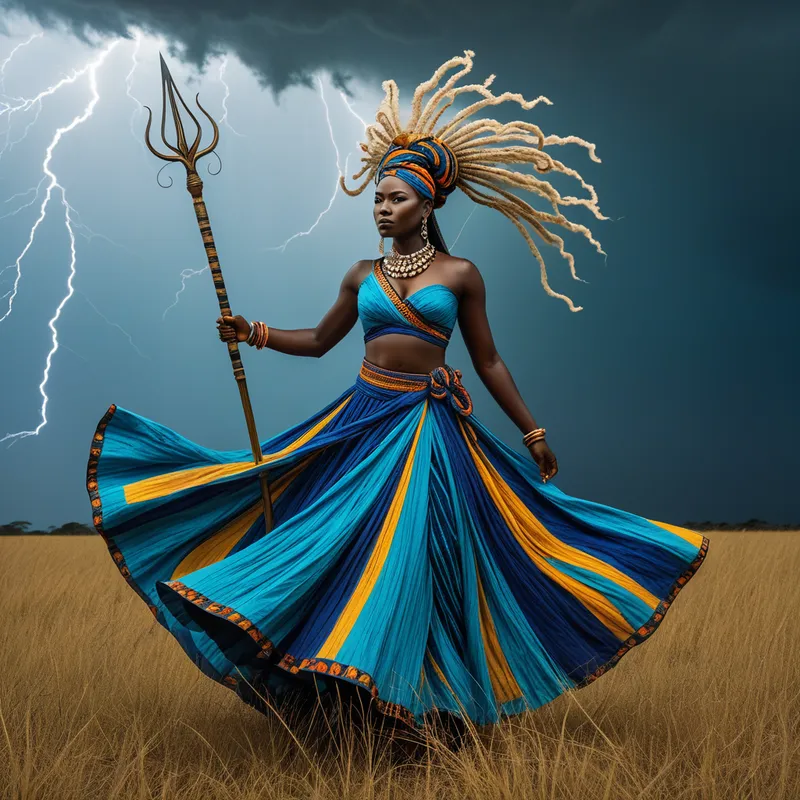
The Yoruba goddess Oya wields nine skirts, each a tempest of change, commanding the winds of life, death, and radical transformation.
The Tale of Oya’s Nine Skirts
Listen. The air is still. The world holds its breath. This is the moment before the storm, the silence that speaks of a coming roar. In this silence, she arrives.
She is Oya, and she walks the boundary between the marketplace and the wilderness, between life and the Irunmole. She is wife to Shango, but her power is her own, forged in the heart of the whirlwind. On this day, a great stillness has fallen over the land, a stagnation that threatens to choke the roots of life itself. The rivers run slow, the thoughts of the people grow thick and heavy, and the path to the ancestors feels overgrown.
Oya feels this stagnation like a weight. She goes to the sacred forge of her being, a place where the four winds meet. There, she does not take up a hammer or anvil. Instead, she gathers the essence of change itself. From the breath of the east that brings new beginnings, she weaves a skirt of pale, hopeful cloth. From the searing heat of the west, the wind of endings, she weaves a skirt of sun-bleached hide. From the fertile rains of the south and the cold mysteries of the north, she weaves more. She weaves with the dust of graves and the pollen of newborn flowers, with the silt of the great river and the ash of lightning-struck trees.
She weaves not one, but nine.
When she ties the first around her waist, a breeze stirs, rustling the dry grass. With the second, the leaves begin to tremble. With the third and the fourth, the wind picks up, singing a low note. By the fifth and sixth, her skirts are no longer mere cloth; they are living elements, swirling like nascent tornadoes, crackling with the promise of lightning. The seventh skirt brings the smell of ozone and the distant rumble that is not yet thunder. The eighth darkens the sun.
She ties the ninth.
And she begins to dance.
It is not a gentle dance. It is the dance of unraveling and re-knitting the world. Her nine skirts become a maelstrom of color and force. They are the nine winds of transformation: the wind that scatters seeds, the wind that fans flames, the wind that carries away the dead, the wind that brings the storm that cleanses. The stagnation shatters. Trees bend. The river churns, finding its course anew. The heavy air is torn apart, replaced by a wild, electric vitality.
In her wake, nothing is as it was. Some things are destroyed, laid bare. Other things, long buried, are revealed. The path to the ancestors is swept clean. The people, hiding in their homes, feel their own inner stagnations stirred, their old griefs and stuck desires lifted and whirled away into the vast, clarifying sky. Oya does not ask permission. She acts. Her dance is the revolution of necessity, and her nine skirts are the instruments of that sacred, terrifying change.
Cultural Origins & Context
This myth originates from the Yoruba people, whose rich spiritual system of Orisha worship forms a complex cosmology. Oya, known as Iansã, is one of its most powerful and revered deities. Her stories were not written in books but carried in the oral tradition, passed down by Babalawos and Iyalorishas during rituals, festivals, and rites of passage.
The myth of the nine skirts served multiple societal functions. It was an etiological narrative explaining the sudden, violent storms of the West African climate, attributing them to a divine, conscious force rather than random chaos. More profoundly, it was a teaching story about the necessity of disruption within the natural and social order. It validated experiences of sudden loss, radical change, and the clearing away of the old to make way for the new. Oya’s domain includes the marketplace (economic and social change), the cemetery (transition to the afterlife), and the river (constant flow and boundary-crossing), making her a goddess deeply embedded in the practical and spiritual realities of life, death, and commerce.
Symbolic Architecture
The nine skirts are the central, [multi](/symbols/multi “Symbol: Multi signifies multiplicity and diversity, often representing various aspects of life or identity in dreams.”/)-layered [symbol](/symbols/symbol “Symbol: A symbol can represent an idea, concept, or belief, serving as a powerful tool for communication and understanding.”/). They represent the totality of transformative power. Nine, in many traditions, is the [number](/symbols/number “Symbol: Numbers in dreams often symbolize meaning, balance, and the quest for understanding in the dreamer’s life, reflecting their mental state or concerns.”/) of completion and [gestation](/symbols/gestation “Symbol: A period of development and preparation before a significant birth or emergence, symbolizing potential, transformation, and the journey toward manifestation.”/) (three times the holy trinity). Oya’s nine skirts are the full [spectrum](/symbols/spectrum “Symbol: A continuum of possibilities, representing diversity, transition, and the full range of existence from one extreme to another.”/) of change, from the gentlest [breeze](/symbols/breeze “Symbol: A breeze often symbolizes change, freedom, and the fleeting nature of life.”/) of a new [idea](/symbols/idea “Symbol: An ‘Idea’ represents a spark of creativity, innovation, or realization, often emerging as a solution to a problem or a new outlook on life.”/) to the cataclysmic [hurricane](/symbols/hurricane “Symbol: A hurricane symbolizes overwhelming chaos, transformation, and the inevitable forces of nature impacting one’s life.”/) that remakes the [landscape](/symbols/landscape “Symbol: Landscapes in dreams are powerful symbols representing the dreamer’s emotional state, personal journey, and the broader context of life situations.”/).
The psyche, like the weather, requires storms. Without them, the atmosphere becomes toxic, and growth ceases. Oya’s skirts are the psyche’s own capacity for necessary violence.
Each [skirt](/symbols/skirt “Symbol: Skirts can symbolize femininity, identity, and societal roles regarding gender expression.”/) can be seen as a specific “wind” or force: the wind of speech and communication, the wind of sudden [opportunity](/symbols/opportunity “Symbol: The symbol ‘opportunity’ signifies potential for advancement, growth, and new beginnings in various life aspects.”/), the wind of erotic [passion](/symbols/passion “Symbol: Intense emotional or physical desire, often linked to love, creativity, or purpose. Represents life force and deep engagement.”/), the wind of [grief](/symbols/grief “Symbol: A profound emotional response to loss, often manifesting as deep sorrow, yearning, and a sense of emptiness.”/) that sweeps all before it, the wind of ancestral messages, the wind of revolutionary [action](/symbols/action “Symbol: Action in dreams represents the drive for agency, motivation, and the ability to take control of situations in waking life.”/), the wind of [death](/symbols/death “Symbol: Symbolizes transformation, endings, and new beginnings; often associated with fear of the unknown.”/), the wind of spiritual awakening, and the wind of [rebirth](/symbols/rebirth “Symbol: A profound transformation where old aspects of self or life die, making way for new beginnings, growth, and renewal.”/). Together, they make Oya the sovereign of the in-between spaces—the [doorway](/symbols/doorway “Symbol: A doorway signifies transition, opportunities for new beginnings, and the choice to walk through into the unknown.”/) (Elegun), the threshold, the [moment](/symbols/moment “Symbol: The symbol of a ‘moment’ embodies the significance of transient experiences that encapsulate emotional depth or pivotal transformations in life.”/) of pivot where one [reality](/symbols/reality “Symbol: Reality signifies the state of existence and perception, often reflecting one’s understanding of truth and life experiences.”/) ends and another begins. Her power is not creation ex nihilo, like [Obatala](/myths/obatala “Myth from Yoruba culture.”/), nor is it the structured justice of Shango’s [thunder](/symbols/thunder “Symbol: A powerful natural sound symbolizing divine communication, sudden change, or emotional release in arts and music contexts.”/). It is the power of transition itself, chaotic, unpredictable, and utterly essential.
The Dreamer’s Resonance
When this myth appears in modern dreams, it rarely comes as a literal image of a goddess. It manifests as the sensation of the nine winds. One might dream of a house with nine rooms, each filled with a different, overwhelming atmosphere—one of unbearable pressure, one of exhilarating speed, one of mournful sighs. The dreamer may be trying to close the doors to these rooms, only to find the winds tearing through the walls.
Somatically, this points to a psychological process where long-held structures—beliefs, emotional patterns, life situations—have become stagnant. The body feels heavy, stuck, or anxious with pent-up energy. The psyche is initiating its own Oya-storm. Dreaming of tornadoes, of all the windows in one’s home suddenly blowing open, or of being caught in a wild, unstoppable dance are all manifestations of this archetypal energy breaking through. It is the unconscious announcing, “The period of stillness is over. A transformation, which may feel destructive, is now non-negotiable.” The process is one of emotional and psychic deconstruction.

Alchemical Translation
For the modern individual, the alchemical journey modeled by Oya is the Nigredo—the blackening, the dissolution—not as a failure, but as the crucial first step of transmutation. Individuation requires the death of outmoded selves. We often try to control this process, to make our growth orderly and polite. Oya’s myth teaches that some aspects of the psyche must be stormed.
To claim sovereignty over one’s life, one must first grant sovereignty to the inner forces of chaos that clear the ground.
The “nine skirts” become the nine layers of identity or circumstance we must allow to be stirred, tested, and potentially torn. The professional identity (skirt one), the familial role (skirt two), the buried trauma (skirt three), the secret ambition (skirt four), and so on. The alchemical work is to, like Oya, consciously “don” these skirts—to acknowledge and engage with these aspects of self—and then to dance. This is the active surrender to one’s own transformative process. It is not a dance of grace, but of power and release. The goal is not to survive the storm unscathed, but to become the eye of the storm: the calm, sovereign center from which the necessary winds of change are wielded with conscious intent, clearing the path to one’s own deepest truths and potential.
Associated Symbols
Explore related symbols from the CaleaDream lexicon:
- Wind — The primary medium of Oya’s power, representing change, communication, invisible force, and the breath of spirit that can either caress or devastate.
- River — Oya is mistress of the Niger River, symbolizing her domain over boundaries, constant flow, transition, and the powerful, carving force of persistent change.
- Lightning — The sudden, illuminating flash of truth and disruptive energy that Oya commands, cutting through darkness and ignorance in an instant.
- Door — Oya guards the gateway between the worlds of the living and the ancestors, embodying the threshold moments of life, death, and profound opportunity.
- Storm — The holistic manifestation of Oya’s energy, representing chaotic but purposeful upheaval, emotional catharsis, and the cleansing power of disruption.
- Dance — Oya’s transformative movement; the active, embodied surrender to and channeling of powerful forces, turning chaos into a sacred act.
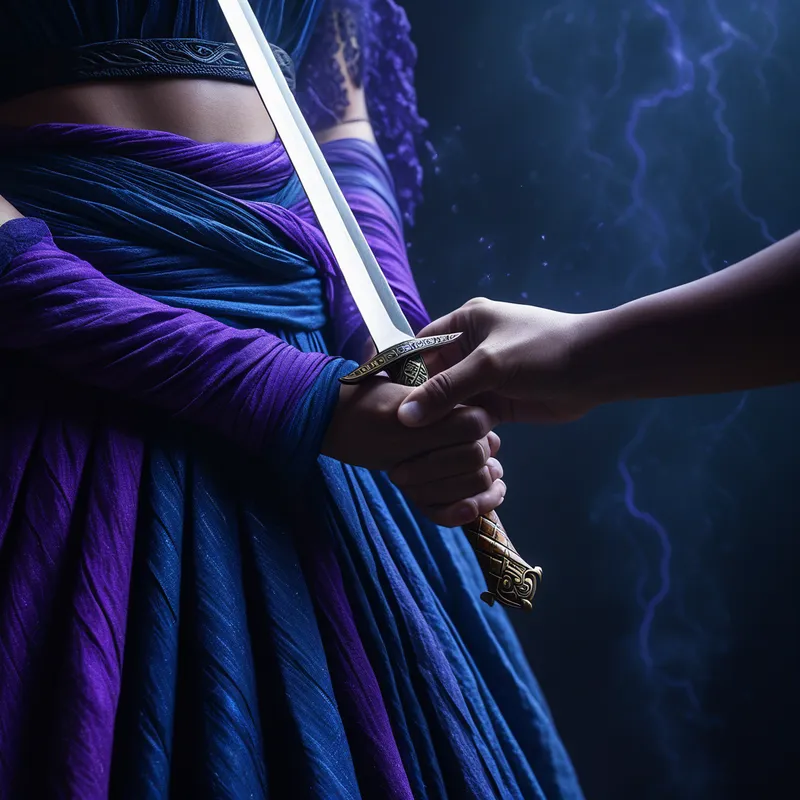
- Sword — Oya’s tool of decisive action and cutting away, representing the sharp discernment and sometimes violent severance required for true growth.
- Fire — An element shared with her consort Shango, but Oya’s fire is the wildfire spread by the wind, symbolizing rapid transformation, passion, and destructive renewal.
- Death — A core aspect of Oya’s domain, not as an end, but as the essential transition and clearing away that makes all rebirth possible.
- Rebirth — The inevitable consequence of Oya’s storm; the new life, clarity, and opportunity that emerges only after the old structures have been swept away.
- Chaos — The raw, unstructured state from which new orders are born, directly embodied by Oya as a sacred and necessary divine force.
- Marketplace — Oya’s social domain, symbolizing exchange, communication, the whirl of human activity, and sudden shifts in fortune or opportunity.