
Oya River Spirit Myth Meaning & Symbolism
A Yoruba orisha of tempests and rivers, Oya embodies the fierce, transformative power of change, sweeping away the old to clear space for the new.
The Tale of Oya River Spirit
Listen, and let the wind carry the tale. In the time when the world was still speaking directly to the gods, there flowed the great River Niger. But it was more than water; it was the breath and blood of the land, and its spirit was Oya.
She was not a gentle stream, but the tempest in liquid form. Her voice was the thunder that cracks the sky; her dance, the tornado that reshapes the earth. She was the consort of Shango, the fiery king, and together they were the drumbeat and the whirlwind. Yet Oya’s power was her own, drawn from a deeper, older source than even fire.
The story is told of a great stagnation that fell upon a kingdom by the river. The waters grew thick and slow, the people complacent, and the rulers corrupt, believing their order was eternal. The air itself grew heavy with silence. Into this stillness, Oya came not as a gentle rain, but as a question posed by a hurricane.
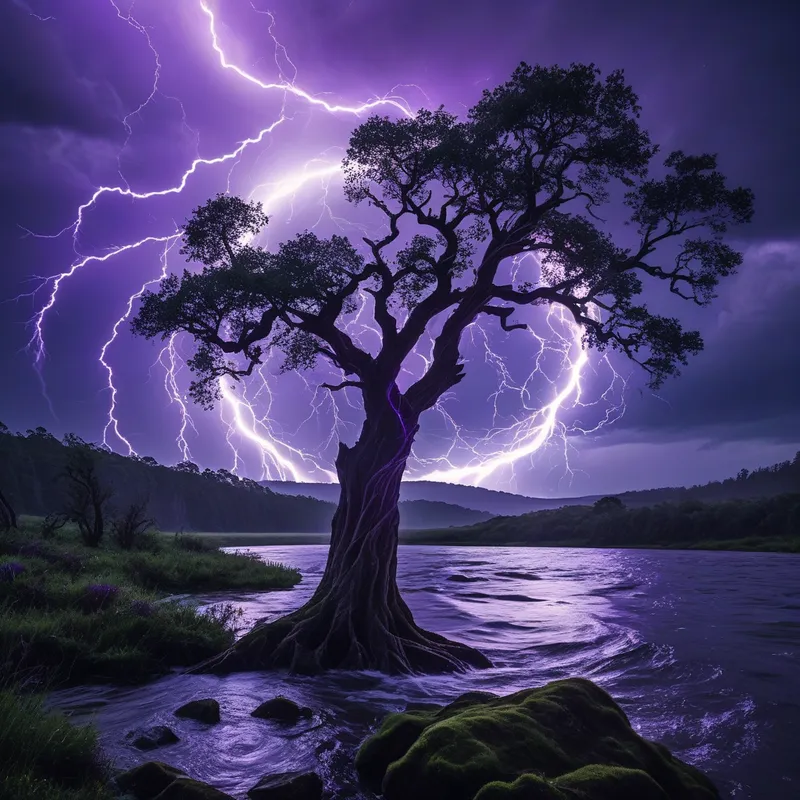
She rose from her riverbed, and the sky darkened as her skirts. She did not argue; she demonstrated. With a breath, she became the wind that tore the roofs from the granaries hoarded by the greedy. With a gesture, her river swelled, not to drown, but to cleanse—rushing through the clogged channels of the city, sweeping the debris of decay into a churning, fertile chaos. The people clung to the shaking earth, witnessing not destruction, but a terrifying, necessary truth: that which does not flow, putrefies.
In her wake, under a sky washed clean by rain, the riverbanks were left bare, muddy, and open. The old, rotten structures were gone. There was grief for what was lost, yes, but also a profound, trembling silence filled with potential. The river flowed again, swift and clear. Oya, having executed her fierce ministry, receded into the flow, leaving behind the scent of ozone and damp earth—the smell of a world made possible again.
Cultural Origins & Context
This powerful narrative emanates from the spiritual cosmology of the Yoruba people. Oya (also known as Oya-Iyansan, “Mother of Nine”) is one of the primary Orishas, a complex pantheon of divine forces that govern aspects of the natural world and human experience. Her domain is explicitly transformative: she is the spirit of the wind, sudden storms, lightning, and, significantly, the River Niger. This association ties her to both immense, unpredictable power and the essential, life-giving flow of water.
Her myths were not written but lived, passed down through sacred oral tradition by priests, priestesses (Iyalorishas and Babalorishas), and griots. They were performed in ritual, dance, and song, particularly during festivals meant to honor her and appease her mighty aspects. Societally, Oya served as a crucial metaphysical concept. She modeled the necessity of radical change, the fact that growth often requires a violent clearing. She was invoked not for gentle comfort, but for the courage to face necessary endings, to navigate the chaos of loss, and to find the fertility hidden within disaster.
Symbolic Architecture
Oya is the archetypal principle of cataclysmic change as a precursor to creation. She is not merely a [destroyer](/symbols/destroyer “Symbol: A figure or force representing radical change through dismantling existing structures, often evoking fear and awe.”/); she is the [space](/symbols/space “Symbol: Dreaming of ‘Space’ often symbolizes the vastness of potential, personal freedom, or feelings of isolation and exploration in one’s life.”/)-maker. Her symbols form a potent [triad](/symbols/triad “Symbol: A grouping of three representing spiritual unity, divine completeness, and cosmic balance across many traditions.”/):
- The [River](/symbols/river “Symbol: A river often symbolizes the flow of emotions, the passage of time, and life’s journey, reflecting transitions and movement in one’s life.”/): It represents the flow of [life](/symbols/life “Symbol: The symbol of ‘Life’ represents a journey of growth, interconnectedness, and existential meaning, encompassing both the joys and challenges that define human experience.”/), time, and psychic [energy](/symbols/energy “Symbol: Energy symbolizes vitality, motivation, and the drive that fuels actions and ambitions.”/). A healthy [river](/symbols/river “Symbol: A river often symbolizes the flow of emotions, the passage of time, and life’s journey, reflecting transitions and movement in one’s life.”/) moves, cleanses, and nourishes. When blocked—by the [silt](/symbols/silt “Symbol: Fine sediment deposited by water, representing accumulation, hidden foundations, and the fertile residue of time’s passage.”/) of stagnation, the dam of repression, or the [debris](/symbols/debris “Symbol: Fragments of what was once whole, representing destruction, aftermath, and the remnants of past structures or experiences.”/) of outworn beliefs—it becomes toxic. Oya’s flooding is the psyche’s own drastic corrective measure.
- The Wind/Storm: This is the sudden, disruptive force of [insight](/symbols/insight “Symbol: A sudden, deep understanding of a complex situation or truth, often arriving unexpectedly and illuminating hidden connections.”/), [revolution](/symbols/revolution “Symbol: A fundamental, often violent transformation of social, political, or personal structures, representing upheaval, liberation, and the overthrow of established order.”/), or [fate](/symbols/fate “Symbol: Fate represents the belief in predetermined outcomes, suggesting that some aspects of life are beyond human control.”/) that enters a stagnant [system](/symbols/system “Symbol: A system represents structure, organization, and interrelated components functioning together, often reflecting personal or social order.”/). It is unpredictable, uncontrollable, and scatters existing structures. Psychologically, it is the emotional gale that finally breaks through intellectualized defenses.
- The [Cemetery](/symbols/cemetery “Symbol: A cemetery symbolizes mortality, memory, and the reflection on life and death, often representing a place of emotional release and contemplation.”/): Oya is famously linked to the [realm](/symbols/realm “Symbol: The symbol of ‘Realm’ often signifies the boundaries of one’s consciousness, experiences, or emotional states, suggesting aspects of reality that are either explored or ignored.”/) of the ancestors and the dead. This connects her transformation to the most fundamental of all changes: [death](/symbols/death “Symbol: Symbolizes transformation, endings, and new beginnings; often associated with fear of the unknown.”/) itself. She governs the [gateway](/symbols/gateway “Symbol: A threshold between states, representing transition, opportunity, or initiation into new phases of life or consciousness.”/), teaching that true [rebirth](/symbols/rebirth “Symbol: A profound transformation where old aspects of self or life die, making way for new beginnings, growth, and renewal.”/) requires a conscious [relationship](/symbols/relationship “Symbol: A representation of connections we have with others in our lives, often reflecting our emotional state.”/) with what must end.
To stand in Oya’s storm is to consent to the dissolution of the familiar self. Her gift is not safety, but authenticity, purchased at the price of everything you thought you were.
Her mythology refuses to sanitize transformation. It acknowledges the [terror](/symbols/terror “Symbol: An overwhelming, primal fear that paralyzes and signals extreme threat, often linked to survival instincts or deep psychological trauma.”/), the [loss](/symbols/loss “Symbol: Loss often symbolizes change, grief, and transformation in dreams, representing the emotional or psychological detachment from something or someone significant.”/), and the sheer violence of psychic rebirth. She is the embodiment of the [truth](/symbols/truth “Symbol: Truth represents authenticity, honesty, and the quest for knowledge beyond mere appearances.”/) that we cannot gently reason our way out of a [prison](/symbols/prison “Symbol: Prison in dreams typically represents feelings of restriction, confinement, or a lack of freedom in one’s life or mind.”/) we’ve built over a lifetime; sometimes, the walls must be torn down by a storm.

The Dreamer’s Resonance
When Oya’s pattern stirs in the modern dreamscape, it signals a profound somatic and psychological upheaval. The dreamer is not tweaking their life; they are being reconfigured by it.
Dreams may feature violent weather—being caught in a tornado, witnessing a lightning strike on one’s home, or watching a familiar landscape be flooded. The dreamer might find themselves at the edge of a raging river, needing to cross but fearing the current. The somatic experience upon waking is key: a racing heart, a feeling of electrified anxiety, or a deep, trembling exhaustion, as if one has physically weathered a gale.
Psychologically, this indicates that a long-avoided change has moved from the realm of thought to the realm of embodied necessity. The ego’s carefully maintained structures—a job, a relationship, a self-image—are being challenged at the root level by the Self (the total, unconscious psyche). The chaos in the dream mirrors the chaos of new psychic contents breaking into consciousness. The dreamer is in Oya’s current, and the process is one of terrifying disorientation, where old landmarks are swept away before new ones have formed.

Alchemical Translation
For the individual on the path of individuation, Oya’s myth models the nigredo, the blackening, the crucial stage of dissolution. Modern life prizes stability and control, yet the psyche’s journey toward wholeness demands the opposite at key junctures: a surrender to destabilization.
The alchemical work here is to transmute passive suffering into active surrender. The flood is coming regardless. The Oya-process asks: Can you recognize the floodwaters not as a punishment, but as a brutal form of grace? Can you release your grip on the crumbling riverbank of your old identity? This is the rebellion against the inner tyrant that insists on “how things have always been.”
The spirit of the river does not ask if you are ready. It asks if you are alive enough to be reshaped by the current.
The triumph in Oya’s myth is not a victory in battle, but the emergence of a cleared space. After the storm passes, the work of rebuilding begins, but now on a fresh, fertile foundation, watered by the tears of the ordeal itself. The individual who integrates this archetype does not become the storm, but gains its qualities: the courage to face necessary endings, the resilience to stand in chaos, and the profound knowledge that on the other side of dissolution lies the only ground authentic enough to build a true life upon.
Associated Symbols
Explore related symbols from the CaleaDream lexicon:
- River — The central life-flow of the myth, representing time, change, and the psychic energy that must keep moving or become stagnant and toxic.
- Spirit — Oya as the conscious, powerful intelligence within the natural force, a deity who governs transformation rather than being a mindless element.
- Lightning — The sudden, illuminating, and destructive flash of insight or fate that Oya wields, capable of shattering old structures in an instant.
- Chaos — The fertile, terrifying state Oya creates, which is not mere disorder but the necessary dissolution of a rigid, outworn order.
- Rebirth — The ultimate promise of Oya’s destruction; the new life and potential that can only emerge from the cleared ground after the storm.
- Death — Oya’s intimate connection to the cemetery and ancestors symbolizes the non-negotiable death of a phase, an identity, or a way of being that precedes renewal.
- Threshold — Oya herself is a gateway or doorway between states of being, between life and death, stagnation and flow, the old world and the new.
- Wind — Her breath and her movement, representing change that is invisible, powerful, and can arrive from any direction without warning.
- Bridge — The dangerous but necessary crossing over the raging waters of transformation that Oya’s myth necessitates.
- Shadow — The disowned, fierce, and chaotic aspects of the self that Oya forces into consciousness through her disruptive power.
- Goddess — Oya as a specific, powerful divine feminine force who commands respect and awe, governing a domain of raw, transformative power.
- Raging River Flood — The specific, activated manifestation of Oya’s power, depicting transformation not as a trickle but as an overwhelming, cleansing deluge.