Oya and the Buffalo Skin
A Yoruba myth where the goddess Oya gains control over winds and storms through a powerful buffalo skin, revealing themes of transformation and elemental power.
The Tale of Oya and the Buffalo Skin
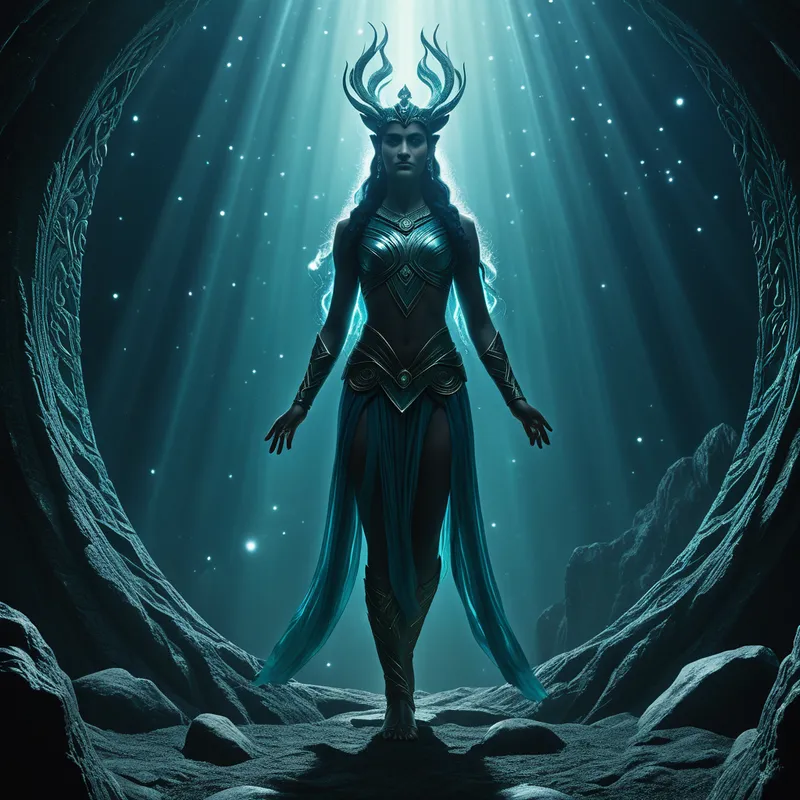
The winds that scour the savannah, that lift the dust into spiraling columns and tear the thatch from roofs, were once wild, orphaned things. They answered to no one, capricious and destructive. Oya, warrior spirit, wife to the king of the gods, [Shango](/myths/shango “Myth from African Diaspora culture.”/), watched their [chaos](/myths/chaos “Myth from Greek culture.”/). In her heart, a tempest of her own yearned to meet them, not to battle, but to converse, to direct their furious energy with purpose. She knew that untamed power is merely chaos; focused, it becomes a force of change, of necessary destruction that clears [the way](/myths/the-way “Myth from Taoist culture.”/) for new growth.
Her quest led her to the edge of the known world, to a place where [the earth](/myths/the-earth “Myth from Hindu culture.”/) trembled with a different kind of thunder. Here dwelled the Buffalo, a primordial embodiment of raw, unstoppable strength. Its hide was not mere flesh and hair; it was a tapestry of condensed earth-power, a living shield against all force. To approach the Buffalo was to court annihilation. But Oya, whose essence is the sudden, transformative strike—the lightning flash and the tornado’s funnel—did not approach as a supplicant. She engaged the beast in a contest of wills, a dance of power that shook the plains. It was not a battle of brute force against brute force, but of cunning, elemental spirit against ancient, grounded might. In a moment of supreme focus, channeling the very lightning she would later command, Oya prevailed.
The Buffalo fell, but its power did not dissipate. Oya, with reverence for the spirit she had overcome, performed the sacred act of transformation. She carefully removed its hide, this dense, potent skin. She did not wear it immediately as a trophy, but prepared it, stretching and treating it through rites known only to the Orisha. When the work was complete, the skin was no longer a heavy pelt. It had become a vessel, a conduit.
The first time she draped the buffalo skin over her shoulders, [the world](/myths/the-world “Myth from Tarot culture.”/) shifted. The wild, shrieking winds that had ignored all calls suddenly stilled, sensing a new authority. The skin hummed with a low, resonant frequency. Oya breathed in, and the winds breathed with her. She gestured, and they gathered, no longer orphans but a legion. She spun, and the skin flared, whipping the air into a roaring cyclone. The Buffalo’s grounded, earthy strength had been alchemized into sovereignty over the air itself. The skin gave her not just command, but kinship; she could hear the storm’s voice, feel the pressure drop in her own bones. The destructive gale and the life-giving rain became extensions of her will. She had not stolen power; she had transmuted one form of elemental might into another, becoming the goddess of the cemetery gates, of radical change, of the storm that clears the air.
Cultural Origins & Context
Oya (also called Oya-Iyansan, “mother of nine”) is a central and complex deity in the Yoruba [pantheon](/myths/pantheon “Myth from Roman culture.”/) and its diasporic traditions, such as Santería and Candomblé. Her domain is vast and potent: she is the ruler of winds, storms, lightning, and the marketplace. She guards the gateway between the living and the dead, presiding over cemeteries. This association with transitions—of weather, of commerce, of spirit—marks her as a goddess of profound change.
The myth of the buffalo skin is foundational to her identity as Iyá Ọ̀fà (Mother of the Winds). In the cosmology, raw elemental forces often exist in the world before being mastered by an Orisha, who then brings them into the service of cosmic order (àṣẹ). Oya’s act is one of civilization in the deepest sense: she domesticates the chaotic, integrating a terrifying natural force into the divine hierarchy. The buffalo itself is a symbol of immense, dangerous, and fertile power in West African lore. By mastering it, Oya demonstrates that true authority involves engaging with the most formidable aspects of reality, not avoiding them. Her story is often told alongside those of her husband Shango (thunder, [justice](/myths/justice “Myth from Tarot culture.”/)) and her sister Oshun (river, love), forming a triad of powerful, complementary feminine and masculine energies.
Symbolic Architecture
The myth presents a profound psychological and spiritual [blueprint](/symbols/blueprint “Symbol: A blueprint represents the foundational plan or design for something, often symbolizing potential, structure, and the mapping of one’s inner self or future.”/) for the acquisition and [integration](/symbols/integration “Symbol: The process of unifying disparate parts of the self or experience into a cohesive whole, often representing psychological wholeness or resolution of internal conflict.”/) of authentic power.
The buffalo skin is the ultimate symbol of transmuted strength. It represents the process by which raw, undifferentiated, and potentially overwhelming life force (the buffalo’s brute power) is encountered, overcome, and consciously transformed into a skilled, directed capability (mastery of wind). The power does not disappear; it changes form, becoming more subtle, more far-reaching, and more aligned with conscious purpose.
Oya’s journey illustrates that power is not taken, but transformed. She does not simply kill the buffalo and claim dominion. The ritual preparation of the hide is crucial. It signifies the necessary period of integration, where a victorious but traumatic encounter with a powerful force must be digested, worked, and refined before it can become a true part of the self. To skip this stage is to risk being possessed by the very power one seeks to wield.
The winds themselves symbolize the volatile, unseen emotional and psychic energies that swirl through [life](/symbols/life “Symbol: The symbol of ‘Life’ represents a journey of growth, interconnectedness, and existential meaning, encompassing both the joys and challenges that define human experience.”/)—passions, inspirations, and destructive impulses. Oya, with her [skin](/symbols/skin “Symbol: Skin symbolizes the boundary between the self and the world, representing identity, protection, and vulnerability.”/), becomes the conscious ego that can, through [connection](/symbols/connection “Symbol: Connection symbolizes relationships, communication, and bonds among individuals.”/) to a deeper, grounded [strength](/symbols/strength “Symbol: ‘Strength’ symbolizes resilience, courage, and the ability to overcome challenges.”/) (the [skin](/symbols/skin “Symbol: Skin symbolizes the boundary between the self and the world, representing identity, protection, and vulnerability.”/)), finally give shape and [direction](/symbols/direction “Symbol: Direction in dreams often relates to life choices, guidance, and the path one is following, emphasizing the importance of navigation in personal journeys.”/) to that inner [chaos](/symbols/chaos “Symbol: In Arts & Music, chaos represents raw creative potential, uncontrolled expression, and the breakdown of order to forge new artistic forms.”/). She is the [archetype](/symbols/archetype “Symbol: A universal, primordial pattern or prototype in the collective unconscious that shapes human experience, behavior, and creative expression.”/) of the Magician, not as a [trickster](/symbols/trickster “Symbol: A boundary-crossing archetype representing chaos, transformation, and the subversion of norms through cunning and humor.”/), but as one who understands and operates the fundamental laws of transformation.
The Dreamer’s Resonance
To dream of Oya, or of a buffalo skin in a storm, is to dream of a critical juncture in one’s inner life. Psychologically, it speaks to the moment when an individual confronts a deep, instinctual, and perhaps frightening source of personal power—a buried rage, a formidable talent, a potent grief, or a wild creativity. This power often first appears as an obstacle or a threat (the charging buffalo), something that seems intent on trampling the conscious personality.
The dream may be urging the dreamer to engage, not flee. The victory is not about annihilation, but about a transformative encounter. The subsequent “wearing of the skin” in life translates to finding a way to carry that integrated power gracefully. It might manifest as a newfound ability to channel fiery anger into assertive boundary-setting, or to transform paralyzing grief into compassionate depth, or to give articulate form to previously chaotic creative impulses. The dream warns, however, that this skin is not an ornament; it is a responsibility. It connects one to fierce, life-altering energies.
Alchemical Translation
The alchemical process here is [Nigredo-Albedo-Rubedo](/myths/nigredo-albedo-rubedo “Myth from Alchemical culture.”/), the blackening, whitening, and reddening, applied to the soul’s substance.
The confrontation with the Buffalo is the Nigredo, the blackening. It is the dark, chaotic, and terrifying encounter with the unintegrated shadow, the prima materia of the psyche. It feels like annihilation, a descent into the brutal facts of one’s own nature.
The preparation and wearing of the skin is the Albedo, the whitening. This is the purification and spiritualization of that raw material. The dense, earthy hide (the problem, the trauma, the instinct) is stretched, treated, and made into a tool of perception and command. The ego consciously works with the contents of the unconscious, refining them.
The command of the winds is the Rubedo, the reddening. This is the culmination, where the transformed substance returns to the world in a new, potent, and life-giving form. The integrated power is now active, creative, and sovereign. The individual operates not from ego alone, but from a place of unified consciousness, able to navigate and influence the emotional and spiritual atmospheres of their life with mastery. Oya becomes the fully realized Magician, whose will is in harmony with the fundamental forces of change.
Associated Symbols
Explore related symbols from the CaleaDream lexicon:
- Skin — The ultimate boundary and organ of sensation, representing identity, vulnerability, and the surface where inner transformation becomes visible to the outer world.
- Buffalo — An emblem of primordial strength, grounded power, unstoppable momentum, and a connection to the raw, fertile forces of the earth.
- Transformation — The core process of alchemical change, where the essence of a [thing](/myths/thing “Myth from Norse culture.”/) is not destroyed but radically altered in form and function.
- Storm — A symbol of tumultuous emotional or psychic upheaval, necessary destruction, the clearing of old patterns, and the awesome, uncontrollable power of nature.
- Wind — The invisible force of spirit, breath, inspiration, change, and the unseen currents that direct fate and emotion.
- Lightning — Sudden, illuminating insight, divine strike, instantaneous transformation, and the flash of truth that cuts through obscurity.
- Gateway — [The threshold](/myths/the-threshold “Myth from Folklore culture.”/) between states of being, consciousness, or worlds; a point of decisive transition and guarded passage.
- Power — The innate capacity for action and influence, which must be integrated and directed to move from potential to skillful manifestation.
- Shadow — The unconscious, often rejected aspects of [the self](/myths/the-self “Myth from Jungian culture.”/) that hold immense power and must be confronted for wholeness.
- Ritual — The structured, conscious act that facilitates transformation, marking the transition of a substance or a soul from one state to another.