
Oxossi Hunter God Brazil Myth Meaning & Symbolism
The myth of Oxossi, the divine hunter of the forest, embodies the sacred quest for sustenance, knowledge, and the elusive truth of one's own soul.
The Tale of Oxossi Hunter God Brazil
Listen. The world was a great, breathing forest, a tangle of green shadow and piercing light. Beneath the canopy, life teemed in a chorus of shrieks, rustles, and whispers. But there was a silence, too—a deep, listening silence that belonged to one alone: Oxossi.
His feet made no sound on the soft earth. His breath was the wind through the leaves. His eyes, sharp as the morning star, saw not just the parrot’s flash of color or the tapir’s heavy print, but the very thread of life that connected them all. He was the provider, the one who knew where the secret springs bubbled and where the sweetest fruits hung. With his bow of ironwood and his arrows fletched with owl feather, he sustained the village, his aim true, his heart clear.
But Oxossi hunted more than meat. He hunted knowledge. The forest held mysteries: the healing root that whispered to the shaman, the stone that remembered the first rain, the path that appeared only under the full moon. His greatest quarry was understanding itself. It is said he once pursued a stag of pure silver, a creature that was not flesh but spirit, that led him deeper into the woods than any mortal had gone. For seven days and seven nights, he followed, his body weary, his spirit alight. The trees grew taller, the light more diffuse, until he stood in a grove where the air hummed.
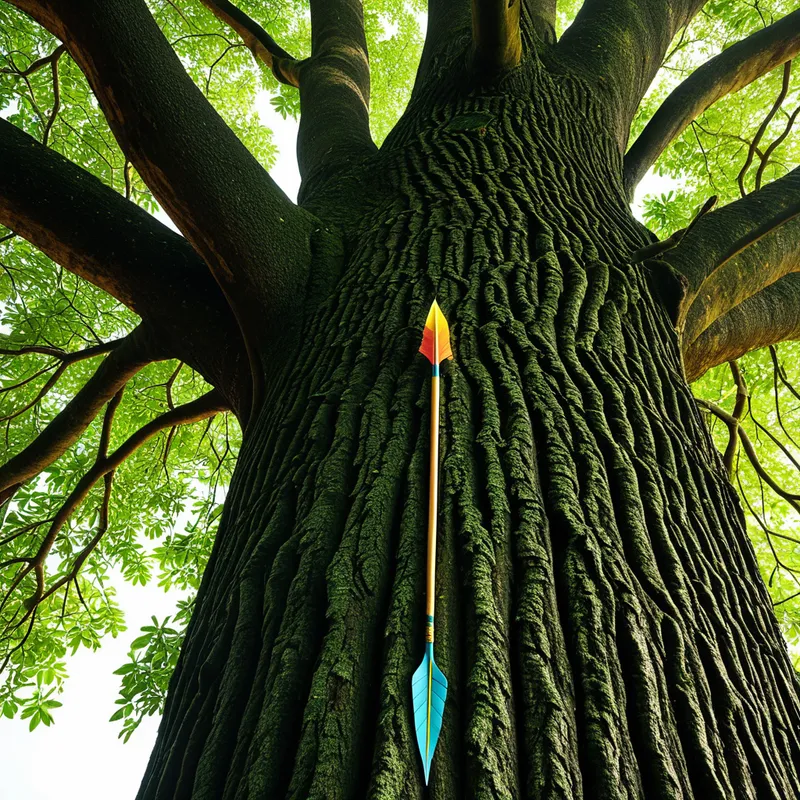
There was no stag. Instead, there stood a majestic gameleira tree, its roots deep in the underworld, its branches brushing the realm of the gods. And in its trunk, shimmering, was a single door. This was the heart of the forest, the boundary between the known and the unknowable. Oxossi did not shoot. He laid down his bow. He approached, placed his hand upon the living wood, and listened. The tree did not speak in words, but in visions—the history of the land, the songs of the ancestors, the patterns of destiny woven like vines.
He emerged not with a kill, but with a knowing. His arrows now carried not just the promise of sustenance, but the sharp point of insight. He became the hunter of truths, the finder of paths, the one who could navigate the wilderness of the human soul as easily as the physical jungle. When people were lost, in body or in spirit, they called to Oxossi. And if their hearts were true, he would send a sign—a sudden clearing, the call of a specific bird, the finding of a needed herb—an arrow of clarity shot straight into the confusion of their lives.
Cultural Origins & Context
The myth of Oxossi is a living root system stretching across the Atlantic. His origins lie with the Yoruba people of West Africa, where he is known as Ọṣọ́ọ̀si. In the brutal trauma of the transatlantic slave trade, this deity was carried in the hearts and memories of the enslaved to the shores of Brazil. There, in the senzalas (slave quarters) and quilombos (maroon communities), the myth took root in new soil—the vast, untamed Brazilian forests that mirrored yet differed from the African savannah.
This myth was not preserved in written texts but in the body: in the rhythms of the atabaque drums, in the intricate steps of ritual dance that mimicked the hunter’s stealthy tread, and in the oral narratives told under cover of night. Within the syncretic spiritual systems of Candomblé and Umbanda, Oxossi found a new home. He became a crucial archetype of survival and autonomy. For a people whose freedom and sustenance were violently controlled, the image of the independent, skilled hunter who provides for his community from the bounty of the land was profoundly empowering. He represented the ability to navigate hostile territory, to find nourishment where none seemed to exist, and to maintain a sacred connection to nature as a source of strength and wisdom.
Symbolic Architecture
Oxossi’s myth is a profound map of [consciousness](/symbols/consciousness “Symbol: Consciousness represents the state of awareness and perception, encompassing thoughts, feelings, and experiences.”/). The [Forest](/symbols/forest “Symbol: The forest symbolizes a complex domain of the unconscious mind, representing both mystery and potential for personal growth.”/) is the primary [symbol](/symbols/symbol “Symbol: A symbol can represent an idea, concept, or belief, serving as a powerful tool for communication and understanding.”/)—it is the wild, uncultivated psyche, dense with potential, [danger](/symbols/danger “Symbol: The symbol of ‘Danger’ often indicates a sense of threat or instability, calling for caution and awareness.”/), hidden resources, and forgotten truths. It is everything that exists outside the ordered “[village](/symbols/village “Symbol: Symbolizes community, connection, and a reflection of one’s roots or origins.”/)” of the ego.
The true hunt is never for the beast, but for the awareness that allows one to see the beast as part of a vast, interconnected whole.
The Bow represents focused [intention](/symbols/intention “Symbol: Intention represents the clarity of purpose and direction in one’s life and can symbolize motivation and commitment within a dream context.”/) and the [application](/symbols/application “Symbol: An application symbolizes engagement, integration of knowledge, or the pursuit of goals, often representing self-improvement and personal development.”/) of will. The [Arrow](/symbols/arrow “Symbol: An arrow often symbolizes direction, purpose, and the pursuit of goals, representing both the journey and the destination.”/) is the specific [quest](/symbols/quest “Symbol: A quest symbolizes a journey or search for purpose, fulfillment, or knowledge, often representing life’s challenges and adventures.”/), the pointed question, the act of consciousness that pierces through [confusion](/symbols/confusion “Symbol: A state of mental uncertainty or disorientation, often reflecting internal conflict, lack of clarity, or overwhelming choices in waking life.”/). Oxossi’s ultimate quarry is not external game but [Knowledge](/symbols/knowledge “Symbol: Knowledge symbolizes learning, understanding, and wisdom, embodying the acquisition of information and enlightenment.”/) itself. The silver stag is the luminous, elusive [truth](/symbols/truth “Symbol: Truth represents authenticity, honesty, and the quest for knowledge beyond mere appearances.”/) of the Self, which leads one deeper into the [interior](/symbols/interior “Symbol: The interior symbolizes one’s inner self, thoughts, and emotions, often reflecting personal growth, vulnerabilities, and secrets.”/) [wilderness](/symbols/wilderness “Symbol: Wilderness often symbolizes the untamed aspects of the self and the unconscious mind, representing a space for personal exploration and discovery.”/) only to transform at the threshold of understanding.
The gameleira [tree](/symbols/tree “Symbol: In dreams, the tree often symbolizes growth, stability, and the interconnectedness of life.”/) is the [Axis](/symbols/axis “Symbol: A central line or principle around which things revolve, representing stability, orientation, and the fundamental structure of reality or consciousness.”/) Mundi, the central pillar of the world that connects the earthly, the ancestral, and the divine. Oxossi’s [journey](/symbols/journey “Symbol: A journey in dreams typically signifies adventure, growth, or a significant life transition.”/) to it models the [individuation process](/symbols/individuation-process “Symbol: The psychological journey toward self-realization and wholeness, integrating conscious and unconscious aspects of personality.”/): leaving the collective (the village), navigating the personal unconscious (the forest), to confront the archetypal core of the psyche (the world [tree](/symbols/tree “Symbol: In dreams, the tree often symbolizes growth, stability, and the interconnectedness of life.”/)).
The Dreamer’s Resonance
When the archetype of Oxossi stirs in the modern dreamer, it often manifests as dreams of being in a dense, unfamiliar forest—a psychological thicket. One may dream of holding a bow, feeling its potential, but having no target, or of seeing a magnificent, elusive animal that always stays just out of sight. These are dreams of a nascent quest.
Somatically, this can feel like a restless energy, a “hunter’s tension”—a sense that something vital needs to be sought, tracked down, and integrated. It is the psyche’s signal that a period of passive reception is over; active seeking is required. The dreamer is being called to identify their “silver stag”: What knowledge do I lack? What truth am I avoiding? What sustenance does my spirit need that I am not providing? The anxiety in such dreams is the fear of being lost forever in the woods of one’s own complexities. The resolution comes when the dream-ego stops frantic chasing and begins to listen to the forest, to read its signs, transforming panic into focused pursuit.

Alchemical Translation
The alchemy of Oxossi is the transmutation of wandering into pilgrimage, of hunger into seeking, and of instinct into intuition. The modern individual often feels “lost in the woods” of life choices, career paths, or spiritual questions. The myth provides a model:
First, one must acknowledge the forest. Stop pretending you are in a safe, manicured garden. You are in the wilds of your own existence. This is the nigredo, the darkening.
Second, one must craft their bow: cultivate focus, discipline, and a clear intention. What is your central question? This is the defining of the quest.
Third, one must follow the trail, even when it seems to double back. This requires patience, resilience, and trust in one’s own senses—the development of an inner compass. This is the albedo, the whitening, where clues begin to shine in the darkness.
The climax is not a violent capture, but a sacred encounter at the world tree. It is the moment when the sought-after external goal (the job, the relationship, the status) reveals itself as a doorway to an internal revelation. You lay down your weapons of force and achieve your aim through receptivity and integration.
The arrow finds its mark when the archer realizes they are both the hunter and the hunted, the seeker and the sought.
Finally, one returns to the community—the integrated psyche—bearing the nourishment of hard-won wisdom. The cycle of the hunt is complete, only to begin again, at a deeper level. Oxossi teaches that life is not a static state of having arrived, but a perpetual, sacred hunt for deeper layers of truth and sustenance for the soul.
Associated Symbols
Explore related symbols from the CaleaDream lexicon:
- Forest — The vast, untamed wilderness of the unconscious mind and the unknown world, representing both the danger of being lost and the bounty of hidden knowledge.
- Bow — The focused will and intention of the seeker, the tool that translates desire into directed action on the sacred hunt.
- Arrow — The specific quest, question, or insight launched into the unknown, symbolizing purposeful direction and the piercing of illusions.
- Tree — The gameleira as the world axis, representing stability, deep-rooted wisdom, and the connection between earthly and spiritual realms.
- Knowledge — The ultimate quarry of the Oxossi archetype, the sustenance for the soul that is more vital than physical food.
- Journey — The core narrative of the myth, embodying the necessary passage through uncertainty to reach a place of revelation and return.
- Path — The trail forged or discovered by the hunter, representing destiny, choice, and the navigation of life’s complex terrain.
- Hunter’s Call — The inner summons to embark on a quest, the instinctual pull toward a destiny that must be actively pursued and claimed.
- Vision — The reward of the deep hunt, the gnosis received at the world tree, which provides a new map for understanding one’s life.
- Spirit — The animating force of the forest and the hunter, representing the connection to the invisible world and the true nature of the quest as a spiritual one.