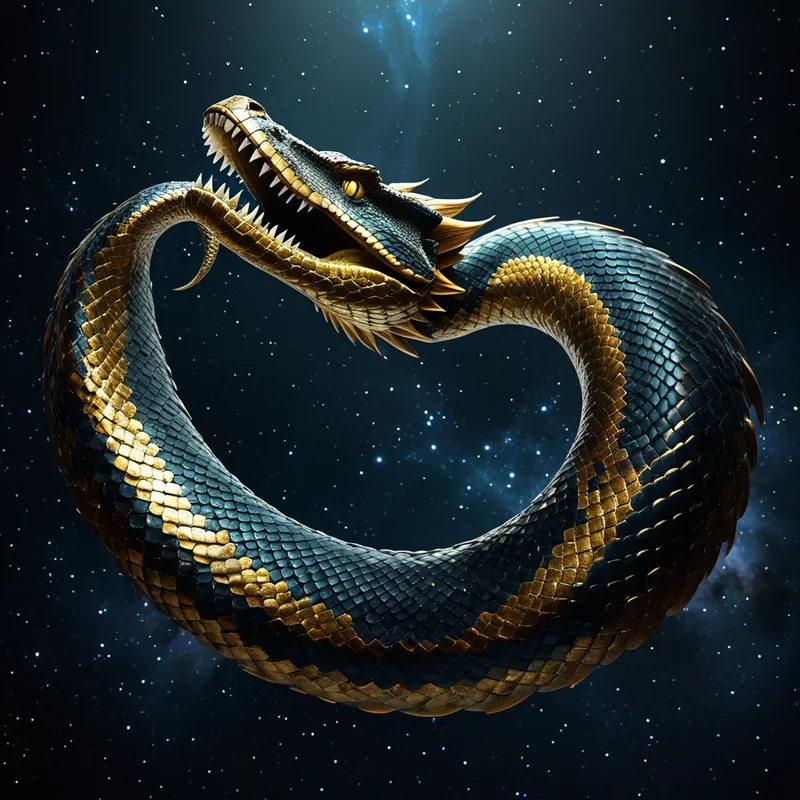
Ouroboros Myth Meaning & Symbolism
The ancient symbol of a serpent devouring its own tail, representing the cyclical nature of existence, self-sufficiency, and the eternal return.
The Tale of Ouroboros
In the time before time, in the silence before the first word was spoken, there existed only the great, unbroken dark. It was a dark not of emptiness, but of potential, thick and heavy as primordial clay. And within that clay, something stirred. Not a breath, not a thought, but a need—a need for form, for boundary, for a beginning to know itself.
From this need, it coiled. Not from nothing, but from the very substance of the dark, drawing itself forth. Scale by scale, it manifested: a serpent of impossible length, its skin the color of deep space dusted with star-shine, its eyes twin pools of liquid obsidian holding the reflection of everything and nothing. It moved, and its motion was the first law. It did not slither toward or away from anything, for there was nothing else. So, it turned inward.
With a grace that was both tender and absolute, it began to trace a circle in the void. Its head, bearing the wisdom of the unmanifest, sought its own tail, the anchor of its being. There was no conflict, only a profound and inevitable seeking. The air—now born from the friction of its passage—hummed with a single, low note, the fundamental tone of existence.
Its jaws opened, not in aggression, but in a gesture of ultimate recognition. It beheld its own tail, the end of itself, and knew it as the source. In that knowing was the completion of the circle. Gently, with the care of a creator for its creation, it took its tail into its mouth. The circle closed. The motion ceased, yet within that stillness, a new kind of motion was born: the perpetual, silent spin of self-containment. Light and dark, beginning and end, inhalation and exhalation—all found their balance in that perfect, self-devouring ring. It was the first act, and it was the final state. The world was not yet made, but the principle for all worlds was now set, turning forever upon itself.
Cultural Origins & Context
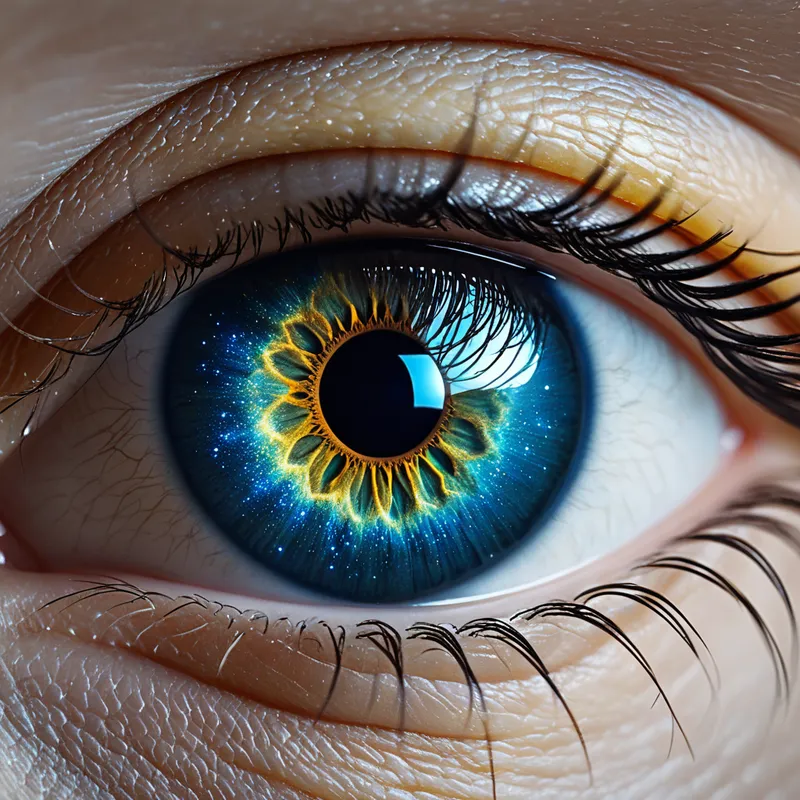
The image of the Ouroboros is one of humanity’s most widespread and enduring symbols, appearing independently across continents and epochs. Its earliest known depiction comes from ancient Egypt, encircling the world in the Enigmatic Book of the Netherworld from the tomb of Tutankhamun, representing the cyclical journey of the sun god and the unity of all things. It traveled through Phoenician culture to the Greeks, who gave it the name we use today: Ouroboros, from oura (tail) and boros (eating).
It found a profound home in Gnosticism and Hermetic alchemy. For alchemists, it was the ultimate symbol of the prima materia and the cyclical nature of their work—dissolution and coagulation, death and rebirth. In Norse myth, the great world-serpent Jörmungandr is an Ouroboric figure, biting its own tail as it girdles Yggdrasil. It appears in Mesoamerican art, Hindu iconography, and the philosophical systems of countless traditions.
It was never merely an ornament. It was a teaching glyph, a compact philosophical treatise passed down by priests, philosophers, smiths, and mystics. Its societal function was to model a fundamental truth about the cosmos and the soul: that all processes are cyclic, that extremes turn into their opposites, and that the seeker must often turn back upon themselves to find the origin and the end.
Symbolic Architecture
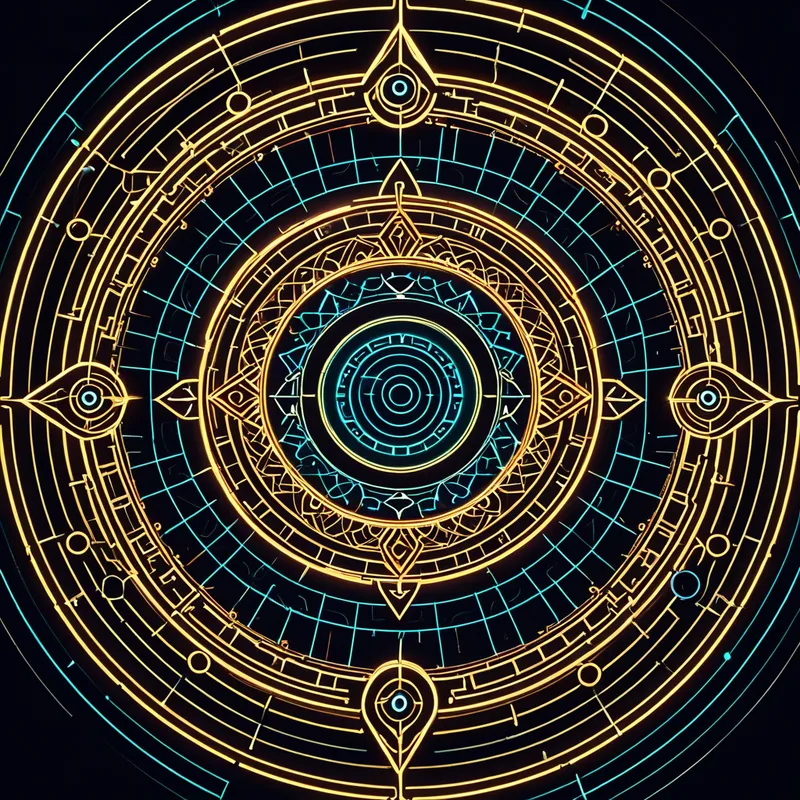
The Ouroboros is a complete symbolic system. Its circular form annihilates linear time, presenting eternity not as endless duration, but as a perpetual present where beginning and end are identical.
The serpent that devours itself gives birth to itself. In that paradox lies the secret of all autonomous existence.
Psychologically, it represents the self-sustaining nature of the psyche. The “tail” is the past, the personal and collective unconscious, the inherited trauma and wisdom. The “head” is consciousness, the ego, the devouring intellect that seeks to understand, assimilate, and often consume its own origins. The act of ingestion symbolizes the process of integrating the shadow—making the unknown, known; making the past, present. It is the symbol of the self-regulating psyche, where psychic energy circulates without leak or external dependency.
It also embodies the concept of the Great Work. The cycle of consumption and regeneration is the cycle of analysis and synthesis, of breaking down complex neuroses (the tail) to rebuild a more conscious personality (the head). It is a map of individuation drawn in a single, relentless line.
The Dreamer’s Resonance
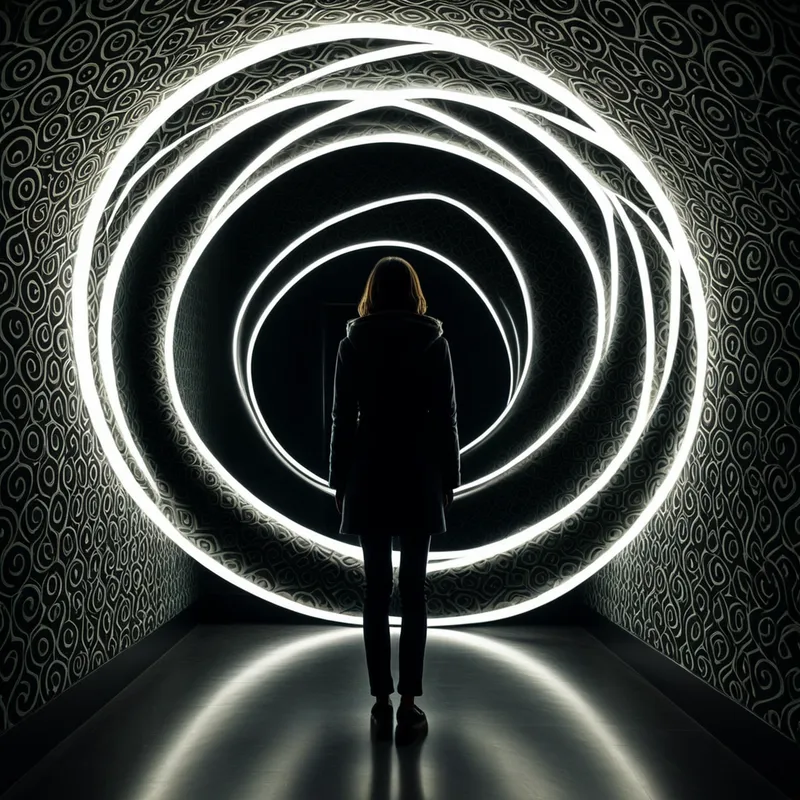
When the Ouroboros appears in a modern dream, it is rarely as a literal serpent. It manifests as a feeling of being trapped in a loop—repeating the same argument, reliving the same anxiety, circling the same career dilemma. It might appear as a round room with no door, a merry-go-round that won’t stop, or a tape recording that seamlessly splices its end to its beginning.
Somatically, the dreamer may report a sensation of tightness in the chest or gut, a literal feeling of being “all wound up.” Psychologically, this is the sign of a self-contained, self-perpetuating complex. The psyche is feeding on its own output, recycling old emotions and thought patterns without drawing in new energy or perspective from the outer world or the deeper Self. The dream Ouroboros is both the problem and the hint of the solution: the system is closed, but it is also complete. The dream asks, “What part of your past are you consuming to fuel your present? And is that nourishment, or is it poison?”
Alchemical Translation
For the modern individual, the Ouroboros models the most critical phase of psychic transmutation: the circulatio. This is the stage where, after the initial dissolution (solutio) of old identities, one must not rush to a new, premature synthesis. Instead, one must endure the cycle, allowing the material of the psyche to be cooked in its own juices, to revolve upon itself until it is purified.
The gold is not found by breaking the circle, but by understanding that you are both the furnace and the ore, the devourer and the devoured.
The “tail” represents all that is unconscious, compulsive, and fate-bound in our lives—our inherited burdens, our knee-jerk reactions. The “head” is our conscious will and understanding. The alchemical work is to bring the head to the tail, not to escape it, but to consciously “eat” it: to fully comprehend, digest, and transform that fate into something self-chosen. This is the movement from being lived by our complexes to authoring our own story.
The triumph of the Ouroboros is not a linear victory, but the achievement of autonomous, self-renewing equilibrium. It is the moment when one’s inner conflict loses its destructive, fragmenting power and becomes the engine of a dynamic, stable wholeness. The individual becomes like the symbol: a self-contained universe, generating their own meaning, sustaining their own life through the perpetual, wise cycle of reflection, integration, and rebirth. The circle is not a prison, but the shape of a soul that has become complete.
Associated Symbols
Explore related symbols from the CaleaDream lexicon:
- Circle
- Round
- Circular
- Around
- Complete
- Recurrent
- Curve
- Loop
- Wreath
- Filled Donut
- Fractal Pattern
- Infinite Loop
- Serpentine Stone
- Malachite Spiral
- Molting Process
- Snake Shed Skin
- Celestial Garter Snake
- Feathered Serpent
- Celtic Knot
- Hula Hoop
- Loop Pedal Secrets
- Cyclic Nature
- Serpent of Growth
- Infinity Loop
- Paradoxical Path
- Chained Infinity
- Perfect Circle
- Torus
- Fractal Waves
- Medicine Wheel
- Serpent Coil
- Snake Shedding
- Archetypal Image
- Trauma Loop
- Möbius Strip
- Infinity
- Recursion
- Palindrome
- Tautology
- Paradox
- Eternity
- Cycle
- Infinite
- Looping