Our Lady's Tears Myth Meaning & Symbolism
A myth of divine compassion where the Mother's sorrow becomes a sacred, healing balm, transforming human suffering through the mystery of shared tears.
The Tale of Our Lady’s Tears
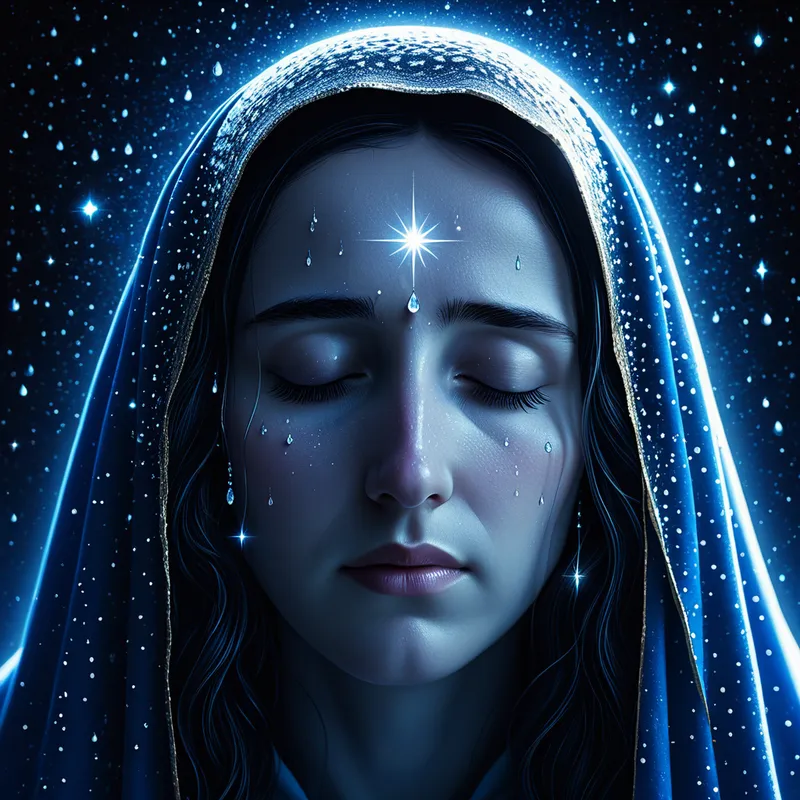
Hear now a tale not carved in stone, but written in water and light. In the silent hours between midnight and dawn, when the world holds its breath, a profound sorrow stirs in the heart of heaven. It is the sorrow of the Mother, she who is called Theotokos, the God-Bearer.
She stands not upon a marble pedestal, but on the threshold between realms, her gaze turned eternally earthward. She sees it all—not as a distant queen, but as a mother watches her sleeping child, sensing every tremor of nightmare, every catch of breath. She sees the spear-thrust into her son’s side, a wound that never truly closes. She sees the wars waged in forgotten names, the silent tears shed on cold pillows, the ache of loneliness in crowded rooms, the slow poison of hatred, and the weary burden of despair that bends human backs.
And from this seeing, from this intimate knowing of every fracture in the human heart, a pressure builds—a divine ache too vast for words. It gathers in the quiet of her being, a sacred weight. Then, from the corners of her eyes, which have witnessed the alpha and the omega of love and loss, a tear forms. It is not a tear of weakness, but of profound solidarity, a liquid witness.
It swells, capturing the cold light of distant stars and the warm glow of undying love. It falls. It does not vanish into ether. As it descends from the realm of spirit to the realm of matter, it transforms. Some say her tears become morning dew on spiderwebs, glistening with transient beauty. Others whisper they become rare springs in desert places, water that tastes of forgiveness. In the oldest tales, they are said to harden into sacred stones—pearls of luminous grey, or beads of amber holding a timeless sorrow within.
Where these tears fall, a subtle alchemy occurs. The ground, hardened by grief, softens. A forgotten seed stirs. A heart sealed by pain feels a strange, cool touch, a reminder that its suffering is seen, is shared, is held in a consciousness greater than its own. The myth does not promise an end to pain, but something more mysterious: the transformation of isolation into communion, through the silent, falling grace of a mother’s shared tears.
Cultural Origins & Context
The motif of Our Lady’s Tears is not found in the canonical scriptures of the New Testament, but blooms in the rich soil of apocrypha, devotional literature, and localized Marian apparition narratives. It is a folk theology, emerging from the human need to bridge the immense gap between a transcendent God and immanent suffering.
This myth circulated in medieval legendaria, monastic meditations, and the oral traditions of countless communities, particularly in Mediterranean and Eastern Christian cultures. It was often told during times of collective trauma—plague, famine, or war—serving as a societal balm. The tellers were monks in scriptoriums, grandmothers at hearthsides, and pilgrims at holy wells. Its function was multifaceted: it validated human grief as sacred, it personalized the divine as compassionate, and it offered a symbolic framework for understanding suffering not as punishment, but as a site of potential divine encounter and transformation.
Symbolic Architecture
At its core, the myth dismantles the hierarchy between the divine and the human condition. The tear is the ultimate symbol of this dismantling.
The divine tear is the solvent that dissolves the illusion of separation. It is God weeping for God, the infinite mourning its finite incarnation.
The Mother represents the archetypal principle of containing consciousness. She is the vessel that holds the paradox of joy and sorrow, death and resurrection. Her tears are not a failure of omnipotence, but an expression of omni-compassion. They symbolize a divinity that does not remain impassive but chooses to participate intimately in the suffering of its creation.
Psychologically, the tear represents the conscious acknowledgment and expression of grief—the catharsis that is necessary for healing. It is the moment when the psyche stops resisting pain and allows it to flow, transforming stagnant, toxic sorrow into a moving, cleansing stream. The myth suggests that true compassion (com-pati, to suffer with) is an active, liquid force that bridges souls and initiates change.

The Dreamer’s Resonance
When this mythic pattern stirs in the modern dreamer, it often signals a profound encounter with the Great Mother archetype, specifically in her sorrowing aspect. To dream of a weeping feminine figure of immense dignity, or of finding mysterious, healing water, or of luminous stones that hold liquid light, is to touch this pattern.
Somatically, the dreamer may be processing a deep, perhaps unacknowledged, reservoir of grief—personal, ancestral, or collective. The psyche is engaging in a process of shadow-work related to sorrow, loss, and empathy. The psychological process is one of moving from a state of arid isolation (“my pain is mine alone”) to one of irrigated connection (“my pain is part of a larger, shared human experience”). The dream presents the archetypal solution: to allow the tears to fall, to honor the sorrow, and in doing so, to discover that grief itself can become a source of nurturing and unexpected growth.

Alchemical Translation
The alchemical journey modeled here is the transmutation of leaden, crushing grief into the silver of compassionate wisdom. It is the nigredo of the soul—the dark night where one feels utterly dissolved in sorrow.
The first operation is not to stem the tears, but to let them fall, for in their descent they carry the soul from the arid heights of intellectual detachment into the fertile valleys of embodied feeling.
The Mother is the vas, the alchemical vessel strong enough to contain the searing contradiction of love and loss. Her tear is the aqua divina, the sacred solvent that begins the work. For the individual undergoing individuation, the myth instructs:
- Witnessing (Visio): Like the Mother, one must first turn a compassionate gaze upon one’s own suffering and the suffering of the world, without flinching.
- Participation (Com-passio): One must allow oneself to feel with, to let the divine ache of connection happen. This is the dissolution of the ego’s walls.
- Expression (Lacrima): The embodied release—the tear, the prayer, the art, the act of kindness—is the crucial moment of transmutation. It is matter expressing spirit.
- Fertilization (Fons): The released emotion, now transformed from private agony into shared compassion, becomes a source of life. It waters the parched aspects of the self and others, giving rise to new growth—empathy, resilience, and a deeper capacity for love.
The ultimate triumph is not a life without tears, but a life where tears have become sacred, where sorrow has been alchemized into the very substance of connection, and where one discovers, in the depths of grief, the reflected light of a shared, compassionate consciousness.
Associated Symbols
Explore related symbols from the CaleaDream lexicon: