Our Lady's Beetle Myth Meaning & Symbolism
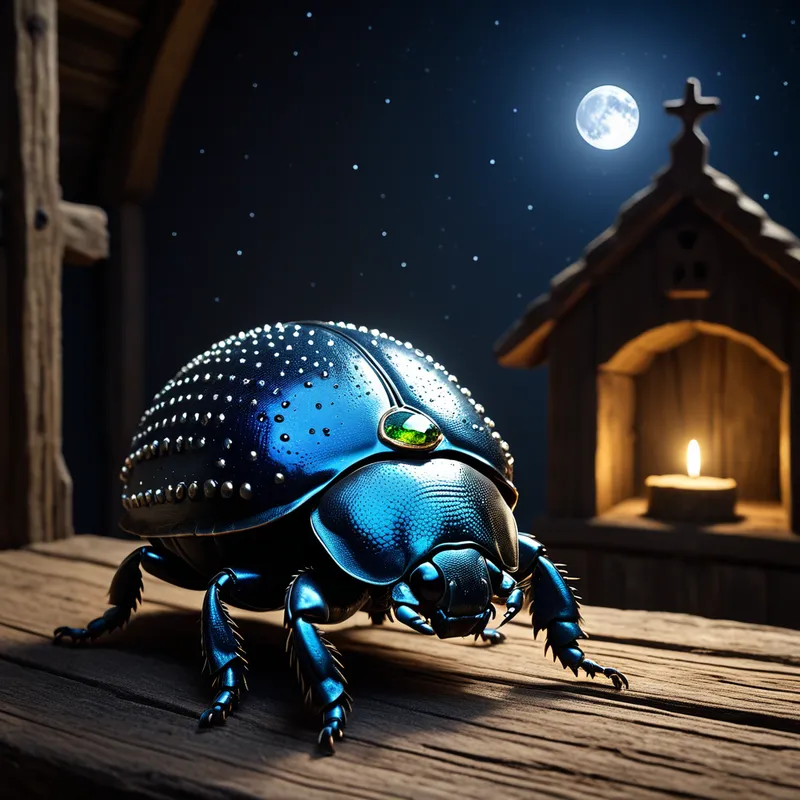
A humble dung beetle, cursed for its earthly toil, is blessed by the Virgin Mary, transforming its labor into a sacred, jeweled offering.
The Tale of Our Lady’s Beetle
Listen, and hear a tale not of kings or warriors, but of the humblest of creatures, a story whispered in the hay-scented dark of a stable. In the time when the heavens bent low to touch [the earth](/myths/the-earth “Myth from Hindu culture.”/), there was a creature of the soil, a small [scarab](/myths/scarab “Myth from Egyptian culture.”/). It knew only the dark, rich earth and its appointed task: to gather the waste of [the world](/myths/the-world “Myth from Tarot culture.”/), to shape it into a sphere, and to roll its burden with endless, patient labor. It was seen by the other animals as lowly, cursed to forever toil in filth, its name a byword for the base and the unclean.
On a night when the very air trembled with a silent promise, all creatures were called to the side of a newborn king. The ox and the ass, with their warm breath, came. The sheep, with their soft wool, came. Even the birds ceased their song to bear witness. But the beetle, covered in the dust of its labor, hid in shame. What could it, a creature of dung and shadow, offer to divine light? It possessed no gift, no song, no warmth fit for a cradle.
Yet, a pull stronger than shame drew it forward. Creeping to the edge of the humble shelter, it saw Our Lady, her face illuminated by a peace that quieted the universe. And it saw [the child](/myths/the-child “Myth from Alchemy culture.”/), swaddled in simplicity, lying not on silk, but in a [manger](/myths/manger “Myth from Biblical culture.”/)—a feeding trough for beasts, filled with rough, scattered straw.
Then the beetle understood its purpose. While others offered what they were, it would offer what it did. In a act of profound, instinctive devotion, it began its work. With delicate, determined legs, it gathered the stray, prickly strands of hay from the cold earthen floor. It gathered the dust. It gathered the minute fragments of the world that had been overlooked. And it began to roll. It rolled and rolled, fashioning not a ball of waste, but a sphere of gathered humility, a perfect orb of offered labor.
The task was immense for so small a creature. The sphere grew heavy, the path to [the manger](/myths/the-manger “Myth from Christian culture.”/) base seemed a mountain. But on it pushed, a tiny monument of perseverance in the holy quiet. Finally, with a last, trembling effort, it pushed its gift—this sphere of gathered earth and straw—into the manger, where it gently came to rest beside the infant’s head, a humble pillow formed from the dust of creation itself.
Our Lady saw this. She saw not the dirt, but the devotion. She saw not the lowliness of the material, but the loftiness of the intent. Moved by this ultimate act of service from the lowest of her son’s subjects, she stretched forth a hand. Not to brush it away, but to bless. Her finger touched the damp, earthen sphere.
And where her divine touch met the offered toil, a miracle of [transfiguration](/myths/transfiguration “Myth from Christian culture.”/) bloomed. The mud and straw melted away, replaced by a shell of gleaming, midnight-hued jewel. The humble ball became a sacred emerald, polished by grace, its surface catching the starlight and the soft glow of the child. And the beetle itself was transformed. Its once-dull carapace now shone with a metallic, sacred luster, a living jewel reflecting the mercy it had received. It was no longer a creature of the curse, but Our Lady’s Beetle, a eternal testament that no labor offered in true love is ever unclean.

Cultural Origins & Context
This tale belongs to the rich tapestry of European Christian folklore, specifically the genre of aetiological legends that blossomed in the Late Medieval and Early Modern periods. It was not scripture, but a story told by [the hearth](/myths/the-hearth “Myth from Norse culture.”/) and in the field, passed down by peasants, monks, and wandering storytellers. Its primary function was didactic and comforting, aimed at the vast majority of humanity who lived lives of relentless, unglamorous toil.
In a society rigidly structured by class and sanctified by the Church, the myth served a profound social purpose. It spoke directly to the ploughman, the washerwoman, the shepherd—those whose lives were spent in “earthly” and often “unclean” labors. The story assured them that their work, if done with a pious and devoted heart, was seen and valued by the divine. It sanctified daily grind, transforming it from a curse of Adam into a potential offering to Christ. The beetle became a folk saint of the humble, a celestial patron for those who felt invisible in the grand architecture of salvation.
Symbolic Architecture
At its core, the myth is a profound [allegory](/symbols/allegory “Symbol: A narrative device where characters, events, or settings represent abstract ideas or moral qualities, conveying deeper meanings through symbolic storytelling.”/) for the [alchemy](/symbols/alchemy “Symbol: A transformative process of purification and creation, often symbolizing personal or spiritual evolution through difficult stages.”/) of [consciousness](/symbols/consciousness “Symbol: Consciousness represents the state of awareness and perception, encompassing thoughts, feelings, and experiences.”/), where the base is not rejected but redeemed through the quality of [attention](/symbols/attention “Symbol: Attention in dreams signifies focus, awareness, and the priorities in one’s life, often indicating where the dreamer’s energy is invested.”/) brought to it.
The sacred is not found by escaping the mundane, but by offering the mundane itself with complete devotion.
The Dung/Sphere represents [the prima materia](/myths/the-prima-materia “Myth from Alchemical culture.”/)—the raw, rejected, and “[shadow](/symbols/shadow “Symbol: The ‘shadow’ embodies the unconscious, repressed aspects of the self and often represents fears or hidden emotions.”/)” aspects of [life](/symbols/life “Symbol: The symbol of ‘Life’ represents a journey of growth, interconnectedness, and existential meaning, encompassing both the joys and challenges that define human experience.”/) and [the self](/myths/the-self “Myth from Jungian culture.”/). It is our burdens, our [shame](/symbols/shame “Symbol: A painful emotion arising from perceived failure or violation of social norms, often involving exposure of vulnerability or wrongdoing.”/), our repetitive tasks, our instincts, and all that we consider waste. The [beetle](/symbols/beetle “Symbol: The beetle symbolizes transformation, resilience, and the ability to adapt to one’s environment, often reflecting personal growth and survival instincts.”/) does not flee from this [material](/symbols/material “Symbol: Material signifies the tangible aspects of life, often representing physical resources, desires, and the physical world’s influence on our existence.”/); it engages with it fully. The act of rolling is the conscious, persistent [effort](/symbols/effort “Symbol: Effort signifies the physical, mental, and emotional energy invested toward achieving goals and personal growth.”/) to contain, shape, and integrate this [shadow](/symbols/shadow “Symbol: The ‘shadow’ embodies the unconscious, repressed aspects of the self and often represents fears or hidden emotions.”/) material. It is [the ego](/myths/the-ego “Myth from Jungian culture.”/)‘s labor in service of a greater, often unseen, whole.
Our [Lady](/symbols/lady “Symbol: The symbol of the ‘Lady’ often signifies femininity, grace, and the complexities of the female experience, representing aspects of nurturing, intuition, and empowerment.”/) symbolizes the [anima](/symbols/anima “Symbol: The feminine archetype within the male unconscious, representing soul, creativity, and connection to the inner world.”/) in its highest form—the receptive, compassionate, transformative function of the [psyche](/myths/psyche “Myth from Greek culture.”/). She is [the principle](/symbols/the-principle “Symbol: A fundamental truth, law, or doctrine that serves as a foundation for a system of belief, behavior, or reasoning, often representing moral or ethical standards.”/) of unconditional witness and grace that sees the intent within the [action](/symbols/action “Symbol: Action in dreams represents the drive for agency, motivation, and the ability to take control of situations in waking life.”/). Her touch represents the [moment](/symbols/moment “Symbol: The symbol of a ‘moment’ embodies the significance of transient experiences that encapsulate emotional depth or pivotal transformations in life.”/) of psychic [integration](/symbols/integration “Symbol: The process of unifying disparate parts of the self or experience into a cohesive whole, often representing psychological wholeness or resolution of internal conflict.”/), where conscious effort is met with unconscious grace, resulting in [transmutation](/symbols/transmutation “Symbol: A profound, alchemical process of fundamental change where one substance or state transforms into another, often representing spiritual evolution or personal metamorphosis.”/). [The emerald](/myths/the-emerald “Myth from Medieval European culture.”/), a [stone](/symbols/stone “Symbol: In dreams, a stone often symbolizes strength, stability, and permanence, but it may also represent emotional burdens or obstacles that need to be acknowledged and processed.”/) of [heart](/symbols/heart “Symbol: The heart symbolizes love, emotion, and the core of one’s existence, representing deep connections with others and self.”/) and hope, signifies the new, valuable psychic [structure](/symbols/structure “Symbol: Structure in dreams often symbolizes stability, organization, and the framework of one’s life, reflecting how one perceives their environment and personal life.”/) born from this union—the [lapis](/symbols/lapis “Symbol: A deep blue stone historically revered as a celestial connection and symbol of wisdom, truth, and spiritual enlightenment.”/) philosophorum or the realized Self.

The Dreamer’s Resonance
When this myth stirs in the modern dreamer, it often manifests in dreams of profound, frustrating, yet purposeful labor. You may dream of pushing a heavy, dark ball up a hill that never ends, or of meticulously cleaning a vast, dirty space. You may be a humble creature in the dream, ignored by grander figures. The somatic feeling is one of deep fatigue coupled with a strange, stubborn determination.
Psychologically, this indicates a crucial phase of “shadow-work.” The psyche is engaged in the unglamorous, often thankless task of gathering and processing neglected aspects of the self—old shames, repressed instincts, or the sheer weight of life’s responsibilities. The dream is not a call to find a more glorious task, but to recognize the sacred potential within the current one. The frustration mirrors the beetle’s doubt; the persistence is the soul’s innate drive to offer its complete experience, even the “waste,” for integration. The dream asks: What part of your life or yourself do you deem too lowly to bring into the light of your own awareness?

Alchemical Translation
The myth of Our Lady’s Beetle is a perfect map for the individuation process. It begins in [nigredo](/myths/nigredo “Myth from Alchemical culture.”/)—the blackening. The beetle in its cursed state is the ego identified solely with its lowly, instinctual, and burdened nature. The call to the manger is the first stirring of the Self, a vague longing for meaning that pierces the identity of shame.
The rolling of the sphere is the long, arduous stage of albedo—the whitening. This is the conscious work of analysis, of gathering the scattered fragments of one’s history and personality, and attempting to give them coherent form. It is therapy, journaling, reflection—the often lonely effort to understand and contain one’s own nature.
The manger is the crucible of the heart, where what is offered is not greatness, but wholeness.
The arrival at the manger and the offering represent citrinitas—the yellowing, or the dawning of spiritual awareness. The ego, having done its labor of gathering, now surrenders the product to a higher authority (the Self/Divine). This surrender is not resignation, but the essential act of devotion that enables transmutation.
Finally, the touch of Our Lady and the emergence of the emerald is [rubedo](/myths/rubedo “Myth from Alchemical culture.”/)—the reddening, the culmination. This is the moment of psychic integration, where the transformed material becomes a permanent, valuable part of the personality. The beetle, now jeweled, is the ego in service to the Self. Its labor continues, but its nature has been fundamentally altered; it now performs its tasks with the radiant awareness that even the most humble action, when connected to the center of one’s being, is a sacred act. The myth teaches that individuation is not about becoming a king, but about becoming a blessed beetle—transforming one’s entire existence, down to its darkest elements, into an offering that gleams with inherent, recognized worth.
Associated Symbols
Explore related symbols from the CaleaDream lexicon: