
Otter Medicine Myth Meaning & Symbolism
A myth of a joyful, playful spirit who retrieves sacred healing from the depths, teaching balance between lightheartedness and profound medicine.
The Tale of Otter Medicine
Listen. [The world](/myths/the-world “Myth from Tarot culture.”/) was young, and a great shadow had fallen upon the people. A sickness, cold and heavy as river stone, had settled in their bones. Laughter had fled the lodges. The songs of the children grew thin and faded. The healers, wise with the knowledge of root and leaf, could not reach this deep-welling sorrow. The people sent their prayers up with the smoke, but [the wind](/myths/the-wind “Myth from Various culture.”/) carried them away, unanswered.
In his lodge, the chief sat with a heart like a winter lake. His daughter, the light of his days, lay still upon her robes, her breath a faint whisper. He had offered all he had—his finest horses, his most prized pelts—to the spirits. Silence was the only reply. In his despair, he walked to the bank of the great, swift river that sang night and day. “Great Mystery,” he cried, his voice breaking against the [water](/myths/water “Myth from Chinese culture.”/)‘s roar, “what must I give? What must I do?”
[The river](/myths/the-river “Myth from Buddhist culture.”/) did not answer with words. But as his tears fell upon the current, a ripple moved against the flow. A sleek, dark head broke the surface. It was Otter. She regarded the man not with pity, but with bright, curious eyes. She chirruped, a sound like water over pebbles, and then she was gone, diving deep into the murky, cold heart of [the river](/myths/the-river “Myth from Buddhist culture.”/).
The chief watched, his hope a fragile thread. The otter was gone for a long time, in that space where breath is held and the world waits. The current swirled, dark and impenetrable. Just as he turned away, believing it a mere animal about its business, the water erupted.
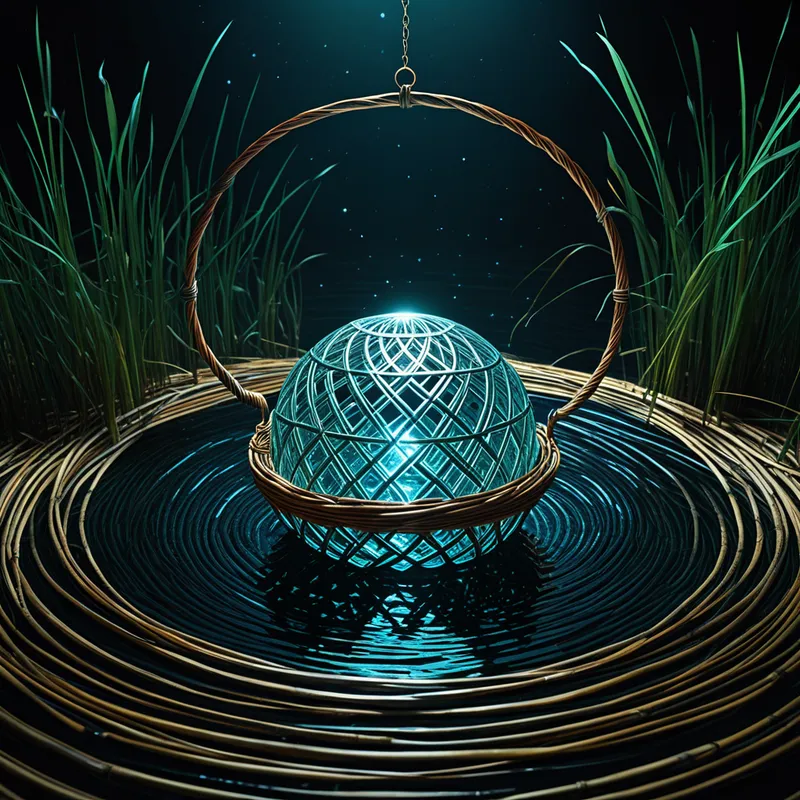
Otter surged onto the bank, shaking a spray of diamond droplets into the sun. In her mouth, she carried not a fish, but something that glowed with a soft, milky light. It was a [pearl](/myths/pearl “Myth from Chinese culture.”/), but not of [the sea](/myths/the-sea “Myth from Greek culture.”/)—a [pearl](/myths/pearl “Myth from Chinese culture.”/) of the river, formed from the essence of moonlight on water and the song of the current. She placed it gently at the chief’s feet, gave another playful chirp, and slipped back into her element.
The chief, trembling, took the luminous pearl. Its warmth spread through his frozen hands. He carried it to his daughter’s side and held it to her heart. The light pulsed, gentle and deep. Color returned to her cheeks. Her eyes fluttered open, and she drew a breath, full and clear. The heavy shadow in the lodge lifted, as if washed away by a clean, joyful rain. The sickness broke, and the sound that returned to the people was not just wellness, but laughter—the pure, bubbling laughter that Otter herself carries in her spirit.

Cultural Origins & Context
The story of Otter Medicine finds its roots among various Native American nations, particularly those whose lives are intertwined with the rivers, lakes, and coasts of the continent, such as some Coastal Salish, Tlingit, and Ojibwe traditions. It is a teaching story, passed down not in formal ceremonies of power, but often in the intimate spaces—by grandmothers to grandchildren, by elders to those who have lost their way.
Its societal function is multifaceted. On one level, it is a etiological myth, explaining why the otter is revered as a bringer of medicine and why its playful nature is sacred, not frivolous. More deeply, it serves as a narrative balm. In cultures that faced profound hardships, the story reaffirms that healing does not always come from solemnity and sacrifice alone. It can arrive on a wave of playfulness, from a spirit who remembers joy in the midst of darkness. The otter is a power animal whose “medicine” is prescribed for a collective soul-sickness, a reminder that resilience is woven with threads of lightness.
Symbolic Architecture
At its core, [Otter](/symbols/otter “Symbol: A playful, social aquatic mammal symbolizing joy, adaptability, and connection to emotions.”/) [Medicine](/symbols/medicine “Symbol: Medicine symbolizes healing, transformation, and the pursuit of knowledge, addressing both physical and spiritual health.”/) dismantles the false [dichotomy](/symbols/dichotomy “Symbol: A division into two contrasting parts, often representing opposing forces, choices, or perspectives within artistic or musical expression.”/) between profound healing and lighthearted play. The [otter](/symbols/otter “Symbol: A playful, social aquatic mammal symbolizing joy, adaptability, and connection to emotions.”/) is the archetypal diver into the unconscious—the dark, cold, flowing [realm](/symbols/realm “Symbol: The symbol of ‘Realm’ often signifies the boundaries of one’s consciousness, experiences, or emotional states, suggesting aspects of reality that are either explored or ignored.”/) of [emotion](/symbols/emotion “Symbol: Emotion symbolizes our inner feelings and responses to experiences, often guiding our actions and choices.”/), [memory](/symbols/memory “Symbol: Memory symbolizes the past, lessons learned, and the narratives we construct about our identities.”/), and the unseen. Unlike the heroic diver who battles monsters, [Otter](/symbols/otter “Symbol: A playful, social aquatic mammal symbolizing joy, adaptability, and connection to emotions.”/) enters the [depths](/symbols/depths “Symbol: Represents the subconscious, hidden emotions, or foundational aspects of the self, often linked to primal fears or profound truths.”/) with curiosity and agility. She does not conquer the [river](/symbols/river “Symbol: A river often symbolizes the flow of emotions, the passage of time, and life’s journey, reflecting transitions and movement in one’s life.”/); she partners with it.
The medicine is not in the struggle against the depths, but in the ability to move through them with fluid grace and emerge bearing a gift.
The [pearl](/symbols/pearl “Symbol: The pearl symbolizes purity, wisdom, and the beauty derived from overcoming adversity.”/) she retrieves is the symbolic prize of this dive: the individuated self, the core of value and luminosity formed through the [friction](/symbols/friction “Symbol: Friction represents resistance, conflict, or the necessary tension required for movement and transformation in dreams.”/) of experience (the [grit](/symbols/grit “Symbol: Grit symbolizes perseverance, resilience, and sustained passion for long-term goals despite obstacles and adversity.”/) in the [shell](/symbols/shell “Symbol: Shells are often seen as symbols of protection, transition, and the journey of personal growth.”/)) layered over with the essence of [soul](/symbols/soul “Symbol: The soul represents the essence of a person, encompassing their spirit, identity, and connection to the universe.”/) ([moonlight](/symbols/moonlight “Symbol: Moonlight represents illumination of the unconscious, creative inspiration, and the cyclical nature of life and emotions.”/) and [water](/symbols/water “Symbol: Water symbolizes the subconscious mind, emotions, and the flow of life, representing both cleansing and creation.”/)). It is not fought for; it is found through engaged, attentive play within the [mystery](/symbols/mystery “Symbol: An enigmatic, unresolved element that invites curiosity and exploration, often representing the unknown or hidden aspects of existence.”/) itself. The chief’s [despair](/symbols/despair “Symbol: A profound emotional state of hopelessness and loss, often signaling a need for transformation or surrender to deeper truths.”/) represents [the ego](/myths/the-ego “Myth from Jungian culture.”/)’s impotence, its offerings of [material](/symbols/material “Symbol: Material signifies the tangible aspects of life, often representing physical resources, desires, and the physical world’s influence on our existence.”/) [wealth](/symbols/wealth “Symbol: Wealth in dreams often represents abundance, security, or inner resources, but can also symbolize burdens, anxieties, or moral/spiritual values.”/) (horses, pelts) useless before a psychic or spiritual malady. The intervention comes from the instinctual, feminine [spirit](/symbols/spirit “Symbol: Spirit symbolizes the essence of life, vitality, and the spiritual journey of the individual.”/) (Otter is often coded feminine in these myths), which operates on a [logic](/symbols/logic “Symbol: The principle of reasoning and rational thought, often representing order, structure, and intellectual clarity in dreams.”/) of [relationship](/symbols/relationship “Symbol: A representation of connections we have with others in our lives, often reflecting our emotional state.”/) and fluidity, not [transaction](/symbols/transaction “Symbol: An exchange of value, energy, or information between parties, representing balance, reciprocity, and the flow of resources in life.”/).
The Dreamer’s Resonance
When the pattern of Otter Medicine arises in modern dreams, it signals a somatic and psychological process of retrieving lost vitality. Dreaming of otters—especially playful ones, or otters diving and surfacing—often coincides with periods of burnout, depression, or creative blockage. The [psyche](/myths/psyche “Myth from Greek culture.”/) is indicating that the dreamer’s approach to their “sickness” (be it anxiety, grief, or stagnation) is too rigid, too heavy.
The otter in the dream is the embodied intelligence of the unconscious, demonstrating the correct method. The dreamer may feel, upon waking, a somatic memory of fluid movement or a surprising uplift of mood, even if the dream content wasn’t explicitly joyful. This is the “medicine” beginning to work. The dream is a prescription to engage with life’s challenges not as a solemn battle, but with a spirit of curious exploration. It asks: Where have you forgotten to play? What deep, emotional current are you afraid to dive into, whose depths might actually hold the very pearl you need?

Alchemical Translation
The alchemical process modeled here is one of [solve et coagula](/myths/solve-et-coagula “Myth from Alchemical culture.”/)—dissolve and coagulate—but performed with a gentle, feminine hand. The “sickness” is the leaden state of the psyche, overly identified with suffering and effort (the chief’s despair). Otter represents the aqua permanens, the permanent water or mercurial spirit that can dissolve this fixation.
The first operation is not to fight the shadow, but to allow the playful, fluid spirit to dissolve the ego’s rigid stance of problem-solving.
The dive into the river is the [nigredo](/myths/nigredo “Myth from Alchemical culture.”/), the descent into the dark, chaotic unconscious. But here, the blackness is not a stage of putrefaction so much as one of fertile potential, navigated with agility. The retrieval of the pearl is the albedo, the whitening—the emergence of the lucid, purified essence from the darkness. This essence, the healing pearl, is the [lapis philosophorum](/myths/lapis-philosophorum “Myth from Alchemical culture.”/) or the integrated Self for this particular mythic cycle.
For the modern individual, the transmutation occurs when we stop trying to “fix” our melancholy with force and instead allow a lighter, more curious, and relational part of ourselves to engage with it. We dive into our emotions not to be overwhelmed by them, but to play within them, to look for the hidden luminosity. The [triumph](/myths/triumph “Myth from Roman culture.”/) is not an eradication of suffering, but the discovery that joy and healing are coiled together at the very heart of the deep, dark river. We surface not as warriors, but as bearers of a gentle, self-generated light, our seriousness washed clean by the waters of a remembered play.
Associated Symbols
Explore related symbols from the CaleaDream lexicon: