Orunmila Myth Meaning & Symbolism
The story of the divine witness who chose to descend with humanity, carrying the wisdom of destiny to illuminate the path through life's chaos.
The Tale of Orunmila
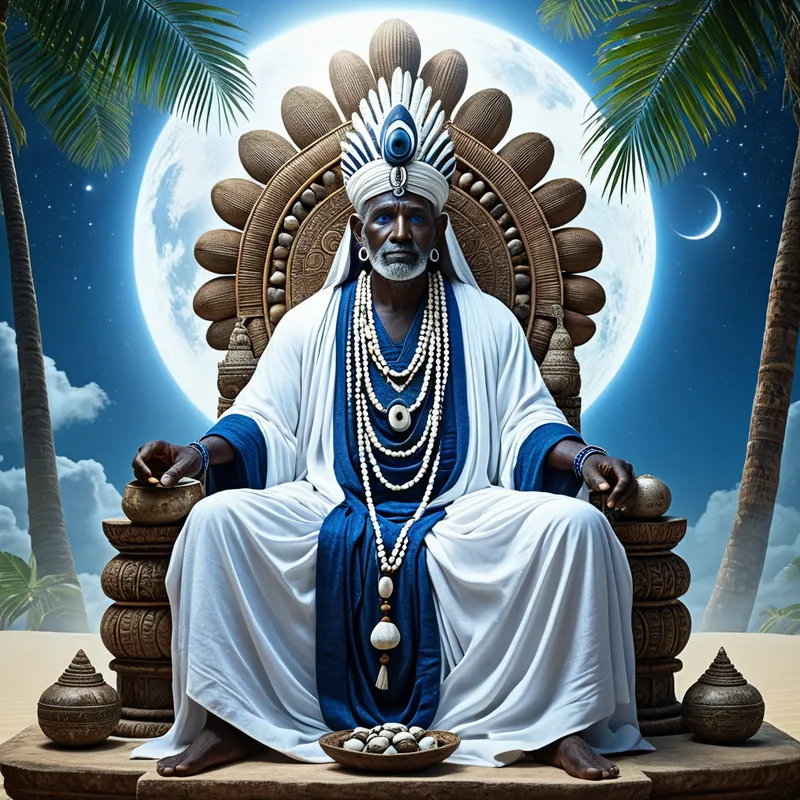
In the beginning, when the world was a whisper of potential and the sky was not yet distant from the earth, there existed a knowing. This knowing was a being, and his name was Orunmila. He was present when [Olodumare](/myths/olodumare “Myth from Yoruba culture.”/) breathed life into the void, when the Irunmole were given their domains. While others received power over wind, thunder, or the deep waters, Orunmila received the calabash of wisdom. He witnessed the blueprint of all that was, is, and could ever be.
The earth, Ile, was rich and fertile, but it was a realm of becoming, fraught with uncertainty. Humanity, the children of [Obatala](/myths/obatala “Myth from Yoruba culture.”/), walked in a haze of forgetfulness. They knew need, fear, and desire, but the path to fulfillment was shrouded in shadow. They stumbled. They suffered. Their cries were a faint, mournful wind that reached the threshold between realms.
From his place of perfect knowledge, Orunmila heard them. He saw the intricate web of cause and consequence, the multiple paths branching from every choice, yet he also saw the confusion in the human heart. The other Orisha advised from afar, but Orunmila felt a pull—a profound compassion that was also a sacred duty. Wisdom, he knew, was not for hoarding in the heavens. It was a light meant for the crossroads.
So, he made his choice. He did not come as a conqueror or a king demanding tribute. He gathered his sacred instruments: the ikin, the opele, and the dust of timeless memory. With a sigh that stirred the stars, he turned his back on serene omniscience and began his descent. He stepped into the tumult of the world, his feet touching the soil at the city of Ile-Ife.
He sat. Not on a high throne, but on the earth. He cast his chain, he tapped his nuts, and the patterns emerged—stories written in shells and seeds. To the first seeker who approached, trembling with a question about life or loss, Orunmila did not give a simple answer. He recited an Odu—a vast, poetic narrative of another time, another being who faced a similar crossroads. Within that ancient story lay the mirror, the warning, and the potential solution. He gave not fate, but the map to navigate it. He became Eleri Ipin, the witness to destiny, who illuminates the road so the traveler may walk it with conscious feet. His presence was the quiet, unwavering assurance that no path is walked alone, and no question is born without a corresponding key hidden in the wisdom of the ages.

Cultural Origins & Context
The narrative of Orunmila is the living heart of the Ifa tradition, a cornerstone of Yoruba spiritual and philosophical thought for centuries. Unlike myths frozen in distant antiquity, this is a continuously enacted reality. The myth is not merely told; it is performed. It is passed down through rigorous initiation and apprenticeship, from Babalawo (Father of Secrets) to student, in a lineage that claims direct descent from Orunmila himself.
The primary vessel of the myth is the monumental Ifa literary corpus, comprised of 256 principal Odu, each containing hundreds of verses, poems, and narratives. Every divination session is a re-enactment of Orunmila’s original act: translating cosmic order into humanly comprehensible guidance. Societally, Ifa and the myth of Orunmila functioned as the bedrock of ethics, law, medicine, and community cohesion. It provided a framework for understanding personal destiny (ayanmo) and the necessity of striving toward it through good character (iwa pele). The myth legitimizes the Babalawo not as a prophet, but as a conduit for an eternal, structured wisdom that pre-exists all human confusion.
Symbolic Architecture
Orunmila represents the [archetype](/symbols/archetype “Symbol: A universal, primordial pattern or prototype in the collective unconscious that shapes human experience, behavior, and creative expression.”/) of [consciousness](/symbols/consciousness “Symbol: Consciousness represents the state of awareness and perception, encompassing thoughts, feelings, and experiences.”/) itself confronting the [paradox](/symbols/paradox “Symbol: A contradictory yet true concept that challenges logic and perception, often representing unresolved tensions or profound truths.”/) of existence. He is the knower who chooses to enter the field of the unknown—the psyche that descends from abstract potential into the messy, suffering [reality](/symbols/reality “Symbol: Reality signifies the state of existence and perception, often reflecting one’s understanding of truth and life experiences.”/) of embodied [life](/symbols/life “Symbol: The symbol of ‘Life’ represents a journey of growth, interconnectedness, and existential meaning, encompassing both the joys and challenges that define human experience.”/).
The greatest sacrifice is not of life, but of certainty. Orunmila exchanges the static perfection of total knowledge for the dynamic, compassionate act of interpretation.
His instruments are profound symbols. The opele chain is the interconnectedness of all things, the tangible [pattern](/symbols/pattern “Symbol: A ‘Pattern’ in dreams often signifies the underlying structure of experiences and thoughts, representing both order and the repetitiveness of life’s situations.”/) of cause and effect. The ikin nuts are the fundamental units of possibility, the seeds of [destiny](/symbols/destiny “Symbol: A predetermined course of events or ultimate purpose, often linked to spiritual forces or cosmic order, representing life’s inherent direction.”/). The act of [divination](/symbols/divination “Symbol: The practice of seeking knowledge of the future or unknown through supernatural means, reflecting humanity’s desire for certainty and connection with hidden forces.”/) is thus a [ritual](/symbols/ritual “Symbol: Rituals signify structured, meaningful actions carried out regularly, reflecting cultural beliefs and emotional needs.”/) of finding order within apparent [chaos](/symbols/chaos “Symbol: In Arts & Music, chaos represents raw creative potential, uncontrolled expression, and the breakdown of order to forge new artistic forms.”/). Orunmila does not control [fate](/symbols/fate “Symbol: Fate represents the belief in predetermined outcomes, suggesting that some aspects of life are beyond human control.”/); he illuminates its [structure](/symbols/structure “Symbol: Structure in dreams often symbolizes stability, organization, and the framework of one’s life, reflecting how one perceives their environment and personal life.”/). Psychologically, he symbolizes the transcendent function—the inner [capacity](/symbols/capacity “Symbol: A measure of one’s potential, limits, or ability to contain, process, or achieve something, often reflecting self-assessment or external demands.”/) to hold the [tension](/symbols/tension “Symbol: A state of mental or emotional strain, often manifesting physically as tightness, pressure, or unease, signaling unresolved conflict or anticipation.”/) between opposites ([knowledge](/symbols/knowledge “Symbol: Knowledge symbolizes learning, understanding, and wisdom, embodying the acquisition of information and enlightenment.”/)/ignorance, [destiny](/symbols/destiny “Symbol: A predetermined course of events or ultimate purpose, often linked to spiritual forces or cosmic order, representing life’s inherent direction.”/)/free will, order/[chaos](/symbols/chaos “Symbol: In Arts & Music, chaos represents raw creative potential, uncontrolled expression, and the breakdown of order to forge new artistic forms.”/)) and produce a third, reconciling [perspective](/symbols/perspective “Symbol: Perspective in dreams reflects one’s viewpoints, attitudes, and how one interprets experiences.”/) that guides the individual forward. He is the internal sage who reminds us that our personal dilemmas are not unique errors, but variations on eternal [human](/symbols/human “Symbol: The symbol of a human represents individuality, complexity of emotions, and social relationships.”/) themes, each with a [history](/symbols/history “Symbol: History in dreams often represents the dreamer’s past experiences, lessons learned, or unresolved issues that continue to influence their present.”/) and a potential [resolution](/symbols/resolution “Symbol: In arts and music, resolution refers to the movement from dissonance to consonance, creating a sense of completion, release, or finality in a composition.”/) encoded in the deep patterns of the psyche.
The Dreamer’s Resonance
When the pattern of Orunmila stirs in the modern dreamer, it often manifests as a profound encounter with the mechanics of one’s own life. One might dream of finding a strange, ancient book whose pages shift and change, containing stories that eerily mirror one’s own struggles. Or of meeting a serene, non-judgmental figure in a place of crossroads—a library, a desert oasis, a quiet room—who offers a complex, symbolic object (a tangled necklace, a set of marked stones) rather than direct advice.
Somatically, this can accompany a feeling of being at a critical juncture, a “karmic” knot that requires untangling. Psychologically, it signals the ego’s desperate need to consult a deeper, wiser layer of the Self. The dreamer is undergoing a process of seeking orientation. The chaos of life—a career crisis, a relational impasse, an identity shift—has become overwhelming, and the conscious mind has exhausted its resources. The dream presents the archetype of the witness, the diviner, implying that the answers are not to be invented anew, but discovered within the innate, patterned wisdom of the psyche. The struggle is the feeling of being lost. The promise of the myth-dream is that there is a map, if only one learns the language in which it is written.

Alchemical Translation
The alchemical journey modeled by Orunmila is the transmutation of blind fate into conscious destiny. It is the opus of moving from being a passive sufferer of life’s circumstances to an active participant in dialogue with your own deepest pattern.
The first stage is the descent: the conscious ego’s humbling. We must, like Orunmila, leave the illusion of control or the fantasy of perfect safety (the heavens) and fully commit to the muddy, uncertain reality of our lived experience (the earth). This is the sacrifice of innocence.
The second stage is the consultation: turning inward. This is the disciplined practice of self-reflection, therapy, journaling, or meditation—casting the “chain” of our memories, choices, and patterns to see what configuration emerges. It is seeking the Odu of our own life, the recurring myth we are living out.
Individuation is not about creating a new self, but about deciphering the ancient, sacred text that you already are.
The final stage is the interpretation and embodiment: Orunmila does not live the seeker’s life for them. He provides the narrative context. Our alchemical task is to take the insight—the recognized pattern—and use our free will to enact the prescribed sacrifice, make the recommended offering, or avoid the foretold pitfall. We integrate the wisdom into action. Thus, blind ayanmo (destiny) becomes realized akunleyan (a destiny prayed for). The lead of confused suffering is transmuted into the gold of meaningful, self-aware existence. We become, in our own small way, witnesses to our own destiny.
Associated Symbols
Explore related symbols from the CaleaDream lexicon:
- Destiny — The core fabric of Orunmila’s domain, representing the pre-ordained pattern of a life that he helps to illuminate and navigate, not control.
- Key — Orunmila himself is the keyholder, and the verses of Ifa are the keys that unlock the meanings hidden within life’s challenges and dilemmas.
- Order — He represents the divine, structured wisdom (Ifa) that underlies the apparent chaos of the world and human experience.
- Wisdom — The sacred essence of Orunmila, not as mere intelligence, but as the deep, timeless, and practical knowledge of life’s fundamental patterns.
- Journey — His myth is defined by the pivotal journey from the heavens to the earth, modeling the soul’s descent into incarnation and the conscious journey through life.
- Sacrifice — Orunmila’s primary act is one of supreme sacrifice: leaving omniscience to serve humanity, teaching that true wisdom requires engagement with suffering.
- Light — He is the bringer of illumination to the dark, confusing paths of human life, casting the light of consciousness on destiny.
- Mirror — The Odu verses act as mirrors, reflecting the seeker’s situation within an ancient, archetypal story, allowing for self-recognition and insight.
- Circle — Symbolic of the opele chain and the cyclical, interconnected nature of all destinies and stories within the Ifa corpus.
- Temple — Represents the sacred space of divination, the consecrated ground where heaven and earth meet, and where Orunmila’s wisdom is accessed.