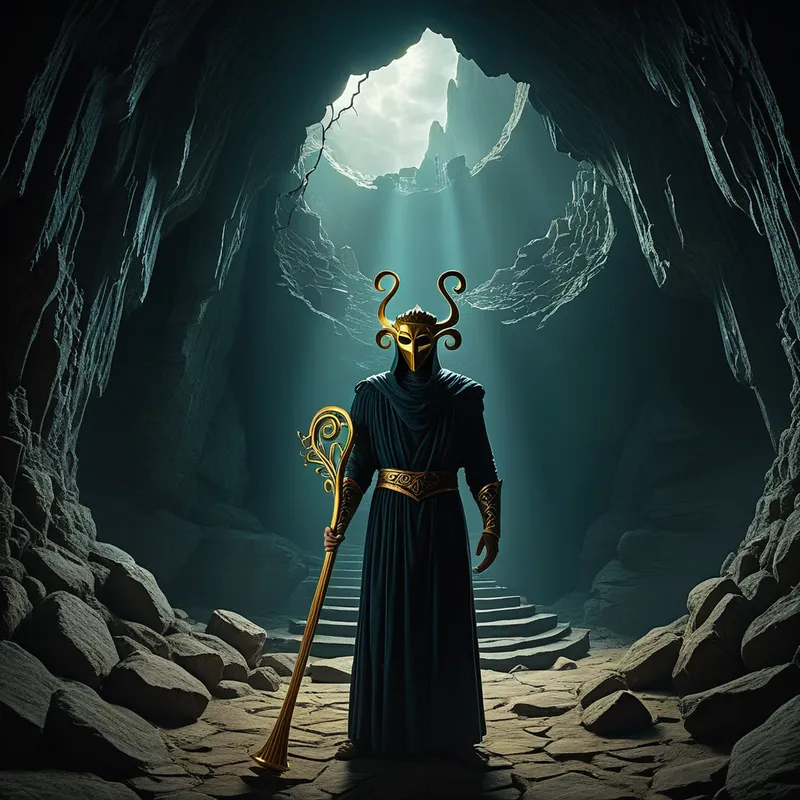
Orpheus's Descent Myth Meaning & Symbolism
A poet descends to the land of the dead to reclaim his love, armed only with music, but a single doubt shatters the impossible.
The Tale of Orpheus’s Descent
Hear now the song of the poet who loved with a force that shook the pillars of [the world](/myths/the-world “Myth from Tarot culture.”/). His name was [Orpheus](/myths/orpheus “Myth from Global/Universal culture.”/), and his music was not mere sound, but a power woven from the soul’s own threads. When he played, rivers halted their flow to listen, and oak trees tore their roots from [the earth](/myths/the-earth “Myth from Hindu culture.”/) to follow him. His heart belonged to Eurydice, a dryad whose laughter was like sunlight on leaves. But their joy was a fleeting season. On their wedding day, fleeing an ardent pursuer, Eurydice trod upon a viper in the tall grass. Its bite was a cold whisper, and her light was extinguished. Her shade was drawn down the long, silent road to the realm of [Hades](/myths/hades “Myth from Greek culture.”/).
Orpheus’s grief was a silence more terrible than any noise. His lyre lay mute. Then, from the depths of that silence, a madness of love was born—not to accept, but to defy. He would go where no living soul, armed with mere flesh and breath, had ever dared to return. Taking up his lyre, he journeyed to Taenarum, a fissure in the world that breathed the cold air of eternity. He descended.
The path was a throat of shadow. He faced Cerberus, the hound of eternity, whose three mouths yawned with hunger for the living. Orpheus did not raise a sword. He plucked a single, quivering chord. The song that spilled forth was the sound of all loss, all longing, all love that endures beyond the body. The beast’s snarls softened to whimpers; its great heads lay down, and it slept, dreaming of a gentler world.
Thus he passed into the [Underworld](/myths/underworld “Myth from Greek culture.”/). Before the ebony thrones of Hades and his queen, [Persephone](/myths/persephone “Myth from Greek culture.”/), Orpheus played. He did not sing of his own pain, but of theirs. He sang of Hades’s abduction of [Persephone](/myths/persephone “Myth from Greek culture.”/), of the love that bloomed in the dark, of the bittersweet cycle of life and death that their union governed. He sang of the truth that even here, in this sunless kingdom, love was the first and final law.
The music seeped into the stone. The shades, who had forgotten the feel of tears, wept [ichor](/myths/ichor “Myth from Greek culture.”/). The wheel of [Ixion](/myths/ixion “Myth from Greek culture.”/) halted. The [water](/myths/water “Myth from Chinese culture.”/) that Danaïdes carried ceased its flow. [Tantalus](/myths/tantalus “Myth from Greek culture.”/) forgot his thirst. For the first and only time, the silence of death was broken not by lament, but by beauty so pure it became a plea.
Moved by a compassion never before recorded, Persephone shed a single, dark tear. Hades, the Unsmiling One, spoke. Eurydice would be returned. But a condition was set, a law of the unseen world: Orpheus must walk ahead, and she would follow, guided by the sound of his footsteps. He must not turn to look upon her until they had both passed fully into the world of light and living air. If he looked back, the gift would be revoked forever.
Hope, a more terrifying burden than despair, now rested on his shoulders. He began the ascent, the sound of a faint, shuffling step echoing behind him. Was it her? Was it merely the echo of his own heart? The climb was an agony of doubt. Each step was a question. As the first grey hint of mortal daylight filtered down, a panic seized him—a fear that he was alone, that the gods had tricked him, that she was not there. At the very threshold of life, with the world of the living just a breath away, he turned.
For one fractured, eternal moment, he saw her. Her eyes met his, filled not with accusation, but with an infinite, tender sorrow. Then, as if made of mist, she was drawn back into the depths, her whisper of “Farewell” lost in the sigh of [the underworld](/myths/the-underworld “Myth from Greek culture.”/) wind. His outstretched hand grasped only empty, cold air. The [gates of Hades](/myths/gates-of-hades “Myth from Greek culture.”/) closed, and this time, his music could not open them.

Cultural Origins & Context
The myth of Orpheus is one of the most resonant and enduring in the Western canon, with roots stretching deep into the pre-classical world of Thrace. Unlike the purely heroic or divine cycles, the Orphic tales sit at [the crossroads](/myths/the-crossroads “Myth from Celtic culture.”/) of religion, poetry, and mystery cult. The stories were central to Orphism, a mystical movement that promised initiates a better fate in the afterlife through asceticism and secret knowledge. Orpheus was thus not just a character, but a prophet and a culture hero.
The primary sources for his descent are the Roman poets, particularly Virgil in his Georgics and Ovid in the [Metamorphoses](/myths/metamorphoses “Myth from Greek culture.”/). These literary retellings codified the narrative we know today, transforming older, perhaps more ritualistic, versions into high poetry. In Greek society, where the finality of death in Hades’s realm was a grim given, the myth served a profound function. It explored the ultimate human fantasy: the power to reverse death itself. Yet, it also reinforced a fundamental cosmic and social order. The condition set by Hades is not arbitrary cruelty; it is [the law](/myths/the-law “Myth from Biblical culture.”/) of the boundary between life and death, a boundary that even divine art can bend but not permanently break. The myth was a cautionary tale about the limits of human endeavor, even when fueled by supreme talent and love, and about the tragic cost of doubt.
Symbolic Architecture
At its [heart](/symbols/heart “Symbol: The heart symbolizes love, emotion, and the core of one’s existence, representing deep connections with others and self.”/), Orpheus’s descent is a map of the [psyche](/myths/psyche “Myth from Greek culture.”/) confronting its deepest [trauma](/symbols/trauma “Symbol: A deeply distressing or disturbing experience that overwhelms the psyche, often manifesting in dreams as unresolved emotional wounds or psychological injury.”/): irreversible [loss](/symbols/loss “Symbol: Loss often symbolizes change, grief, and transformation in dreams, representing the emotional or psychological detachment from something or someone significant.”/). Orpheus himself symbolizes the conscious ego, the part of us that believes in its own power—here, the power of art, [memory](/symbols/memory “Symbol: Memory symbolizes the past, lessons learned, and the narratives we construct about our identities.”/), and will—to rectify a catastrophic [rupture](/symbols/rupture “Symbol: A sudden break or tear in continuity, often representing abrupt change, separation, or the shattering of established patterns.”/) in our world. Eurydice represents the lost content of the [soul](/symbols/soul “Symbol: The soul represents the essence of a person, encompassing their spirit, identity, and connection to the universe.”/): a vital [aspect](/symbols/aspect “Symbol: A distinct feature, quality, or perspective of something, often representing a partial view of a larger whole.”/) of [life](/symbols/life “Symbol: The symbol of ‘Life’ represents a journey of growth, interconnectedness, and existential meaning, encompassing both the joys and challenges that define human experience.”/), joy, or love that has been suddenly taken into the unconscious (the [Underworld](/symbols/underworld “Symbol: A symbolic journey into the unconscious, representing exploration of hidden aspects of self, transformation, or confronting repressed material.”/)).
The descent is not a failure, but the necessary journey to confront the fact of loss itself. To truly grieve, one must first go to the land where the lost thing resides.
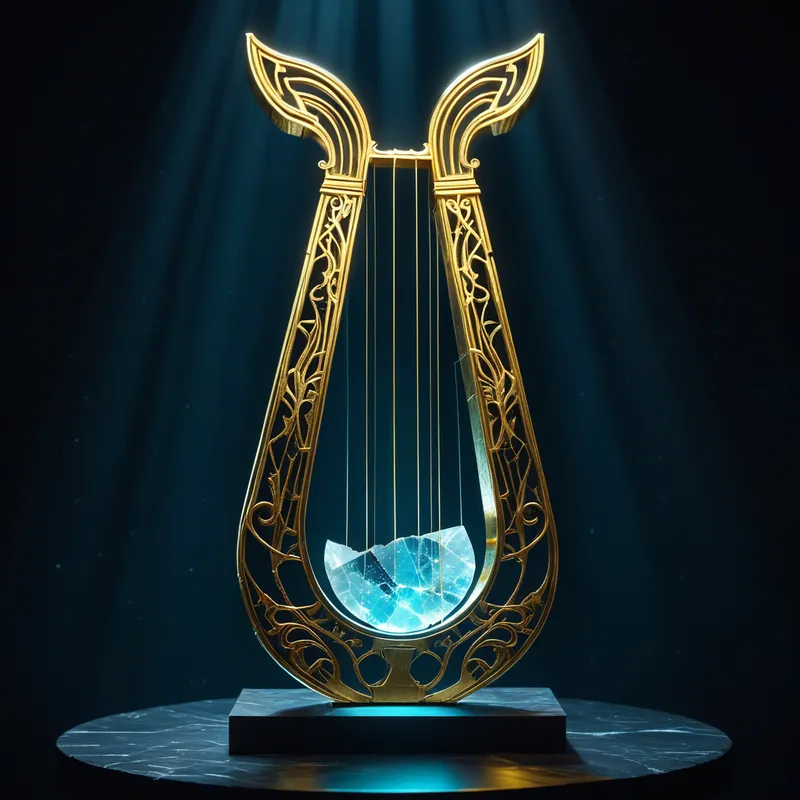
The [lyre](/symbols/lyre “Symbol: The lyre symbolizes harmony, creativity, and the connection between the divine and human experiences.”/) is the [instrument](/symbols/instrument “Symbol: An instrument symbolizes creativity, communication, and the means by which one expresses oneself or influences the world.”/) of [consciousness](/symbols/consciousness “Symbol: Consciousness represents the state of awareness and perception, encompassing thoughts, feelings, and experiences.”/)—[language](/symbols/language “Symbol: Language symbolizes communication, understanding, and the complexities of expressing thoughts and emotions.”/), reason, creative [expression](/symbols/expression “Symbol: Expression represents the act of conveying thoughts, emotions, and individuality, emphasizing personal communication and creativity.”/)—that seeks to negotiate with the unconscious powers ([Hades](/symbols/hades “Symbol: Greek god of the underworld, representing death, the unconscious, and hidden aspects of existence.”/) and Persephone). Its success in charming the guardians shows that the unconscious is responsive to the [authentic voice](/symbols/authentic-voice “Symbol: The ‘Authentic Voice’ symbolizes the true expression of self, encompassing personal beliefs, emotions, and individuality.”/) of the soul’s pain. The [condition](/symbols/condition “Symbol: Condition reflects the state of being, often focusing on physical, emotional, or situational aspects of life.”/)—“do not look back”—is the archetypal test of [faith](/symbols/faith “Symbol: A profound trust or belief in something beyond empirical proof, often tied to spiritual conviction or deep-seated confidence in people, ideas, or outcomes.”/). It represents the fragile thread of trust required to integrate a lost part of [the self](/myths/the-self “Myth from Jungian culture.”/). To “look back” is to succumb to [the ego](/myths/the-ego “Myth from Jungian culture.”/)’s doubt, its need for premature, sensory confirmation, which disrupts the slow, invisible process of psychic [integration](/symbols/integration “Symbol: The process of unifying disparate parts of the self or experience into a cohesive whole, often representing psychological wholeness or resolution of internal conflict.”/). The backward [glance](/symbols/glance “Symbol: A brief, often unspoken visual connection between people, suggesting fleeting attention, hidden interest, or social assessment.”/) is the [moment](/symbols/moment “Symbol: The symbol of a ‘moment’ embodies the significance of transient experiences that encapsulate emotional depth or pivotal transformations in life.”/) the conscious mind, terrified of the dark and the unseen, reasserts control and in doing so, destroys the very possibility of healing.
The Dreamer’s Resonance
When this myth patterns a modern dream, the dreamer is likely in the throes of a profound psychological process of retrieval and grief. They are attempting to bring something vital back from the “underworld” of their own unconscious—a lost passion, a forgotten talent, a sense of self that faded after a trauma, or the integrated memory of a lost loved one.
The somatic feeling is often one of tense, agonizing anticipation—walking forward in darkness, listening intently for a sign of presence behind you. The dream landscape may feature long corridors, dark tunnels, or ascending staircases where turning around is a palpable temptation. The dreamer might hear footsteps or whispers but be forbidden from looking. The moment of “the turn” in the dream is often accompanied by a jolt of anxiety or profound despair upon waking. This dream pattern signals that the dreamer’s conscious mind is engaged in the work, but its doubt and impatience—its need to see and control the healing process—are actively sabotaging it. The psyche is dramatizing the core conflict between the desire to heal and the inability to surrender to the process.

Alchemical Translation
In the alchemy of individuation, Orpheus’s journey models the [nigredo](/myths/nigredo “Myth from Alchemical culture.”/), the blackening, the descent into [the prima materia](/myths/the-prima-materia “Myth from Alchemical culture.”/) of one’s deepest pain. The goal is not to rescue a static past (the old Eurydice), but to undergo a transmutation where both the ego (Orpheus) and the lost content are changed by the journey.
The triumph is not in the retrieval, but in the transformation of the one who dared to descend. The poet who returns is not the same as the one who left; he carries the knowledge of the underworld in his silenced song.
The “failure” at [the threshold](/myths/the-threshold “Myth from Folklore culture.”/) is, paradoxically, essential. A successful return with Eurydice would mean the ego had completely conquered death, an inflation that would sever it from humanity and the natural cycle. The tragic loss forces the integration inward. Orpheus’s subsequent wandering and dismemberment (in the later parts of his myth) speak to the final stage: the conscious personality, shattered by its encounter with the absolute, must be dissolved so that a more holistic consciousness can emerge. For the modern individual, the myth teaches that we descend to our wounds not to “fix” them, but to be reshaped by them. Our art, our love, our will can win us an audience with our deepest shadows, but the final integration requires a faith that operates beyond the need for proof—a faith that, as the myth shows, is agonizingly difficult to sustain. The legacy is not in the rescue, but in the depth of the song that made the attempt possible.
Associated Symbols
Explore related symbols from the CaleaDream lexicon: