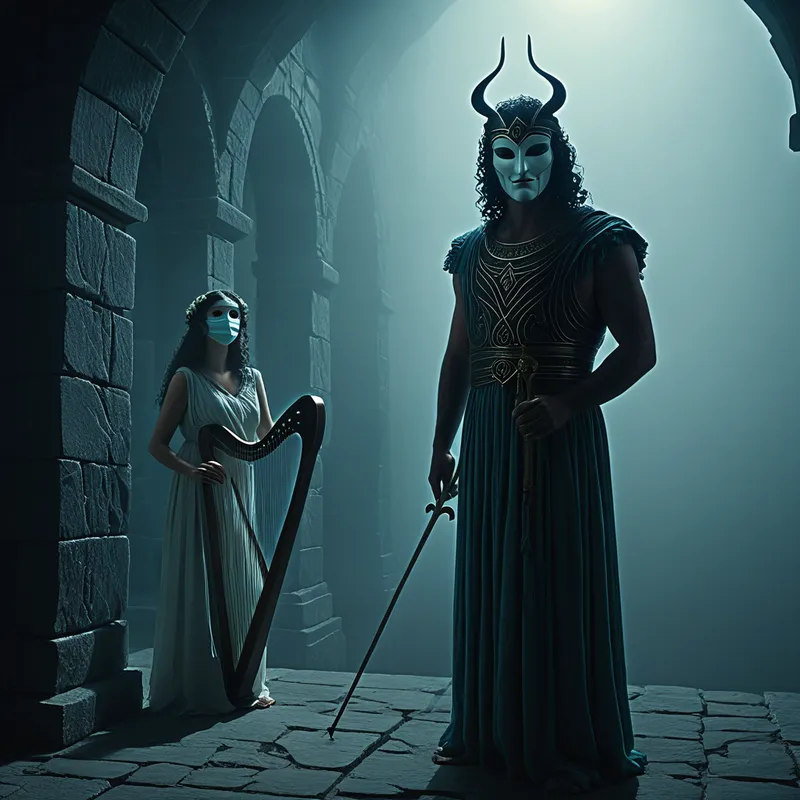
Orpheus looking back at Eurydi Myth Meaning & Symbolism
A poet descends to the underworld to retrieve his lost love, but a single glance of doubt shatters the miracle, losing her forever.
The Tale of Orpheus looking back at Eurydi
Hear now the song of the poet who moved stone and silenced hell. His name was [Orpheus](/myths/orpheus “Myth from Global/Universal culture.”/), whose voice was not his own but a gift from Apollo, and whose lyre could charm the very trees to dance. His heart belonged to Eurydice, a spirit of the woods whose laughter was the sound of clear [water](/myths/water “Myth from Chinese culture.”/) over stone. But fate is a serpent in the grass. On their wedding day, fleeing a satyr’s unwanted advance, Eurydice stepped upon a viper’s nest. The bite was swift, her life fleeting as a sigh. She was gone, her light extinguished, drawn down the dark path to the realm of [Hades](/myths/hades “Myth from Greek culture.”/).
Orpheus’s grief was a sound [the world](/myths/the-world “Myth from Tarot culture.”/) had never heard. His songs turned to dirges that wilted flowers. But within his sorrow, a mad, divine resolve was forged. He would not plead with the heavens; he would challenge the depths. Taking only his lyre, he found the entrance at Taenarum and descended. The air grew cold and thick with the whispers of the dead. He passed [the ferryman](/myths/the-ferryman “Myth from Various culture.”/) Charon, lulling him with a melody of such profound homesickness that the oar fell still. He stood before the three-headed hound Cerberus, and sang a lullaby of such stillness that the beast lay down to dream.
Finally, in the silent throne room of shadows, he stood before the pale king Hades and his queen, [Persephone](/myths/persephone “Myth from Greek culture.”/). He did not demand. He played. He sang of love that defies season, of a beauty that should not belong to decay, of a union severed before its time. His music was so pure, so utterly devoid of guile, that it stirred a memory of sunlight in that sunless place. For the first time, the wailing of the shades ceased. [The Furies](/myths/the-furies “Myth from Greek culture.”/), those avengers, paused to weep black tears. Moved by a grace unknown in his dominion, Hades granted the impossible. Eurydice could follow Orpheus back to the world of the living. But on one condition, a law of the deep earth: Orpheus must walk ahead and not look back at her until both had fully emerged into the light. A test of trust in the unseen.
The ascent began. Orpheus led, his ears straining for a footfall, a breath, the rustle of her ghostly gown. He heard only the echo of his own desperate heart. The path was steep, dark, and endless. Doubt, a seed planted by the very silence he had conquered, began to grow. Was she there? Had the lords of the dead tricked him? Was he leading only a phantom, a cruel echo of his own hope? The weight of the unseen became unbearable. Just as the first grey hint of mortal daylight filtered through the cavern mouth, as he himself stepped into the air, his faith broke. He turned. For a single, devastating moment, he saw her—beautiful, real, her eyes meeting his with a love already turning to sorrow. Then, as the condition shattered, she was pulled back, not with a cry, but with a whisper. “Farewell.” Her form dissolved into [the mist](/myths/the-mist “Myth from Celtic culture.”/), fainter than a memory. His hand grasped only empty air. The gates of Hades closed forever. This time, no song could open them.

Cultural Origins & Context
This cornerstone of Western mythology originates from the Greek world, most famously preserved in the works of the Roman poet Ovid in his [Metamorphoses](/myths/metamorphoses “Myth from Greek culture.”/) and the poet Virgil in his Georgics. It was a tale told and retold, not as mere entertainment, but as a foundational narrative about the limits of human art and the tragic nature of the human condition. Orpheus, as the archetypal poet, represents the highest human achievement: art so powerful it can momentarily suspend the laws of nature and death. The myth was central to Orphic mystery cults, which saw in his descent and failure a map of the soul’s journey—its divine origin, its fall into bodily existence, and its struggle for purification and return. The story functioned as a societal meditation on the power and ultimate insufficiency of [logos](/myths/logos “Myth from Christian culture.”/) (reason, art, speech) in the face of ananke (necessity, fate, death). It was a warning and a consolation, acknowledging both our transcendent aspirations and our inescapable mortal flaws.
Symbolic Architecture
The myth is a perfect, painful diagram of the [psyche](/myths/psyche “Myth from Greek culture.”/)’s confrontation with [loss](/symbols/loss “Symbol: Loss often symbolizes change, grief, and transformation in dreams, representing the emotional or psychological detachment from something or someone significant.”/) and the unconscious. Orpheus’s descent is the heroic [journey](/symbols/journey “Symbol: A journey in dreams typically signifies adventure, growth, or a significant life transition.”/) into the [shadow](/symbols/shadow “Symbol: The ‘shadow’ embodies the unconscious, repressed aspects of the self and often represents fears or hidden emotions.”/), the [underworld](/symbols/underworld “Symbol: A symbolic journey into the unconscious, representing exploration of hidden aspects of self, transformation, or confronting repressed material.”/) of repressed [trauma](/symbols/trauma “Symbol: A deeply distressing or disturbing experience that overwhelms the psyche, often manifesting in dreams as unresolved emotional wounds or psychological injury.”/), [grief](/symbols/grief “Symbol: A profound emotional response to loss, often manifesting as deep sorrow, yearning, and a sense of emptiness.”/), and forgotten parts of [the self](/myths/the-self “Myth from Jungian culture.”/) (Eurydice). His art is the conscious discipline ([music](/symbols/music “Symbol: Music in dreams often symbolizes the harmony between the conscious and unconscious mind, illustrating emotional expression and communication.”/), therapy, introspection) that can negotiate with these dark forces.
The condition—do not look back—is the supreme law of psychic integration: trust the process. The nascent self, retrieved from the depths, must be given space to follow in its own time, without the crushing scrutiny of the conscious ego.
The [glance](/symbols/glance “Symbol: A brief, often unspoken visual connection between people, suggesting fleeting attention, hidden interest, or social assessment.”/) backward is not curiosity; it is [the ego](/myths/the-ego “Myth from Jungian culture.”/)’s doubt, its need for premature confirmation, its inability to tolerate the [ambiguity](/symbols/ambiguity “Symbol: A state of uncertainty or multiple possible meanings, often found in abstract art and atonal music where clear interpretation is intentionally elusive.”/) of [faith](/symbols/faith “Symbol: A profound trust or belief in something beyond empirical proof, often tied to spiritual conviction or deep-seated confidence in people, ideas, or outcomes.”/). It is the controlling intellect demanding proof of the healing it has set in [motion](/symbols/motion “Symbol: Represents change, progress, or the flow of life energy. Often signifies transition, personal growth, or the passage of time.”/), thereby poisoning that very healing. Eurydice’s second [death](/symbols/death “Symbol: Symbolizes transformation, endings, and new beginnings; often associated with fear of the unknown.”/) represents the most profound psychological [truth](/symbols/truth “Symbol: Truth represents authenticity, honesty, and the quest for knowledge beyond mere appearances.”/): some losses, once integrated, cannot be returned to their previous, naive state. The old [relationship](/symbols/relationship “Symbol: A representation of connections we have with others in our lives, often reflecting our emotional state.”/) is gone forever. What is retrieved is not the literal past, but its meaning—and that meaning is often sealed by the act of losing it a second, conscious time. Orpheus is left not with his [bride](/symbols/bride “Symbol: A bride symbolizes new beginnings, commitment, and the transition into a partnership or a new phase in life.”/), but with his art, now deepened by an irreversible, tragic understanding.
The Dreamer’s Resonance
When this myth patterns a modern dream, the dreamer is likely in a critical phase of retrieving something vital from their personal unconscious—a lost passion, a childhood wound, a disowned talent, or the memory of a lost loved one. The somatic feeling is one of agonizing tension: walking forward with a fragile hope, feeling a presence just behind, coupled with a terrifying uncertainty.
Dreams of losing someone as you turn a corner, of a phone call disconnected just as connection is made, or of a door closing on a beloved face—all are echoes of the Orphic glance. The psychological process is the struggle between the ego’s desire for control and the psyche’s organic, often unseen, timeline for healing. The dream signals that the dreamer’s doubt or impatience (“looking back” through obsessive analysis, demanding premature closure, or clinging to the form of what was lost) is actively sabotaging a delicate process of internal recovery. [The underworld](/myths/the-underworld “Myth from Greek culture.”/) in the dream may be a labyrinthine office, a decaying childhood home, or a vast, dark landscape—all symbols of the inner world where the lost soul-fragment resides.

Alchemical Translation
In the alchemical vessel of individuation, the Orpheus myth models the stage of mortificatio and failed sublimatio. The descent (descensus ad inferos) is the necessary dissolution of the conscious attitude into [the prima materia](/myths/the-prima-materia “Myth from Alchemical culture.”/) of the unconscious. The retrieval of Eurydice is the promise of the coniunctio, [the sacred marriage](/myths/the-sacred-marriage “Myth from Various culture.”/) of conscious and unconscious that produces the philosopher’s stone—the integrated Self.
The failure is not the end of the work, but its most crucial ingredient. The irreversible loss transmutes the lead of naive longing into the gold of tragic wisdom.
Orpheus’s ultimate fate—being torn apart by [Maenads](/myths/maenads “Myth from Greek culture.”/)—speaks to the final stage. His conscious, artistic ego is dismembered, but his head, still singing, floats down a river. This signifies that the ego-structure that failed (by looking back) must be sacrificed. What remains and endures is the pure, autonomous voice of the Self, the transcendent function that continues its song even from beyond egoic control. For the modern individual, the alchemical translation is this: we must undertake the descent into our pain and loss. We may, inevitably, “look back” and fail to restore the past in its original form. But that very failure, if fully suffered, kills our childish hope of return and initiates us into a deeper, more resonant wholeness. Our “song” after the failure is not one of happy reunion, but one of authentic, hard-won meaning—the only [thing](/myths/thing “Myth from Norse culture.”/) we can truly bring back from the [underworld](/myths/underworld “Myth from Greek culture.”/).
Associated Symbols
Explore related symbols from the CaleaDream lexicon: