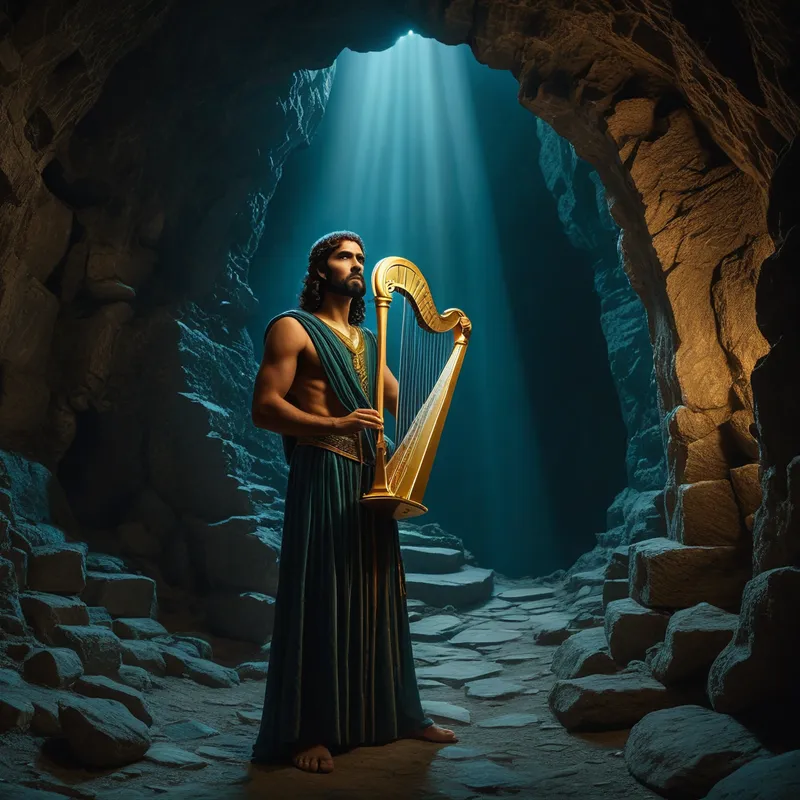
Orpheus and Eurydice Myth Meaning & Symbolism
A poet descends to the land of the dead to reclaim his lost love, granted a single condition he cannot fulfill.
The Tale of Orpheus and Eurydice
Hear now the song of the poet who loved with a force that shook the pillars of [the world](/myths/the-world “Myth from Tarot culture.”/). His name was [Orpheus](/myths/orpheus “Myth from Global/Universal culture.”/), son of the muse Calliope, and his voice was not his own but a gift from the gods. When he sang, rivers ceased their flow to listen. Oaks and stones pulled themselves from [the earth](/myths/the-earth “Myth from Hindu culture.”/) to follow his melody. And his heart belonged wholly to Eurydice, a dryad whose laughter was like sunlight on [water](/myths/water “Myth from Chinese culture.”/).
Their joy was a brief, perfect chord. On their wedding day, fleeing the unwanted advances of the shepherd Aristaeus, Eurydice trod upon a nest of vipers in the tall grass. A single bite, a cry cut short, and her light was extinguished. Her shade was swept down the dark river Styx to the realm of [Hades](/myths/hades “Myth from Greek culture.”/).
Orpheus’s world turned to ash. His songs became dirges that made the heavens weep. But love, true love, is a madness that fears no darkness. Taking only his lyre, the poet descended. He walked paths no living foot should tread, past [the ferryman](/myths/the-ferryman “Myth from Various culture.”/) Charon, whom he lulled with song. He passed the three-headed hound Cerberus, who lay down, whimpering, at his melody. He stood at last in the bone-chilling silence of the throne room of Hades and his queen, [Persephone](/myths/persephone “Myth from Greek culture.”/).
There, he did not demand. He poured out his grief. He sang of Eurydice’s warmth, of the emptiness of the world without her, of a love that defied the very order of life and death. The music was so pure, so full of raw, human ache, that the iron heart of Hades softened. The eternally weeping Furies wiped their eyes. The wheel of [Ixion](/myths/ixion “Myth from Greek culture.”/) stopped its turning.
Moved by this testament, Hades granted the impossible. Eurydice could follow Orpheus back to the world of the living. But on one condition, a law of [the underworld](/myths/the-underworld “Myth from Greek culture.”/): Orpheus must walk ahead and not look back at her until both had reached the sunlight. If he turned, even once, she would be lost to him forever.
Hope, a fragile, terrifying [thing](/myths/thing “Myth from Norse culture.”/), bloomed in Orpheus’s chest. He turned and began the long ascent, hearing only the faintest whisper of a footfall behind him. Was it her? Was it the echo of his own desperate hope? The tunnel was endless, black, silent but for the pounding of his heart. With each step, doubt coiled tighter around his mind. Had the gods tricked him? Was she truly there? Had she fallen behind? The weight of the condition became unbearable. Just as the first grey hint of mortal light touched the tunnel’s mouth, as relief should have been his, the terror of loss overcame the command of the god. He turned.
For one fleeting, eternal moment, he saw her. His Eurydice, her form already fading, her eyes filled not with accusation, but with an infinite, gentle sorrow. Her lips formed his name, a sound lost to [the void](/myths/the-void “Myth from Buddhist culture.”/). Then she was gone, not with a cry, but with a sigh, pulled back into the depths from which she had almost escaped. His hand clutched only empty, cold air. The silence that followed was more complete than any he had ever known.
Cultural Origins & Context
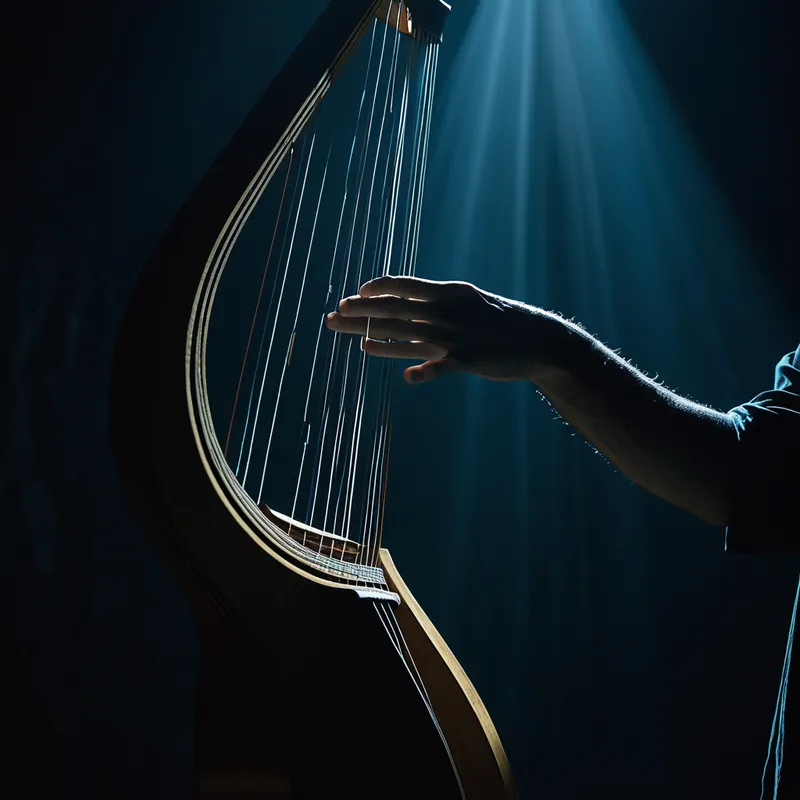
The myth of Orpheus and Eurydice is not a single, canonical text but a tapestry woven from many looms. Its most famous telling comes from the Roman poet Ovid in his [Metamorphoses](/myths/metamorphoses “Myth from Greek culture.”/), and the poet Virgil in the Georgics. However, its roots are deeply Orphic, connected to a powerful mystic cult that flourished in the 6th century BCE. Orpheus was more than a character; he was a prophet, the supposed founder of these Mysteries, which promised initiates a better fate in the afterlife.
The story functioned on multiple levels in Greek culture. On one hand, it was a profound tragedy about the human condition, exploring the limits of love and art in the face of absolute law (the laws of [Themis](/myths/themis “Myth from Global/Universal culture.”/) and Ananke). On another, it was a theological narrative for the Orphics, illustrating the soul’s ([psyche](/myths/psyche “Myth from Greek culture.”/)) descent into incarnation and its painful, often failed, attempt to ascend back to divine unity. It was performed, sung, and ritualized, serving as both entertainment and a somber meditation on the price of consciousness and the fragility of redemption.
Symbolic Architecture
At its core, this is a myth about the [tension](/symbols/tension “Symbol: A state of mental or emotional strain, often manifesting physically as tightness, pressure, or unease, signaling unresolved conflict or anticipation.”/) between [faith](/symbols/faith “Symbol: A profound trust or belief in something beyond empirical proof, often tied to spiritual conviction or deep-seated confidence in people, ideas, or outcomes.”/) and sensory proof, between [the directive](/symbols/the-directive “Symbol: An authoritative instruction or command from a higher power, institution, or authority figure that demands compliance or action.”/) of the [soul](/symbols/soul “Symbol: The soul represents the essence of a person, encompassing their spirit, identity, and connection to the universe.”/) and the compulsion of [the ego](/myths/the-ego “Myth from Jungian culture.”/). Orpheus is not just a [lover](/symbols/lover “Symbol: A lover in dreams often represents intimacy, connection, and the emotional aspects of relationships.”/); he is the archetypal [Artist](/symbols/artist “Symbol: An artist symbolizes creativity, expression, and the exploration of the human experience through various forms of art.”/). His [music](/symbols/music “Symbol: Music in dreams often symbolizes the harmony between the conscious and unconscious mind, illustrating emotional expression and communication.”/) is the power of the authentic Self, the Self, which can charm even the lords of [death](/symbols/death “Symbol: Symbolizes transformation, endings, and new beginnings; often associated with fear of the unknown.”/). His descent is the heroic [journey](/symbols/journey “Symbol: A journey in dreams typically signifies adventure, growth, or a significant life transition.”/) into the unconscious, the [shadow](/symbols/shadow “Symbol: The ‘shadow’ embodies the unconscious, repressed aspects of the self and often represents fears or hidden emotions.”/) [realm](/symbols/realm “Symbol: The symbol of ‘Realm’ often signifies the boundaries of one’s consciousness, experiences, or emotional states, suggesting aspects of reality that are either explored or ignored.”/), to retrieve a lost value ([anima](/symbols/anima “Symbol: The feminine archetype within the male unconscious, representing soul, creativity, and connection to the inner world.”/), inspiration, wholeness).
The condition—do not look back—is the ultimate test of faith in the unseen process. It is the law of psychic integration: you cannot stare directly at the transforming content of the unconscious as it emerges, or it will dissolve.
Eurydice represents the soul-[image](/symbols/image “Symbol: An image represents perception, memories, and the visual narratives we create in our minds.”/), the lost [connection](/symbols/connection “Symbol: Connection symbolizes relationships, communication, and bonds among individuals.”/) to [life](/symbols/life “Symbol: The symbol of ‘Life’ represents a journey of growth, interconnectedness, and existential meaning, encompassing both the joys and challenges that define human experience.”/) and instinct that has been “bitten” by the [serpent](/symbols/serpent “Symbol: A powerful symbol of transformation, wisdom, and primal energy, often representing hidden knowledge, healing, or temptation.”/) of [trauma](/symbols/trauma “Symbol: A deeply distressing or disturbing experience that overwhelms the psyche, often manifesting in dreams as unresolved emotional wounds or psychological injury.”/), [accident](/symbols/accident “Symbol: An accident represents unforeseen events or mistakes that can lead to emotional turbulence or awakening.”/), or time. The [underworld](/symbols/underworld “Symbol: A symbolic journey into the unconscious, representing exploration of hidden aspects of self, transformation, or confronting repressed material.”/) is not merely a place of death, but the unconscious itself, where all that is lost to us resides. Orpheus’s fatal [glance](/symbols/glance “Symbol: A brief, often unspoken visual connection between people, suggesting fleeting attention, hidden interest, or social assessment.”/) is not simple impatience; it is the ego’s insistence on verification, on possessing and controlling the [mystery](/symbols/mystery “Symbol: An enigmatic, unresolved element that invites curiosity and exploration, often representing the unknown or hidden aspects of existence.”/) rather than trusting in its gradual, unseen restoration. He looks to know, and in that knowing, he loses. The myth tells us that some truths can only be approached indirectly, and some unions can only be completed in darkness.

The Dreamer’s Resonance
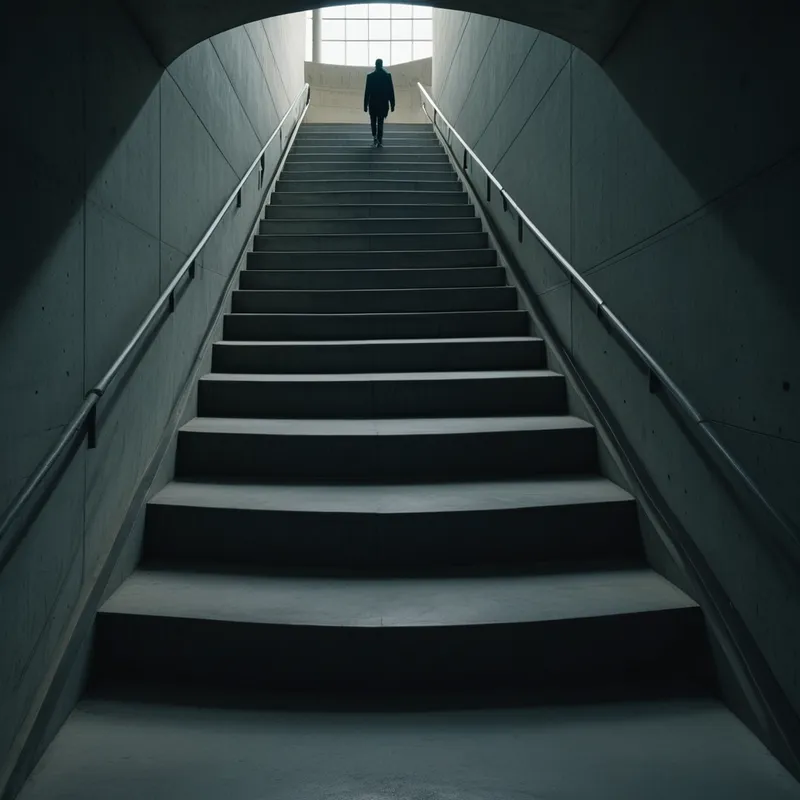
When this myth stirs in the modern dreamer, it often manifests as a profound somatic anxiety around a process of recovery or creation. You may dream of leading someone by the hand out of a dark place, but you dare not turn to see their face. You may dream of working on a crucial project, only to have it disintegrate the moment you check on its progress. The dream landscape is often a tunnel, a long corridor, or a staircase—a liminal space between states.
Psychologically, this signals a critical phase in integrating a lost part of [the self](/myths/the-self “Myth from Jungian culture.”/) or healing a deep wound. The “Eurydice” in the dream is a recovering trauma, a nascent talent, a mending relationship, or a new psychological insight. The “Orpheus” is the conscious mind attempting to guide it into the light of daily life. The intense anxiety in the dream is the ego’s terror of the void, its lack of trust in the autonomous healing processes of the psyche. The dream is a warning from the unconscious: to succeed, you must surrender the need for constant reassurance and control. The glance back is the act of applying old, critical consciousness to a fragile, new growth, thereby killing it.
Alchemical Translation
The alchemical journey of individuation is mirrored perfectly in this myth. The [nigredo](/myths/nigredo “Myth from Alchemical culture.”/), the blackening, is the death of Eurydice and Orpheus’s despair—the necessary dissolution of the old, naive conscious attitude. The descent is the [solutio](/myths/solutio “Myth from Alchemical culture.”/), a dissolving into the unconscious waters to retrieve the [prima materia](/myths/prima-materia “Myth from Alchemical culture.”/), the raw soul-stuff (Eurydice).
The ascent from the underworld is the albedo, the whitening, where the purified elements are brought toward consciousness. The fatal glance is the failed coniunctio—the marriage of conscious and unconscious is aborted at the very threshold.
For the modern individual, the myth models a painful but essential truth: transformation requires a death and a journey to the [underworld](/myths/underworld “Myth from Greek culture.”/) of one’s own psyche. We all must go down to reclaim what we have lost—our vitality, our creativity, our love for life. The gods (the unconscious Self) may grant us a chance, but they impose the stern law of the process. We cannot force insight; we cannot demand to see the healing as it happens. We must walk forward in the darkness, trusting the faint footfall behind us. The ultimate tragedy—and teaching—of Orpheus is that he achieves the impossible (the descent and the bargain) but fails at the seemingly simple (the trust). His subsequent wandering and dismemberment speak to the psychic fragmentation that follows when we violate the sacred law of our own becoming. The myth ends not with union in life, but with reunion in death—a poetic resolution that suggests some wholeness is only achieved beyond the ego’s desperate gaze, in the acceptance of a larger, more mysterious order.
Associated Symbols
Explore related symbols from the CaleaDream lexicon: