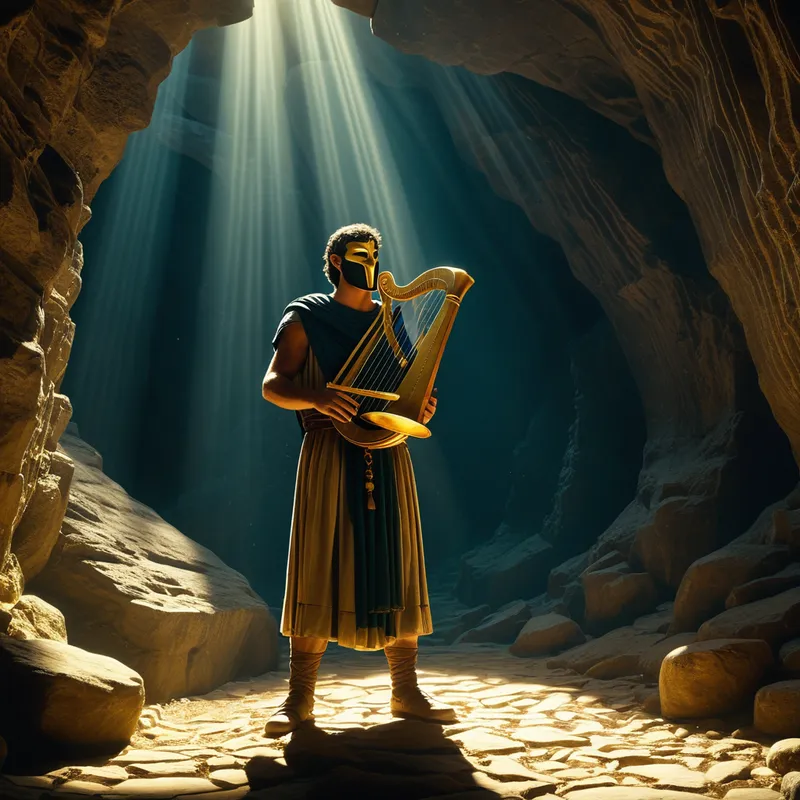
Orpheus Myth Meaning & Symbolism
A poet's music charms the underworld to retrieve his lost love, but a single glance of doubt shatters the miracle, leaving only his song behind.
The Tale of Orpheus
Listen, and you will hear the story of the sound that shook the foundations of the world.
In the wild, vine-clad hills of Thrace, a man was born with a god’s gift in his throat and a spirit in his hands. His name was Orpheus. When he sang, the oaks would tear their roots from the earth and shuffle closer to hear. Wolves would lay down their fury beside lambs. Rivers would pause in their courses, and stones would weep. His music was not mere entertainment; it was the hidden grammar of creation made audible. His greatest song, however, was his love for Eurydice. Her laughter was the counter-melody to his verses, and in her eyes, he saw the world made whole.
But the Fates, who spin their cruel threads, cut hers short. Fleeing an unwanted advance in a sun-dappled meadow, Eurydice stepped upon a nest of vipers. A single bite, a gasp, and the light fled from her eyes. Her shade was swept down the dark river Cocytus to the realm of Hades.
Orpheus’s world shattered into silent fragments. No song came, only a howl of grief that finally resolved into a single, mad purpose. He would go where no living soul may tread. Taking only his lyre, he descended through a crack in the world, past the grove of mourning poplars, to the black gates of the underworld. Before him lay the Charon, silent and grim, and the three-headed hound Cerberus, whose bark froze blood.
Orpheus did not fight. He did not plead. He simply played. He plucked a melody so pure with longing that it was the very sound of a soul remembering its other half. The notes fell like soft light into the gloom. The wails of the dead ceased. The fiery Phlegethon’s roar softened to a murmur. Cerberus lay down, all three heads dreaming. Charon, without a word, ferried him across the Styx. Even the wheel of Ixion stopped its turning.
In the bone-white palace of Hades and his queen, Persephone, Orpheus sang his petition. He sang of love, not as a fleeting passion, but as the fundamental law the universe forgets. He sang of the emptiness in the sunlit world without its shadow. His music was so true that for the first time, the dust of the dead remembered warmth. A tear, cold as a diamond, traced a path down Persephone’s cheek. Moved by a mercy unknown in that realm, Hades granted the impossible. Eurydice could follow Orpheus back to the land of the living. But on one condition, a law of the deep places: he must not look back at her until they both stood in the full light of the sun.
The ascent began. Orpheus led, his ears straining for a footfall, a sigh, the rustle of a shade behind him. He heard only the echo of his own desperate hope in the endless tunnel. Was she there? Had the gods tricked him? Was he leading only a memory? The silence behind him became a roar of doubt. As the first, faint grey light of the upper world kissed his brow, his faith broke. He turned. For one fleeting, eternal second, he saw her—his Eurydice, her face a mask of tender sorrow, her form already dissolving like mist in dawn’s light. Her whisper, “Farewell,” was swallowed by the darkness, pulling her back, forever this time.
The gates of hell closed with a finality that echoed in his soul. This time, no song could open them.

Cultural Origins & Context
The myth of Orpheus is a cornerstone of the Greek mythological tradition, most comprehensively told in the works of Roman poets like Ovid and Virgil. It belongs to a body of lore concerning heroic journeys to the underworld (a theme known as katabasis), but it is uniquely centered not on strength or cunning, but on the power of art and emotion. The story was not merely entertainment; it was a sacred narrative for the Orphic mysteries, a religious movement that promised its initiates a better fate in the afterlife through asceticism and ritual. In this context, Orpheus was a prophet and a theologian, his descent and failure a parable about the soul’s struggle with earthly attachment and divine law. The myth was performed, sung, and ritualized, serving as a societal vessel for exploring the most profound human anxieties about death, the limits of love, and the transcendent, yet perilous, power of creative genius.
Symbolic Architecture
At its heart, the myth of Orpheus is an anatomy of consciousness confronting the unconscious. Orpheus represents the ego, the performing, creative self that believes its art can order chaos. Eurydice symbolizes the soul-image or the lost content of the psyche—the intuitive, instinctive, and deeply connected part of life that is easily “bitten” and lost to the shadows of trauma or neglect.
The journey to the underworld is not a geographical trip, but a descent into the personal and collective unconscious, where the logic of the day-world holds no power.
His music, which charms the guardians of the deep, represents the authentic language of the psyche—poetry, melody, raw emotion—that can temporarily reconcile opposites and access realms where intellect fails. The fatal condition—do not look back—is the core paradox of psychological integration. It is the law of the unconscious: you cannot seize the retrieved content with the conscious, scrutinizing eye of doubt and possession. Integration requires trust in a process beyond egoic control, a faith in following the path while allowing the reclaimed self to follow in its own time and form. The glance is the ego’s insistence on verification, its tragic inability to surrender, which guarantees the loss it most fears.
The Dreamer’s Resonance
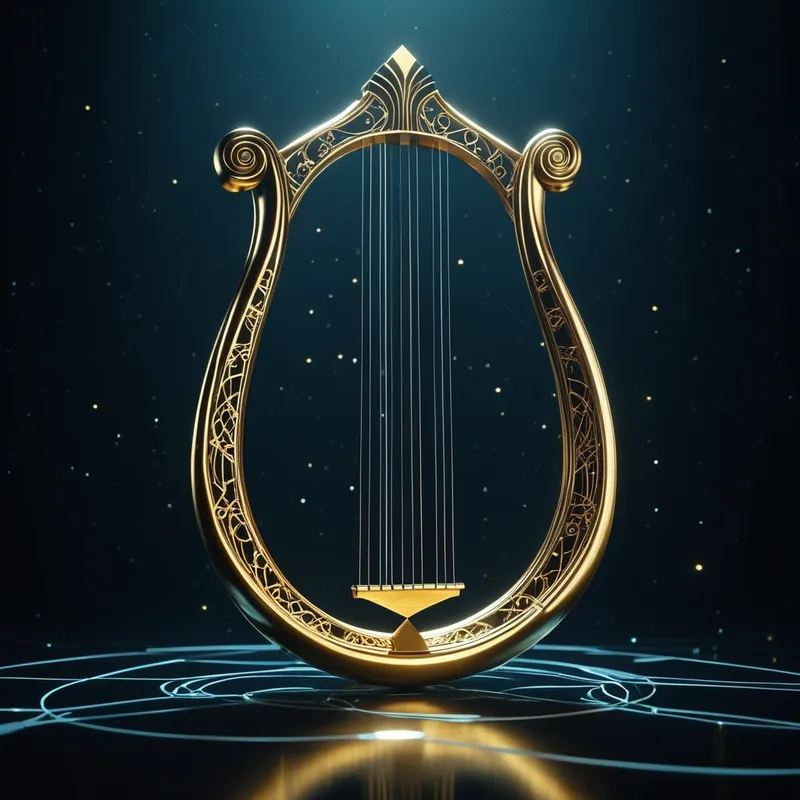
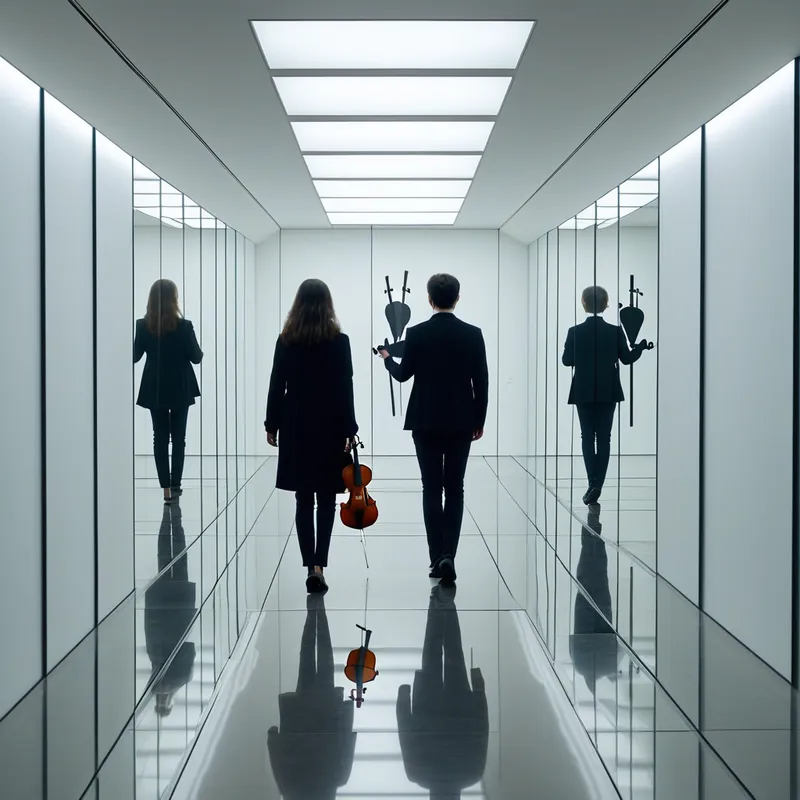
When this myth stirs in modern dreams, it often manifests as a profound somatic experience of almost. You may dream of finding a lost object or person, only to have it vanish as you reach for it. You may be leading someone by sound alone through a fog, terrified to turn around. The dream landscape is frequently a liminal space: a long corridor, a dark staircase, a tunnel between platforms. The emotional tone is one of acute, anxious yearning mixed with a dread of irreversible error.
Psychologically, this signals a process of retrieving a disowned part of the self—a forgotten passion, a buried trauma, a repressed talent. The dreamer is in the delicate phase where this content has been acknowledged and is being “led up” into consciousness. The intense anxiety mirrors Orpheus’s doubt. The body may feel heavy, the chest tight with the burden of this responsibility. The dream is the psyche’s rehearsal, warning that the old pattern of obsessive scrutiny, of needing to “see it to believe it,” could sabotage the nascent healing. The loss upon turning is felt not as sadness, but as a devastating collapse of potential, a return to a more barren inner world.
Alchemical Translation
The alchemical process mirrored in Orpheus’s saga is the Nigredo, the dark night of the soul, and the failed Coniunctio. His initial loss of Eurydice is the necessary dissolution, the crushing of the naive, conscious attitude. His descent is the courageous immersion in the prima materia of grief and shadow.
The triumph is not in the retrieval, but in the song that makes the retrieval possible. The failure is not the end, but the forging of a deeper, more tragic wisdom.
For the modern individual, the myth models the path of individuation not as a linear success story, but as a transformative failure. We all must descend with our unique “music”—our therapy, our art, our meditation—to face what we have lost. We may, like Orpheus, even be granted a glimpse of redemption. But the ultimate teaching is that some integrations cannot be completed by the conscious will alone. The “look back” is our hubris, our trauma response, our insecurity. The subsequent, final loss transmutes the individual. Orpheus is shattered, but his song remains, now infused with the knowledge of the depths. He becomes the archetypal artist whose creation is born not from perfect wholeness, but from sacred fracture. His legacy is not a rescued wife, but the eternal power of the lyric that once stopped hell itself—a power that now speaks directly to the hell and the heaven within every human heart. The work is not to avoid the glance, but to understand that after the glance, the song must change, and in that change lies the real, hard-won gold.
Associated Symbols
Explore related symbols from the CaleaDream lexicon:
- Mouth
- Music
- Instrument
- Musical
- Singer
- Tune
- Poem
- Musician
- Jaw
- Conductor
- Vintage Record Player
- Time Travel Device
- Digging Hole
- Forgotten Melody
- Misunderstood Artist
- Bard
- Melodic Bird of Paradise
- Dredger
- Celestial Music Box
- Phantom Violin
- Eloquent Poet
- Lively Musician
- Musician’s Instrument
- Miner’s Helmet
- Musical Score
- Electric Guitar
- Violin Bow
- Cello
- Lute
- Lyre
- Clavichord
- Theremin
- Bowed Psaltery
- Basset Horn
- Translucent Lute
- Mystical Theremin
- Glistening Oud
- Cascading Piano Keys
- Forgotten Baglama
- Ephemeral Dulcimer
- Harmonizing Theremin
- Echoing Cello
- Haunting Oboe
- Fractured Bassoon
- Veiled Bouzouki
- Glass Marimba
- Rustic Banjo
- Horned Lyre
- Mosaic Organ
- Guitar Hero Controller
- Karaoke Machine
- Musical Notes
- Jazz Club
- Guitar Picks
- Caroling
- Shakespeare’s Quill
- Beethoven’s Symphony
- Bob Marley’s Guitar
- Bard’s Lute
- Martin Luther King’s Speech
- Vincent van Gogh’s Starry Night
- Spanish Guitar
- Harmonium
- Echoing Symphony
- Sonic Artwork
- Thematic Soundtrack
- Nomadic Poet
- Veiled Poet
- Echoing Verses
- Melancholic Ballad
- Echoing Tuner
- Wired Headphones
- Sound Mixer
- Violin
- Acoustic Guitar
- Marimba
- Glass Harmonica
- Astrological Lyre
- Celestial Strings
- Harp
- Vintage Guitar
- Lyre of Dreams
- Harp of Hope
- Sapphire Tuner
- Magic Fretboard
- Vintage Music Room
- Street Musician
- Live Music Venue
- Concert Hall
- Authentic Voice
- Forsaken Path
- Riverbank Willow
- Shamanic Journey
- Hunger for the Abyss
- Graffiti Stone
- Gathering Drum
- Willow Tree
- Boughs of Willow
- Portable Drum
- Kagura Dance
- Shaman’s Rattle
- Mantra Chanting
- Melodic Drone
- Resonant Tone
- Melodic Harmony
- Anima’s Song
- 404 Error
- Resonance
- Vibration
- Overtone
- Sonic Bloom
- Sound Sculpture
- Sonic Texture
- Frequency Shift
- Sound Field
- Acoustic Flow
- Acoustic Gradient
- Sound Atmosphere
- Thermospheric Resonance
- Sonic Resonance
- Fourier Transform
- Assonance
- Modality
- Reanalysis
- Expressive
- Verse
- Shaft
- Sacrifice
- Soundtrack
- Necromancy
- Backward
- Counterclockwise
- Longing
- Yearning
- Faith
- Glimpsing