Orestes' Trial Myth Meaning & Symbolism
A son, haunted by his mother's Furies for avenging his father, stands trial before gods and men, forging a new justice from ancient blood.
The Tale of Orestes’ Trial
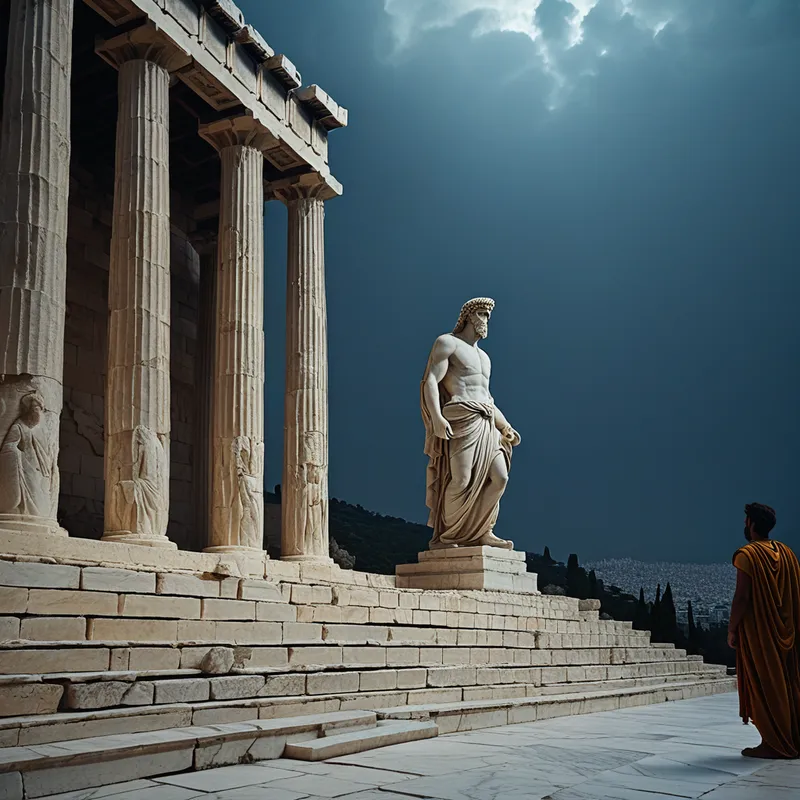
The air on the Areopagus was still and charged, heavy with the scent of olive wood and cold stone. It was a place of endings and, perhaps, beginnings. At its center stood [Orestes](/myths/orestes “Myth from Greek culture.”/), son of Agamemnon. His hands were stained, not with visible grime, but with a deed that had drawn the very darkness from beneath [the earth](/myths/the-earth “Myth from Hindu culture.”/). He had slain his mother, Clytemnestra, to avenge her murder of his father. A son’s duty fulfilled, a son’s ultimate crime committed.
And they had come for him. Not soldiers, but the Furies. Born from the blood of the primordial sky, they were ancient, older than [the Olympian gods](/myths/the-olympian-gods “Myth from Greek culture.”/) themselves. They appeared as haggard women with serpents for hair and eyes that wept black tears, or sometimes only as a chilling whisper, a coppery taste of fear, a relentless pressure behind the eyes. They had hounded Orestes across [the world](/myths/the-world “Myth from Tarot culture.”/), their voices the sound of his own guilt given form, shrieking of violated blood, of the sacred bond between mother and child torn asunder.
Driven to the edge of madness, Orestes had fled to the sanctuary of Phoebus Apollo at Delphi. The god of light and order had given him the very command: purify the stain of your father’s death. Now, Apollo stood beside him on [the Areopagus](/myths/the-areopagus “Myth from Greek culture.”/), a radiant shield against the clinging dark. Opposing them was the eldest of [the Furies](/myths/the-furies “Myth from Greek culture.”/), her voice like stone grinding on stone, demanding the ancient law: blood for blood. The cycle demanded its due.
To break the impasse, the goddess Athena, grey-eyed and grave, summoned a jury of the noblest Athenians. This was to be no petty squabble. It was the trial of the age, a clash of cosmic orders. The Furies sang of the old, primal [justice](/myths/justice “Myth from Tarot culture.”/), rooted in the family, in [the womb](/myths/the-womb “Myth from Various culture.”/), in vengeance. Apollo argued for the new, for the sanctity of the husband and king, for the rule of patriarchal law and civic order. Orestes stood silent, the human fulcrum upon which the universe threatened to tilt.
The votes were cast, each pebble dropping into the urn like a fate sealed. When they were counted, the votes were equal. All eyes turned to Athena. The goddess, born of no mother but sprung from the mind of Zeus, contemplated the trembling son and the furious avengers. Then she cast her vote for Orestes. “I am ever for the male,” she declared, honoring the father’s claim. Orestes was acquitted, free of the blood guilt.
But the Furies howled, threatening to blight the land that had denied them their due. With profound wisdom, Athena did not banish them. Instead, she offered them a new home, a new honor. She persuaded them to become the Eumenides, the “Well-Disposed Ones,” guardians of justice from beneath the earth, protectors of the city’s fertility and moral order. Their rage was not destroyed, but transformed. The ancient darkness was invited in, given a seat at [the hearth](/myths/the-hearth “Myth from Norse culture.”/), and in doing so, the world was made whole.
Cultural Origins & Context
The myth of Orestes’ Trial is the culminating drama of the Oresteia, a trilogy penned by the Athenian playwright Aeschylus in 458 BCE. It was performed at the City Dionysia, a major religious and civic festival, before the entire citizen body of Athens. This was not mere entertainment; it was a profound piece of civic theology and political discourse.
The story functioned as a foundational myth for the Athenian legal system, specifically for the homicide court of the Areopagus. Aeschylus’ drama provided a divine origin story for the court’s authority, showing it to be instituted by Athena herself. In an era when Athens was consolidating its democratic reforms and defining itself against older, tribal models of justice based on clan vengeance, the myth served a critical purpose. It dramatized the painful but necessary transition from a primitive, cyclical law of blood-feud to a civilized, rational law of the polis (city-state), where judgment is passed by a jury of peers and final authority rests with the community, not the individual.
Symbolic Architecture
At its [heart](/symbols/heart “Symbol: The heart symbolizes love, emotion, and the core of one’s existence, representing deep connections with others and self.”/), Orestes’ Trial is a myth about the [birth](/symbols/birth “Symbol: Birth symbolizes new beginnings, transformation, and the potential for growth and development.”/) of [consciousness](/symbols/consciousness “Symbol: Consciousness represents the state of awareness and perception, encompassing thoughts, feelings, and experiences.”/) from the [prison](/symbols/prison “Symbol: Prison in dreams typically represents feelings of restriction, confinement, or a lack of freedom in one’s life or mind.”/) of unconscious compulsion. Orestes is caught in an impossible bind, a double bind of divine commandments: the ancient, chthonic law of the [Mother](/symbols/mother “Symbol: The symbol of ‘Mother’ represents nurturing, protection, and the foundational aspect of one’s emotional being, often associated with comfort and unconditional love.”/) (avenge your mother’s [victim](/symbols/victim “Symbol: A person harmed by external forces, representing vulnerability, injustice, or sacrifice in dreams. Often symbolizes powerlessness or moral conflict.”/)) and the newer, Olympian law of the [Father](/symbols/father “Symbol: The father figure in dreams often symbolizes authority, protection, guidance, and the quest for approval or validation.”/) (avenge your father). He is not a [villain](/symbols/villain “Symbol: A character representing opposition, moral corruption, or suppressed aspects of self, often embodying fears, conflicts, or societal threats.”/), but a tragic [instrument](/symbols/instrument “Symbol: An instrument symbolizes creativity, communication, and the means by which one expresses oneself or influences the world.”/) through which a systemic conflict erupts.
The hero is not the one who avoids the crime, but the one who endures the consequences of the impossible choice, becoming the crucible for a higher synthesis.
The Furies symbolize the autonomous, unconscious [psyche](/myths/psyche “Myth from Greek culture.”/)—specifically, the raw, unprocessed force of [guilt](/symbols/guilt “Symbol: A painful emotional state arising from a perceived violation of moral or social standards, often tied to actions or inactions.”/), [shame](/symbols/shame “Symbol: A painful emotion arising from perceived failure or violation of social norms, often involving exposure of vulnerability or wrongdoing.”/), and the super-ego’s brutal, archaic voice. They are not “evil,” but are relentless in upholding an old, absolute order. Apollo represents [the principle](/symbols/the-principle “Symbol: A fundamental truth, law, or doctrine that serves as a foundation for a system of belief, behavior, or reasoning, often representing moral or ethical standards.”/) of [logos](/myths/logos “Myth from Christian culture.”/)—reason, [clarity](/symbols/clarity “Symbol: A state of mental transparency and sharp focus, often representing resolution of confusion or attainment of insight.”/), and the conscious, willed [action](/symbols/action “Symbol: Action in dreams represents the drive for agency, motivation, and the ability to take control of situations in waking life.”/) often in stark [opposition](/symbols/opposition “Symbol: A pattern of conflict, duality, or resistance, often representing internal or external struggles between opposing forces, ideas, or desires.”/) to the murky [depths](/symbols/depths “Symbol: Represents the subconscious, hidden emotions, or foundational aspects of the self, often linked to primal fears or profound truths.”/). Athena embodies the reconciling third, the transcendent function. She does not take sides in the old battle but creates a new container—the court—and ultimately integrates the furious [energy](/symbols/energy “Symbol: Energy symbolizes vitality, motivation, and the drive that fuels actions and ambitions.”/) by giving it a new, constructive [purpose](/symbols/purpose “Symbol: Purpose signifies direction, meaning, and intention in life, often reflecting personal ambitions and core values.”/).

The Dreamer’s Resonance
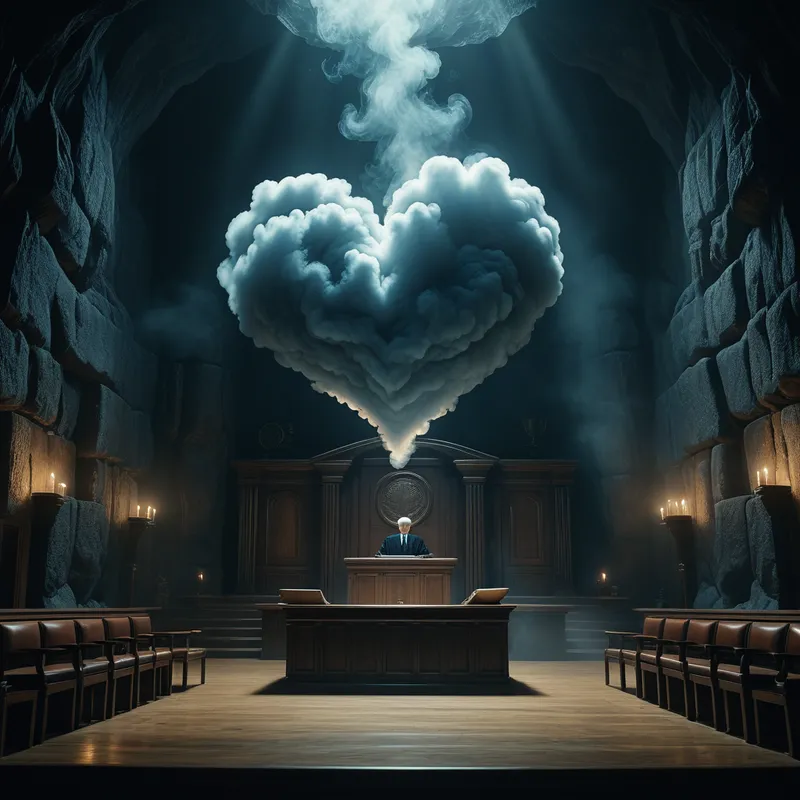
When this myth stirs in the modern dreamer, it often manifests as a profound experience of being on trial. The dreamer may find themselves in a surreal courtroom, accused by shadowy figures or a terrifying judge of an unspeakable crime, often related to family, duty, or a past action. The accusers are frequently monstrous, weeping, or relentless—direct representations of the Furies. This is the psyche’s somatic enactment of a severe inner conflict.
The psychological process is one of confronting a “loyalty bind” or a moral injury where every choice feels wrong. The dream-trial signals that an old, unconscious pattern of guilt or a familial curse (a cycle of abuse, a legacy of trauma) is demanding conscious attention. The Furies’ pursuit is the somatic feeling of anxiety, panic, or a pervasive sense of being haunted that cannot be outrun. The dream is not a verdict, but the psyche’s attempt to stage the conflict, to bring the primal, persecutory voices of the unconscious into a space (the courtroom) where they can be witnessed and, potentially, addressed.
Alchemical Translation
The alchemical journey modeled by Orestes is the individuation process in its most harrowing form. The initial stages—the murder of Clytemnestra—represent the necessary, often destructive, act of differentiating from the primal, possessive power of the personal mother or the mother complex. It is a severing that feels like a crime against nature itself.
The subsequent flight and persecution are the [nigredo](/myths/nigredo “Myth from Alchemical culture.”/), the blackening. The hero is dissolved in the poison of his own deed and the relentless self-accusation of the psyche. He is not purified by Apollo’s command alone; the command merely sets the stage. The true alchemy occurs at the trial.
The transmutation happens not in the acquittal, but in the reconciliation. The gold is not freedom from guilt, but the capacity to hold the conflict consciously and transform the persecutor into a partner.
The equal votes signify that the conflict between old and new, instinct and reason, maternal and paternal principles, is eternal within the psyche. Athena’s decisive vote represents the emerging sovereignty of the conscious Self, making a choice that honors one’s own inner truth and forward movement. The final, crucial step is the integration of the Furies as Eumenides. This is the [rubedo](/myths/rubedo “Myth from Alchemical culture.”/), the reddening. The raw, destructive energy of guilt, shame, and obsessive self-criticism is not eliminated. It is acknowledged, honored, and given a new job: as a protective, discerning force within the now-civilized psyche. The individual no longer flees their own darkness but has built a city—a coherent self—where even the darkest parts have a sacred function. The cycle of vengeance ends because it is internalized and transformed into conscience.
Associated Symbols
Explore related symbols from the CaleaDream lexicon: