Oregon Trail Pioneers Myth Meaning & Symbolism
A mythic journey across a vast, unforgiving land, where pioneers confront their limits in a sacred quest for a new world and a new self.
The Tale of Oregon Trail Pioneers
Listen. Before the rails of iron, before the wires sang with voices, there was the Road of Dust. It was not a road laid by kings or engineers, but a scar drawn by hope across the belly of [the world](/myths/the-world “Myth from Tarot culture.”/). It began in the settled lands, where the trees were known and the fences ran straight, and it pointed its bony finger west, toward a rumor called Oregon.
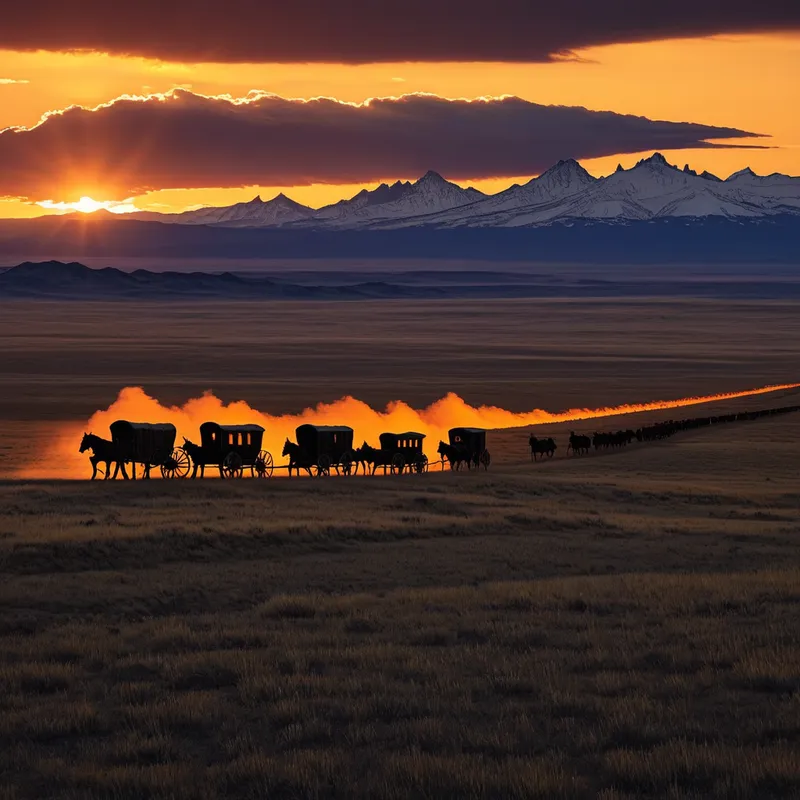
They were not gods, these travelers, but men and women of flesh and failing. They piled their lives into wooden arks—the Conestoga—and pointed the bows of their ships into the grass sea. The deity of their journey was not a person but a force: Manifest Destiny, a whisper on [the wind](/myths/the-wind “Myth from Various culture.”/) that said “Go.” It was a covenant written in wagon ruts.
The conflict was the land itself, a living, breathing antagonist. The [Great Plains](/myths/great-plains “Myth from Native American culture.”/) were not empty; they were full of a terrible, singing emptiness that tested faith. The rivers were not crossings; they were hungry gods—the Platte, wide and shallow, stealing time; the Snake, cold and swift, claiming wagons and bones. The mountains were not scenery; they were final judges. The Blue Mountains and the passes to the Willamette Valley demanded a toll of sweat, starvation, and sometimes, a child’s grave marked with stones.
The rising action was the daily sacrament of endurance. The oxen, slow and patient, were the beating heart of the pilgrimage. Cholera was the invisible thief in the night. The rising dust was a shroud, the setting sun a bloody gate. They traded with the People of the Buffalo, whose world they were cutting through, a tension humming in the space between sign language and rifle sight.
The resolution was not a battle won, but a threshold crossed. It was the moment the lead wagon crested the final ridge and the green, watered valley lay spread below like a rumored heaven made real. It was the silence that followed the last exhausted cheer. The myth does not end with a crown, but with the first swing of an axe into an Oregon fir, the first furrow turned in foreign soil. The hero is not the one who arrived, but the one who left a self behind on the trail, buried in the dust of Nebraska or the sands of the Humboldt Sink. The new self steps into the rain, haunted and hallowed, having wrestled with the continent and survived.
Cultural Origins & Context
This is a modern foundation myth, born not in the mists of antiquity but in the ink of diaries and the cracks of parched lips in the 19th century. Its primary bards were not poets but ordinary people—farmers, blacksmiths, mothers—who recorded their odyssey in ledgers and letters. The myth was amplified and codified by the booster literature of the time, pamphlets and guides that painted Oregon as a Garden of the World, and by the subsequent nostalgia of a rapidly industrializing nation.
Its societal function was dual. For the culture that created it, it was a narrative of justification and identity-formation. It transformed a complex, often brutal process of migration and displacement into a sacred mission, a national rite of passage. It served to galvanize the community back east, to turn settlers into pilgrims, and to weave the raw experience of hardship into the tapestry of American exceptionalism. The myth was passed down through schoolbooks, folk songs, and family lore, becoming the story a nation told itself about its own boldness, its resilience, and its divine right to the land.
Symbolic Architecture
At its core, the Oregon Trail myth is a master [symbol](/symbols/symbol “Symbol: A symbol can represent an idea, concept, or belief, serving as a powerful tool for communication and understanding.”/) of the [Hero’s Journey](/symbols/heros-journey “Symbol: A universal narrative pattern representing personal transformation through trials, discovery, and return with wisdom.”/), stripped of magical aids and clear villains. The [pioneer](/symbols/pioneer “Symbol: A person who ventures into unknown territory, embodying exploration, settlement, and the establishment of new frontiers.”/) is the archetypal Explorer, but also the [Orphan](/symbols/orphan “Symbol: Represents spiritual abandonment, primal vulnerability, and the quest for belonging beyond biological ties. Often signifies a soul’s journey toward self-reliance.”/).
The wagon is the mobile vessel of the psyche, containing all one values and believes essential for survival. What is left behind on the trail is the weight the soul can no longer carry.
The Trail itself is the [path](/symbols/path “Symbol: The ‘path’ symbolizes a journey, choices, and the direction one’s life is taking, often representing individual growth and exploration.”/) of individuation—long, non-negotiable, and fraught with the perils of the unconscious ([disease](/symbols/disease “Symbol: Disease represents turmoil, issues of control, or unresolved personal conflicts manifesting as physical or emotional suffering.”/), [accident](/symbols/accident “Symbol: An accident represents unforeseen events or mistakes that can lead to emotional turbulence or awakening.”/), [despair](/symbols/despair “Symbol: A profound emotional state of hopelessness and loss, often signaling a need for transformation or surrender to deeper truths.”/)). The [River](/symbols/river “Symbol: A river often symbolizes the flow of emotions, the passage of time, and life’s journey, reflecting transitions and movement in one’s life.”/) Crossings are symbolic thresholds, moments of irreversible commitment where the old [life](/symbols/life “Symbol: The symbol of ‘Life’ represents a journey of growth, interconnectedness, and existential meaning, encompassing both the joys and challenges that define human experience.”/) is truly drowned. The [Mountain](/symbols/mountain “Symbol: Mountains often symbolize challenges, aspirations, and the journey toward self-discovery and enlightenment.”/) Pass represents the ultimate confrontation with [the Self](/myths/the-self “Myth from Jungian culture.”/), [the ego](/myths/the-ego “Myth from Jungian culture.”/)‘s last, greatest [obstacle](/symbols/obstacle “Symbol: Obstacles in dreams often represent challenges or hindrances in waking life that intercept personal progress and growth. They can symbolize fears, doubts, or external pressures.”/) before reaching a new state of [consciousness](/symbols/consciousness “Symbol: Consciousness represents the state of awareness and perception, encompassing thoughts, feelings, and experiences.”/) (the [fertile valley](/symbols/fertile-valley “Symbol: The fertile valley symbolizes abundance, growth, and potential, representing both physical and emotional nourishment.”/)).
The myth’s profound psychological [truth](/symbols/truth “Symbol: Truth represents authenticity, honesty, and the quest for knowledge beyond mere appearances.”/) lies in its equation of geographic [movement](/symbols/movement “Symbol: Movement symbolizes change, progress, and the dynamics of personal growth, reflecting an individual’s desire or need to transform their circumstances.”/) with psychic transformation. You cannot cross the continent and remain who you were. [The promised land](/myths/the-promised-land “Myth from Biblical culture.”/) is not just a place, but a state of being earned through sacrifice.

The Dreamer’s Resonance
When this myth stirs in the modern dreamer, it rarely appears as a history lesson. It manifests as the dream of a necessary, arduous journey. One may dream of packing a vehicle frantically for a trip with no clear destination, of driving down an endless, fading road at night, or of trying to ford a swollen, dark river.
Somatically, this can correlate with feelings of profound life transition—career change, divorce, relocation, a spiritual crisis. The dreamer is psychologically “on the trail.” The cholera in the dream may be a latent anxiety or illness. The broken wagon wheel is a failed project or a collapsed support system. The endless plains reflect a period of existential flatness, where progress feels invisible and motivation wanes.
The dream is an unconscious affirmation: you are in the middle of your ordeal. The [psyche](/myths/psyche “Myth from Greek culture.”/) is mapping its current transformation onto this foundational pattern of ordeal-and-arrival. The dream asks: What are you carrying that is too heavy? What river of change are you afraid to cross? What part of your old self must you bury to move forward?
Alchemical Translation
The alchemy of the Oregon Trail is the transmutation of the leaden ego into the golden, integrated self through the fire of experience. It is a recipe for psychic individuation written in dust and determination.
The [prima materia](/myths/prima-materia “Myth from Alchemical culture.”/)—the raw, unformed stuff—is the dreamer in their “Missouri” state: restless, constrained, full of potential but unactualized. The first operation, calcinatio, is the burning away of attachments: saying goodbye to home, to security, to the known world. This is the fire of departure.
The long trail is the operation of [solutio](/myths/solutio “Myth from Alchemical culture.”/) and coagulatio—dissolution and re-coagulation—repeated endlessly. The self is dissolved by hardship ([the river](/myths/the-river “Myth from Buddhist culture.”/), the disease, the hunger) and must re-form, each time a little harder, a little leaner, more essential. The Humboldt Sink represents the [Nigredo](/myths/nigredo “Myth from Alchemical culture.”/), the darkest night of the soul, where all seems barren and hope itself threatens to evaporate.
The arrival in the valley is not the end of the work, but the beginning of the Albedo. The new land must be built not with the tools of the old life, but with the wisdom forged on the trail.
For the modern individual, this myth models that true growth is not a gentle incline but a perilous migration. Your “Oregon” is that state of being you intuit but cannot see—a career, a relationship, a state of inner peace. The trail is the difficult, non-negotiable process of becoming the person who can inhabit that [promised land](/myths/promised-land “Myth from Biblical culture.”/). You must consent to be worn down by the journey. You must leave graves by the roadside. You must let the vast sky of the unknown humble you. Only then, having made a covenant with your own endurance, do you earn the right to plant your flag in the rich, unknown soil of your own becoming. The pioneer’s ultimate discovery is that the destination was always within; the continent they crossed was the landscape of their own soul.
Associated Symbols
Explore related symbols from the CaleaDream lexicon: