
Orchis Myth Meaning & Symbolism
A youth of divine lineage, Orchis defiles a sacred rite and is torn apart, only to be reborn as the first orchid, a symbol of desire and mortality.
The Tale of Orchis
Hear now a tale not of glorious heroes, but of a seed of ruin sown in the fertile soil of arrogance. It begins with a youth, Orchis, born of wild blood. His father was a satyr, all lust and laughter, and his mother a nymph, a spirit of the whispering spring. From this union, Orchis inherited a beauty that was sharp and perilous, a charm that masked a heart swollen with a god’s own pride.
He walked the world as if it were his birthright, believing the divine ichor in his veins granted him license over all he saw. His laughter was too loud for the temples, his gaze too bold for the modest. The world was a feast laid out for his pleasure alone.
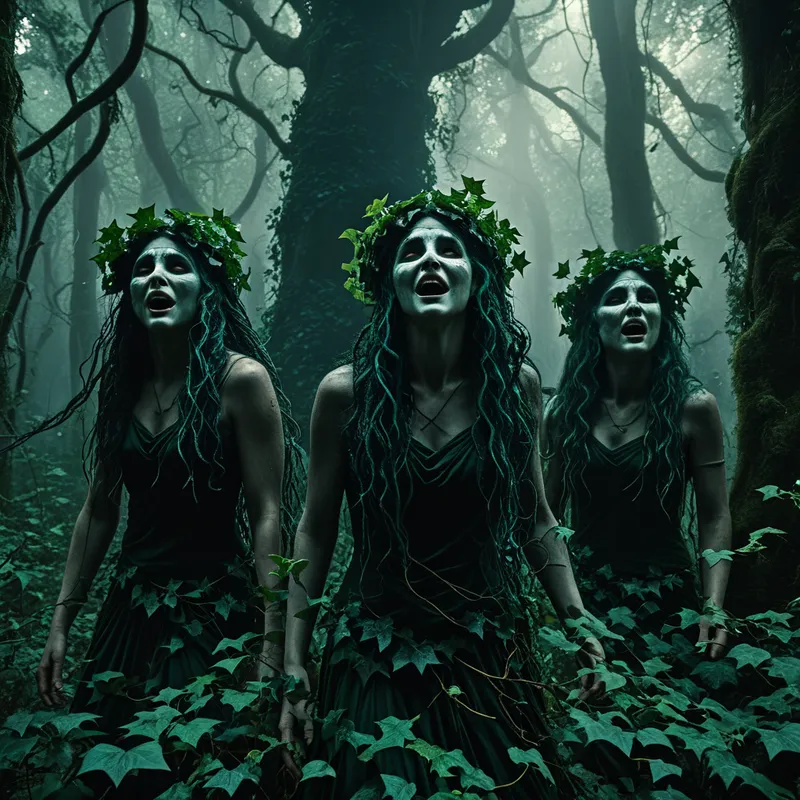
One night, drawn by the distant, throbbing pulse of drums and the ecstatic cries that slithered through the oak-dark forests, he came upon a rite not meant for mortal eyes—or even for demi-gods with impure hearts. It was the Bacchic revel, the sacred frenzy of the Dionysus. The Maenads moved in a whirling storm of ivy and fawnskin, their minds unbound, their souls married to the god’s wild breath. To witness this was a privilege; to intrude upon it, a blasphemy of the highest order.
Yet Orchis did not kneel in awe. He did not veil his eyes. Drunk on his own daring, he strode into the sacred circle. His intention was not worship, but conquest. He laid hands upon a Maenad, seeking to claim her divine ecstasy as a personal trophy, to violate the mystery itself. The air, once thick with the scent of crushed grape and damp earth, turned sharp as a blade.
A silence fell, more terrible than any scream. The whirling ceased. The eyes of the Maenads, once glazed with god-touched joy, now focused on him with a clarity that was purely, terribly divine. The god’s presence, once a wave of liberating madness, coalesced into a single point of wrath. In that moment, Orchis was not a demi-god; he was a stain upon the sacred.
With a sound like tearing silk, the frenzy turned upon its violator. They fell upon him—not as women, but as instruments of a outraged deity. There was no battle, only a swift and brutal unraveling. His beautiful, arrogant form was pulled apart, limb from limb, scattered upon the earth that had borne his footsteps. The life fled from him, leaving only a cooling silence and a patch of dark, thirsty soil.
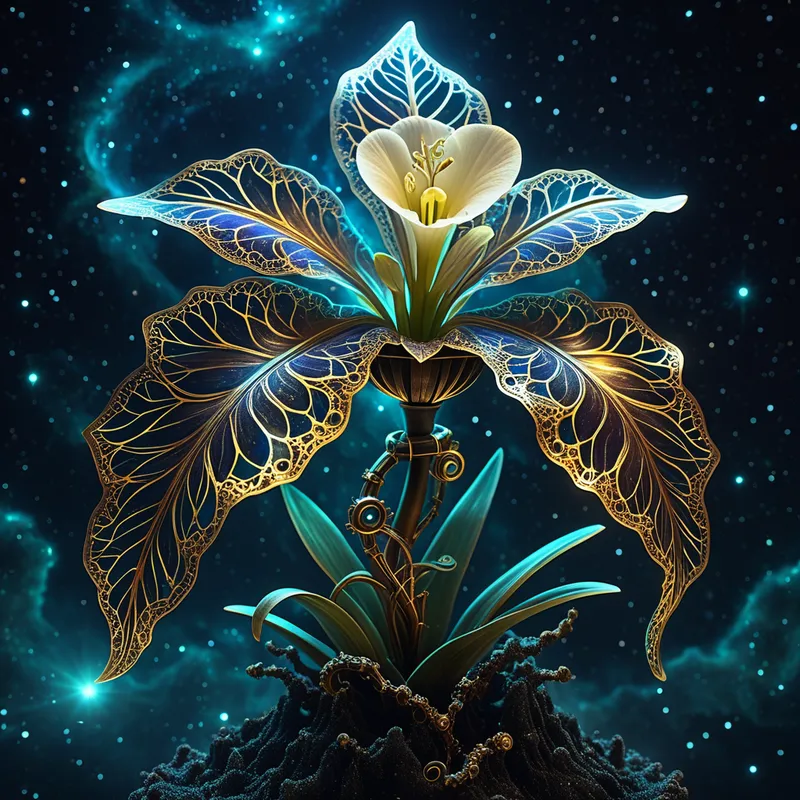
But the tale does not end in mere annihilation. For where his father’s blood—the wild, generative force of the satyr—soaked into the ground, and where his mother’s essence—the nurturing spirit of the nymph—wept into the earth, something new stirred. From that grim fertilizer, a slender green shoot pushed toward the sun. It grew, not into a mighty oak or a fruitful vine, but into a flower of exquisite and strange beauty: the first orchid. Its blossoms were complex, often resembling the forms of creatures, its roots tangled and fleshy. It was a monument not to a life lived well, but to a life torn asunder and returned in a new, fragile, and deeply desirous form.
Cultural Origins & Context
The myth of Orchis is a etiological tale, a narrative root from which the orchid flower is said to have sprung. It belongs to the rich tapestry of Greek lore that explains the natural world through divine and heroic drama. Unlike the grand epics of Homer, this story was likely passed down in more localized traditions, perhaps in the regions where wild orchids flourished. It shares thematic DNA with other myths of metamorphosis—like Daphne or Narcissus—where a human crisis precipitates a botanical birth.
Its tellers would have been those close to the land: farmers, herbalists, and local priests. The story served a dual function. Primarily, it explained the origin of a peculiar and captivating flower, whose bulbous roots (orchis means "testicle" in Greek) and often erotic shape invited a story of lust and punishment. Secondarily, it was a potent moral and religious lesson. It reinforced the sacred boundaries around the cult of Dionysus, a god whose gifts of ecstasy and liberation were powerful but perilous. To mistake his madness for mere license was to invite utter disintegration. The myth acted as a warning against hubris, especially the hubris of believing one could possess or control the divine.
Symbolic Architecture
At its core, the myth of Orchis is a map of a catastrophic failure of integration. Orchis represents the uninitiated ego, one that possesses raw potential (his divine lineage) but lacks the wisdom or respect to channel it. He sees the sacred, ecstatic state of the Maenads not as a state of being to be entered into with humility, but as an object to be seized. This is the psychology of possession, not participation.
The ultimate transgression is not desire, but the attempt to own the mystery that can only be experienced through surrender.
His dismemberment is the symbolic annihilation of this arrogant, grasping ego-structure. It is not merely a punishment, but a necessary deconstruction. The Maenads, in their god-filled rage, become agents of a brutal but purposeful dissolution. They return him to his constituent parts. This is the essential first step in any profound transformation: the old self must be broken apart before a new configuration can emerge.
The rebirth as the orchid is the alchemical result. The flower is a perfect symbol of this new state: beautiful, intricate, and rooted in the very matter of its own destruction. Orchids are often epiphytic, drawing sustenance from the air and from decay. They symbolize a life that has learned to thrive not in spite of its fragmented origins, but because of them. The orchid’ famed association with sexuality and desire remains, but it is a desire that has been transfigured—no longer a force of violent acquisition, but one of intricate attraction and delicate interdependence.
The Dreamer's Resonance
When the pattern of Orchis stirs in the modern unconscious, it often manifests in dreams of violent fragmentation or being pulled apart by a crowd or a force. One may dream of teeth falling out, limbs detaching, or being scattered to the winds. This is not necessarily a portent of literal harm, but a somatic expression of a psyche undergoing a necessary deconstruction.
The psychological process at work is the crumbling of a long-held identity or a rigid pattern of behavior that has become arrogant in its own way—perhaps a professional persona, a defensive cynicism, or a pattern of entitled relationships. The dream-ego, like Orchis, may have overstepped, trying to control an emotional or creative force (the Dionysian energy) that demands surrender. The dismemberment in the dream is the psyche’s dramatic way of saying, "This structure cannot contain this energy. It must come down."
The emotional tone is key. Alongside the terror, there is often a strange, paradoxical sense of release or inevitability. The dreamer is experiencing the death-throes of an outmoded self. Upon waking, one might feel raw, vulnerable, and strangely empty—the fertile void where the old identity once stood, waiting for the new shoot to emerge.

Alchemical Translation
For the individual on the path of individuation, the myth of Orchis models the nigredo—the blackening, the putrefaction, the darkest night of the soul. It is the stage where one’s conscious attitudes are confronted by the overwhelming power of the unconscious (the Dionysian revel). The ego’s attempt to rationalize, manage, or possess this unconscious content leads to a psychic crisis.
The alchemy of the soul begins not in gold, but in the humus of humiliation.
The triumph here is not in avoiding the dismemberment, but in surviving it and finding the seed of new life within the ruins. The modern individual must learn to differentiate between hubris and rightful confidence. The lesson of Orchis is that before we can truly create or love, we must first allow our arrogant, controlling self-image to be dismantled by forces greater than our will. This is a sacred humiliation.
The rebirth as the orchid signifies the next alchemical stage: the emergence of a new, more authentic self from this dark matter. This self is more complex, more beautiful in its vulnerability, and deeply connected to both its primal origins (the satyr and nymph) and its transformative suffering. It does not seek to dominate life, but to engage with it in a delicate, symbiotic dance. The individual learns to draw nourishment not from brute force or possession, but from the subtle exchanges of relationship, creativity, and a respect for the mysteries that can be witnessed, but never owned. The orchid, then, becomes a symbol of the soul that has been shattered and rewoven into a form capable of holding a more profound and resonant beauty.
Associated Symbols
Explore related symbols from the CaleaDream lexicon: