Ora Myth Meaning & Symbolism
A myth of a primordial serpent embodying the chaotic, creative potential of the unconscious, whose binding brings order and consciousness to the world.
The Tale of Ora
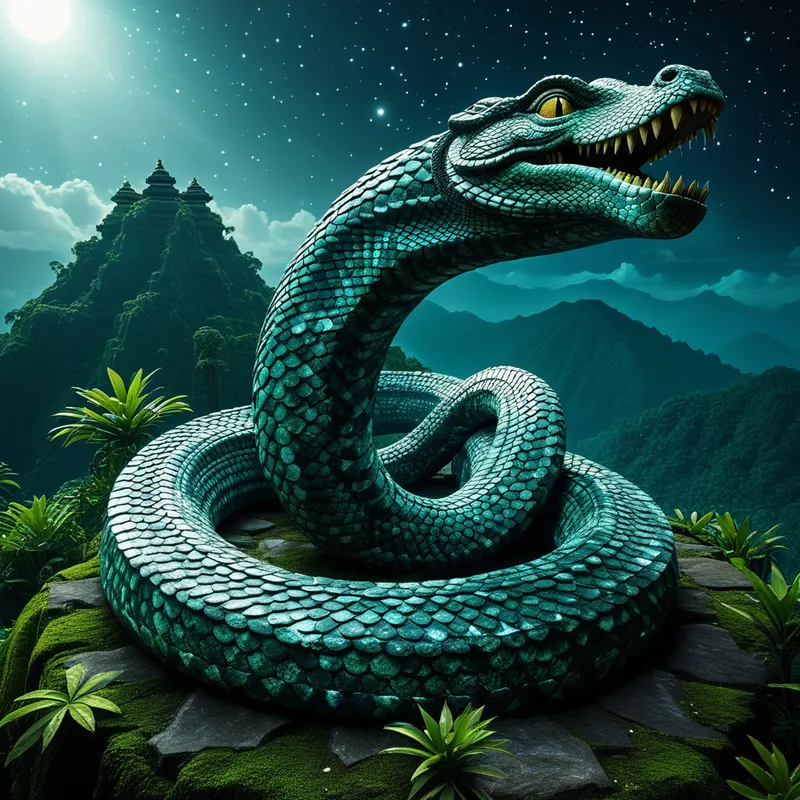
In the time before time, when the world was soft and unformed, there was only the deep, dreaming sea and the whispering void above. From the meeting of these two great nothings, a presence stirred in the abyss. This was Ora, the great serpent of the deep. She was not born but simply was, a coil of potential as vast as the ocean trenches, her scales the color of midnight and her eyes holding the cold fire of distant stars. The world was her silent, shapeless domain.
But the spirits of the air and the ancestors of the first people looked upon the formless deep and felt a longing for shape, for land, for a place to plant their feet and call home. They saw Ora not as a guardian, but as a restless power whose endless, sinuous movements churned the primal waters, preventing any firmament from rising. Her breath was the typhoon; the flick of her tail spawned tidal waves that erased any nascent shore. She was the embodiment of perpetual becoming that never allowed for being. A world of pure potential is also a world without a hearth, without a story.
So, the ancestors and the celestial spirits convened in a great council beneath the banyan tree that bridges worlds. Their voices were the wind through leaves, the crackle of the first fire. They knew they could not destroy Ora, for she was a fundamental force, the very chaos from which creation springs. To kill her would be to still the heart of the world itself. Instead, they resolved to bind her. To give her a place, so the world might have others.
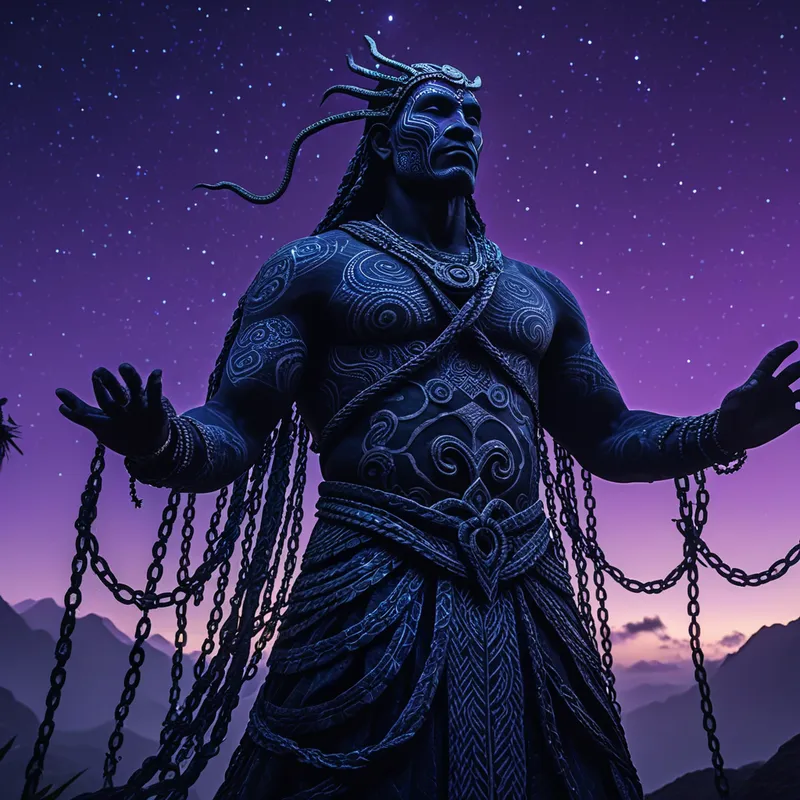
With great cunning and greater courage, they forged chains not of simple iron, but of sung spells, woven destinies, and the hard resolve of purpose. They descended to the foaming shore where the serpent’s back sometimes broke the surface like a chain of dark islands. A great ritual began, a symphony of chanting that vibrated in the bones of the earth. Ora, feeling the constraint, rose in her terrible majesty, a mountain range of living flesh surging from the deep, her roar the sound of continents grinding.
The struggle shook the foundations of the sky. But the ancestors stood firm. They cast their enchanted bonds, not as attackers, but as partners in a dreadful, necessary dance. They looped the chains around her colossal form, not to imprison, but to orient. With a final, earth-sundering effort, they drew her immense coils down, down, anchoring her to the very roots of the world. They settled her great body around the base of the first and greatest mountain, a living foundation stone. Her restless motion became the slow, tectonic pulse of the earth. Her contained breath became the geothermal fires that warm the hot springs. Her bound chaos became the fertile, creative force that makes the land verdant and alive.
And so, from the binding of Ora, the world found its form. The seas receded, revealing islands. The mountains stood firm. And humanity, the children of those brave ancestors, could now build their homes upon the stable earth, forever living atop the slumbering power of the serpent who made it all possible.
Cultural Origins & Context
The myth of Ora finds its roots in the diverse archipelago of Indonesia, particularly among communities in Nusa Tenggara and Papua. It is not a singular, canonical text, but a living oral tradition, passed down through generations by village elders and ritual specialists. The story functions as a cosmogonic myth—an explanation for the very shape of the world. It answers fundamental questions: Why is the land stable? Why do earthquakes happen? Why is the sea both nurturing and terrifying?
Societally, the myth served multiple crucial functions. It established a sacred geography, where the local landscape (a particular mountain, a specific lake) is literally the body of the primordial being, infusing it with profound significance and demanding respect. It also encoded an ecological ethos: the world’s fertility and stability are not a given, but a precarious balance achieved through a primordial covenant. The binding of Ora is not a victory of good over evil, but a sacred act of negotiation between humanity (through its ancestral proxies) and the wild, untamed forces of nature. It legitimizes the human need for order while acknowledging the supreme power and necessity of the chaotic, creative ground from which all life springs.
Symbolic Architecture
Psychologically, Ora is a master symbol of the unconscious in its raw, primordial state. She is the teeming, formless, and immensely powerful psychic substrate that exists before the ego—the “I”—establishes its territory. Her endless movement in the formless deep represents the ceaseless, undirected flow of instinct, image, and potential within the psyche.
The serpent does not need to be slain, only related to. Its chaos is not an enemy, but the raw material of the self.
The ancestors represent the emerging forces of consciousness, culture, and differentiation. They are not outsiders, but parts of the same psychic system attempting to create a livable space—an ego-consciousness—from the oceanic unconscious. The binding is the critical act of psychogenesis. It is the process by which we give structure to our inner chaos: through language, ritual, identity, and conscious attention. The chains are the structures of the psyche itself—complexes, archetypal patterns, and the laws of logic and morality that allow for coherent experience.
The resulting world—the stable land atop the bound serpent—is the conscious personality. It is fruitful and alive precisely because it rests upon, and remains connected to, the dynamic power of the unconscious. An earthquake or volcanic eruption in the myth is not a failure, but a reminder of the living power beneath the surface; psychologically, this is the eruption of repressed content, a necessary adjustment to the tension between order and chaos within.
The Dreamer’s Resonance
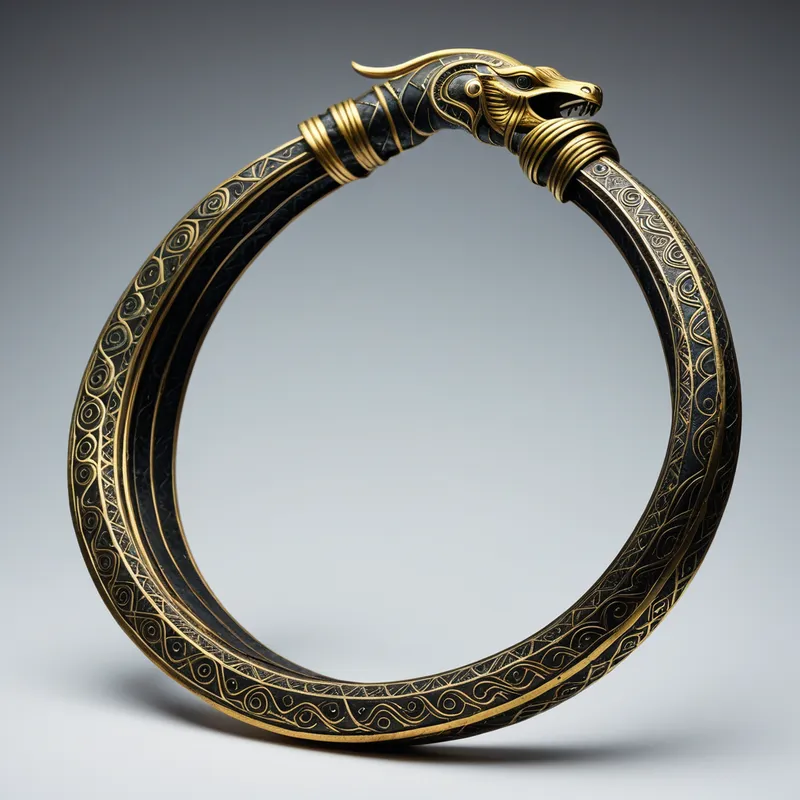
When this mythic pattern stirs in the modern dreamer, it often signals a profound encounter with the foundational layers of the psyche. To dream of a vast, unseen serpent moving in deep water, or of feeling the ground tremble with a buried presence, is to feel the Ora-force within.
This is not typically a dream of fear, but of awe and immense scale. The somatic experience might be one of vibration, deep pressure, or a sense of the ground of one’s being becoming unstable or alive. Psychologically, the dreamer is likely undergoing a process where old structures of identity (the “land”) are being challenged by a surge of new, raw psychic material from the unconscious. It is the psyche’s way of announcing that a re-negotiation is due. The dreamer may be called to forge new “chains”—new ways of understanding, containing, and integrating powerful emotions, creative impulses, or instinctual drives that have been too wild or too long ignored. The dream asks: What part of your primal, creative chaos are you trying to suppress, and how might you honorably bind it to serve your life’s new form?
Alchemical Translation
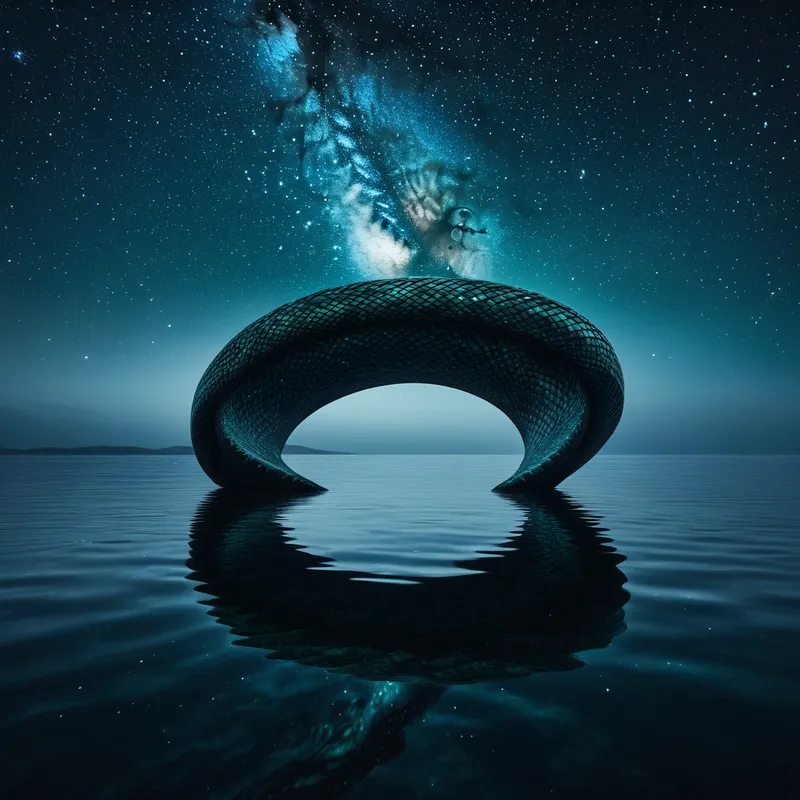
The alchemical journey of individuation—becoming who one truly is—is perfectly modeled by the myth of Ora. The process begins in the nigredo, the black chaos of the unexamined life, where the serpent swims free and the self is diffuse, reactive, and without center.
The conscious decision to engage in self-work is the council of the ancestors. We resolve to face the inner chaos. The binding is the central alchemical operation. It is the conscious effort to contain and transform the prima materia of our raw nature—our passions, shadows, and latent genius—into a stable structure. This is not repression, but a sacred containment. We create rituals (journaling, therapy, artistic practice), ethics, and self-knowledge to “bind” these forces, giving them a defined place and purpose in our psychic geography.
Individuation is the art of building a stable island of consciousness upon a respectful, dynamic relationship with the inner sea.
The result is the albedo and rubedo—the whitening and reddening—symbolized by the fertile, stable land. The personality becomes firm, capable, and creative precisely because it is now consciously founded upon and fed by the immense energy of the once-formless unconscious. The bound serpent becomes the cornerstone, the source of vitality. The modern individual’s triumph is not the eradication of their inner darkness or chaos, but the heroic, ongoing act of constructing a conscious life in full acknowledgment of that power, turning primal potential into a lived, authentic, and grounded creation. We become, like the world in the myth, both stable and alive, because we remember what lies, respectfully bound, beneath our feet.
Associated Symbols
Explore related symbols from the CaleaDream lexicon: