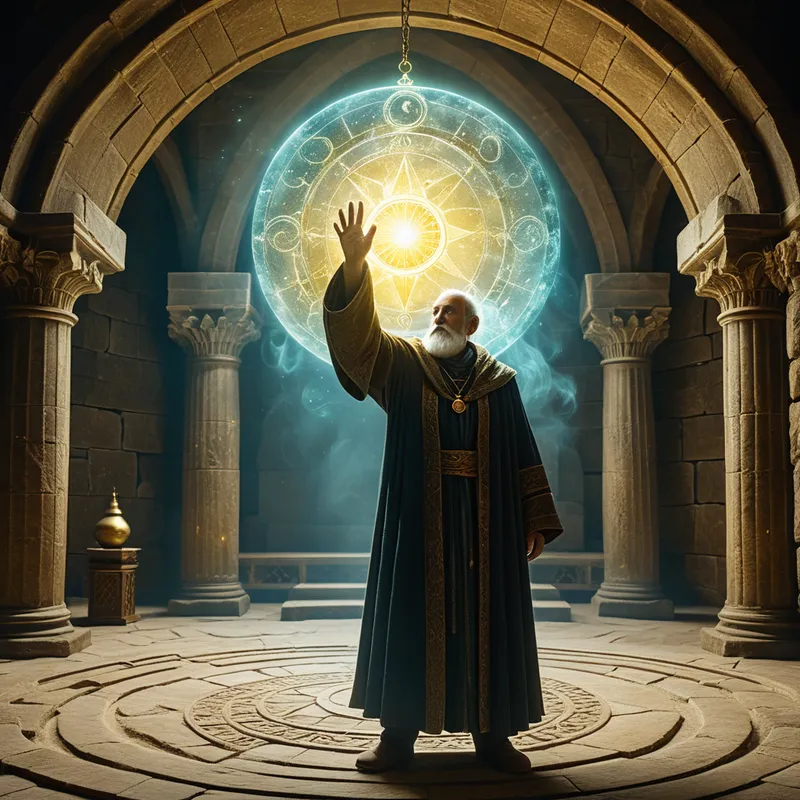
Opus Alchymicum Myth Meaning & Symbolism
A myth of the alchemist's soul, where base matter and spirit undergo dissolution, purification, and union to birth the philosopher's stone of the self.
The Tale of Opus Alchymicum
Listen, and I will tell you of the work that is not a work, of the fire that does not burn, and the birth that comes from a death. In the beginning, there was the Massa Confusa—a weeping, sighing [thing](/myths/thing “Myth from Norse culture.”/) of leaden weight and shadowed corners. It was the soul asleep, a kingdom in disarray, where the king slumbered in a tower of intellect and the queen wandered lost in a garden of forgotten senses.
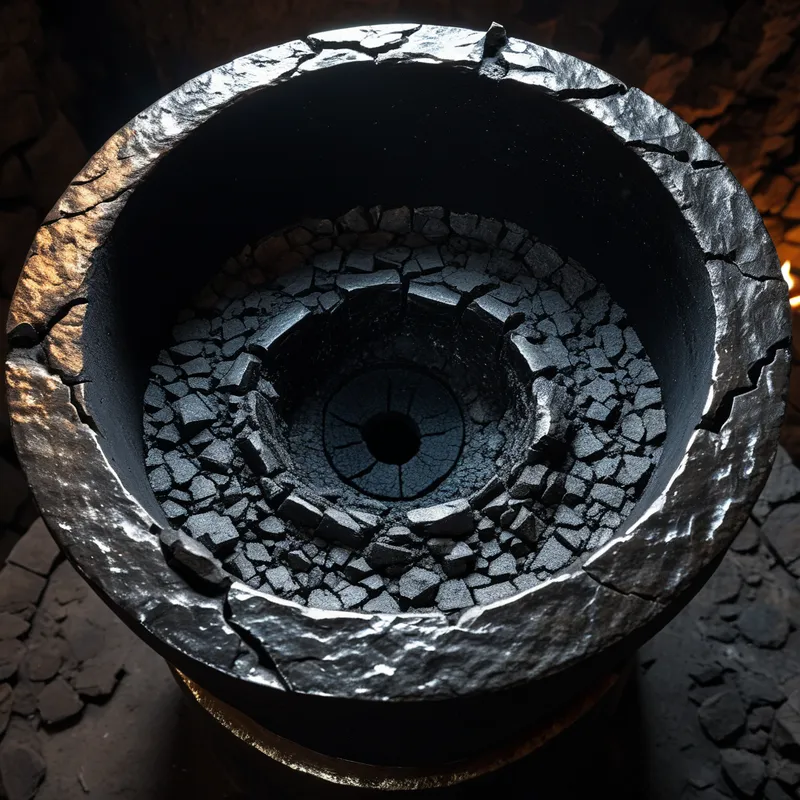
A figure, the Artifex, entered this twilight realm. Not with a sword, but with a sigh of resolve. His first act was one of terrible violence: the Solve. He took the Massa Confusa, this lump of all his unresolved years and unmourned losses, and cast it into the [Vas Hermeticum](/myths/vas-hermeticum “Myth from Alchemical culture.”/). He sealed it with the sign of [Mercurius](/myths/mercurius “Myth from Alchemical culture.”/), and applied the fire. Not the fire of [the hearth](/myths/the-hearth “Myth from Norse culture.”/), but the Ignis Innaturalis, the fire of anguish and longing. The Massa melted, screamed, dissolved into a black, bitter sea—the [Nigredo](/myths/nigredo “Myth from Alchemical culture.”/). Here, in the absolute dark, [the Artifex](/myths/the-artifex “Myth from Alchemical culture.”/) despaired. All identity was lost in a starless night.
But in that very dissolution, a strange separation began. The heavy dross sank, a sediment of old griefs. And from the chaos, two essences arose, dancing in the gloom: the [Sulfur](/myths/sulfur “Myth from Alchemical culture.”/), a restless, hot golden light, and the [Mercury](/myths/mercury “Myth from Roman culture.”/), a cool, silver, elusive stream. They were opposites, repelling and attracting in a maddening whirl. The Artifex watched, and his task became one of impossible mediation. He had to coax, to temper, to persuade.
This was the long labor, the Albedo. He washed the substance with the Aqua Divina—tears of insight, [the dew](/myths/the-dew “Myth from Alchemical culture.”/) of dawn contemplation. Slowly, the black turned to gray, then to a luminous, moon-white purity. A single, perfect white rose bloomed in [the vessel](/myths/the-vessel “Myth from Alchemical culture.”/). Hope returned, but it was a cold, chaste hope.
Now came the true marriage, the Coniunctio. The fiery Sulfur and the fluid Mercury, purified and willing, drew closer. The Artifex, with breath held, introduced the final agent: the Salt, the enduring earth. In a flash of unbearable, glorious heat—the [Rubedo](/myths/rubedo “Myth from Alchemical culture.”/)—the three became one. The vessel blazed with an inner sun. When the light faded, there it rested: no larger than a hazelnut, yet containing the cosmos. The [Lapis Philosophorum](/myths/lapis-philosophorum “Myth from Alchemical culture.”/). [The Philosopher’s Stone](/myths/the-philosophers-stone “Myth from Alchemical culture.”/). The Artifex opened the vessel, and the Stone’s mere presence caused the leaden walls of his own being to shimmer, then gleam with immortal gold. The work was complete. The king and queen were crowned, ruling together in a body of light.
Cultural Origins & Context
The myth of the Opus Alchymicum is not a single story from a single time, but the core narrative skeleton upon which centuries of European alchemical practice and literature built its flesh. It emerged from the smoky scriptoria of the Middle Ages and the Renaissance, a coded tradition passed down in lavishly illustrated manuscripts like the [Rosarium Philosophorum](/myths/rosarium-philosophorum “Myth from Alchemical culture.”/) and the [Tabula Smaragdina](/myths/tabula-smaragdina “Myth from Alchemical/Hermetic culture.”/). Its tellers were not bards, but often anonymous adepts writing under pseudonyms, embedding the myth in complex sequences of symbolic woodcuts and labyrinthine Latin prose.
Its societal function was dual. Exoterically, it was a manual for laboratory practice, describing the transmutation of physical matter. Esoterically, and more profoundly, it served as a spiritual roadmap for a select few. It was a myth for the individual soul in an age where orthodox religious paths felt insufficient for some deep seekers. It provided a non-dogmatic, experiential framework for inner transformation, using the language of chemistry to describe the drama of the [psyche](/myths/psyche “Myth from Greek culture.”/). The culture that nurtured it was one of hidden knowledge, where the myth itself was the ultimate secret, revealed only to those who had eyes to see beyond the literal.
Symbolic Architecture
The myth is a perfect map of the [individuation process](/symbols/individuation-process “Symbol: The psychological journey toward self-realization and wholeness, integrating conscious and unconscious aspects of personality.”/). The Massa Confusa is the undifferentiated, conflicted state of [the ego](/myths/the-ego “Myth from Jungian culture.”/), burdened by complexes and unconscious content. The Vas Hermeticum is the total psyche—the sealed container of the work, where no part of [the self](/myths/the-self “Myth from Jungian culture.”/) can escape the process. It is the [crucible](/symbols/crucible “Symbol: A vessel for intense transformation through heat and pressure, symbolizing spiritual purification, testing, and alchemical change.”/) of conscious engagement.
The first step to gold is the willing acceptance of lead. To become something more, you must first consent to be nothing as you were.
The stages—Nigredo, [Albedo](/symbols/albedo “Symbol: In alchemy, the whitening stage representing purification, spiritual ascension, and the emergence of consciousness from darkness.”/), Rubedo—are not [linear](/symbols/linear “Symbol: Represents order, predictability, and a direct, step-by-step progression. It symbolizes a clear path from cause to effect.”/) but spiralic states of being. The Nigredo symbolizes the encounter with the [Shadow](/symbols/shadow “Symbol: The ‘shadow’ embodies the unconscious, repressed aspects of the self and often represents fears or hidden emotions.”/), the depression and [despair](/symbols/despair “Symbol: A profound emotional state of hopelessness and loss, often signaling a need for transformation or surrender to deeper truths.”/) that accompanies the dismantling of the [persona](/symbols/persona “Symbol: The social mask or outward identity one presents to the world, often concealing the true self.”/). The [Albedo](/symbols/albedo “Symbol: In alchemy, the whitening stage representing purification, spiritual ascension, and the emergence of consciousness from darkness.”/) is the [emergence](/symbols/emergence “Symbol: A process of coming into being, rising from obscurity, or breaking through a barrier, often representing birth, transformation, or revelation.”/) of the [Anima](/symbols/anima “Symbol: The feminine archetype within the male unconscious, representing soul, creativity, and connection to the inner world.”/) or [Animus](/symbols/animus “Symbol: In Jungian psychology, the masculine inner personality in a woman’s unconscious, representing logic, action, and spiritual guidance.”/), purified and recognized. The fiery Coniunctio is the [integration](/symbols/integration “Symbol: The process of unifying disparate parts of the self or experience into a cohesive whole, often representing psychological wholeness or resolution of internal conflict.”/) of conscious and unconscious, ego and Self, leading to the Rubedo—the [birth](/symbols/birth “Symbol: Birth symbolizes new beginnings, transformation, and the potential for growth and development.”/) of the Self, symbolized by the [Stone](/symbols/stone “Symbol: In dreams, a stone often symbolizes strength, stability, and permanence, but it may also represent emotional burdens or obstacles that need to be acknowledged and processed.”/).
The three principles—Sulfur ([spirit](/symbols/spirit “Symbol: Spirit symbolizes the essence of life, vitality, and the spiritual journey of the individual.”/), will, desire), [Mercury](/symbols/mercury “Symbol: Mercury symbolizes communication, intellect, and swift movement, often representing the messenger between realms in spiritual and mythological contexts.”/) ([soul](/symbols/soul “Symbol: The soul represents the essence of a person, encompassing their spirit, identity, and connection to the universe.”/), [intuition](/symbols/intuition “Symbol: The immediate, non-rational understanding of truth or insight, often described as a ‘gut feeling’ or inner knowing that bypasses conscious reasoning.”/), adaptability), and [Salt](/symbols/salt “Symbol: Salt represents purification, preservation, and the essence of life. It is often tied to the balance of emotions and spiritual cleansing.”/) ([body](/symbols/body “Symbol: The body in dreams often symbolizes the dreamer’s self-identity, personal health, and the relationship they have with their physical existence.”/), [structure](/symbols/structure “Symbol: Structure in dreams often symbolizes stability, organization, and the framework of one’s life, reflecting how one perceives their environment and personal life.”/), manifestation)—represent the tripartite [nature](/symbols/nature “Symbol: Nature symbolizes growth, connectivity, and the primal forces of existence.”/) of the complete [human](/symbols/human “Symbol: The symbol of a human represents individuality, complexity of emotions, and social relationships.”/), whose unification is the goal.
The Dreamer’s Resonance
When this myth stirs in the modern dreamer, it announces a profound somatic and psychological process of transmutation. Dreaming of chaotic, melting substances (Nigredo) often coincides with life crises, breakdowns, or intense therapy—the feeling of the old self dissolving. It is a somatic experience of disorientation, weight, and visceral gloom.
Dreams of washing, bathing in clear [water](/myths/water “Myth from Chinese culture.”/), or seeing white flowers or lunar figures signal the Albedo. This is a phase of cleansing grief, insightful introspection, and a cooling of compulsive passions. The body may feel lighter, but strangely detached.
The climactic dream symbols of the Coniunctio and Rubedo are potent: a [sacred marriage](/myths/sacred-marriage “Myth from Alchemy culture.”/), a king and queen embracing, a radiant child, a glowing red stone, or a golden, sun-filled interior. These dreams carry a palpable somatic charge of warmth, expansion, and rightness. They mark moments of profound integration, where a previously irreconcilable inner conflict is suddenly resolved into a new, higher unity. The dreamer awakens not just remembering a story, but feeling like the Stone—dense with meaning, radiant with a quiet, enduring power.
Alchemical Translation
For the modern individual, [the Opus](/myths/the-opus “Myth from Alchemical culture.”/) is not about lead-to-gold, but self-to-Self. It models the process of psychic transmutation as a voluntary descent into one’s own complexity. The first step is the Solve: the courageous decision to question one’s own solidity, to let the certainties of identity be dissolved by honest self-examination and the unavoidable suffering of life.
The Philosopher’s Stone is not found; it is grown from the compost of the discarded self.
The long, patient work of the Albedo is the therapeutic, reflective work—“washing” our perceptions, separating reactive emotions (Sulfur) from deep, fluid patterns of being (Mercury). It is learning to hold opposites in mind without rushing to a false synthesis.
The ultimate goal, the Lapis, is not a state of perfect, static bliss. It is the creation of a functioning capability—the psychological equivalent of the Stone’s legendary powers. It is the ability to “transmute” experience: to take the leaden events of failure, loss, and pain and find within them the gold of meaning. It is the “[projection](/myths/projection “Myth from Alchemical culture.”/)” of this integrated state, which heals not by doing, but by being—a calm, centered presence that unconsciously influences one’s environment. The individual becomes their own vessel, their own fire, and their own priceless creation. The work is never truly finished, for the Stone, once made, becomes the agent for an endless process of refinement, a lifelong conversation between the base and the sublime within the human soul.
Associated Symbols
Explore related symbols from the CaleaDream lexicon: