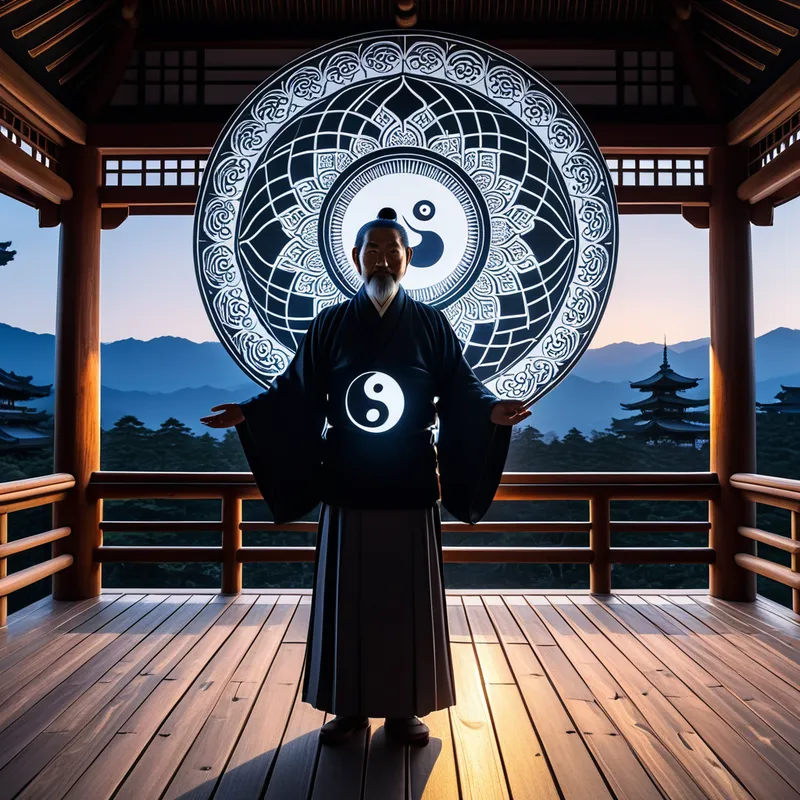
Onmyōdō Myth Meaning & Symbolism
The ancient Japanese art of harmonizing cosmic forces, weaving the visible and invisible worlds into a sacred balance of order and flow.
The Tale of Onmyōdō
Listen, and let the veil between worlds grow thin. In the heart of the Heian-kyō, where cherry blossoms fell like silent snow and the scent of incense clung to the cedar halls, there walked a man between the realms. He was an Onmyōji, a keeper of the secret tides. His world was not merely the polished floors of the palace or the rustling silk of the court; his true domain was the liminal space where daylight bled into shadow, where a sigh could become a curse, and a misplaced stone could unravel a destiny.
The air in the capital grew heavy, thick with a malaise no physician could name. Children woke screaming from identical dreams of a woman weeping in a dry well. Blights appeared on the imperial gardens overnight. The seasons themselves seemed to hesitate, an unseasonal frost gripping spring blossoms. The Emperor, seated behind a screen of state, felt the disquiet in his very bones. He summoned the Master of Yin-Yang.
The Onmyōji did not rush. He first consulted the Jikkan Jūnishi, his fingers tracing the day’s celestial breath. He cast the bokusen, reading the cracks like a map of the unseen. The answer was not a invading army, but a wound in the world’s fabric—a spirit of profound grievance, a mononoke, its anger festering like a canker in the city’s spiritual flesh. It was a woman wronged, her name erased, her story untold, her energy twisted into a vortex of pure yin.
Under a moonless sky, the ritual began. Not in a grand hall, but at a forgotten crossroads, a place where energies converged. The Onmyōji planted sacred gohei, pure white streamers that fluttered like captured breaths. With a blade of purified paper, he cut the malignant knots of fate. He chanted the ancient syllables, each one a key to a different layer of reality, calling upon the guardians of the Gohō. From folded paper talismans, his shikigami emerged—not as monsters, but as focused intentions in the form of a fox, a hawk, a wolf—to patrol the boundaries of his sacred space.
The conflict was not of clashing swords, but of competing harmonies. The wail of the spirit was a discordant note threatening to shatter the city’s song. The Onmyōji did not seek to destroy it, but to listen. Through the medium of a trembling court attendant, the story poured forth—a tale of betrayal, silence, and stolen legacy. The Onmyōji, acting as both judge and physician, acknowledged the truth. He offered not banishment to hell, but translation. With a final, profound mudra and the presentation of offerings, he guided the concentrated yin of grievance back into the flowing cycle of the Gogyō. The oppressive weight lifted. The next morning, a single, perfect cherry blossom bloomed in the center of the blighted garden. Balance, fragile and precious, was restored. The Onmyōji returned to his observatory, his work unseen, the world once more turning on its rightful axis.
Cultural Origins & Context
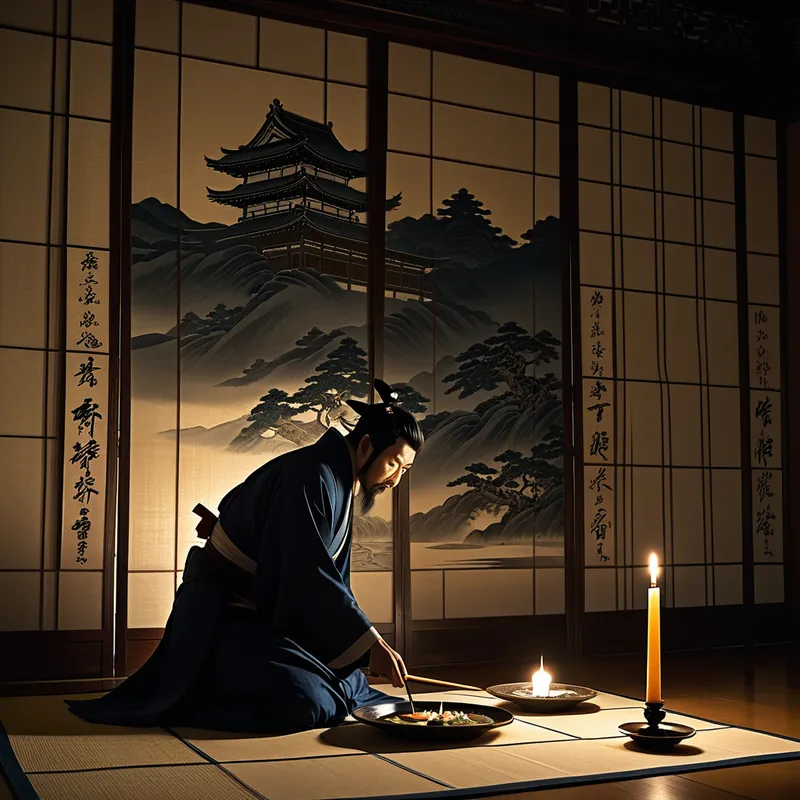
Onmyōdō, the "Way of Yin and Yang," is not a single myth but a comprehensive cosmological and magical system that coalesced in Japan during the 6th to 8th centuries. It was a profound synthesis, weaving Chinese philosophical concepts of Yin-Yang and the Five Elements with native Japanese animism (Shinto) and later, esoteric Buddhist (Mikkyō) practices. Its practitioners, the Onmyōji, were not mere folk magicians but state-sanctioned scholars, astronomers, and diviners operating within the powerful Onmyōryō.
Their societal function was critical: to maintain cosmic and social order. They determined auspicious dates for ceremonies, journeys, and construction; performed exorcisms and protective rites; interpreted omens from the stars and unusual events; and created astrological calendars. In the Heian court, where invisible forces were considered as real as political ones, the Onmyōji was a crucial advisor, protecting the Emperor and the capital from spiritual pollution (kegare) and disharmony. The myths of Onmyōdō are thus embedded in historical records, diaries, and literature like The Tale of Genji, where spiritual imbalance is a direct driver of plot. It was a science of the subtle, a technology of the soul applied to the governance of the world.
Symbolic Architecture
At its core, Onmyōdō is a grand symbolic system for navigating the fundamental dualities and cycles of existence. It presents the universe not as a battleground of good versus evil, but as a dynamic, living system of complementary opposites seeking equilibrium.
The master does not fight the shadow but knows it is the necessary condition for the perception of light.
The Taijitu is its central glyph: each half contains the seed of the other, and they swirl in eternal, generative embrace. This rejects absolute binaries. Grief (yin) contains the potential for release (movement toward yang); rigid order (yang) must soften into flow (yin) or it will shatter. The Gogyō represent the phases of transformation—how creativity (Wood) leads to action (Fire), which leads to embodiment (Earth), then structure (Metal), and finally release/ dissolution (Water), which nourishes new creativity.
The Onmyōji himself is the archetype of the conscious mediator, the ego that does not identify with one pole but holds the tension between them. His tools are symbols of this function: the bokusen reads the "cracks" in fate—the places where potential manifests; the shikigami represent the taming and directing of one's own unconscious, instinctual energies (the "animal" spirits within) toward a conscious purpose.
The Dreamer's Resonance
When the patterns of Onmyōdō stir in the modern psyche, they often manifest in dreams of profound imbalance seeking correction. You may dream of a house where one room is freezing and dark (excess yin) while another is unbearably hot and bright (excess yang), and you are tasked with opening a window or door to allow circulation. You might encounter a repetitive, haunting figure—a weeping person, a stalled vehicle, a blocked path—that represents a "stuck" emotional or psychic energy, a mononoke of your own unresolved history.
Somatically, this can feel like being "out of phase"—chronic fatigue (drained yang), anxiety that feels like electrical buzzing (scattered yang), or a heavy, depressive stagnation (congested yin). The dream is the psyche's own Onmyōji, attempting a ritual of re-harmonization. It presents the problem in symbolic form: the neglected relationship (Earth element), the unexpressed creative impulse (Wood), the unprocessed grief (Water). The dreamer is not just witnessing a ghost story; they are being shown the geography of their own inner Heian-kyō, pointing to where the spiritual infrastructure requires attention.

Alchemical Translation
The process modeled by Onmyōdō is the alchemy of consciousness itself: the transmutation of raw, unconscious, often disruptive psychic content into a coherent part of the self's ecosystem. It is a blueprint for individuation.
First comes Divination (Bokusen): Self-observation. Instead of casting shells, we practice honest introspection and mindfulness. "What cracks are appearing in my life? Where do I feel resistance or rupture?" This is the diagnosis of the inner landscape.
Second, Confrontation & Listening (The Ritual): We must face our "spirits"—our repressed anger, shame, or trauma—not to annihilate them, but to hear their story. Like the Onmyōji listening to the mononoke, we must acknowledge the truth of our wounds. This is shadow work.
The goal is not to live in perpetual daylight, but to become the graceful dancer who moves between day and night, knowing both as home.
Third, Re-integration (The Offering): This is the act of translation. The energy bound up in a grievance is potent. The alchemical task is to unbind it from its frozen, destructive form and redirect its power. The rage can become healthy boundaries (Metal). The grief can become compassion (Water). The ritual "offering" is the conscious act of giving that transformed energy a new, constructive place in the psyche's Gogyō cycle.
Finally, Ongoing Harmonization (The Calendar): Onmyōdō teaches that balance is not a static achievement but a daily practice. It requires attending to the "auspicious dates" of our own inner rhythms—knowing when to act (yang) and when to rest (yin), when to build structure and when to let flow. To master Onmyōdō within is to become the sovereign of your own inner kingdom, no longer at the mercy of unseen forces, but in conscious, respectful dialogue with the entire cosmos of the self.
Associated Symbols
Explore related symbols from the CaleaDream lexicon: