Ondal and Princess Pyeonggang Myth Meaning & Symbolism
A princess defies prophecy to marry a fool, transforming him through love and war into a great general, in a myth of destiny and self-made nobility.
The Tale of Ondal and Princess Pyeonggang
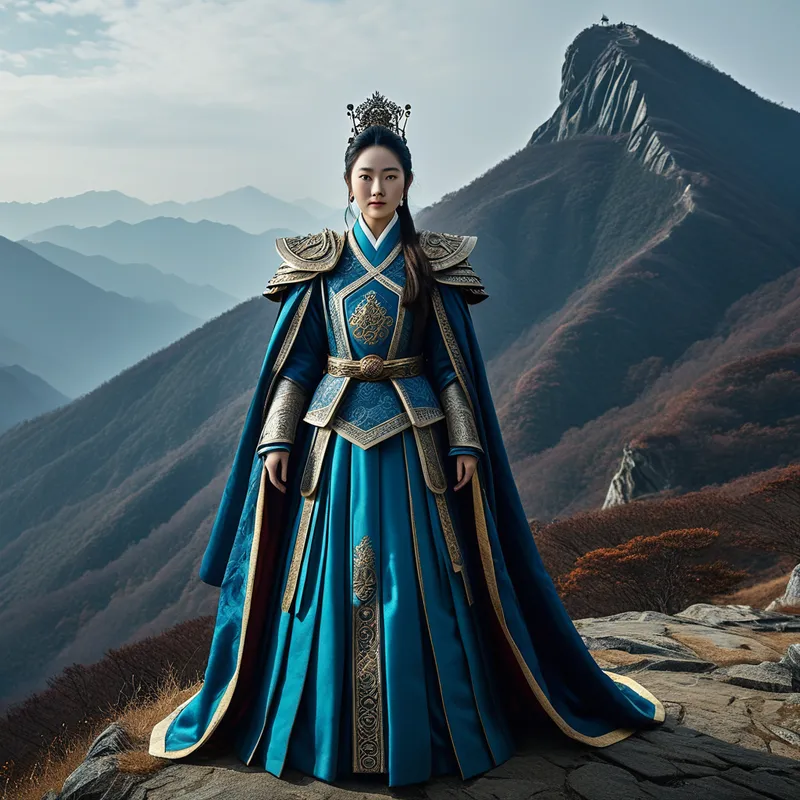
Listen, and hear a tale not of gods, but of mortals who touched the hem of fate. In the ancient kingdom of Silla, a prophecy was born with a princess. They named her Pyeonggang, and the court astrologers, peering into the star-choked heavens, declared with trembling voices: “This child will bring a beggar into the palace.” The king, Jinheung, roared with fury. A beggar? In his sacred halls? He ordered the infant princess cast out, sent to be raised far from the gilded capital, hoping to sever the thread of this wretched destiny.
Years flowed like the Nakdong River. The princess grew in exile, her spirit as unyielding as the mountains that cradled her. She knew her fate, not as a curse, but as a compass. Meanwhile, in a dusty village at the kingdom’s edge, lived Ondal. The people called him a fool. His clothes were rags, his speech was simple, and his greatest joy was playing with a crude bow, shooting at leaves, dreaming of being a soldier. He was the laughingstock, the embodiment of lack—the very beggar of the prophecy.
The day arrived. The king, perhaps softened by time or haunted by guilt, summoned his exiled daughter home. Her procession, a river of silk and steel, wound through the countryside. As it passed Ondal’s village, the princess commanded a halt. The crowd held its breath. She stepped from her palanquin, her gaze sweeping over the gawking peasants until it settled on the wide-eyed, ragged young man. The air grew still. Pointing directly at Ondal, Princess Pyeonggang spoke words that shattered the world’s order: “This is my husband.”
The court was plunged into chaos. The king’s rage was a tempest. But Pyeonggang’s will was granite. She would have no other. In a furious compromise, the king banished them both. Cast out from the palace, the princess and the fool were left with nothing but each other. She saw not the ragged clothes, but the strong hands. Not the simple speech, but the honest heart. She took his crude bow and said, “A man must have a horse and armor to become a general.” With her own hands, she sold her last jewels, her fine garments, and bought him a steed and equipment. She taught him strategy, history, and the bearing of a lord. Her love was the forge, and Ondal, the raw ore.
War came to Silla. From the north, the Goguryeo armies pressed like a dark tide. In this hour of desperation, Ondal stepped forward. The fool-turned-warrior, tempered by a princess’s faith, led the Silla forces. He fought not for glory, but for the kingdom that had scorned him, for the wife who had seen his soul. In a legendary battle, his valor turned the tide. He returned not as Ondal the fool, but as General Ondal, the savior of Silla. The king, humbled and awed, welcomed the hero and his princess home. The prophecy was fulfilled, but not as a tragedy—as a triumph. The beggar had entered the palace, but he entered as a lion, forged in the fire of unwavering love.
Cultural Origins & Context
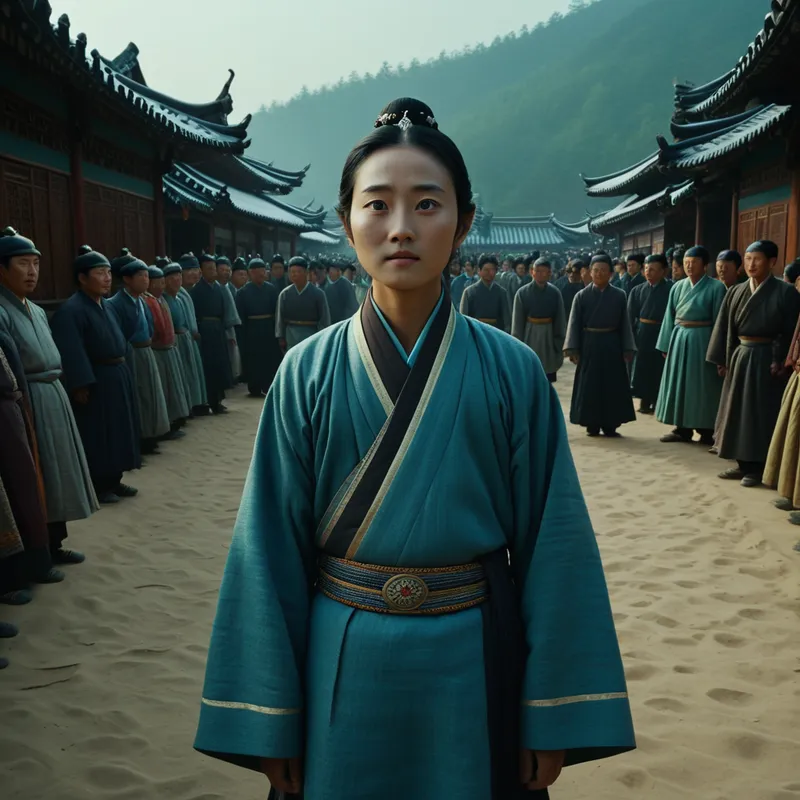
This myth, rooted in the Three Kingdoms Period, is preserved in the <abbr title=""Samguk Sagi,” a historical record of the Three Kingdoms compiled in the 12th century”>Samguk Sagi and the <abbr title=""Samguk Yusa,” a collection of legends, folktales, and histories from the Three Kingdoms period”>Samguk Yusa. Unlike tales of divine founders, it is a distinctly human drama, likely evolving from oral folktales before being recorded by scholars like Iryeon. Its societal function was multifaceted. On one level, it served as a folk justification for social mobility in a rigid aristocratic system—a fantasy where inherent worth could trump birth. On another, it was a narrative about the wisdom of women and the power of perception, with Pyeonggang acting as the seer who identifies true value where society sees none. It reassured that destiny, while potent, is not a prison, but a pattern to be fulfilled with courage and choice.
Symbolic Architecture
At its core, this is a myth of recognition and actualization. [Princess](/symbols/princess “Symbol: The symbol of a princess embodies themes of power, privilege, and feminine grace, often entailing a journey of self-discovery.”/) Pyeonggang represents the [anima](/symbols/anima “Symbol: The feminine archetype within the male unconscious, representing soul, creativity, and connection to the inner world.”/) in its most potent form: not as a passive muse, but as an active, [fate](/symbols/fate “Symbol: Fate represents the belief in predetermined outcomes, suggesting that some aspects of life are beyond human control.”/)-determining force of [insight](/symbols/insight “Symbol: A sudden, deep understanding of a complex situation or truth, often arriving unexpectedly and illuminating hidden connections.”/) and will. She is the [aspect](/symbols/aspect “Symbol: A distinct feature, quality, or perspective of something, often representing a partial view of a larger whole.”/) of the psyche that can see the latent [Hero](/symbols/hero “Symbol: A hero embodies strength, courage, and the ability to overcome significant challenges.”/) within the [Orphan](/symbols/orphan “Symbol: Represents spiritual abandonment, primal vulnerability, and the quest for belonging beyond biological ties. Often signifies a soul’s journey toward self-reliance.”/). Ondal symbolizes the potential self, the prima materia, full of unrealized power but socially devalued and internally undeveloped.
The prophecy is not a sentence, but a seed. It contains the end state, but not the path. The path is carved by love’s stubborn hand.
The “[fool](/symbols/fool “Symbol: Represents innocence, risk-taking, and new beginnings. Often symbolizes a leap into the unknown or naive trust.”/)” is not an [absence](/symbols/absence “Symbol: The state of something missing, void, or not present. Often signifies loss, potential, or existential questioning.”/) of intelligence, but an absence of worldly form and [direction](/symbols/direction “Symbol: Direction in dreams often relates to life choices, guidance, and the path one is following, emphasizing the importance of navigation in personal journeys.”/). Pyeonggang’s act of selling her jewels is profoundly alchemical: she transmutes the [static](/symbols/static “Symbol: Static represents interference, disruption, and the breakdown of clear communication or signal, often evoking feelings of frustration and disconnection.”/), ornamental [wealth](/symbols/wealth “Symbol: Wealth in dreams often represents abundance, security, or inner resources, but can also symbolize burdens, anxieties, or moral/spiritual values.”/) of her old [life](/symbols/life “Symbol: The symbol of ‘Life’ represents a journey of growth, interconnectedness, and existential meaning, encompassing both the joys and challenges that define human experience.”/) (her royal [status](/symbols/status “Symbol: Represents one’s social position, rank, or standing within a group, often tied to achievement, power, or recognition.”/)) into the dynamic, functional tools of his new one ([armor](/symbols/armor “Symbol: Armor represents psychological protection, emotional defense, and the persona presented to the world. It symbolizes both safety and the barriers that separate us from vulnerability.”/), a horse). She invests the [capital](/symbols/capital “Symbol: A capital city represents the center of power, governance, and national identity, often symbolizing authority, structure, and collective aspirations.”/) of the old [identity](/symbols/identity “Symbol: Identity represents the sense of self, encompassing personal beliefs, cultural background, and social roles.”/) into the startup of the new. The bow, his childish toy, becomes the [instrument](/symbols/instrument “Symbol: An instrument symbolizes creativity, communication, and the means by which one expresses oneself or influences the world.”/) of his [destiny](/symbols/destiny “Symbol: A predetermined course of events or ultimate purpose, often linked to spiritual forces or cosmic order, representing life’s inherent direction.”/), symbolizing how latent, playful skills, when properly directed, become the weapons of one’s [life](/symbols/life “Symbol: The symbol of ‘Life’ represents a journey of growth, interconnectedness, and existential meaning, encompassing both the joys and challenges that define human experience.”/) [purpose](/symbols/purpose “Symbol: Purpose signifies direction, meaning, and intention in life, often reflecting personal ambitions and core values.”/).
The Dreamer’s Resonance
When this myth stirs in the modern unconscious, it often manifests in dreams of profound misplacement or hidden calling. One might dream of being in a grand setting wearing rags, yet feeling a strange, unshakeable rightness. Or of a powerful, unknown figure (often feminine) pointing directly at the dreamer in a crowd, conferring a daunting identity. These are somatic signals of the psyche’s Pyeonggang recognizing the Ondal-within.
The psychological process is one of confronting the “fool” aspect of oneself—the parts deemed foolish, embarrassing, unskilled, or naive by the inner critic and the outer world. The dream asks: What potential have you exiled because it looked like foolishness? What prophecy of your own soul are you running from? The emotional tone is not of shame, but of a tense, awe-filled inevitability. The dreamer is on the cusp of allowing a deeper, knowing part of the self to “marry” that raw potential, initiating a difficult but glorious transformation.

Alchemical Translation
The individuation process modeled here is the Coniunctio—the sacred marriage—not between a man and a woman, but between the conscious ego’s resources (the Princess) and the unconscious, undeveloped potential (the Fool). The first stage is the exile. Both the princess (conscious identity) and the fool (unconscious potential) are rejected by the ruling King (the prevailing conscious attitude, societal norms, internal critic). They must leave the familiar kingdom to found their own psychic space.
The work of soul-making begins not in the palace of achievement, but in the wilderness of exile, where old titles are meaningless.
The second stage is investment. The conscious mind must willingly “sell its jewels”—its treasured self-concepts, its defenses, its pride—to fund the development of the raw potential. This is the hard work: patience, teaching, believing when there is no external evidence. Finally, the third stage is the return. The now-integrated potential, forged in the fires of relationship and purpose, returns to the kingdom (the wider psyche and world) not as a beggar, but as a protector and a leader. The once-rejecting king (the critical ego) must now bow to the wholeness it helped create. The prophecy is fulfilled through the alchemy of love, which here means steadfast, discerning attention and faith.
Associated Symbols
Explore related symbols from the CaleaDream lexicon:
- Princess — The archetypal figure of conscious value and destined will who recognizes and names latent nobility, acting as the catalyst for transformation.
- Hero — The archetype realized through the myth, representing the journey from devalued potential to integrated, purposeful strength and social contribution.
- Fool — The unformed, naive, yet authentic potential self that exists before society’s labels and before the conscious ego takes up its transformative task.
- Destiny — The overarching pattern or prophecy that guides the narrative, representing the soul’s inherent blueprint, which must be engaged with actively, not passively accepted.
- Love — The active, shaping force of recognition and investment that transmutes raw material into realized form, far beyond mere romantic feeling.
- Crown — The symbol of achieved identity and rightful authority, which is not given by birthright in this myth, but forged through inner marriage and courageous action.
- Horse — Represents mobilized energy, instinctual power, and the means to journey toward one’s destiny, purchased at the cost of old, static treasures.
- Bow — The latent skill or innate talent in its crude, playful form, which becomes the focused instrument of purpose and defense when wielded by a developed self.
- Exile — The necessary separation from the old order and familiar comforts, the wilderness where true identity is forged outside of assigned roles.
- Warrior — The aspect of the psyche that engages with conflict and challenge, emerging from the integration of love’s guidance and raw courage.
- Stone — The unhewn, overlooked potential within the self, which contains the latent statue of the hero waiting to be revealed by the sculptor’s hand.
- Journey — The fundamental process of moving from a state of lack and ridicule to a state of wholeness and honor, encompassing both external travel and profound internal change.