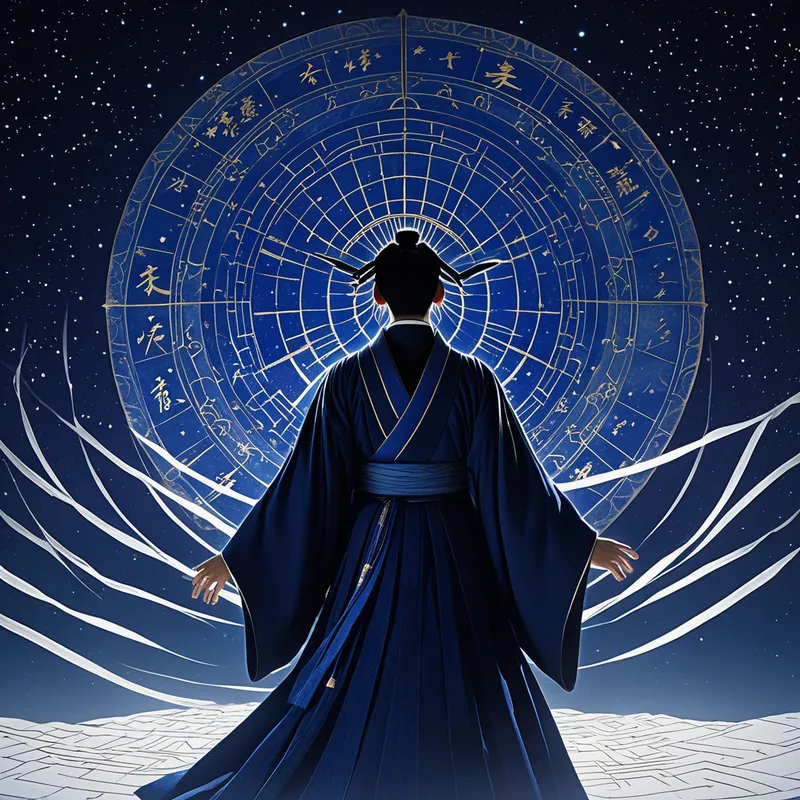
Omikuji Myth Meaning & Symbolism
An ancient tale of a celestial messenger weaving human fates into sacred papers, inviting mortals into a dialogue with destiny itself.
The Tale of Omikuji
In the time when the world was younger and the veil between the realms of Utsushiyo and the Kakuriyo was but a sigh of wind through ancient pines, there existed a profound silence in the human heart. People lived beneath the vast, indifferent sky, their joys and sorrows seeming like random strokes of a brush they could not see, their futures a scroll kept tightly rolled by unseen hands.
This silence was heard by the Kami. Not the great creators, but a quieter, more attentive order of celestial beings—the scribes of fate. Among them was a messenger, whose form was like shifting mist and whose task was to listen to the unspoken questions that gathered in the sacred spaces: the whispered fears at a child’s bedside, the silent pleas for a good harvest, the tangled hopes for love that lodged in the throat.
Moved by this silent chorus, the messenger descended one twilight to the grounds of a grand shrine, where the oldest Shinboku stood sentinel. From its branches, the messenger gathered the essence of the coming seasons—the promise of spring blossoms, the ferocity of summer storms, the abundance of autumn, the austerity of winter. From the sighs of the petitioners, they gathered the raw material of human longing.
Then, with a brush dipped in starlight and ink made from shadow, the messenger began to write. Not on clay or bamboo, but on strips of paper as white and pure as first snow. Upon each, they inscribed a fragment of the future. Some bore characters of great blessing: Daikichi, Great Good Fortune. Others carried gentle encouragement: Kichi, Good Fortune. Some were neutral: Suekichi, Future Good. And some bore the stark, necessary words of caution: Kyo, Misfortune, and the solemn Daikyo, Great Misfortune.
But the messenger knew that to hand a fate, sealed and absolute, to a mortal would be a cruelty. It would be a sentence, not a gift. So, they introduced a sacred ambiguity, a ritual of return. They decreed that the paper, once received and read, must be given a choice. It could be kept, a companion for the journey ahead. Or, it could be surrendered—tied to the branch of a pine tree or a designated frame within the shrine grounds.
To tie the fortune was to complete the dialogue. It was to say to the kami, "I have heard your whisper. I acknowledge this possibility. Now, I return it to the winds of change, to the flow of the universe." The tied papers would flutter like a thousand silent prayers, their messages dissolving back into the cosmic weave, their energy transmuted. The act of tying was not an act of rejection, but one of profound participation—a collaboration with fate itself. And so, the first Omikuji were born, not as decrees, but as the first words in an eternal conversation between the human heart and the patterns of the world.

Cultural Origins & Context
The practice of Omikuji finds its roots deep within the animistic and syncretic soil of Japan. While not tied to a single, canonical myth like those of the Kojiki or Nihon Shoki, its essence is a pure expression of Shinto principles. Shinto is fundamentally relational, concerned with the harmonious interaction between humans, nature, and the myriad kami that inhabit it. Divination, in this context, is not about foretelling a fixed future, but about seeking alignment—musubi, the spiritual energy of connection and creation.
Historically, forms of lot-based divination (uranai) were used for significant state decisions and by the aristocracy. By the Heian period (794-1185), this trickled down into popular religious practice at temples and shrines, often those associated with Mikkyo Buddhism, which incorporated complex symbolic systems. The standardized paper-slip Omikuji, drawn randomly from a box, became widespread in the Edo period (1603-1868), as travel and pilgrimage became more common among the populace. The shrines and temples along major routes offered these portable oracles, providing spiritual guidance for journeys, business ventures, marriages, and health.
The societal function was multifaceted. It was a ritual of orientation, a way to "take the temperature" of one's current path. It provided a sanctioned space for anxiety and hope to be externalized, contained on a piece of paper. The physical ritual—shaking the cylinder, selecting the numbered stick, retrieving the corresponding paper—created a mindful pause, a moment of intention in the midst of uncertainty. The subsequent act of reading and then tying the paper (especially an unlucky one) served as a cathartic release and a symbolic act of returning one's troubles to the divine realm, thus maintaining the crucial cycle of exchange and purification central to Shinto practice.
Symbolic Architecture
At its core, the myth and ritual of Omikuji are a profound symbolic system for navigating the human relationship with the unknown. The paper strip itself is a powerful symbol: it is a temporary vessel for a truth. It is not the truth in its eternal form, but a snapshot, a potentiality given form for a fleeting moment of contemplation.
The Omikuji is not a verdict from the universe, but a question posed to the soul. Its power lies not in its prediction, but in the reflection it provokes.
The random draw symbolizes the aspect of life that is genuinely beyond our control—chance, circumstance, the roll of cosmic dice. The message on the paper symbolizes the interpretation of that chance. The "Great Misfortune" is not a curse; it is the archetypal shadow, the warning, the potential for loss that is an inherent part of any journey. The "Great Good Fortune" is the potential for grace, the archetypal gift. The vast majority of fortunes lie in the middle spectrum, reflecting life's nuanced, mixed nature.
The pine branch or metal rack for tying is the axis mundi of this ritual. The pine (matsu) in Japan symbolizes longevity and steadfastness. By tying the paper to it, one attaches their transient concern to something eternal and resilient. The fluttering papers collectively represent the community of seekers, a visual tapestry of shared human vulnerability and hope. The ritual completes a sacred circuit: intention (the draw) -> revelation (the reading) -> integration/release (the tying). It models a healthy psychological process of confronting information, processing its emotional impact, and then consciously deciding how to hold or release it.
The Dreamer's Resonance
When the motif of Omikuji appears in a modern dream, it seldom manifests as a simple shrine visit. The dreamer might find themselves in a vast, empty hall where fortunes fall from the ceiling like snow, each bearing a single word relevant to a current life dilemma. They may dream of trying to read a fortune, but the kanji are blurry, shifting, or written in an unknown language. Alternatively, they may dream of a tree so heavy with tied papers that its branches groan, or of frantically trying to untie one specific paper from a tangled multitude.
These dreams signal a psyche engaged in a process of sorting potentialities. The dreamer is likely at a crossroads, faced with choices whose outcomes feel obscure or subject to forces beyond their control. The somatic feeling is often one of suspension—a held breath, a moment before a dice roll. The blurry text points to intuition not yet fully formed; the overwhelming tree suggests a burden of unresolved "what-ifs" and past decisions whose emotional weight has not been released.
The dream is an expression of the Self prompting the ego to engage in the Omikuji ritual internally: to consciously draw forth the hidden fears and hopes (the random stick), to articulate the possible outcomes they represent (the paper), and then to perform the crucial act of psychological "tying"—to acknowledge these possibilities without letting them define or paralyze. It is a call to move from passive anxiety about fate to active dialogue with it.

Alchemical Translation
The alchemical journey modeled by Omikuji is not one of heroic conquest, but of sophisticated relational attunement. It maps the individuation process as a series of conscious engagements with chance and meaning.
The first stage, Nigredo, is represented by the moment of reaching into the dark box. This is the confrontation with the unknown, the chaotic prima materia of life—the job loss, the relationship beginning or ending, the illness. It is the acknowledgment, "I do not know what comes next."
The Albedo, the washing and whitening, is the drawing forth of the pure white paper. This is the act of giving that chaos a form, however tentative. It is the courage to ask, "What story is trying to emerge from this?" The reading of the fortune is the beginning of Citrinitas, the yellowing, where the intellect and feeling engage to interpret the symbol. Is this "misfortune" a warning to be heeded, or a fear to be faced and dissolved?
The true gold of the Omikuji ritual is not in receiving a lucky paper, but in achieving the state of mind where one can gracefully tie even the unluckiest paper to the tree. This is the Rubedo: the reddening, the achievement of the philosopher's stone.
This final stage is the act of tying. Psychologically, this is transcendent function—the creation of a new, third attitude that supersedes the binary of "good fate vs. bad fate." It is the realization that one's destiny is not written on the paper, but in the relationship one has to the paper. By tying it, one internalizes the message's lesson but releases its power to dictate. One becomes, like the pine, both rooted in one's own experience (Utsushiyo) and open to the winds of change and spirit (Kakuriyo). The individual is no longer a passive recipient of fate, but an active participant in a continuous, sacred conversation with the unfolding mystery of their own existence. The fortune is transmuted from a prediction into a partner in the soul's journey.
Associated Symbols
Explore related symbols from the CaleaDream lexicon: