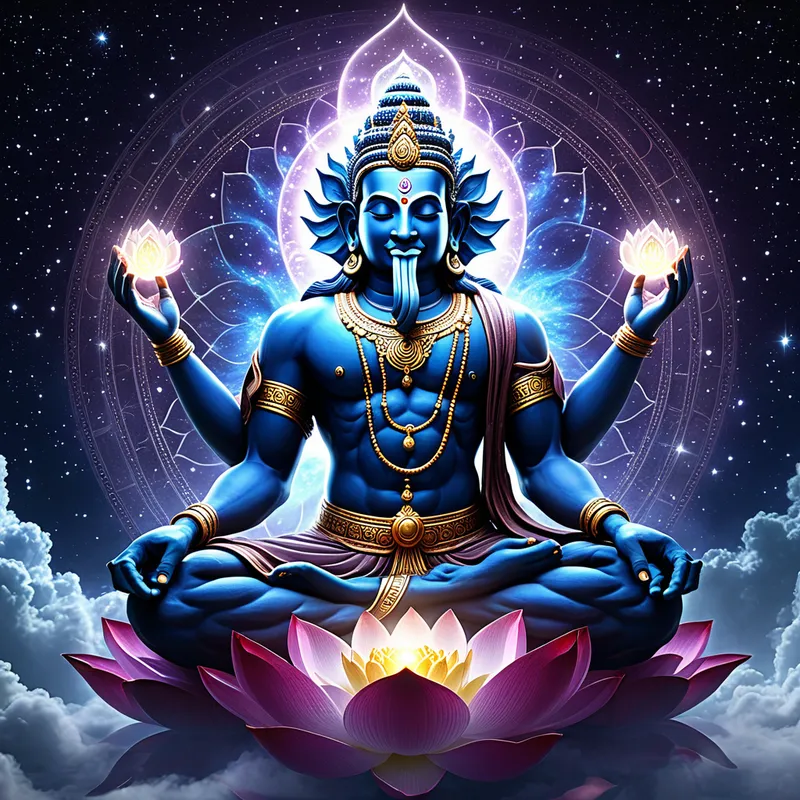
OM/AUM Myth Meaning & Symbolism
The sacred syllable from which all reality emerges, containing the past, present, future, and the transcendent silence beyond.
The Tale of OM/AUM
Before the beginning, there was neither being nor non-being. There was only a profound, pregnant silence—a darkness not of absence, but of potential. Then, within that boundless womb of possibility, a vibration stirred. It was not a sound heard by ears, but a tremor felt by the soul of existence itself.
From this tremor arose a longing, a desire to become. And that desire took form as a resonance, a hum that grew in intensity and intention. This was the first thought, the first word, the first note. It was the seed-syllable, OM.
The sages say that in the timeless time before time, the great deity Brahma sat in meditation upon the cosmic waters. He sought the source, the blueprint, the first principle from which he could fashion the worlds. He listened into the silence until he heard it—the faintest echo of that original vibration. He focused his entire being, his breath, his consciousness, upon that echo. As he inhaled, the universe contracted into a point of infinite density. As he exhaled, he gave voice.
From his lips issued forth the syllable AUM.
The ‘A’ (अ) burst forth like the dawn, bright and open-throated, birthing the realm of waking consciousness, Jagrat. With it came light, form, and the gross material world. It was the beginning of all things.
The ‘U’ (उ) rolled out like a wave, deep and resonant, weaving the realm of dream consciousness, Swapna. Here, the subtle worlds took shape—desires, thoughts, memories, and the astral landscapes of the mind.
The ‘M’ (म) resonated as a hum, closing the lips, turning awareness inward to the realm of deep, dreamless sleep, Sushupti. This was the seed-state of pure potential, the unmanifest from which all manifestation springs.
And then… the silence.
After the ‘M’ faded, there remained a fourth state, Turiya. This was not a sound, but the substratum of silence from which the sound emerged and into which it returned. It was the ineffable, the absolute, the peaceful witness to the great play of creation, preservation, and dissolution.
With this one utterance, the cosmos unfolded. The vibration of AUM structured the elements: ether, air, fire, water, earth. It gave rhythm to the cycles of day and night, the seasons, and the very breath of life. It became the chariot upon which prayers travel, the anchor for the meditating mind, and the secret name of the ultimate reality, Brahman.
Cultural Origins & Context
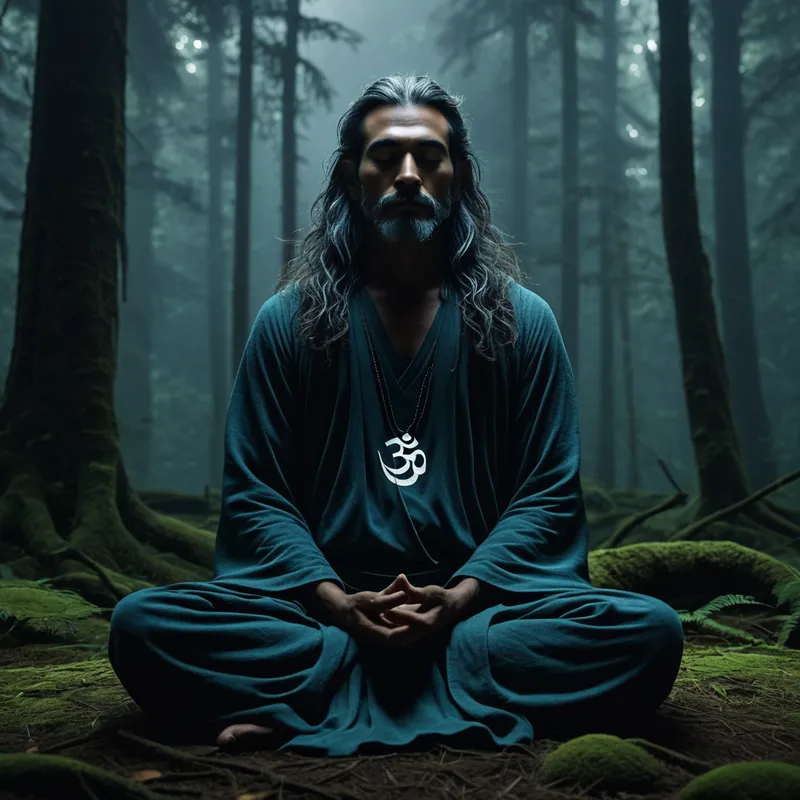
The myth of OM is not a single story with a plot, but a foundational metaphysical truth woven into the very fabric of Vedic and post-Vedic thought. Its origins are as ancient as the quest to understand existence itself. It first appears explicitly in the Mandukya Upanishad, which is entirely dedicated to elucidating its meaning.
This knowledge was transmitted orally for millennia, from guru to disciple in the forest hermitages of ancient India. It was not merely taught; it was experienced. Disciples would spend years mastering the precise pronunciation and resonance of the syllable, feeling its vibration in their bodies and minds, using it as a vehicle to traverse the states of consciousness it describes. Its societal function was profound: it was the key to all ritual (beginning and ending every chant), the essence of all scripture (said to be contained within it), and the practical tool for the individual’s spiritual journey from ignorance to enlightenment.
Symbolic Architecture
The myth of OM is a map of consciousness itself. It is a symbolic encoding of the entire spectrum of experience, from the outermost layers of material reality to the innermost core of pure being.
OM is the audible form of the unmanifest; it is the bridge between the finite and the infinite, the personal and the universal.
The three phonetic components (A-U-M) represent the Hindu Trimurti—creation, preservation, and dissolution—as well as the three gunas or qualities of nature: Rajas (A), Sattva (U), and Tamas (M). Psychologically, they map the full movement of the psyche: the outward projection of the ego (A), the inward flow of subjective imagery and feeling (U), and the dissolution of individual identity into the unconscious (M). The fourth, silent state (Turiya) is the Self, the transcendent center that observes all these movements without being identified with any of them.
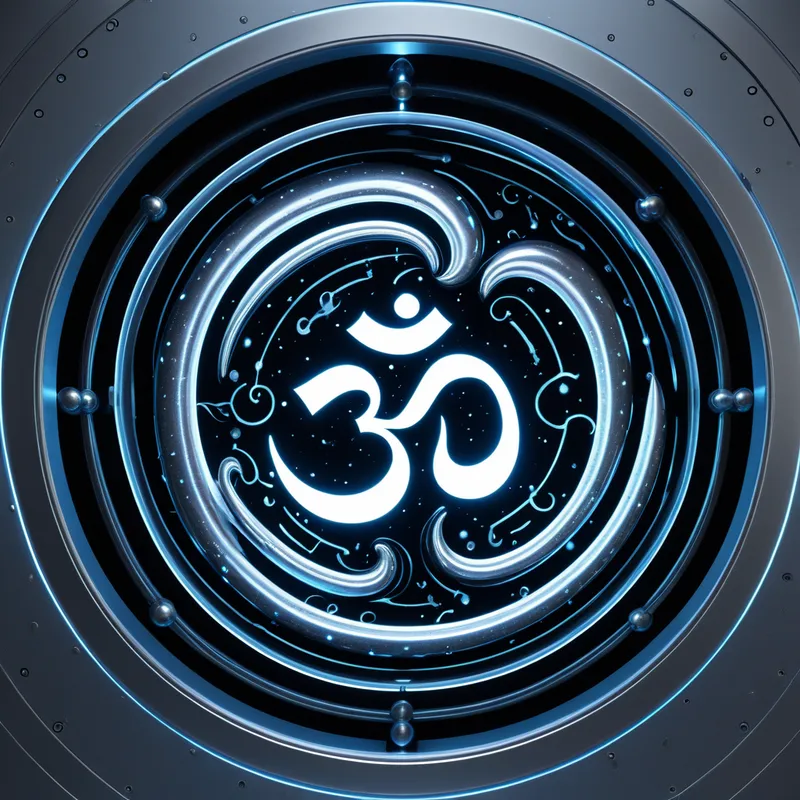
The written symbol of OM is itself a mandala of profound meaning. The lower curve represents the waking state, the upper curve the dream state, the curling curve emerging from the center represents deep sleep and illusion, and the dot with the crescent moon represents the transcendent state and the veil of maya that is finally pierced.
The Dreamer's Resonance
When the pattern of OM vibrates in the modern dreamscape, it rarely appears as a literal Sanskrit character. Instead, it manifests as the experience of foundational sound or resonant silence.
A dreamer may hear a profound, single-note hum that seems to stabilize a chaotic dream landscape, signaling a call to find their center. They may experience a moment of absolute, peaceful silence within a storm of dream events, representing a fleeting touch of the transcendent Turiya state. Alternatively, they might dream of a three-part structure—a journey through three rooms, meeting three figures, or hearing three distinct sounds—that culminates in a serene emptiness. This somatic process is the psyche attempting to recalibrate, to move from fragmentation (being lost in one state—all waking ego, all dreaming chaos, or all numbing sleep) toward integration. The dream is sounding the note of wholeness.

Alchemical Translation
The alchemical journey modeled by OM is the quintessential process of psychic transmutation and individuation. It is the path of gathering the scattered fragments of the self and realizing the gold of the unified consciousness.
The modern individual begins identified solely with the “A” state—the waking ego, the persona, the material world and its demands. The alchemical work starts with the “U”—the descent into the dream world, the exploration of the personal and collective unconscious, confronting shadows, anima/animus, and the wealth of symbolic imagery. This is the solutio, the dissolving of rigid ego structures. The “M” represents the nigredo, the dark night of the soul, where even these inner contents dissolve into the formless ground of being. It feels like a void, a loss of identity, a profound sleep.
The goal is not to remain in any one state, but to become the silent witness who can consciously participate in all three.
The triumph is the realization of the fourth state, Turiya—the albedo and rubedo of the spirit. This is the birth of the Self, the individuated being who can engage in the world (A), process inner life (U), and rest in deep renewal (M), all while anchored in the timeless, silent awareness that they are none of these roles exclusively. The chant of OM in practice is this alchemy in motion: using sound and vibration to consciously move awareness through each state, training the psyche to find its home in the silence behind the noise, the stillness at the heart of creation.
Associated Symbols
Explore related symbols from the CaleaDream lexicon: