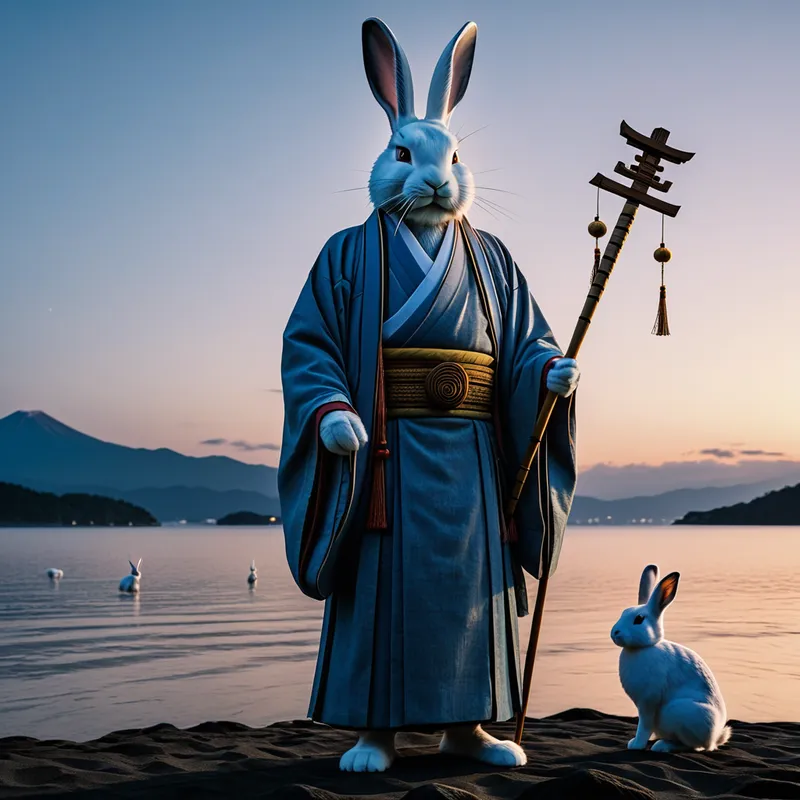
Okuninushi Myth Meaning & Symbolism
A myth of a gentle, exiled god who endures trials, masters life and death, and builds a nation through compassion, becoming a deity of healing and relationships.
The Tale of Okuninushi
Listen, and hear the tale of the Great Land Master, the one who endured.
In the age when the world was still raw and the kami walked the earth in forms of wind and stone, there was a prince. His name was Okuninushi, and he was the eightieth child of a storm. His father was the tempestuous Susano-o, who raged in exile. From this violent lineage, Okuninushi was born with a gentle heart, a flaw his many brothers saw as weakness. They coveted the land of Izumo, and they plotted against their gentle sibling.
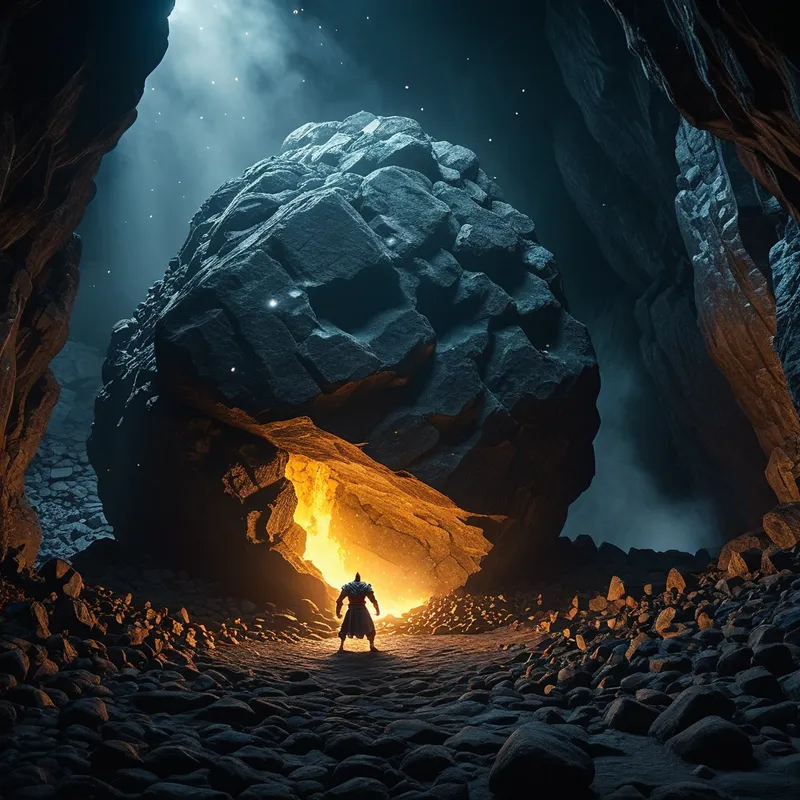
The air was thick with malice the day they invited him to hunt on the Mount Tema. “Brother,” they smiled with sharp teeth, “chase this red boar for us.” Okuninushi, trusting, ran ahead. But the boar was no beast—it was a boulder, heated in a mountain fire until it glowed like the sun, rolled down the slope to crush him. He fled, his breath searing his lungs, but the stone found him. His flesh burned, his spirit screamed. He fell, and his brothers laughed, believing him dead, and left for home.
But life still flickered within him. From the shadows came a whisper, a presence. It was the kami of healing, sent by his weeping mother. She gathered herbs, she sang incantations, and from the charred earth, Okuninushi rose, whole once more. Yet his trials had only begun. His brothers, enraged by his survival, laid trap after trap: they shattered a tree to crush him, they filled a field with angry wasps. Each time, through divine aid or desperate cunning, he survived.
His path led him to a place of ultimate shadow: Ne-no-kuni, the Root-Land, ruled by none other than his own formidable father, Susano-o. Here, in a palace that echoed with the sighs of the dead, Okuninushi met his fate. Susano-o tested him with monstrous sleep in a chamber of serpents, then of centipedes and wasps. Each time, a silken scarf from Susano-o’s daughter, Suseri-hime, became a charm of protection. The storm god, seeing his daughter’s love and the young god’s resilience, set a final task: to find and return the arrows he shot into a vast meadow.
As Okuninushi searched the grassy plain, Susano-o set it ablaze, a wall of fire roaring to consume him. In that moment of certain doom, a field mouse whispered, “The earth is cool beneath. Dig, and live.” Okuninushi burrowed into the cool soil as fire raged above. When the flames passed, the mouse brought him the arrows. He returned them to the storm god, who, finally recognizing a spirit as unyielding as his own, granted him his daughter and a gift: the mighty sword and bow that would tame the land.
With Suseri-hime at his side, Okuninushi fled the underworld, pursued by his father’s thunderous wrath. He blocked the pass with a great boulder, severing the world of the living from the world of the dead. He returned to Izumo, not as a victim, but as a master. When the heavenly kami, led by Amaterasu, demanded the land, he did not fight. With profound wisdom, he negotiated, securing a majestic palace for his spirit and becoming the hidden, benevolent ruler of the invisible world of relationships, medicine, and fortune. The gentle, burned prince had become the Great Land Master, the unshakable foundation.
Cultural Origins & Context
This epic, known primarily from the ancient chronicles Kojiki (712 CE) and Nihon Shoki (720 CE), is not merely a story. It is a foundational kuni-yuzuri (“land-transfer”) myth, explaining the theological and political shift of divine authority from the earthly kami of Izumo to the heavenly kami of Yamato. It served to legitimize the emerging imperial line while honoring and incorporating the powerful indigenous cults of the Izumo region.
The tale was preserved and recited by kannushi (shrine priests) and miko (shrine maidens), especially at the grand Izumo Taisha, one of Japan’s oldest and most significant shrines. Its societal function was multifaceted: it explained natural phenomena (like geothermal activity, linked to the burning boulder), validated social structures of resilience and diplomacy, and provided a model for overcoming adversity through patience, cleverness, and divine connection. Okuninushi evolved into a kami of nation-building, agriculture, medicine, and, most intimately, of en-musubi—the tying of bonds in love, business, and all human relationships.
Symbolic Architecture
The myth of Okuninushi is a masterclass in symbolic initiation. He is the archetype of the wounded healer. His repeated “deaths” and resurrections are not failures, but essential alchemical stages of dissolution and coagulation. The burning boulder, the crushing tree—these are the brutal, initiatory wounds inflicted by the unconscious (his jealous brothers, his stormy father) upon a consciousness that is too soft, too identified with its innocent beginnings.
To be burned by the world is not to be destroyed, but to be tempered. The scar tissue becomes the strongest part of the soul.
His descent into Ne-no-kuni is a classic katabasis. Here, he does not fight the father/tyrant; he endures him. He accepts the tests, and crucially, he accepts help—the scarves from Suseri-hime, the advice of the mouse. This symbolizes the integration of the anima (the inner feminine principle of connection and life) and the wisdom of the instinctual, humble self (the mouse) to survive the psychic infernos of rage and despair. His final act—blocking the pass with a boulder—represents the necessary ego boundary that must be erected after a deep dive into the unconscious: one must return to the world, integrating the power but sealing the chaos.
The Dreamer’s Resonance
When this myth stirs in the modern psyche, it often manifests in dreams of profound persecution and hidden aid. You may dream of being unfairly blamed at work (the jealous brothers), of your home or body being invaded or burned (the heated boulder), or of being trapped in a labyrinthine, oppressive bureaucracy (the palace of Ne-no-kuni). The somatic feeling is one of crushing weight, searing heat, or suffocating entanglement.
The psychological process at work is the confrontation with the shadow of the family or social system—the envious, destructive forces that seek to suppress one’s gentle, creative, or unique nature. The dream is not merely replaying trauma; it is initiating it. The crucial element to watch for is the helper: the unexpected gift (a scarf, a key), the small animal that speaks, the sudden discovery of a hidden space or tool. This is the psyche’s own healing function, the “kami sent by the mother,” activating. The dream signals that you are in the middle of the ordeal, and the task is not to fight the fire head-on, but to find the cool earth beneath—the inner resource you have overlooked.

Alchemical Translation
For the individual, Okuninushi’s journey is a map for individuation through surrender, not conquest. His initial archetype is the orphan, cast out by his kin. But he does not harden into a rebel or warrior. Instead, he transmutes into the caregiver. His power comes from being forged in the fires of betrayal and the depths of the underworld, emerging not with a weapon to dominate the land, but with the wisdom to tend to it.
The ultimate power is not in refusing to be wounded, but in allowing the wound to become a womb for a new kind of strength.
The alchemical stages are clear: Calcinatio (the burning boulder—the burning away of naive identity), Mortificatio (the repeated “deaths”—the ego’s dissolution), Sublimatio (the descent and ascent from Ne-no-kuni—distillation of spirit), and finally Coagulatio (building his hidden palace in Izumo—the concrete, embodied realization of the new self). For us, this means enduring professional or personal trials not with the goal of victory over others, but of inner consolidation. It means going into our own “underworld” of depression, grief, or rage, not to battle it, but to find the “Suseri-hime” within—our capacity for loving connection—and the “field mouse”—our instinct for humble, survival-level wisdom. The triumph is not a crown in the sunlight, but a secure, benevolent authority in the twilight realms of relationship, healing, and creative foundation-building.
Associated Symbols
Explore related symbols from the CaleaDream lexicon:
- Fire — The transformative, destructive, and purifying element that tests Okuninushi, burning away his old identity and forcing him to find refuge in the cool earth beneath.
- Wound — The central motif of the myth; Okuninushi’s repeated injuries are not defeats but initiatory portals that forge his resilience and ultimate capacity as a healer.
- Mother — Represented by the healing kami who resurrects him, symbolizing the unconditional, restorative love of the Great Mother that sustains life through all trials.
- Cave — The underworld of Ne-no-kuni, a chthonic realm of death, testing, and profound transformation where the old self is dismantled.
- Key — The wisdom offered by the field mouse and the love of Suseri-hime, which unlock survival and mastery in the face of seemingly insurmountable obstacles.
- Journey — The essential structure of the myth: a perilous passage from victimhood to sovereignty, involving exile, descent, ordeal, and return.
- Healing — The ultimate domain of Okuninushi, who transforms his own suffered wounds into the power to mend and bind others, both physically and relationally.
- Stone — The burning boulder of persecution and the final boulder used to seal the underworld, representing both crushing adversity and the firm foundation of established boundaries.
- Earth — The cool soil that provides sanctuary from the fire and the very land of Izumo that Okuninushi learns to rule with compassion, symbolizing groundedness and refuge.
- Shinto Shrine — The physical and spiritual culmination of his journey; the sacred space (like Izumo Taisha) where his benevolent, relational power is honored and accessed.