Okomfo Anokye Myth Meaning & Symbolism
The tale of the priest who plunged a golden stool from the heavens, uniting a people and forging a nation through divine will and unbreakable oath.
The Tale of Okomfo Anokye
Listen. The story begins not with a king, but with the sky tearing open.
In a time when the people of the forest were many but divided, warring like scattered embers from a dying fire, a child was born marked by destiny. His name was Okomfo Anokye. From his first breath, it was said his fist was clenched tight around a talisman—a gift from the spirit world. He grew not as other men, but as a bridge between realms. His body was a vessel for Nyame, his ears tuned to the whispers of the earth and the ancestors.
The air in Kumasi was thick with the smoke of countless small fires, each clan tending its own flame. Osei Tutu, a leader of vision, saw not scattered flames but the potential for a single, great blaze. But to unite the Akan clans required more than ambition; it required a covenant from heaven itself. He turned to his twin in spirit, Okomfo Anokye.
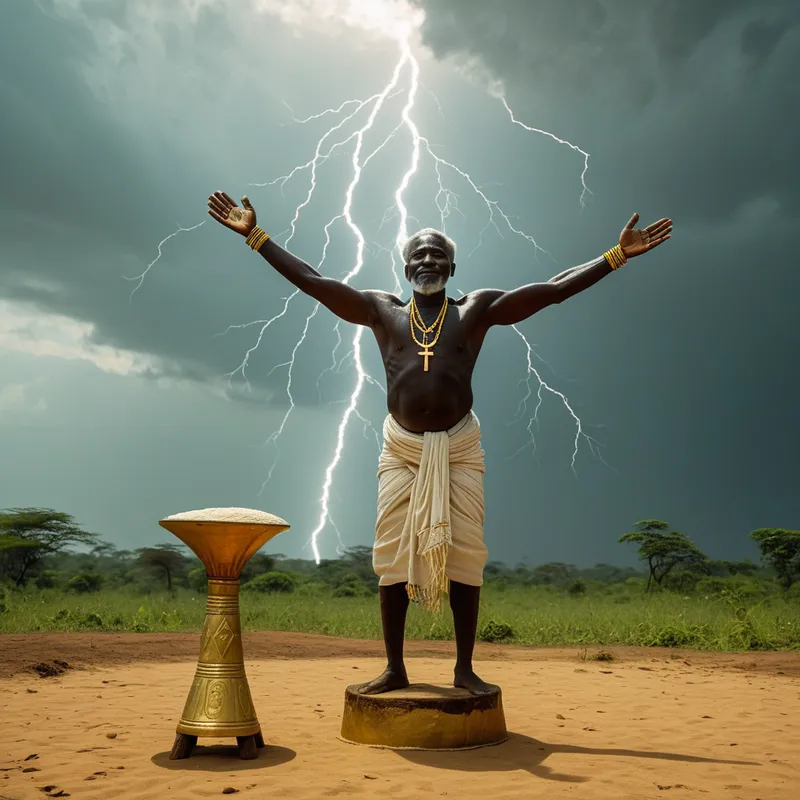
On a day when the sun seemed to hesitate, Anokye called the gathered chiefs and people to the open ground. The atmosphere crackled, heavy with expectation and doubt. He raised his arms, his voice not his own, but a channel for a force that made the very light tremble. He called upon Nyame, upon the ancestors, upon the soul of the land itself.
Then, a hush deeper than silence. The clouds darkened, swirled, and groaned. From the heart of the storm, amidst peals of thunder that shook the bones of the world, an object descended, cradled in a mist of gold and grey. It settled gently upon the earth before the priest. A stool, wrought of solid gold, embodying the very soul, the Sunsum, of the Ashanti nation. “This,” Anokye’s voice boomed, “is your king. All other chiefs derive their power from it. It holds your collective spirit. It must never touch the bloodied earth, nor be sat upon by mortal flesh.”
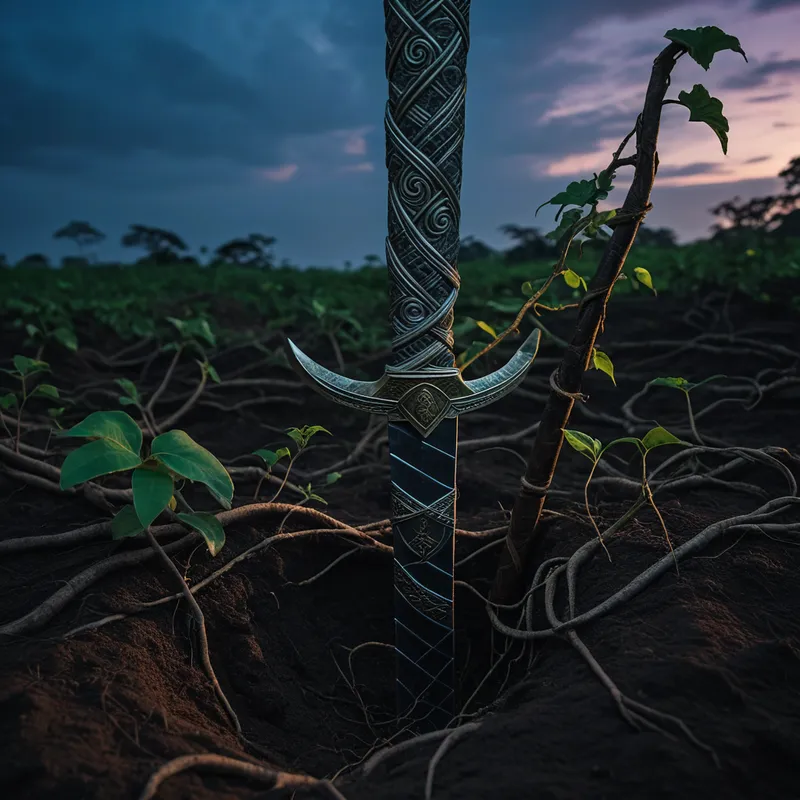
Unity was born in that awe-struck moment. But a nation needs more than a soul; it needs a body, a rooted, unshakable foundation. Anokye took a sword, a blade of potent Asuman. With a cry that fused human will with divine decree, he drove it deep into the ground at the heart of Kumasi. “This sword,” he proclaimed, “is the peg that holds your nation to the earth. When it is removed, the Ashanti will scatter to the winds.” To this day, they say, that sword remains, unmovable, the literal anchor of a people’s destiny.
Cultural Origins & Context
The myth of Okomfo Anokye is the foundational narrative of the Ashanti Empire (Asanteman), originating among the Akan peoples of present-day Ghana. It is not a folktale of the distant past but a living, historical myth, intricately woven into the very fabric of Ashanti identity, law, and kingship. The story was and is transmitted through oral tradition by court historians known as Akyeame (singular Okyeame), who serve as custodians of genealogies and state lore.
Its societal function is paramount. The myth provides divine sanction for the Ashanti Union under the Sika Dwa Kofi and the authority of the Asantehene. It transforms a political confederation into a spiritual entity, a nation with a soul. The story explains the source of Ashanti sovereignty (from Nyame), establishes the sacred, non-hereditary nature of the Stool’s authority, and codifies the mystical bond between the ruler, the priest, and the people. It is a charter myth in the truest sense, a narrative that creates the reality it describes.
Symbolic Architecture
At its core, the myth is a profound [allegory](/symbols/allegory “Symbol: A narrative device where characters, events, or settings represent abstract ideas or moral qualities, conveying deeper meanings through symbolic storytelling.”/) for the [birth](/symbols/birth “Symbol: Birth symbolizes new beginnings, transformation, and the potential for growth and development.”/) of [consciousness](/symbols/consciousness “Symbol: Consciousness represents the state of awareness and perception, encompassing thoughts, feelings, and experiences.”/) and cultural order from the [chaos](/symbols/chaos “Symbol: In Arts & Music, chaos represents raw creative potential, uncontrolled expression, and the breakdown of order to forge new artistic forms.”/) of disparate instincts. Okomfo Anokye is the archetypal Magician, the psychopomp who translates the will of the unconscious (the divine/sky) into a tangible [symbol](/symbols/symbol “Symbol: A symbol can represent an idea, concept, or belief, serving as a powerful tool for communication and understanding.”/) for the conscious world.
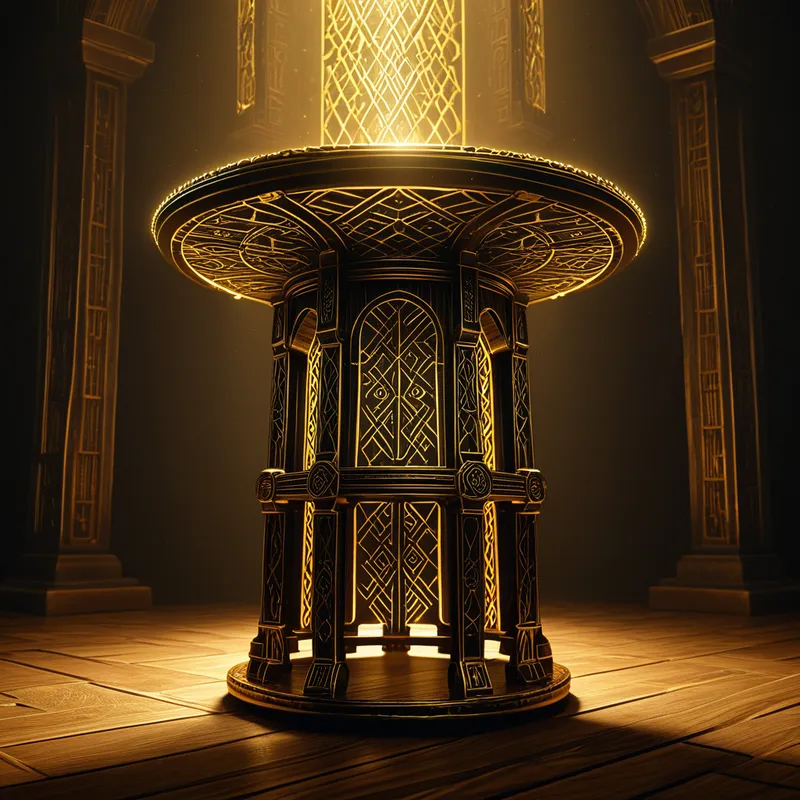
The Golden Stool is not a throne for a man, but a vessel for the soul of a people. It represents the emergent, transcendent Self that can only appear when the fragmented parts of the psyche (the clans) agree to serve a higher, collective principle.
The sword in the [stone](/symbols/stone “Symbol: In dreams, a stone often symbolizes strength, stability, and permanence, but it may also represent emotional burdens or obstacles that need to be acknowledged and processed.”/) is a universal [motif](/symbols/motif “Symbol: A recurring thematic element, pattern, or design in artistic or musical works, representing underlying ideas or emotional currents.”/), but here its meaning is uniquely grounded. It is not an [instrument](/symbols/instrument “Symbol: An instrument symbolizes creativity, communication, and the means by which one expresses oneself or influences the world.”/) to be withdrawn by a singular [hero](/symbols/hero “Symbol: A hero embodies strength, courage, and the ability to overcome significant challenges.”/), but an anchor to be left in place. It symbolizes the necessary sacrifice of total, unchecked freedom for the [stability](/symbols/stability “Symbol: A state of firmness, balance, and resistance to change, often represented by solid objects, foundations, or steady tools.”/) of [community](/symbols/community “Symbol: Community in dreams symbolizes connection, support, and the need for belonging.”/). It is [the law](/symbols/the-law “Symbol: Represents external rules, societal order, moral boundaries, and the tension between personal freedom and collective structure.”/), the foundational [trauma](/symbols/trauma “Symbol: A deeply distressing or disturbing experience that overwhelms the psyche, often manifesting in dreams as unresolved emotional wounds or psychological injury.”/), and the enduring contract all at once. The unremovable sword is the fixed point around which the dynamism of a nation revolves, the non-negotiable core of [identity](/symbols/identity “Symbol: Identity represents the sense of self, encompassing personal beliefs, cultural background, and social roles.”/).
The Dreamer’s Resonance
When this myth stirs in the modern psyche, it often manifests in dreams of profound unification or foundational anchoring. One might dream of discovering a central, radiant object in a cluttered house (the soul), or of trying to bind together scattered, arguing voices within oneself into a coherent council. The somatic sensation is often one of a deep, grounding pressure—a feeling of something being irrevocably set, like a keystone sliding into place.
Conversely, anxiety dreams rooted in this pattern may involve the terror of the Golden Stool being desecrated or the sword being wrenched loose. This translates to a psychological state of disintegration, where the hard-won unity of the personality feels threatened by old conflicts, shame, or a betrayal of one’s core values. The dream-ego is then the guardian of its own sacred center, facing the shadow of chaos.

Alchemical Translation
The individuation process modeled here is not a solitary hero’s journey, but the arduous creation of a psychic polity. The “clans” are our competing complexes: the inner critic, the wounded child, the ambitious persona, the repressed instincts. The first step, orchestrated by the inner Magician (our capacity for reflection and symbol-creation), is to summon a “Golden Stool”—a central, sacrosanct value or Self-image that all inner parts can acknowledge as supreme. This could be a commitment to integrity, to creativity, or to healing.
The alchemical fire is the oath of unity. The base metals of conflicting desires are transmuted only when they are willingly offered to a higher, symbolic gold.
The “sword in the earth” is the consequent, conscious sacrifice. To anchor this new Self, one must willingly give up certain freedoms: the freedom to be perpetually inconsistent, the freedom to let old wounds dictate all actions, the freedom to avoid commitment. One drives the sword of conscious choice into the soil of one’s life, saying, “Here I stand. This is my foundation.” It is an act of self-binding that paradoxically creates true sovereignty. The myth teaches that the soul (Stool) is given, but the nation (the integrated personality) must be built and anchored through a conscious, sacrificial act of will.
Associated Symbols
Explore related symbols from the CaleaDream lexicon:
- Golden Stool — The supreme symbol of the Ashanti soul and nationhood, representing the emergent Self that unifies all disparate parts of the psyche under a sacred, collective principle.
- Sword — The anchor of law and sacrifice, driven into the earth to create an unshakable foundation for community and identity, symbolizing the conscious choice that limits freedom to create stability.
- Sky — The realm of Nyame and the divine, representing the source of transcendent inspiration, authority, and the soul-destiny that descends into human reality.
- Earth — The grounding, receiving principle that anchors the divine sword and supports the nation, symbolizing the physical world, tradition, and the body into which spirit must be integrated.
- Thunder — The audible manifestation of divine power and presence during the Stool’s descent, representing the shocking, awe-inspiring force that accompanies a revelation of destiny.
- Sacrifice — The core act of driving the sword, representing the voluntary giving up of individual or clan autonomy for the greater good of the unified whole, essential for creation.
- Order — The ultimate achievement of the myth, the transformation of chaotic, warring factions into a structured, sovereign nation with a central sacred symbol and law.
- Ritual — The performed ceremony through which Anokye mediates between heaven and earth, demonstrating that profound psychological and social transformations require formal, conscious acts.
- Anchor — The essential function of the immovable sword, representing the non-negotiable core value or trauma that fixes the identity of a person or people in place.
- Spirit — The intangible Sunsum contained within the Golden Stool, representing the animating essence and collective destiny of a people, more important than any individual ruler.