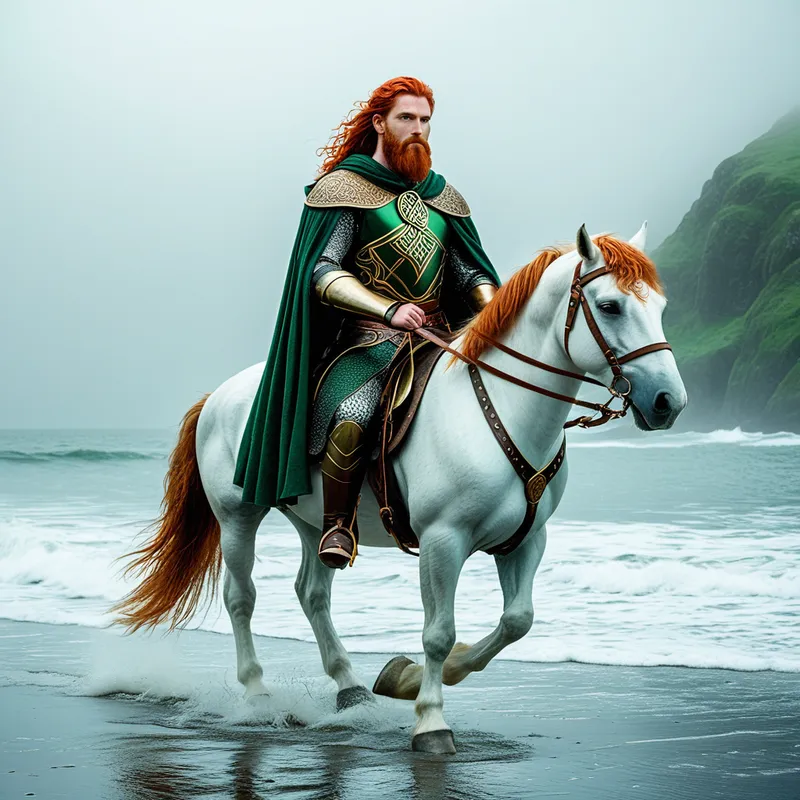
Oisín Myth Meaning & Symbolism
A warrior-poet journeys to a timeless land of youth, only to return to a changed world, embodying the soul's longing and the price of transformation.
The Tale of Oisín
Listen, and I will tell you of a loss that shaped a people, of a longing that bends time itself. In the days when the Tuatha Dé Danann still walked the green hills, though hidden from mortal eyes, there lived a man named Oisín. He was the son of Fionn mac Cumhaill, and in his veins ran the blood of heroes and the soul of a poet. His strength could topple oaks, but his songs could make the stones weep.
One day, as the Fianna rested from the hunt, a vision appeared. Across the sun-dappled grass came a woman riding a horse whiter than winter’s first snow. Her hair was a cascade of gold, and her eyes held the light of a starry sky at dusk. She was Niamh of the Golden Hair, and she had crossed the sea from the land of Tír na nÓg to seek him.
“Oisín, son of Fionn,” her voice was like a harp’s chord, “I have loved you from afar, through the tales of your deeds and the beauty of your verse. Come with me to my father’s kingdom, where sorrow is unknown, where time does not age the flesh, and where joy is as constant as the sun.”
What mortal heart could resist? Oisín took her hand, mounted the white steed behind her, and they galloped across the waves, the horse’s hooves skimming the sea-foam as if it were solid ground. They passed into a mist that glowed with an inner light, and emerged into Tír na nÓg. Here, the trees bore blossoms and fruit together, music hung in the perfumed air, and feasts lasted for years without anyone growing weary. For what felt like three weeks, Oisín lived in bliss with Niamh, a prince in a timeless paradise.
But a thorn began to prick his heart—a homesickness for the rugged hills of Ireland, for the rough camaraderie of the Fianna, for the weathered face of his father. Niamh, her eyes clouded with a foreknowledge of sorrow, begged him to stay. Yet the longing grew. Finally, she relented, lending him her white horse with one grave condition: he must not let his feet touch the soil of Ireland.
The white horse carried him back across the sea. But the Ireland he found was not his Ireland. The forts were smaller, overgrown. The people seemed diminished. Asking for word of Fionn mac Cumhaill, he was met with confusion, then tales of a giant hero who had died centuries past. Three weeks in Tír na nÓg had been three hundred years in the mortal world. In despair, Oisín turned his horse, but as he rode, he saw a group of men struggling to lift a great stone slab. Moved by the old instinct of the Fianna to aid others, he leaned from his saddle to help them. The girth strap broke. Oisín tumbled to the earth.
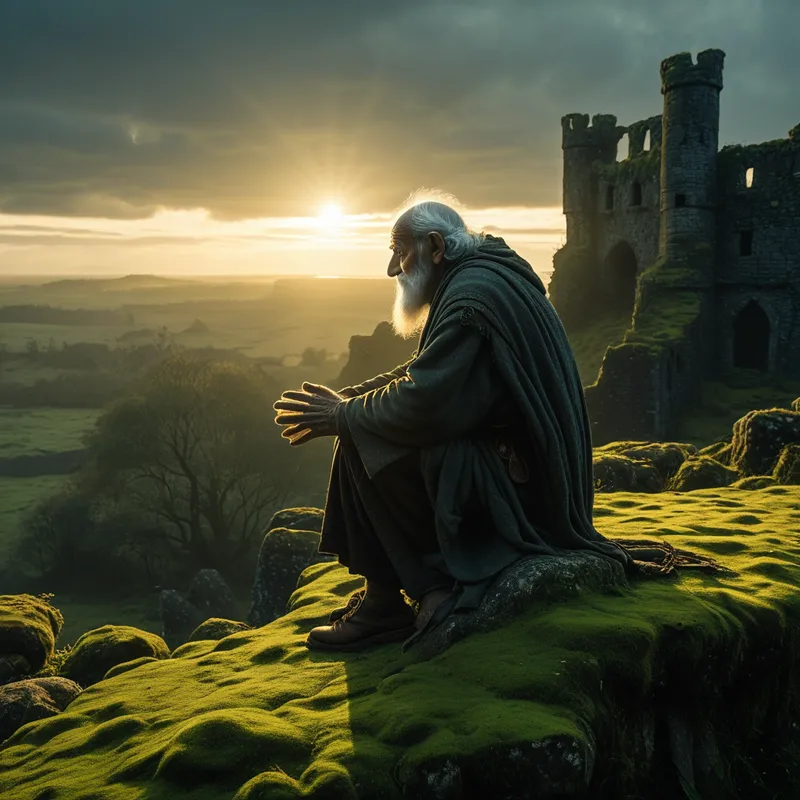
The moment he touched the soil of Ireland, the centuries he had evaded crashed upon him. The youthful warrior vanished. In his place lay an ancient, blind, withered man, the white horse vanishing with a sorrowful whinny back towards the west. The explorer had returned, but the home he sought existed only in the songs he would now spend his last days telling.
Cultural Origins & Context
The story of Oisín is a central pillar of the Fenian Cycle. Unlike the earlier mythological cycles dealing with gods and the founding of Ireland, this cycle concerns itself with a later, heroic age—a band of warrior-hunters who stood as protectors of the land and the high king. These tales were the province of the filid, the poet-seers, and were told in the halls of chieftains for centuries before being written down by Christian monks.
The function of Oisín’s story was multifaceted. On one level, it is a foundational aisling, or vision-poem, expressing the Celtic fascination with the Otherworld—a realm parallel to our own, accessible through mist, mounds, or invitation. It served as a cultural meditation on the nature of time, heroism, and memory. Furthermore, Oisín, as the last of the Fianna, becomes the ultimate witness. His return and transformation into a blind sage is the mechanism by which the entire epic tradition of Fionn is preserved; he is the living memory of a lost golden age, singing its stories into a diminished present.
Symbolic Architecture
At its core, the myth of Oisín is an archetypal map of the soul’s journey into the numinous and its tragic, necessary return. Tír na nÓg is not merely a paradise; it is the realm of the unconscious Self in its perfected, timeless state—a state of psychic wholeness where opposites (blossom and fruit) coexist. Oisín’s journey there with Niamh represents the ego’s rapturous, all-consuming encounter with the anima, the soul-image, which promises completion and an end to conflict.
The call to the Otherworld is the call of the soul to become more than it is, a summons that carries the price of all you have been.
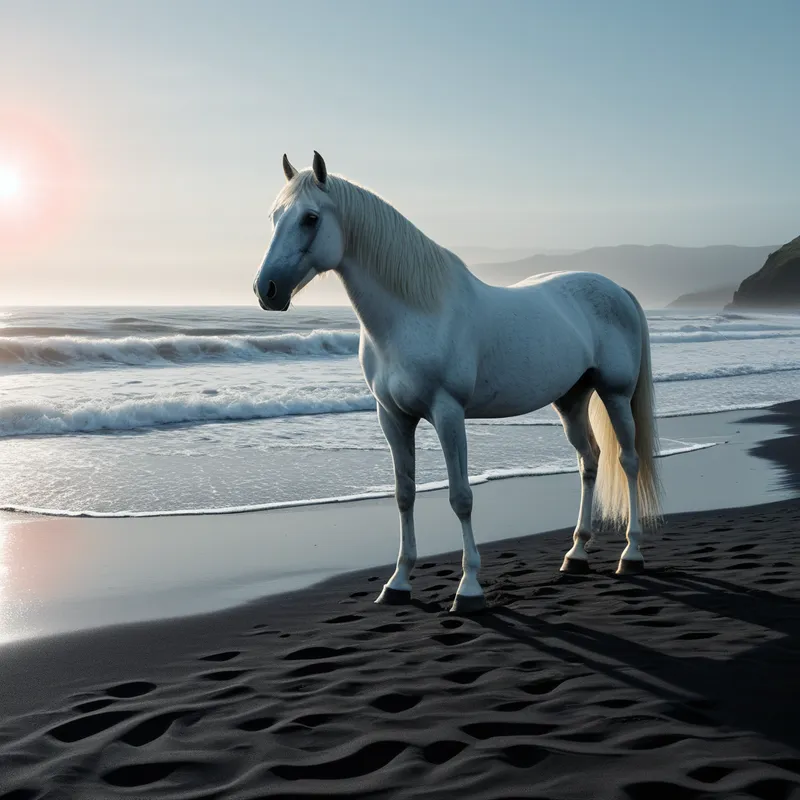
The white horse is the transcendent function, the vehicle that can traverse the threshold between consciousness and the unconscious, between mortal time and eternal essence. Oisín’s fatal mistake—dismounting, touching the earth—is profoundly symbolic. It is the impossibility of integrating a timeless, unconscious wholeness directly into the temporal, conditioned world of the ego. The two realms operate on different laws. The attempt to force them together, to act from the god-like perspective of Tír na nÓg within the human context of struggle (lifting the stone), results in the catastrophic inflation of the ego dissolving into the reality of time and decay.
The Dreamer’s Resonance
When this myth stirs in the modern psyche, it often manifests in dreams of profound dislocation and poignant longing. You may dream of returning to a childhood home that is eerily altered, or of meeting a beloved from the past who does not recognize you. The somatic sensation is one of profound heaviness, a literal weight of years or sorrow pressing on the chest upon waking.
This is the psyche working through an “Oisín moment”: a recognition that a transformative inner experience—a period of spiritual awakening, deep therapy, or creative flow—has fundamentally changed you. You have, in a sense, been to your own Tír na nÓg. The dream of the impossible return signals the difficult, often disillusioning process of re-entry. The old life, the old identity, no longer fits. The dreamer is navigating the grief of realizing that one cannot bring the full, radiant Self back intact; it must be translated, and part of that translation feels like loss, aging, blindness to the old ways of being.
Alchemical Translation
The alchemy of Oisín’s story is not in his stay in the Land of Youth, but in his fall and his survival as the ancient bard. This is the model of psychic transmutation. The goal of individuation is not to live in the unconscious paradise (a state of psychosis or permanent inflation), but to be transformed by its encounter and return to the human community bearing its meaning.
The gold is not in the eternal sunset, but in the song that is sung after the sun has set.
The initial nigredo, the blackening, is Oisín’s crushing disillusionment and physical decay upon touching the earth. His youth is killed. The albedo, the whitening, is his acceptance of his new state—the blind old man who no longer sees the outer world but sees into the truth of the stories. The final rubedo, the reddening, is the act of storytelling itself. His wasted body becomes the vessel, the alchemical retort, in which the raw experience of timeless beauty is cooked into the enduring cultural gold of poetry and myth.
For the modern individual, this myth cautions against spiritual bypass. It insists that any profound inner awakening must eventually be brought down to earth, where it will seem to age, diminish, and be met with incomprehension. The triumph is not in avoiding this fate, but in becoming the bard of your own journey. The transformed Self is not the eternally young hero, but the one who can articulate the loss, who can sing of the beauty that was and the reality that is, weaving them into a wisdom that nourishes the present. The stone he tried to lift was the weight of his own story, and in dropping it, he finally found its true form.
Associated Symbols
Explore related symbols from the CaleaDream lexicon: