Ogun's Iron Grove
A myth exploring Ogun's sacred iron grove, where the Yoruba god of metalwork, war, and civilization reveals the dual nature of creation through fire and forge.
The Tale of Ogun’s Iron Grove
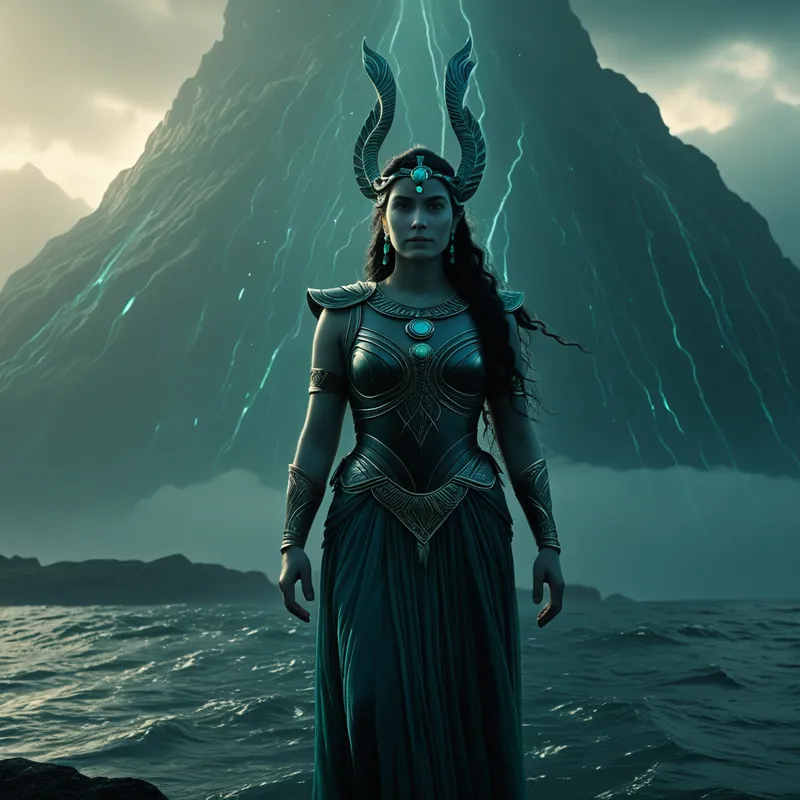
Before [the world](/myths/the-world “Myth from Tarot culture.”/) knew the straight road or the ordered city, there was the wild, green [chaos](/myths/chaos “Myth from Greek culture.”/) of beginnings. And in that primal world, Ogun, the lord of iron, fire, and the forge, walked. He was not yet the patron of civilization, but its potential, a force of pure, undirected will. His journey brought him to a place where the air hummed with a strange song—a grove unlike any other. Here, the trees were not of wood, but of living iron. Their trunks were dark, metallic columns, their leaves shimmering blades that chimed in [the wind](/myths/the-wind “Myth from Various culture.”/). The ground was littered not with fallen leaves, but with shards of ore and cooled slag. This was his sanctuary, his crucible: the Iron Grove.
Within this sacred space, Ogun’s nature unfolded in its terrifying duality. He was the creator and the destroyer, the healer and the warrior. Here, he would take the raw, red earth—the iron ore—and with the breath of his divine bellows and the fury of his own contained fire, he would force it to change. The process was not gentle. It was a violent marriage of earth and flame, a screaming birth in the heart of the furnace. From this agony, new forms emerged: the first machete to clear the impenetrable bush for the farm, the first hoe to turn the soil for seed, the first spear to defend the community, and [the first tool](/myths/the-first-tool “Myth from Various culture.”/) to build the house.
Yet, the grove was also a place of profound tension. The very iron that could build a city could also level it; the blade that harvested yams could spill lifeblood. It is said that Ogun, in his relentless drive to shape and order, would sometimes become lost in the ecstasy of the forge. The clangor of his hammer would drown out all other sounds—the songs of birds, the whispers of the other Orisha, even the cries of his own people. In these moments, the grove became not a place of creation, but of isolated, furious focus, where the god risked becoming a slave to the very forces he commanded. The myth tells us that the grove’s shadows held not just the promise of tools, but also the specter of weapons; its fires could warm a hearth or raze a village. Ogun’s mastery was never pure blessing, but a pact with a power that demanded respect and ritual care, lest it turn on its wielder.
Cultural Origins & Context
Ogun is one of the most pivotal and widely venerated Orisha in the Yoruba [pantheon](/myths/pantheon “Myth from Roman culture.”/) and its diasporic traditions, such as Santería and Candomblé. His domain is vast and essential to human society: metal, technology, warfare, hunting, politics, and all forms of construction and pioneering work. He is the archetypal pathfinder, the one who clears [the way](/myths/the-way “Myth from Taoist culture.”/) with his cutlass.
The Iron Grove is a powerful metaphysical concept within this cosmology. It is not merely a mythical location but a symbolic representation of the source of civilization’s tools and its inherent ambiguities. In a culture where the transition from forest to farm, from nature to culture, was a fundamental and perilous human task, Ogun presided over that threshold. The grove embodies the moment raw nature (the forest) is transformed by human (or divine) ingenuity and force (iron, fire) into culture (tools, order). His followers—blacksmiths, soldiers, surgeons, drivers, and engineers—are all seen as children of this grove, working with fragments of his transformative power. Rituals for Ogun often involve iron implements, palm oil, and gin, offerings meant to honor his strength and temper his fierce, sometimes volatile, aspect.
Symbolic Architecture
The Iron [Grove](/symbols/grove “Symbol: A grove symbolizes a sacred space of nature, tranquility, and introspection, often associated with spiritual growth and connection.”/) is a master [symbol](/symbols/symbol “Symbol: A symbol can represent an idea, concept, or belief, serving as a powerful tool for communication and understanding.”/) of the [psyche](/myths/psyche “Myth from Greek culture.”/)’s transformative engine. It is the inner workshop where raw, unconscious [material](/symbols/material “Symbol: Material signifies the tangible aspects of life, often representing physical resources, desires, and the physical world’s influence on our existence.”/) (the ore of instinct, [passion](/symbols/passion “Symbol: Intense emotional or physical desire, often linked to love, creativity, or purpose. Represents life force and deep engagement.”/), [trauma](/symbols/trauma “Symbol: A deeply distressing or disturbing experience that overwhelms the psyche, often manifesting in dreams as unresolved emotional wounds or psychological injury.”/)) is subjected to the focused heat of [consciousness](/symbols/consciousness “Symbol: Consciousness represents the state of awareness and perception, encompassing thoughts, feelings, and experiences.”/) (the forge fire) to be shaped into something usable for the [business](/symbols/business “Symbol: Dreaming of ‘business’ often symbolizes the dreamer’s ambitions, desires for success, and management of resources in their waking life.”/) of [life](/symbols/life “Symbol: The symbol of ‘Life’ represents a journey of growth, interconnectedness, and existential meaning, encompassing both the joys and challenges that define human experience.”/)—a skill, a work of art, a disciplined [strength](/symbols/strength “Symbol: ‘Strength’ symbolizes resilience, courage, and the ability to overcome challenges.”/).
The grove’s trees of iron represent the paradoxical nature of psychological structure: it is both living, growing, and organic, yet also hard, defining, and unyielding. True strength in the psyche is not rigid like dead metal, but resilient and adaptive like living ironwood.
The central [tension](/symbols/tension “Symbol: A state of mental or emotional strain, often manifesting physically as tightness, pressure, or unease, signaling unresolved conflict or anticipation.”/) of the myth—Ogun’s [capacity](/symbols/capacity “Symbol: A measure of one’s potential, limits, or ability to contain, process, or achieve something, often reflecting self-assessment or external demands.”/) for both creation and destruction, his inspirational focus and his dangerous [isolation](/symbols/isolation “Symbol: A state of physical or emotional separation from others, often representing a need for introspection or signaling distress.”/)—mirrors the [human](/symbols/human “Symbol: The symbol of a human represents individuality, complexity of emotions, and social relationships.”/) experience of any powerful drive or talent. The creative [fury](/symbols/fury “Symbol: An intense, overwhelming rage that consumes the dreamer, often representing suppressed anger or a primal emotional eruption.”/) of the [artist](/symbols/artist “Symbol: An artist symbolizes creativity, expression, and the exploration of the human experience through various forms of art.”/), the relentless focus of the innovator, the disciplined aggression of the protector: all can build worlds, and all can, if unchecked, burn them down. The grove teaches that the power to shape our [reality](/symbols/reality “Symbol: Reality signifies the state of existence and perception, often reflecting one’s understanding of truth and life experiences.”/) is inseparable from the power to devastate it. Civilization itself, Ogun’s greatest gift, is portrayed not as a serene utopia but as a hard-won, perpetually fragile order wrested from [chaos](/symbols/chaos “Symbol: In Arts & Music, chaos represents raw creative potential, uncontrolled expression, and the breakdown of order to forge new artistic forms.”/), always requiring ethical [application](/symbols/application “Symbol: An application symbolizes engagement, integration of knowledge, or the pursuit of goals, often representing self-improvement and personal development.”/) and [ritual](/symbols/ritual “Symbol: Rituals signify structured, meaningful actions carried out regularly, reflecting cultural beliefs and emotional needs.”/) remembrance of its bloody, fiery origins.
The Dreamer’s Resonance
When the image of Ogun’s Iron Grove arises in the modern psyche—whether in dream, vision, or artistic inspiration—it signals a profound call to the forge of [the self](/myths/the-self “Myth from Jungian culture.”/). It speaks to a time of necessary, and often difficult, transformation. To dream of entering such a grove may reflect a confrontation with one’s own raw, unprocessed strengths and rages (the iron ore), and a summons to consciously, deliberately shape them into something of utility and integrity.
The resonant sound of the iron leaves chiming is the call of one’s own latent potential, a potential that feels both innate and formidable. The heat of the forge is the anxiety, passion, or focused pressure required for change. This myth resonates deeply with anyone at a [crossroads](/myths/crossroads “Myth from Celtic culture.”/) of identity, anyone building a career, healing from a wound, or forging a new path through a personal wilderness. It warns against becoming so enamored with the act of forging—the work, the ambition, the control—that one becomes isolated in a self-made cage of iron, deaf to the softer, connecting rhythms of relationship, community, and the natural world outside the grove.
Alchemical Translation
In the alchemy of the soul, Ogun’s Grove is the [vas hermeticum](/myths/vas-hermeticum “Myth from Alchemical culture.”/)—the sealed vessel where [the great work](/myths/the-great-work “Myth from Alchemical culture.”/) takes place. [The prima materia](/myths/the-prima-materia “Myth from Alchemical culture.”/), the chaotic first matter, is the dense, red iron ore of our unrefined nature. The [nigredo](/myths/nigredo “Myth from Alchemical culture.”/), the blackening, is the smelting process, the dissolution of old forms in the fire of suffering, discipline, or intense introspection.
The bellows of the forge are the breath of awareness, the conscious attention that must be steadily applied to keep the transformative fire alive. Without this breath, the fire dies, and the ore remains inert; with too violent a blast, the fire rages out of control and consumes all.
The eventual product—the shining blade or useful tool—is the [albedo](/myths/albedo “Myth from Alchemical culture.”/) and [rubedo](/myths/rubedo “Myth from Alchemical culture.”/), the whitening and reddening, symbolizing the refined spirit made functional in the world. Ogun’s myth insists that this alchemy is not a peaceful, ethereal process. It is gritty, sweaty, and demands confrontation with our most formidable elements. The ultimate goal is not transcendence of the material, but its masterful, ethical incarnation. The god does not leave the grove; he works within it, reminding us that our transformation happens here, in the dense reality of our lives.
Associated Symbols
Explore related symbols from the CaleaDream lexicon:
- Fire — The primal agent of transformation, possessing the dual capacity to purify through destruction and to provide the essential heat for forging new forms from raw material.
- Forge — The sacred workspace of the soul, where pressure, heat, and skilled force are applied to shape unconscious potential into conscious, usable reality.
- Iron — Symbol of will, strength, and the structuring principle; it represents the necessary hardness we cultivate to navigate the world, which carries the risk of inflexibility.
- Grove — A natural sanctuary that is also a workshop, representing the intersection of organic growth and conscious cultivation, where wild potential is deliberately tended.
- Tool — The embodied intention and extended will of the creator; the physical manifestation of an inner capacity now made available for use in the outer world.
- Weapon — [The shadow](/myths/the-shadow “Myth from Jungian culture.”/) aspect of the tool, representing the same forged strength turned outward in aggression or defense, highlighting the dual-use nature of power.
- Chaos — The unshaped, raw material of existence—the dense forest and red ore—that provokes and necessitates the creative, ordering impulse.
- Order — The pattern, structure, and civilization wrought from chaos, always maintained through ongoing effort and ethical application of force.
- Transformation Cocoon — A vessel of metamorphosis where an old state of being is broken down and reshaped under intense pressure, akin to the smelting and forging process.
- Duality Dance — The perpetual, dynamic interplay between creation and destruction, focus and isolation, strength and brutality, as performed by the archetypal force within its sacred space.
- Pathfinder — The archetype who ventures into the unknown wilderness, clearing the way for others through decisive action and the application of transformative force.