
Ogun Myth Meaning & Symbolism
The story of the warrior deity who clears the primal forest with his machete, forging civilization from chaos and embodying the disciplined fire of transformation.
The Tale of Ogun
Listen. Before the roads, before the towns, there was only the green. A world of endless, breathing leaves, of roots that gripped the bones of the earth, of vines that whispered secrets in the stifling dark. It was a beautiful, suffocating womb. Humanity huddled in small, fearful clearings, their world bounded by the wall of the forest. They could not travel, could not trade, could not meet one another. The world was a collection of isolated heartbeats.
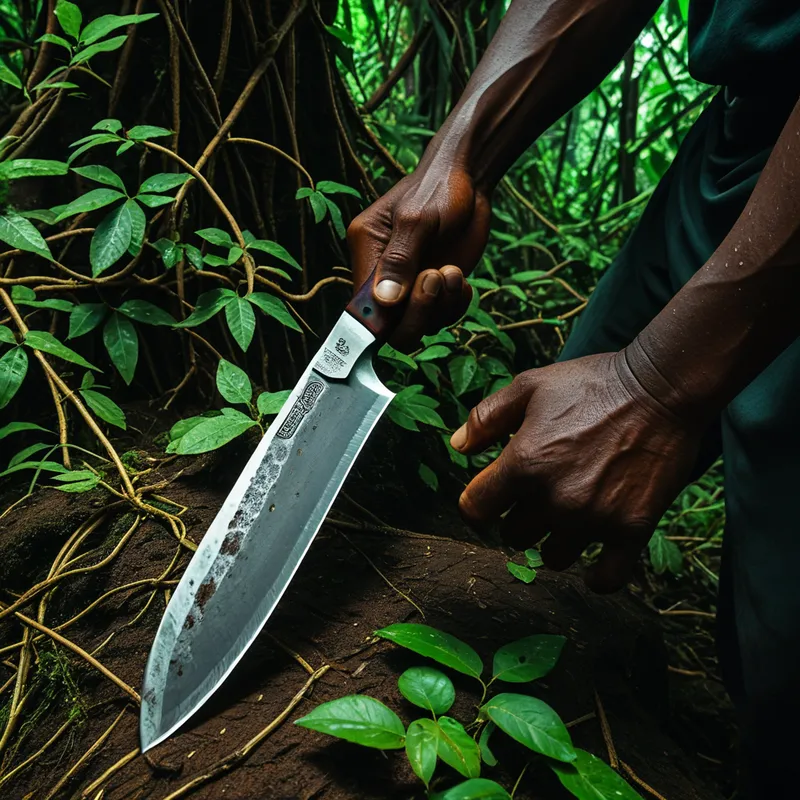
Then came the sound. Not the cry of a bird or the growl of a jaguar, but a new sound—a ringing, singing, cleaving sound. It was the sound of ashe meeting stubborn wood. From the deepest green emerged a figure who was not born but forged. His skin was the color of wet earth at twilight, his muscles like river-smoothed stone. In his hand, he held not a weapon of bone or fire-hardened wood, but a blade of pure, dark iron—a machete. This was Ogun.
He did not speak to the people. He showed them. He walked to the edge of their trembling clearing, raised his iron arm, and brought it down. The blow was not angry, but purposeful. A thick, coiling liana, as old as time, parted with a sigh. Sunlight, sharp and golden, stabbed into a place it had never been. He took another step into the wall of green. Chuk. A sapling fell. Chuk. A thorn bush was laid low. With every swing, the ringing song echoed, and a path was born.
For seven days and seven nights, the song did not cease. Sweat and rain mixed on his back. Sap, red as blood, stained his blade. Blisters formed and broke on his hands, but his rhythm never faltered. He was not fighting the forest; he was in conversation with it. He was asking for a space, negotiating a passage. Where he passed, the chaotic, interlocked life of the jungle was respectfully parted, not annihilated. A straight, clean line of bare earth appeared behind him, steaming in the new sun.
The people, first one brave soul, then another, then families, followed in his wake. They walked the path he had opened. They met other people from other clearings. On the road forged by Ogun’s will, they exchanged yams, stories, and marriage vows. Where paths crossed, markets and villages sprang up. The ringing of his machete became the ringing of the blacksmith’s hammer, the farmer’s hoe, the hunter’s blade. Civilization was not built; it was cleared. And at the center of every new town, in the forge and at the crossroads, they placed a piece of iron for Ogun, so he would always remember the way.
Cultural Origins & Context
The story of Ogun traveled the Middle Passage, a spiritual seed carried in the hearts of the enslaved Yoruba people from West Africa to the brutal shores of the Caribbean. In the hellish furnaces of the sugar plantation, where iron was used for chains and whips, the memory of Ogun underwent a profound and painful alchemy. The god of the blacksmith and the hunter had to become the god of those who were bound and broken by iron.
His worship persisted in secret, syncretized with Catholic saints like Saint Peter (holder of the keys, the opener) or Saint George (the dragon-slayer, the warrior). In the diasporic traditions, Ogun’s narrative was not just preserved in formal liturgy but in the lived reality of survival. The machete, the tool of brutal colonial labor in the cane fields, was reclaimed as his sacred symbol—the same instrument of oppression became the means of carving out dignity, community, and resistance. The myth was passed down not only by priests (babalawos and iyalorishas) in ceremonies but in the everyday resilience of people who used tools to shape a life from nothing. His societal function was dual: he was the patron of all who work with their hands (drivers, surgeons, soldiers, mechanics) and the psychic force that clears obstacles, both literal and spiritual.
Symbolic Architecture
Ogun is the archetype of necessary, focused force. He represents the moment when potential must become action, when the idea must meet the resistant material world. He is not brute destruction; he is definition. The primal forest is the undifferentiated chaos of the unconscious, the overwhelm of possibilities, traumas, and instincts that have grown wild and impenetrable.
The machete is consciousness itself—the focused, disciplined, and sharp edge of the will that makes distinctions, sets boundaries, and creates form from formlessness.
His labor is solitary, sweaty, and repetitive. This symbolizes the often lonely, arduous work of psychological differentiation. To become an individual, one must clear a path through the internal thicket of familial patterns, social conditioning, and inherited trauma. Ogun’s iron is the principle of structure, law, and technology—the human capacity to impose order, for better or worse. He embodies the terrifying truth that creation is always preceded by a cut, a separation, a sacrifice of the old, entangled way of being. He is the resolve to begin, and the endurance to continue.

The Dreamer's Resonance
When the energy of Ogun stirs in the modern psyche, it often manifests in dreams of intense, focused action within clutter or obstruction. You may dream of desperately trying to clear a blocked road with your bare hands, of wielding a tool (often a knife, axe, or yes, a machete) to cut through dense vegetation in your own home or workplace. There is a somatic quality of frustration coupled with determination—the feeling of needing to make a way through.
Psychologically, this signals a profound impasse. The dreamer is facing a life situation—a career path, a relationship dynamic, a creative project—that feels choked and impassable. The unconscious is presenting the problem as a literal jungle. The appearance of the tool or the sudden capacity for decisive action is the emergent Ogun energy. It is the psyche’s innate resource, activating the will to analyze, to cut away what is no longer serving (even if it is familiar and old-growth), and to establish a new direction. The dream may feel violent, but its intent is liberatory. It is the self prescribing the surgery it requires.
Alchemical Translation
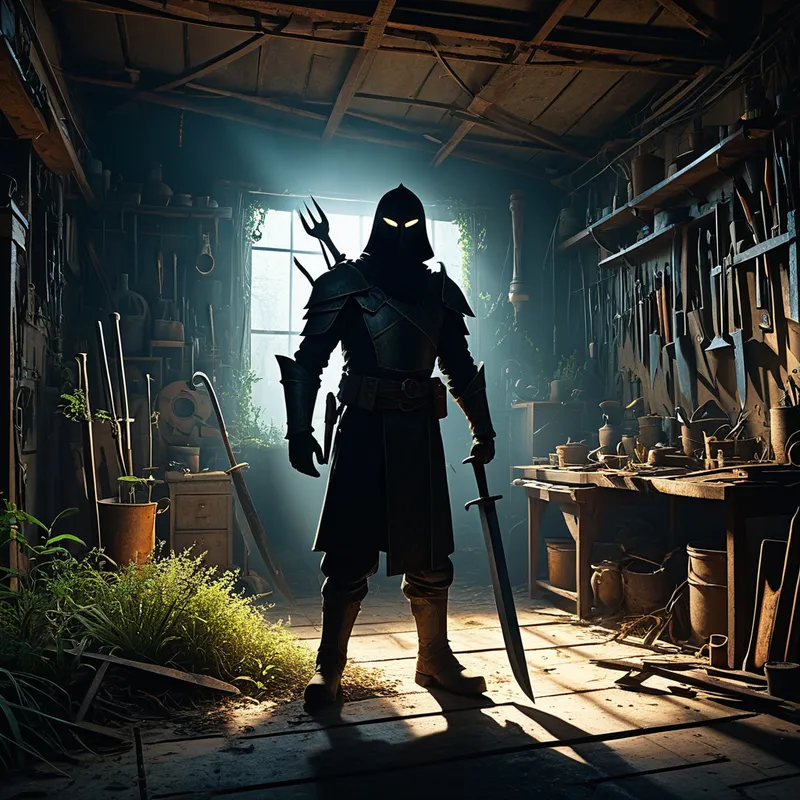
The individuation process modeled by Ogun is the alchemy of the will. It begins with the acknowledgment of the “green wall”—the stuck, entangled, and overwhelming state of one’s life. The first stage is to forge the tool. This is the conscious work of self-discipline: honing a skill, cultivating mental focus, or strengthening the body. It is creating the “iron” of one’s character.
The second stage is the relentless, daily application. This is the “work in the forest.” It is the act of sitting down to write the first sentence, of having the difficult conversation, of ending the toxic habit. Each act is a swing of the machete. It is repetitive, often thankless, and met with immense internal resistance. The old growth does not want to be cleared.
The triumph is not in the final, open field, but in the integrity of the path itself—the straight, true line carved by consistent, principled action.
Finally, the alchemical translation is the realization that the path you clear becomes a road for others. Your personal discipline, your faced trauma, your carved-out authenticity creates a template, a way that others can see and perhaps follow. The isolated self becomes connected. The iron, once a symbol of brutal separation, becomes the medium of community and culture. You become, in your own life, both the warrior in the solitude of the forge and the opener of the ways. The goal is not to escape the forest, but to learn its language and, with respect and unwavering force, to negotiate a passage through it, so that life may flow.
Associated Symbols
Explore related symbols from the CaleaDream lexicon: