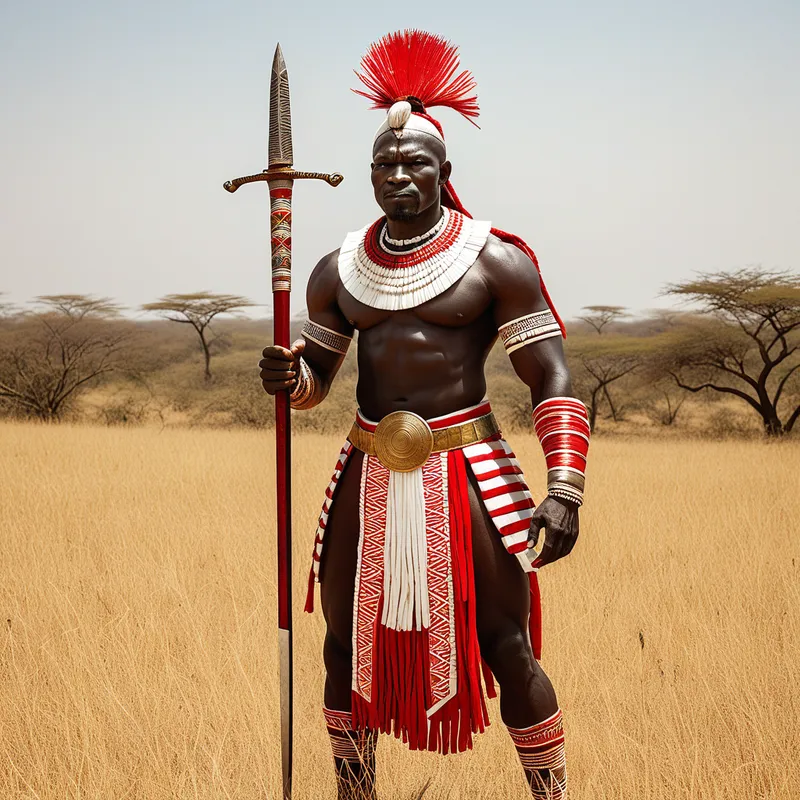
Ogou Warrior Spirit Myth Meaning & Symbolism
The story of Ogou, a divine force of iron and fire, embodying the warrior's path of righteous action, sacred rage, and alchemical transformation.
The Tale of Ogou Warrior Spirit
Hear the tale that is told when the sun hangs heavy and red, when the air tastes of dust and the promise of rain. This is not a story of the beginning, but of a forging. In the time when the world was still soft clay, the Olorun breathed life into the elements. From the heart of the earth, they called forth a spirit of unyielding resolve, a being not of gentle growth, but of necessary force. His name was Ogou.
He emerged not from a womb of water, but from the sacred belly of the mountain, where the earth’s bones are molten and black. His first breath was the hiss of hot metal plunged into water; his first sight was the blinding glare of the forge. The Orisha of the rivers and forests watched from a distance, for his energy was sharp, a vibration that cut through the hum of life. He was given dominion over the red earth, over the ore that slept in darkness, and over the fire that could wake it.
For ages, the world knew balance, but also vulnerability. Creatures of chaos, born from forgotten shadows, would sometimes creep from the edges of the world. They brought confusion, unchecked appetite, and a corrosion of order. The people, though wise in the ways of spirit, had no defense against such raw predation. Their prayers were songs, not shields.
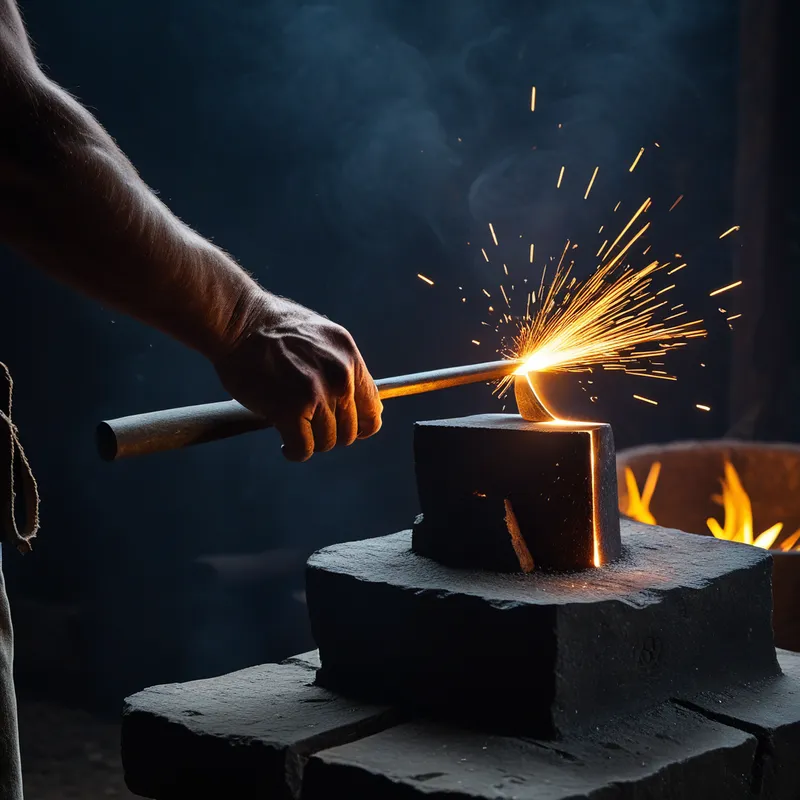
Then came the day the sky wept iron. A star, burning with a metallic heart, fell to earth. Where it struck, the ground bled a strange, hard stone. Ogou approached this wound in the world. He placed his hands upon the strange ore and felt its potential—a song of edges and points, of structure and strength. He built the first forge, a womb of flame and bellows. With a hammer that was an extension of his will, he sang to the stone. He did not ask it to be soft; he commanded it to be true.
The first strike was a clap of thunder that shook the roots of the Iroko. The second strike drew sparks that became the first fireflies. On the third strike, the ore yielded, flowing like liquid light. He shaped it, cooled it, and lifted from the ashes the first blade. It was not an object of beauty, but of terrible clarity. It was a line drawn. A boundary made manifest. A promise.
With this iron, Ogou did not seek war for its own sake. He became the protector of the threshold. Where chaos threatened to swallow a village, his presence was a wall of resolve. Where injustice festered like a wound, his blade was the surgeon’s tool, cutting away the sickness to save the body. His path was painted in the colors of his essence: the white of purity of purpose, and the red of the sacrifice such purpose demands. He became the spirit who stands at the crossroads, not to choose for you, but to give you the strength to choose for yourself, and to defend the path you walk.
Cultural Origins & Context
The narrative of Ogou finds its roots deep within the spiritual soil of West Africa, particularly among the Yoruba, Fon, and Ewe peoples. This is not a myth confined to a single, ancient text, but a living tradition carried across the Atlantic through the Middle Passage, evolving into the Santería (where he is syncretized with Saint James the Moor-Slayer) and Vodou pantheons.
The myth was and is transmitted through sacred oral history, ritual songs, dance, and the tangible reality of the blacksmith’s art. It was the blacksmiths, masters of transforming earth into tool and weapon, who were often seen as the earthly priests of Ogou. The story served a crucial societal function: it sacralized technology, framing the discovery of iron not as a mere accident, but as a divine bestowal of the means for protection, justice, and societal order. It provided a spiritual framework for the necessary, yet dangerous, aspects of force and boundary-setting, ensuring they remained tethered to principles of righteousness and communal good, lest they devolve into tyranny.
Symbolic Architecture
At its core, the myth of Ogou is an [allegory](/symbols/allegory “Symbol: A narrative device where characters, events, or settings represent abstract ideas or moral qualities, conveying deeper meanings through symbolic storytelling.”/) for the [birth](/symbols/birth “Symbol: Birth symbolizes new beginnings, transformation, and the potential for growth and development.”/) of conscious, directed will from the raw, unconscious forces of [nature](/symbols/nature “Symbol: Nature symbolizes growth, connectivity, and the primal forces of existence.”/). The [iron ore](/symbols/iron-ore “Symbol: Iron ore symbolizes strength, resilience, and potential, representing the raw materials necessary for transformation and creation.”/) is the latent potential of the psyche—powerful, unrefined, and buried. The forge is the [crucible](/symbols/crucible “Symbol: A vessel for intense transformation through heat and pressure, symbolizing spiritual purification, testing, and alchemical change.”/) of experience, conflict, and discipline. The hammer is the force of conscious [effort](/symbols/effort “Symbol: Effort signifies the physical, mental, and emotional energy invested toward achieving goals and personal growth.”/), and the [blade](/symbols/blade “Symbol: A sharp-edged tool or weapon symbolizing cutting action, separation, precision, or violence. It represents both creative power and destructive force.”/) that emerges is the individuated will: a tool that can defend, define, and cut away what no longer serves.
The warrior’s first battle is not against an external enemy, but against the formless ore of his own nature. His triumph is not conquest, but craftsmanship.
Ogou symbolizes the psychological principle of [differentiation](/symbols/differentiation “Symbol: The process of distinguishing or separating parts of the self, emotions, or identity from a whole, often marking a developmental or psychological milestone.”/). He is the archetypal [energy](/symbols/energy “Symbol: Energy symbolizes vitality, motivation, and the drive that fuels actions and ambitions.”/) that says “I am” and “this is not me.” He establishes the ego not as a selfish entity, but as a necessary [fortress](/symbols/fortress “Symbol: A fortress symbolizes security and protection, representing both physical and psychological safety from external threats.”/) for the [soul](/symbols/soul “Symbol: The soul represents the essence of a person, encompassing their spirit, identity, and connection to the universe.”/), enabling one to engage with the world from a place of [strength](/symbols/strength “Symbol: ‘Strength’ symbolizes resilience, courage, and the ability to overcome challenges.”/) and integrity. His dual colors—white for purity of intent, red for the [blood](/symbols/blood “Symbol: Blood often symbolizes life force, vitality, and deep emotional connections, but it can also evoke themes of sacrifice, trauma, and mortality.”/), sweat, and [passion](/symbols/passion “Symbol: Intense emotional or physical desire, often linked to love, creativity, or purpose. Represents life force and deep engagement.”/) required—speak to the essential [marriage](/symbols/marriage “Symbol: Marriage symbolizes commitment, partnership, and the merging of two identities, often reflecting one’s feelings about relationships and social obligations.”/) of principle and [action](/symbols/action “Symbol: Action in dreams represents the drive for agency, motivation, and the ability to take control of situations in waking life.”/). True [warrior](/symbols/warrior “Symbol: A spiritual archetype representing inner strength, discipline, and the struggle for higher purpose or self-mastery.”/) [spirit](/symbols/spirit “Symbol: Spirit symbolizes the essence of life, vitality, and the spiritual journey of the individual.”/) is [action](/symbols/action “Symbol: Action in dreams represents the drive for agency, motivation, and the ability to take control of situations in waking life.”/) infused with ethical [clarity](/symbols/clarity “Symbol: A state of mental transparency and sharp focus, often representing resolution of confusion or attainment of insight.”/).
The Dreamer’s Resonance
When the energy of Ogou stirs in the modern dreamscape, it often signals a psyche engaged in a process of forging its own will. You may dream of being in a forge, feeling the intense heat, hammering a resistant piece of metal. This is the somatic echo of integrating a difficult truth or honing a new skill through repetitive, demanding effort.
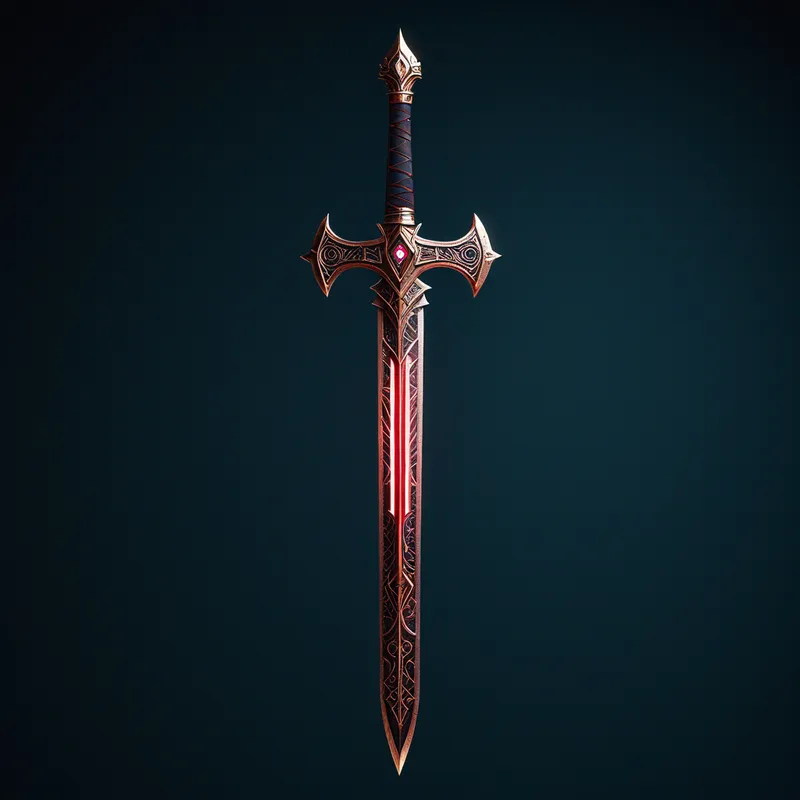
Dreams of finding ancient, rusted weapons and cleaning or sharpening them point to the retrieval of personal power—rediscovering one’s capacity to set boundaries or fight for a cause. Conversely, dreams of a broken sword or a weapon that feels too heavy indicate a crisis of will, a feeling that one’s personal power is ineffective or burdensome. To dream of Ogou himself, often as a formidable, silent figure at a crossroads, presents the dreamer with a profound choice: to embrace the responsibility of one’s own strength, or to remain in a state of undefended vulnerability. The figure does not point the way; his presence is the question.

Alchemical Translation
The journey of Ogou models the alchemical process of coagulatio—the moving from a fluid, passive state to a solid, active one. In the individuation process, this is the stage where insights from the unconscious must be given form and structure in conscious life. The “base metal” of our raw instincts, our unexpressed anger, our latent courage, is subjected to the fire of conscious attention.
To transmute rage into justice, passion into purpose, and force into protection is the highest work of the inner blacksmith.
This is not about spiritual bypassing or denying one’s shadow. The myth insists that the shadow—the chaotic, predatory forces—is real and must be met. Ogou’s path teaches that the goal is not to become a peaceful being who never feels conflict, but to become a whole being who can consciously wield their power. The sacred rage is not eliminated; it is tempered, shaped into a blade of discernment. The triumph is the creation of a resilient, defined Self, capable of engaging with life’s battles without being destroyed by them, and of protecting the soft, creative, and loving parts of the psyche so they may flourish within the stronghold of a forged spirit.
Associated Symbols
Explore related symbols from the CaleaDream lexicon:
- Warrior — The archetypal embodiment of focused will, courage, and the capacity to defend boundaries, directly mirroring Ogou’s primary role as a protector and enforcer of justice.
- Fire — Represents the transformative, purifying, and energizing force of the sacred forge, the essential element that tempers raw potential into usable strength.
- Iron — The core substance of Ogou, symbolizing resilience, structure, willpower, and the technology of consciousness that cuts through ambiguity and chaos.
- Sword — The forged tool of Ogou, representing discernment, decisive action, the establishment of boundaries, and the power to sever unhealthy ties or injustices.
- Crossroads — The liminal space where Ogou often resides, symbolizing critical life choices, the moment of commitment, and the necessity of choosing one’s path with conviction.
- Forge — The sacred womb of transformation, representing the intense psychological and life experiences that shape and temper the individual’s character and will.
- Blood — Symbolizes the sacrifice, vitality, and passionate life-force required on the warrior’s path, as well as the ties of kinship and ancestral legacy Ogou protects.
- Thunder — The audible manifestation of Ogou’s power and arrival, representing shocking truth, sudden clarity, and the formidable force of a righteous will making itself known.
- Mountain — The source of iron ore and Ogou’s primal domain, representing solidity, endurance, challenge, and the inner resources that must be mined and mastered.
- Shadow — The chaotic, predatory forces that Ogou confronts, representing the unintegrated, aggressive, or fearful aspects of the self that must be faced and mastered.
- Rage — The raw, untamed emotional energy that Ogou’s path seeks to alchemize into the focused fuel for justice, protection, and empowered action.
- Honor — The ethical framework and code of conduct that guides the Ogou energy, ensuring that power is wielded with righteousness and for the greater good, not for tyranny.