Ogham Stones Myth Meaning & Symbolism
The god Ogma carves the first Ogham script on stone, creating a sacred language to preserve memory and wisdom against the tide of forgetting.
The Tale of Ogham Stones
Listen. The wind does not just blow through the oak trees; it speaks. The rain does not just fall on the moss; it chants. But in the time before memory, the people were forgetting the words. The great tales of the Tuatha Dé Danann, the deep names of the sacred hills, the secret paths of the stars—all were slipping into the fog, like stones sinking into a bog.
In the hall of Nuada of the Silver Hand, a silence grew, thick and cold. The bards fumbled for verses that had flown from their tongues. The druids stared into the sacred fires and saw only flame, not prophecy. A great forgetting was upon the land, a tide that threatened to wash away the very soul of the people. It was a theft not of gold, but of meaning.
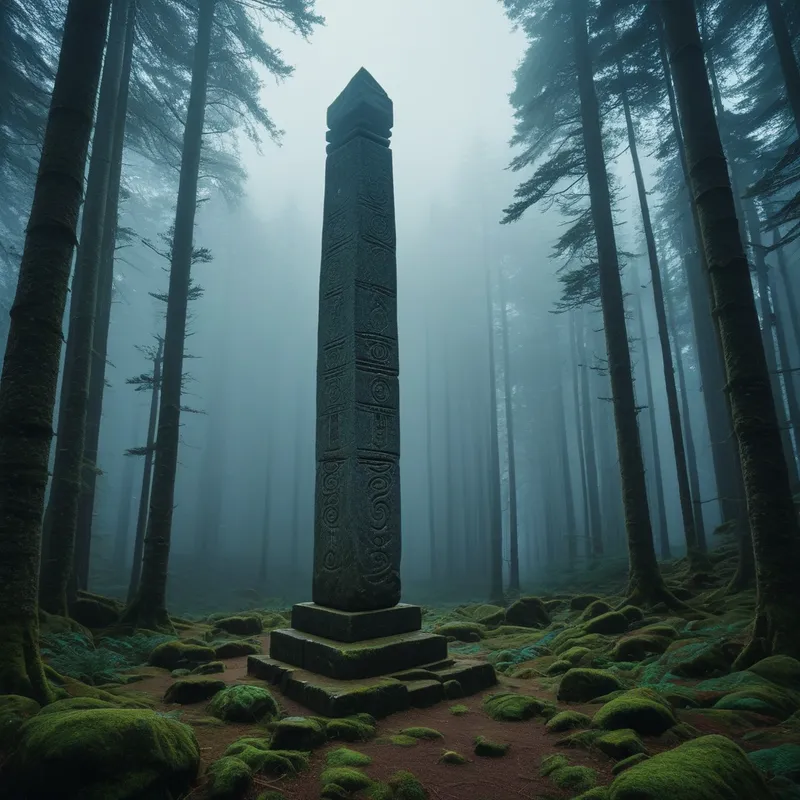
Then Ogma Sun-Face, champion of the gods, he whose strength was matched only by the honeyed power of his speech, felt the weight of this silence. He walked away from the feasting hall, his heart heavy as a millstone. He wandered into the deep forest, to a place where the world grew quiet. There, in a clearing where the moonlight fell upon a single, towering pillar of stone, he stopped.
He placed his palm upon the stone. It was cold, enduring, silent. It held the memory of the mountain from which it was born. And in that moment, Ogma understood. The breath of speech is fleeting. The mind of man is fragile. But stone… stone remembers.
Inspired by the shape of the world around him—the straight trunk of the birch, the forked branch of the hawthorn, the spreading roots of the alder—he took his knife. Not to fight a foe of flesh, but to battle the void of forgetting. With a sound like a whisper given form, he carved the first stroke: a vertical line, the spine of all that was to come. This was Beith.
Stroke by stroke, he gave the silence a skeleton. Each mark, a notch across or beside that central spine, was a sound, a tree, a truth. Dair for the mighty oak’s wisdom. Saille for the weeping willow’s hidden knowledge. He carved the names of the trees, the elements, the tools of life. He carved a language that was not merely spoken, but seen; not merely heard, but touched.
As the first grey light of dawn touched the forest, the stone stood transformed. The elegant, angular script ran up its edge like a ladder from the underworld to the heavens. Ogma stepped back, his knife dulled, his spirit alight. He had not just written. He had planted language. He had turned memory into a forest of stone. The wind rose again, and as it passed over the carved notches, it seemed to hum a new, ancient song. The forgetting had been given an answer, and its name was Ogham.
Cultural Origins & Context
The myth of Ogham’s invention is preserved in the medieval Irish Lebor Gabála Érenn (The Book of Invasions), a text that seeks to weave Ireland’s pagan past into a Christian historical framework. Here, Ogma is credited as the inventor of this unique script, said to be created for the learned, specifically the druids and filid (poet-seers).
This was not a script for mundane record-keeping. Its primary historical use appears on memorial standing stones, boundary markers, and territorial claims, dating from roughly the 4th to 7th centuries CE. The myth, therefore, reflects a profound cultural truth: Ogham was a technology of memory and identity. In a pre-literate society transitioning into literacy, the act of carving a name or a lineage in stone was a magical and legal act of permanence. It was a way to anchor a person, a family, or a claim to the land itself, defying the erosion of time and oral transmission. The myth elevates this practical function to a divine drama, framing literacy itself as a sacred, culture-saving gift from the gods to combat the ultimate enemy—oblivion.
Symbolic Architecture
At its core, the myth of the Ogham Stones is about the birth of symbolic consciousness. It represents the moment the formless inner world of thought and memory seeks a form in the outer world that can endure.
The vertical Ogham stem is the axis mundi, the world-tree of the individual and the cosmos; each intersecting mark is a moment of consciousness intersecting with eternity.
Ogma, the god of eloquence, faces not a physical monster but the psychic terror of the shadow of forgetting. His heroic act is one of creation, not destruction. The stone symbolizes the hardened, resistant material of reality—the “hard facts,” the body, the external world. The script is the imprint of the soul, of mind and culture, upon that reality. The trees each letter represents connect this intellectual creation back to the living, organic world, ensuring the language remains rooted in nature’s wisdom, not abstracted from it. The myth tells us that true wisdom (the sage) requires translating the fluid, internal voice (Ogma’s speech) into a structured, external form (the carved stone) that can be shared and can outlive the self.
The Dreamer’s Resonance
To dream of Ogham Stones is to dream of a crossroads in the psyche where memory and identity are being negotiated. The stone in the dream may appear as a monolith in a modern parking lot, a forgotten pillar in a backyard, or a tablet clutched in one’s own hands.
Somatically, one might feel the cold, gritty texture of the stone, or a tingling in the fingers as if compelled to trace unseen grooves. Psychologically, this dream emerges during periods of life review, legacy-building, or when facing a fear of being forgotten or of losing one’s core narrative. The act of finding or trying to read the stone is the ego’s attempt to decipher the often cryptic messages of the Self—the deeper, total personality. It is a dream of encryption and decryption, where the dreamer is both the carver (the one making their mark) and the reader (the one trying to understand the mark they or others have made).

Alchemical Translation
The alchemical process mirrored here is coagulatio—the making solid, the embodiment of spirit. The modern individuation journey often involves a phase where fleeting insights, therapeutic breakthroughs, or creative visions must be “carved into stone.”
The prima materia is the fog of forgetting, the un-lived life; the philosopher’s stone is the enduring testament of a self-created meaning.
First, one must feel the “great forgetting”—the sense that one’s life lacks coherence or lasting significance (the crisis in Nuada’s hall). Then, one must retreat into the forest of the unconscious (Ogma’s solitary journey) to confront the raw, enduring material of one’s nature (the standing stone). The “knife” is the discipline of attention and the courage of self-definition. The act of “carving” is any sustained practice—journaling, art, building a career or family, embodying a value—that translates inner reality into outer fact.
The resulting “Ogham Stone” is not perfection, but permanence-in-process. It is the unique, etched legacy of an individual life, a hard-won script that stands against the erasing winds of conformity, time, and doubt. It says: I was here. This is what I understood. This is the tree of my knowledge. The myth teaches that our highest calling may not be to speak brilliantly in the moment, but to craft a language of our being so tangible that it continues to speak long after we have fallen silent.
Associated Symbols
Explore related symbols from the CaleaDream lexicon: