Ogham Calendar Myth Meaning & Symbolism
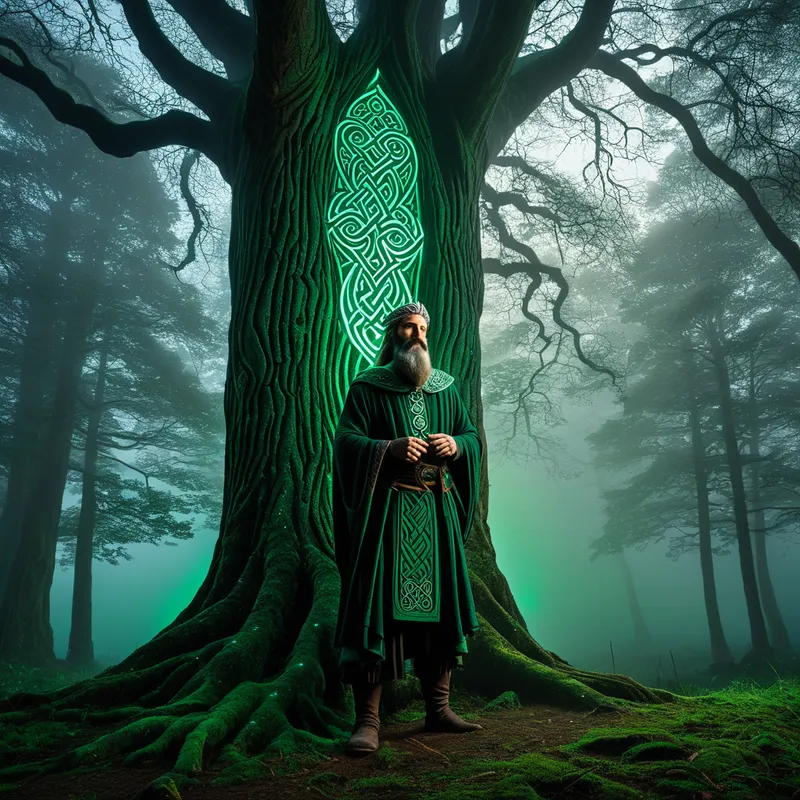
The myth of the Ogham Calendar is the story of how the god Ogma, in a moment of divine inspiration, carved the secret language of the trees into a pillar of ash, gifting humanity a map of time and spirit.
The Tale of the Ogham Calendar
Listen now, and let the fire’s crackle be your drum, the wind in the oaks your harp. This is not a tale of swords and shields, but of silence and sap, of knowledge carved in the living wood.
In the time before memory, when the world was a tapestry of mist and green, the Tuatha Dé Danann held the wisdom of the earth in their hearts. Among them was Ogma Sun-Face, whose words could build kingdoms or break mountains. Yet, for all his eloquence, he felt a profound silence at the world’s core—a language spoken not by tongue, but by root and branch, by the turning of seasons in the dark soil.
One Samhain eve, as the veil between worlds grew thin as a moth’s wing, Ogma was drawn to a sacred grove. In its heart stood Bile, the primal Ash, its branches scraping the star-road, its roots drinking from the well of the underworld. A great stillness hung there, heavier than any winter frost. Ogma placed his palm upon the bark and felt the tree’s slow, vast memory: the first spring bud, the summer’s fullness, the autumn’s surrender, the winter’s deep sleep. He felt the twenty-fold pulse of the forest, each tree a keeper of a moon, a quality, a secret.
Then, the inspiration struck like a lightning bolt from a clear sky. It was not a voice, but a vision—a script not of ink, but of essence. His fingers, tipped with a faint, green-gold light, moved of their own accord. Upon a great pillar of ashwood hewn from Bile itself, he began to carve. Not curves, but straight lines—fingernail slashes across a stemline, like branches from a limb, like marks on a tally-stick of time.
First came Beith for the birch, the pioneer, the pure start of the new sun-year. Then Luis of the rowan, guardian against enchantment. On and on he worked, through the alder’s mysteries, the willow’s sorrows, the hawthorn’s fierce thresholds. Each stroke was a pact, a naming. He carved the nurturing apple and the vengeful blackthorn, the noble oak and the persistent holly. He gave form to the vine’s joy and the ivy’s determination, the reed’s resilience and the elder’s culmination.
For thirteen moons of the tree-year and five of the elemental realms, he worked, and when he was done, the pillar stood humming with a silent song. It was a key. It was a map. It was a calendar that measured not just the sun’s journey, but the soul’s. Ogma Sun-Face had given the world a way to hear the forest speak, to read the scripture of time written in living wood.

Cultural Origins & Context
The Ogham script is a historical reality—an early medieval alphabet used primarily for inscriptions on stone and wood, found across Ireland, Wales, and parts of Britain. The myth of its divine invention, however, is preserved in the medieval Irish textual tradition, most notably in the Auraicept na n-Éces (The Scholar’s Primer). This text positions Ogham not merely as a tool for communication, but as a sacred, esoteric system.
In a culture where druids were the philosophers, judges, and astronomers, knowledge was power, but it was also sacred. The transmission of such knowledge was oral, poetic, and ritualistic. The myth of Ogma’s creation served multiple functions: it sacralized the script, giving it a divine pedigree; it encoded botanical and calendrical wisdom into a memorable format; and it acted as a mnemonic framework for the educated class. The calendar, dividing the year into thirteen lunar months (plus an intercalary period) each named for a tree, was a way of synchronizing human life with the profound, intelligent rhythms of the natural world. It was a cosmological model, asserting that to understand the tree was to understand a facet of time, fate, and self.
Symbolic Architecture
At its core, the Ogham Calendar myth is about the incarnation of abstract, cyclical time into concrete, living form. The tree is the perfect symbol for this alchemy: it is cyclical (shedding and regrowing leaves), yet linear (growing upward and downward), a living record of its own past in its rings.
The tree does not tell time; it is time made visible, a standing testament to endurance through change.
Ogma, the god of eloquence, represents the human (or divine) consciousness striving to articulate the inarticulate—the silent processes of growth, decay, and transformation. His act of carving is an act of discernment, cutting away ambiguity to reveal the essential character—the bua—of each temporal phase. Each Ogham fid (letter) is thus a psychic complex: Birch is not just a tree, but the archetype of New Beginnings; Oak is not just wood, but the principle of Sovereign Strength; Reed is not just a plant, but the essence of Unyielding Truth.
The pillar itself, the flesc, is the axis mundi, the world pillar connecting the realms of sky, earth, and underworld. The calendar, therefore, is not a flat circle but a vertical journey. To move through the Ogham year is to spiritually descend into the roots of experience and ascend through the branches of realization.
The Dreamer’s Resonance
When this myth stirs in the modern unconscious, it often manifests in dreams of forests where specific trees feel intensely significant, or of finding carved messages on wood or stone that feel urgently personal yet ancient. One might dream of trying to read a book whose text is made of leaves and bark, or of a guiding figure (a sage, an ancestor) pointing to a particular tree in a grove.
Psychologically, these dreams signal a process of psychic seasonality. The dreamer is not on a linear path of “progress,” but is moving through an internal lunar cycle of qualities. Dreaming of the nurturing Apple month (Quert) may indicate a need for self-care and gratitude. Dreaming of the challenging Blackthorn month (Straif) might point to a necessary confrontation with a “prickly” shadow aspect or a period of harsh truth. The somatic feeling is often one of being oriented or placed within a larger, intelligent pattern, alleviating the modern anxiety of existential drift. It is the deep self asserting, “You are in your Hawthorn time, your boundary-setting phase. This is natural. This, too, has a name and a place in the cycle.”
Alchemical Translation
The individuation process, the journey toward psychic wholeness, is not a straight line. It is a spiral journey through recurring themes at deepening levels. The Ogham Calendar provides a profound model for this alchemical work.
Individuation is the slow growth of the inner tree, ring by ring, season by season, integrating each fid of experience into the pillar of the Self.
The modern seeker can engage in an “Ogham year” practice, not as superstition, but as a framework for conscious inner work. Each lunar month becomes an invitation to embody a specific quality: to cultivate the purity and clarity of Birch at a new beginning; to work with the protective, visionary energy of Rowan when facing confusion; to tap into the enduring strength of Oak when standing one’s ground.
The alchemical translation is this: Ogma’s act is mirrored in our own self-reflection. We must “carve” our own experiences onto the pillar of our awareness, giving name and form to the fleeting phases of our inner life. The “conflict” is the human resistance to nature’s cycles—our desire to stay in the fruitful Apple time and avoid the die-back of the Elder. The “triumph” is the realization that wholeness requires all seasons, all trees. By internalizing this calendar, we move from being victims of time to participants in its sacred grammar, learning the language of our own growth. We become, like Ogma, the scribe of our own soul, reading the scripture written in the rings of our being.
Associated Symbols
Explore related symbols from the CaleaDream lexicon: