
Ogham Myth Meaning & Symbolism
The myth of Ogham tells of the god Ogma's creation of a sacred script from trees, a system of knowledge, memory, and connection to the living world.
The Tale of Ogham
Listen, and let [the mist](/myths/the-mist “Myth from Celtic culture.”/) of memory gather. In the time when [the world](/myths/the-world “Myth from Tarot culture.”/) was younger, and [the veil](/myths/the-veil “Myth from Various culture.”/) between the realms of the Tuatha Dé Danann and [the world](/myths/the-world “Myth from Tarot culture.”/) of mortals was thin as a [spider](/myths/spider “Myth from Native American culture.”/)’s silk, there lived a god of many faces. His name was Ogma. He was a champion, his arm strong enough to wield a sword that sang in battle, but his truest power lay in his tongue. For Ogma was the master of speech, the weaver of words that could bind a promise, curse a foe, or praise a king into immortality.
Yet, in his wisdom, Ogma saw a sorrow unfolding. The great deeds of his people, the intricate laws of the land, the secret names of the [sacred groves](/myths/sacred-groves “Myth from Celtic culture.”/)—all these lived only in the breath of bards and the fading memory of elders. Words, once spoken, vanished into [the wind](/myths/the-wind “Myth from Various culture.”/). Knowledge was a river, ever-flowing, but with no vessel to hold its waters. This grieved the poet-god, for what is a story if it cannot cross the generations?
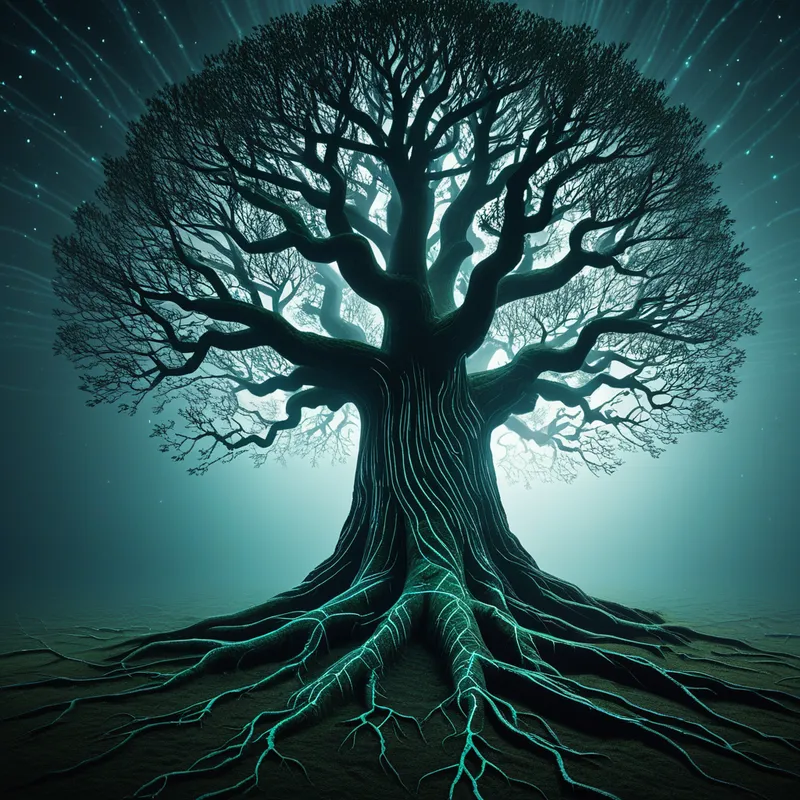
He withdrew from the halls of Brug na Bóinne and walked into the deep, murmuring heart of the forest. Here, the world was not silent, but spoke in a language older than words: the creak of ancient boughs, the rustle of leaves, the sigh of roots in the dark earth. For seven days and seven nights, Ogma sat at the base of [the World Tree](/myths/the-world-tree “Myth from Celtic culture.”/), his ear pressed to [the earth](/myths/the-earth “Myth from Hindu culture.”/), his eyes watching the dance of light through the canopy.
On the eighth morning, as the first light touched [the dew](/myths/the-dew “Myth from Alchemical culture.”/) on a spider’s web, he saw it. The pattern. The truth. The forest was not a collection of things, but a conversation. The sturdy Dair (oak) spoke of sovereignty and endurance. The bitter Luis (rowan) whispered of warding and quickening. The pliant Saille (willow) sang of the ebb and flow of emotion. Each tree, each plant, was a living letter in a grand, green alphabet.
With a flash of inspiration that was both thought and action, Ogma took his knife. He did not look to clay or parchment, but to the living wood itself. Upon the edge of a great standing stone, facing the rising sun, he made the first mark: a single, vertical line, the primal staff. Then, with precise strokes, he carved notches across it, to the right, to the left, diagonally, straight through. Each combination of marks was a key, a name, a sound. He called this system Ogham, and it was born not from abstraction, but from direct communion with the soul of the world. The first word he carved was his own name, and as the final notch was cut, the stone hummed, and the forest seemed to lean in, recognizing its own secret language given form. The breath of memory had found its vessel in the bones of the land.

Cultural Origins & Context
[The Ogham script](/myths/the-ogham-script “Myth from Celtic culture.”/) is a historical reality, found carved on stone monuments primarily in Ireland, Wales, and Scotland, dating from roughly the 4th to 7th centuries CE. Its mythological origin story, however, belongs to the later medieval Irish tradition, preserved by Christian scribes who recorded the native lore in manuscripts like the Lebor Báile an Mhóta and the Lebor Laignech. This myth served a crucial societal function in a culture where oral tradition was paramount.
By attributing the invention of writing to Ogma, a pre-Christian god of eloquence, the myth sanctified the act of inscription. It transformed writing from a mere technical skill into a divine gift, a magical technology that captured the fluid power of the spoken fili’s word. Ogham was not just for mundane record-keeping; it was used for boundary markers, memorials, and likely for ritual and divinatory purposes. The myth thus provided a charter, a sacred “why” for the script’s existence, embedding it within the Celtic cosmological framework where the natural world was inherently intelligent and communicative.
Symbolic Architecture
At its core, the myth of Ogham’s creation is a profound [metaphor](/symbols/metaphor “Symbol: A figure of speech where one thing represents another, often revealing hidden connections and deeper truths through symbolic comparison.”/) for the [birth](/symbols/birth “Symbol: Birth symbolizes new beginnings, transformation, and the potential for growth and development.”/) of [consciousness](/symbols/consciousness “Symbol: Consciousness represents the state of awareness and perception, encompassing thoughts, feelings, and experiences.”/) from the [womb](/symbols/womb “Symbol: A symbol of origin, potential, and profound transformation, representing the beginning of life’s journey and the unconscious source of creation.”/) of the unconscious. Ogma, the god of conscious [expression](/symbols/expression “Symbol: Expression represents the act of conveying thoughts, emotions, and individuality, emphasizing personal communication and creativity.”/), ventures from the known halls of divine society ([the ego](/myths/the-ego “Myth from Jungian culture.”/)) into the deep, non-verbal [forest](/symbols/forest “Symbol: The forest symbolizes a complex domain of the unconscious mind, representing both mystery and potential for personal growth.”/) of the unconscious (the genius loci of [nature](/symbols/nature “Symbol: Nature symbolizes growth, connectivity, and the primal forces of existence.”/)).
The alphabet is not an invention, but a discovery—the grammar of the world’s soul made visible.
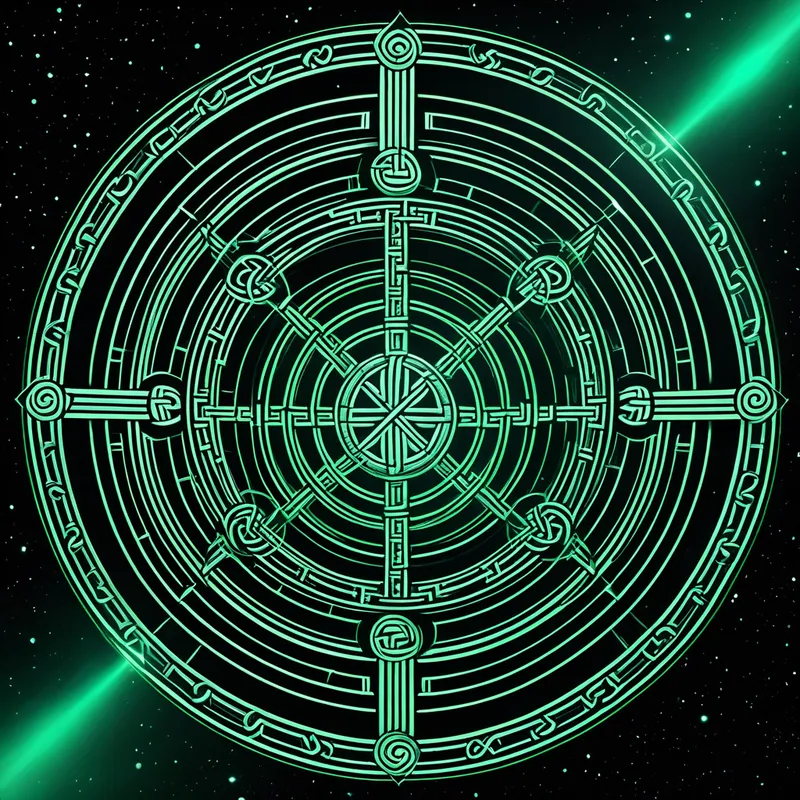
The vertical Ogham stave represents the [axis](/symbols/axis “Symbol: A central line or principle around which things revolve, representing stability, orientation, and the fundamental structure of reality or consciousness.”/) mundi, the world pillar connecting [heaven](/symbols/heaven “Symbol: A symbolic journey toward ultimate fulfillment, spiritual transcendence, or connection with the divine, often representing life’s highest aspirations.”/), [earth](/symbols/earth “Symbol: The symbol of Earth often represents grounding, stability, and the physical realm, embodying a connection to nature and the innate support it provides.”/), and [underworld](/symbols/underworld “Symbol: A symbolic journey into the unconscious, representing exploration of hidden aspects of self, transformation, or confronting repressed material.”/)—the individual’s [spine](/symbols/spine “Symbol: The spine symbolizes strength, support, and the foundational structure of one’s life and identity.”/) of [awareness](/symbols/awareness “Symbol: Conscious perception of self, surroundings, or internal states. Often signifies awakening, insight, or heightened sensitivity.”/). The crossing notches are the intersections where this conscious [axis](/symbols/axis “Symbol: A central line or principle around which things revolve, representing stability, orientation, and the fundamental structure of reality or consciousness.”/) engages with the multifaceted contents of the living world (the trees). Each [tree](/symbols/tree “Symbol: In dreams, the tree often symbolizes growth, stability, and the interconnectedness of life.”/)-[letter](/symbols/letter “Symbol: A letter symbolizes communication, messages, and the sharing of thoughts and feelings.”/) is thus an archetypal complex: the Oak of solidity and law, the Hazel of wisdom and concentration, [the Blackthorn](/myths/the-blackthorn “Myth from Celtic culture.”/) of harsh [truth](/symbols/truth “Symbol: Truth represents authenticity, honesty, and the quest for knowledge beyond mere appearances.”/) and protection. Ogham is a [system](/symbols/system “Symbol: A system represents structure, organization, and interrelated components functioning together, often reflecting personal or social order.”/), a [pattern](/symbols/pattern “Symbol: A ‘Pattern’ in dreams often signifies the underlying structure of experiences and thoughts, representing both order and the repetitiveness of life’s situations.”/) imposed on [chaos](/symbols/chaos “Symbol: In Arts & Music, chaos represents raw creative potential, uncontrolled expression, and the breakdown of order to forge new artistic forms.”/), mirroring the [psyche](/myths/psyche “Myth from Greek culture.”/)’s fundamental drive to differentiate, name, and make meaning from the raw, undifferentiated experience of being.
Ogma’s act is one of [relationship](/symbols/relationship “Symbol: A representation of connections we have with others in our lives, often reflecting our emotional state.”/). He does not invent symbols from nothing; he listens and translates. This positions [knowledge](/symbols/knowledge “Symbol: Knowledge symbolizes learning, understanding, and wisdom, embodying the acquisition of information and enlightenment.”/) not as domination over nature, but as a sacred [dialogue](/symbols/dialogue “Symbol: Conversation or exchange between characters, representing communication, relationships, and narrative flow in games and leisure activities.”/) with it. The [script](/symbols/script “Symbol: The symbol of ‘script’ indicates a narrative or roadmap for one’s life, representing the conscious and unconscious stories we tell ourselves.”/) is a bridge, a chain (like the one often depicted linking Ogma’s [tongue](/symbols/tongue “Symbol: Represents communication, self-expression, and the power of words.”/) to an admirer’s ear) between the inner world of thought and the outer, animate [cosmos](/symbols/cosmos “Symbol: The entire universe as an ordered, harmonious system, often representing the totality of existence, spiritual connection, and the unknown.”/).
The Dreamer’s Resonance
When the pattern of [the Ogham](/myths/the-ogham “Myth from Celtic culture.”/) myth stirs in the modern dreamer, it often signals a critical phase of psychic differentiation. To dream of finding or carving strange, cryptic marks on trees or stone is to encounter the nascent forms of one’s own unspoken truth.
Somatically, this may coincide with a feeling of “prickling” awareness, a need to “get something out,” or a sense of being “rooted” yet straining to grow. Psychologically, the dreamer is in the forest with Ogma. They are grappling with a wealth of internal experience—emotions, intuitions, memories—that feels potent but inarticulate. The dream images are the psyche’s attempt to create its own “script,” to develop a personal symbolic language to contain and communicate depths that everyday words fail to capture. It is a process of moving from a foggy, holistic feeling-state toward clarity, definition, and the ability to “write” one’s own story. Resistance to this process might manifest as dreams of blurred, unreadable, or frightening inscriptions.
Alchemical Translation
The alchemical journey modeled by the Ogham myth is that of individuation through creative formulation. [The prima materia](/myths/the-prima-materia “Myth from Alchemical culture.”/), the raw substance, is the lush, overwhelming, and wordless totality of the unconscious—the forest. [The first stage](/myths/the-first-stage “Myth from Alchemical culture.”/) ([nigredo](/myths/nigredo “Myth from Alchemical culture.”/)) is Ogma’s grief and withdrawal, the feeling that one’s inner life is ephemeral and unanchored.
The work of the soul is to carve the stave of consciousness and inscribe it with the living names of all that dwells within.
The albedo is the act of listening in the forest—the patient, receptive observation of inner archetypal patterns (the trees). The citrinitas is [the flash of insight](/myths/the-flash-of-insight “Myth from Alchemical culture.”/), the recognition of a systematic connection. Finally, the [rubedo](/myths/rubedo “Myth from Alchemical culture.”/) is the act of carving itself: the disciplined, willful application of consciousness to give lasting form to that insight. The resulting “Ogham” is the philosopher’s stone for the modern psyche—not a single truth, but a personalized, living system of meaning.
For the individual, this translates to the work of finding one’s own vocabulary. It is the journal that holds a fleeting emotion, the art that expresses a complex inner conflict, the chosen life path that aligns with one’s inner “tree” of values. It is the transmutation of chaotic experience into navigable knowledge, creating an inner standing stone that says, “I was here, I learned this, I am part of the conversation.” One becomes, like Ogma, both a warrior defending one’s truth and a poet giving it a name, forever linking the tongue of expression to the ear of deep, listening wisdom.
Associated Symbols
Explore related symbols from the CaleaDream lexicon: