Oedipus Rex Myth Meaning & Symbolism
A king's quest for truth reveals a terrible prophecy fulfilled: he has killed his father and married his mother, unraveling his world.
The Tale of Oedipus Rex
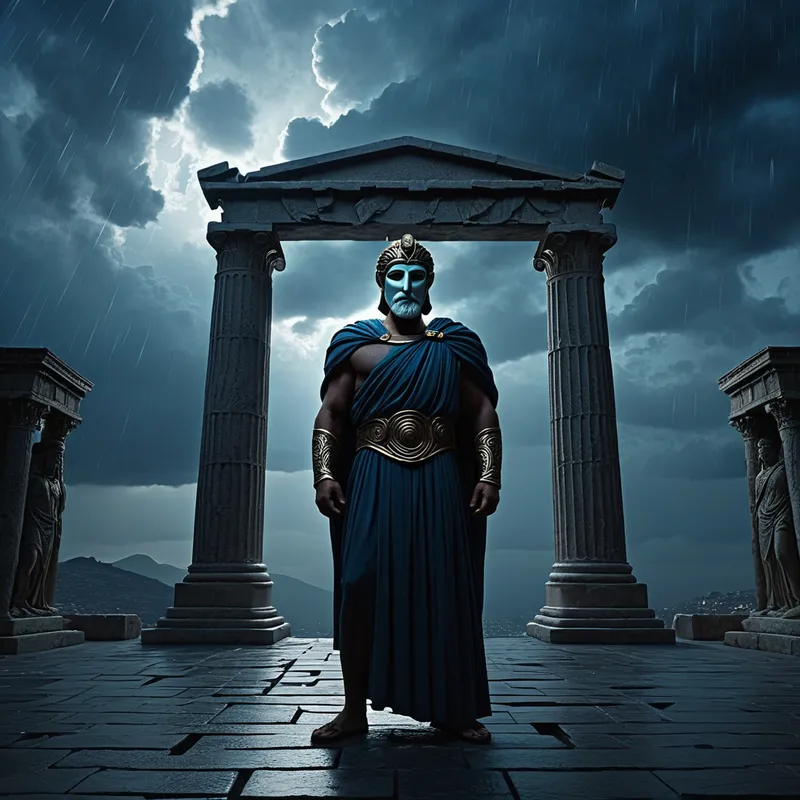
Hear now a tale from a time when the gods walked close to [the earth](/myths/the-earth “Myth from Hindu culture.”/), and their words were iron chains upon the souls of men. It begins in the city of Thebes, a place cursed. A vile sickness—not of body, but of the very soil and spirit—clung to its stones. The crops withered, mothers bore stillborn children, and a miasma of divine wrath hung in the air. The people cried out to their king, [Oedipus](/myths/oedipus “Myth from Greek culture.”/), the solver of the [Sphinx](/myths/sphinx “Myth from Greek culture.”/)‘s riddle, their savior. “Deliver us!” they wailed.
Oedipus, with the bearing of a lion and a mind sharp as a spearpoint, had already sent his brother-in-law, Creon, to the sacred oracle of Apollo at Delphi. Creon returned, his face ashen. The message from the god was clear and terrible: the plague would lift only when the murderer of the former king, Laius, was driven from the land. The killer walked among them, unpunished.
With righteous fury, Oedipus swore a mighty oath to hunt this pollution down, cursing the murderer to a life of wretchedness. He summoned the blind seer, [Tiresias](/myths/tiresias “Myth from Greek culture.”/), who sees not the light of day, but the dark truths of fate. The old prophet resisted, begging the king to let the matter lie. “How terrible is wisdom when it brings no profit to the wise!” he cried. But Oedipus, his pride stung, accused [Tiresias](/myths/tiresias “Myth from Greek culture.”/) and Creon of conspiracy. Pushed to the brink, Tiresias spoke the unspeakable: “You are the murderer you seek.”
The king laughed in scorn, a hollow sound that echoed in the suddenly cold air. He spun a tale of his own past to refute it: how he, raised as a prince in Corinth, fled from a prophecy that he would kill his father and marry his mother. How at a lonely crossroads, he was accosted by an arrogant old man in a chariot, and in a flash of rage, killed him and all his servants. How he came to Thebes, answered [the Sphinx](/myths/the-sphinx “Myth from Greek culture.”/)‘s riddle, and was given the vacant throne and the hand of the widowed queen, Jocasta, as his reward.
As Oedipus raged, seeking one witness, one thread to unravel the seer’s claim, the truth began to coil around him. A messenger arrived from Corinth with news of his supposed father’s death—a natural death. In relief, Oedipus still feared the second half of the prophecy, marriage to his mother. The messenger, seeking to comfort him, revealed the deepest secret: Oedipus was not their natural son, but a foundling, rescued from a mountainside with his ankles pierced and bound.
A low moan came from Queen Jocasta. She had heard enough. She knew the story of her own infant son, condemned by a prophecy and left to die. “May you never know who you are!” she screamed at Oedipus before fleeing into the palace. But the king, now a man possessed, demanded the final witness: the old herdsman who had been given [the child](/myths/the-child “Myth from Alchemy culture.”/) long ago. Under threat, the old man broke. The infant was the son of Laius and Jocasta. The prophecy was complete.
A great cry tore from Oedipus’s throat, a sound of [the world](/myths/the-world “Myth from Tarot culture.”/) breaking. He stormed into the palace to find Jocasta dead by her own hand, hanged in her bridal chamber. Then came the sounds—not of grief, but of a brutal, deliberate violence. Oedipus emerged, his eyesockets two ruined, bleeding voids. “What use were eyes to me, who could never again see a sight I could love?” He had blinded himself with the golden brooches from his wife’s—his mother’s—robe. Begging for exile, led by his daughters, the once-great king became a walking embodiment of his own curse, a sightless witness to the terrible architecture of fate.
Cultural Origins & Context
The myth of Oedipus is not the invention of a single author but a deep, pre-existing strain in the Greek mythological consciousness, refined and crystallized into its most iconic form by the Athenian playwright Sophocles in his play Oedipus Tyrannus (c. 429 BCE). It belongs to the Theban cycle of myths, a body of stories concerning the founding, glory, and ruin of that legendary city. In the competitive, public crucible of the City Dionysia, these stories were not mere entertainment but a form of civic and religious ritual.
The function was profound. For the Athenian polis, the myth served as a terrifying exploration of the limits of human knowledge and control. It asked: What happens when the very intelligence and drive ([metis](/myths/metis “Myth from Greek culture.”/) and bie) that make a successful leader—the solver of riddles, the defender of the city—collide with an inescapable divine order (moira)? The audience, living in a culture deeply concerned with pollution (miasma), kinship obligations, and the often-inscrutable will of the gods, witnessed the ultimate cautionary tale. It reinforced the cultural idea that hubris—the overweening pride that leads one to defy fate or the gods—invariably brings catastrophic downfall ([nemesis](/myths/nemesis “Myth from Greek culture.”/)). The myth was a communal meditation on the fragility of human identity and the hidden structures of destiny that underpin our seemingly ordered lives.
Symbolic Architecture
At its core, the myth of Oedipus is a brutal [allegory](/symbols/allegory “Symbol: A narrative device where characters, events, or settings represent abstract ideas or moral qualities, conveying deeper meanings through symbolic storytelling.”/) for the acquisition of self-[knowledge](/symbols/knowledge “Symbol: Knowledge symbolizes learning, understanding, and wisdom, embodying the acquisition of information and enlightenment.”/). The “pollution” in Thebes is not merely a physical [murderer](/symbols/murderer “Symbol: A murderer symbolizes hidden fears, guilt, and the darker aspects of the self, representing conflict and moral dilemmas.”/), but a psychic [truth](/symbols/truth “Symbol: Truth represents authenticity, honesty, and the quest for knowledge beyond mere appearances.”/) that has been repressed, a [crime](/symbols/crime “Symbol: Crime in dreams often symbolizes guilt, inner conflict, or societal rules that are being challenged or broken.”/) against the natural order festering in the unconscious of the [king](/symbols/king “Symbol: A symbol of ultimate authority, leadership, and societal order, often representing the dreamer’s inner power or external control figures.”/) and, by extension, the state. Oedipus’s relentless investigation is [the ego](/myths/the-ego “Myth from Jungian culture.”/)‘s [journey](/symbols/journey “Symbol: A journey in dreams typically signifies adventure, growth, or a significant life transition.”/) into the shadowy [basement](/symbols/basement “Symbol: The basement in dreams often symbolizes the unconscious mind, where hidden fears, repressed memories, and unacknowledged aspects of the self reside.”/) of the [psyche](/myths/psyche “Myth from Greek culture.”/).
The most terrifying riddle is not posed by a monster at the gates, but by the echo of our own origins within us.
The key symbols are stark and potent. The [Crossroads](/symbols/crossroads “Symbol: A powerful spiritual symbol representing a critical decision point where paths diverge, often associated with fate, transformation, and life-altering choices.”/) represents the critical, fateful [moment](/symbols/moment “Symbol: The symbol of a ‘moment’ embodies the significance of transient experiences that encapsulate emotional depth or pivotal transformations in life.”/) of [choice](/symbols/choice “Symbol: The concept of choice often embodies decision-making, freedom, and the multitude of paths available in life.”/) where [character](/symbols/character “Symbol: Characters in dreams often signify different aspects of the dreamer’s personality or influences in their life.”/) and [destiny](/symbols/destiny “Symbol: A predetermined course of events or ultimate purpose, often linked to spiritual forces or cosmic order, representing life’s inherent direction.”/) intersect; it is the point of no return, where an act of passionate violence sets the tragic [mechanism](/symbols/mechanism “Symbol: Represents the body’s internal systems, emotional regulation, or psychological processes working together like a machine.”/) in [motion](/symbols/motion “Symbol: Represents change, progress, or the flow of life energy. Often signifies transition, personal growth, or the passage of time.”/). The [Sphinx](/symbols/sphinx “Symbol: The Sphinx is a mythical creature that embodies the convergence of strength and intelligence, often associated with mystery, protection, and the challenge of riddles.”/), with her [riddle](/symbols/riddle “Symbol: A puzzle or enigmatic statement requiring cleverness to solve, symbolizing hidden truths, intellectual challenge, and the search for meaning.”/) (“What walks on four [legs](/symbols/legs “Symbol: Legs in dreams often symbolize movement, freedom, and the ability to progress in life, representing both physical and emotional support.”/) in the morning, two at [noon](/symbols/noon “Symbol: The peak of daylight, representing clarity, achievement, and the height of power or awareness.”/), and three in the evening?”), represents the [mystery](/symbols/mystery “Symbol: An enigmatic, unresolved element that invites curiosity and exploration, often representing the unknown or hidden aspects of existence.”/) of the [human](/symbols/human “Symbol: The symbol of a human represents individuality, complexity of emotions, and social relationships.”/) [life](/symbols/life “Symbol: The symbol of ‘Life’ represents a journey of growth, interconnectedness, and existential meaning, encompassing both the joys and challenges that define human experience.”/)-cycle itself. Oedipus answers “Man,” but fails to grasp the personal [application](/symbols/application “Symbol: An application symbolizes engagement, integration of knowledge, or the pursuit of goals, often representing self-improvement and personal development.”/) of that [riddle](/symbols/riddle “Symbol: A puzzle or enigmatic statement requiring cleverness to solve, symbolizing hidden truths, intellectual challenge, and the search for meaning.”/) to his own [lineage](/symbols/lineage “Symbol: Represents ancestral heritage, family connections, and the transmission of traits, values, and responsibilities across generations.”/) and [mortality](/symbols/mortality “Symbol: The awareness of life’s finitude, often representing transitions, impermanence, or existential reflection in dreams.”/). [Blindness](/symbols/blindness “Symbol: Represents a lack of awareness, insight, or refusal to see truth, often tied to emotional avoidance or spiritual ignorance.”/) and [Sight](/symbols/sight “Symbol: Sight symbolizes perception, awareness, and insight, representing both physical and inner vision.”/) are utterly inverted. Tiresias, the physically blind, possesses true [insight](/symbols/insight “Symbol: A sudden, deep understanding of a complex situation or truth, often arriving unexpectedly and illuminating hidden connections.”/). Oedipus, who sees the world, is psychologically blind. His eventual physical blinding is not a [punishment](/symbols/punishment “Symbol: A dream symbol representing consequences for actions, often tied to guilt, societal rules, or internal moral conflicts.”/), but a tragic [integration](/symbols/integration “Symbol: The process of unifying disparate parts of the self or experience into a cohesive whole, often representing psychological wholeness or resolution of internal conflict.”/)—an [outward](/symbols/outward “Symbol: Movement or orientation away from the self or center; expansion, expression, or externalization of inner states into the world.”/) manifestation of an [inward](/symbols/inward “Symbol: A journey toward self-awareness, introspection, and the exploration of one’s inner world, thoughts, and unconscious mind.”/) realization. He can now only “see” the terrible truth he has uncovered.
The [prophecy](/symbols/prophecy “Symbol: A foretelling of future events, often through divine or supernatural means, representing destiny, fate, and hidden knowledge.”/) itself symbolizes the inescapable psychic structures that shape us—what we might call complexes or the dynamics of the [family](/symbols/family “Symbol: The symbol of ‘family’ represents foundational relationships and emotional connections that shape an individual’s identity and personal development.”/) unconscious. The struggle against it is the ego’s futile rebellion against the deeper, archetypal patterns that govern human life.
The Dreamer’s Resonance
When the Oedipal pattern stirs in the modern dreamscape, it rarely appears as literal patricide or incest. Instead, it manifests as a profound crisis of identity and authority. The dreamer may find themselves in a labyrinthine bureaucratic building (the state/Thebes) trying to solve a critical problem, only to discover that they are the source of the systemic error. They may dream of furious arguments with an older male authority figure that culminate in a shocking act of violence, followed by deep remorse. Or they may experience the surreal horror of realizing a beloved partner or parent has transformed into someone else, revealing a foundational misunderstanding of a key relationship.
Somatically, this dream process can feel like a tightening coil, a building pressure in the chest or head as the dream-ego gets closer to an unbearable revelation. There is often a motif of investigation—searching through old files, following clues, interrogating dream figures. The psychological process is one of unavoidable confrontation with a repressed aspect of the personal or familial shadow. The dream is forcing a consciousness that the waking ego has spent a lifetime avoiding: the recognition of how one’s own actions, driven by unconscious motives, have contributed to one’s suffering, or the shattering acknowledgment of a foundational lie at the heart of one’s self-narrative.

Alchemical Translation
The alchemical journey of Oedipus models the most painful stage of individuation: the [nigredo](/myths/nigredo “Myth from Alchemical culture.”/), the blackening, the descent into the utter darkness of self-confrontation. His initial state is one of identified consciousness—he is the wise king, the savior, the solver of problems. The plague represents the symptom, the suffering that initiates the work. His investigation is the conscious mind applying its full force to the mystery, not knowing it is hunting itself.
The gold of the sovereign self can only be forged in the fire of a truth that burns away everything we believed we were.
The moment of recognition—the unio mentalis or mental union with [the shadow](/myths/the-shadow “Myth from Jungian culture.”/)—is the catastrophic center of [the opus](/myths/the-opus “Myth from Alchemical culture.”/). It dissolves the old [persona](/myths/persona “Myth from Greek culture.”/) completely. The king is dead. The son is a criminal. The husband is an abomination. This is the necessary death. His self-blinding is a powerful, if extreme, symbol of the voluntaria mortificatio, the voluntary mortification. He sacrifices his old way of seeing the world (his egoic orientation) because it has become obsolete and poisonous. What remains is not nothingness, but a transformed consciousness.
The exiled Oedipus, led by his children (the innocent, connective parts of the psyche), becomes a different kind of figure—the wounded witness, the carrier of unbearable wisdom. For the modern individual, the alchemical translation is this: the path to wholeness demands we turn our problem-solving intelligence inward, onto the mysteries of our own origin and motivation. We must be willing to follow the clues of our symptoms, our repeated failures, and our deepest shames, even if they lead to a truth that shatters our cherished self-image. The [triumph](/myths/triumph “Myth from Roman culture.”/) is not in avoiding the fate, but in having the courage to see it fully, bear the consciousness of it, and integrate that knowledge into a humbler, more authentic way of being. The plague lifts not when the “murderer” is destroyed, but when he is finally seen and acknowledged.
Associated Symbols
Explore related symbols from the CaleaDream lexicon: