Oedipus at the Crossroads Myth Meaning & Symbolism
A prince, fleeing a prophecy, meets a stranger at a dusty junction. The violence that follows seals a fate he was trying to escape.
The Tale of Oedipus at the Crossroads
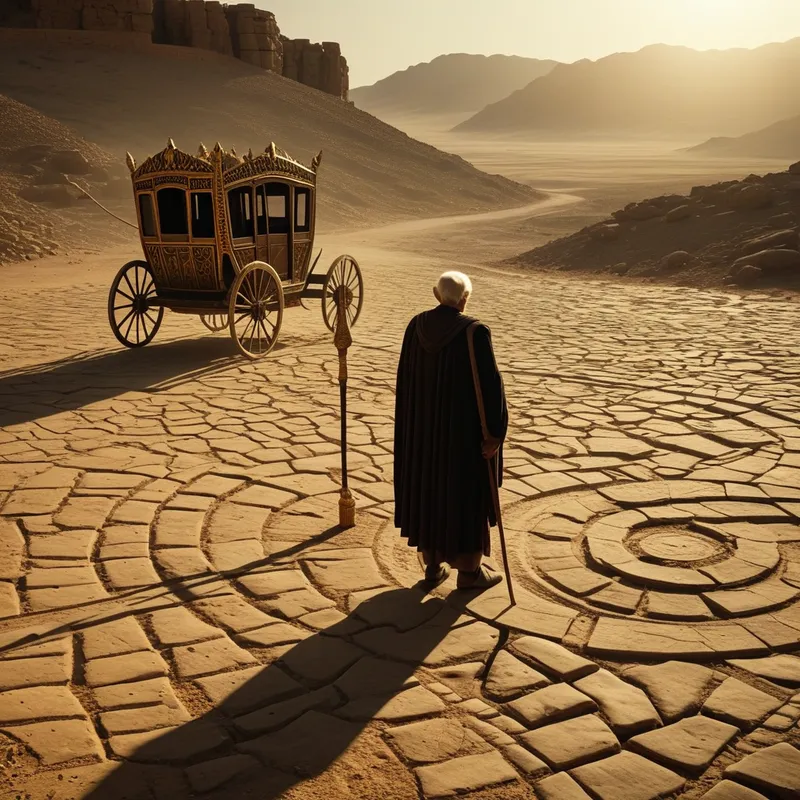
The dust of Phocis hangs thick in the air, a golden haze under the pitiless sun. Here, where three roads claw their way from [the earth](/myths/the-earth “Myth from Hindu culture.”/)—one from Delphi, one from Daulis, and one from the wilds—[the world](/myths/the-world “Myth from Tarot culture.”/) narrows to a point of decision. A young man, his brow furrowed not with years but with a terrible knowing, stumbles into this barren junction. He is [Oedipus](/myths/oedipus “Myth from Greek culture.”/), a prince in exile, his ankles still bearing the cruel scars of the pins that once pierced them. The prophecy of Apollo rings in his ears like a bronze bell: You will kill your father and wed your mother. In terror and defiance, he has turned his back on the only parents he has ever known, the king and queen of Corinth, fleeing toward what he believes is an unknown, safer horizon.
The crunch of gravel, the snort of horses. A chariot, ornate and dust-caked, rumbles down the road from Delphi. Upon it stands a man of regal bearing, his hair touched with grey, his eyes sharp with the authority of one accustomed to instant obedience. Around him ride heralds and attendants. This is Laius, though neither man knows the other. The [herald](/myths/herald “Myth from Greek culture.”/) barks an order: “Make way for the king!” He gestures with his goad, clearing the narrow pass.
But Oedipus is no peasant to be cowed. The prophecy has made him raw, a coiled spring of dread and pride. To be ordered aside, here at this lonely fork where he already wrestles with the daimons of his destiny, is an insult that strikes the flint of his spirit. He stands his ground. “I yield to no man,” he declares, his voice tight.
The herald, enforcing his master’s will, swings his goad. The blow cracks against Oedipus’s head. In that flash of pain, all reason dissolves. The buried fury of the abandoned infant, the terror of the oracle, the arrogance of the prince—all erupt. He seizes the long, heavy staff from the charioteer’s hands. A blur of motion, a storm of wrath. The staff descends. The herald falls. The charioteer meets the same fate. And then, Oedipus turns to the old king himself, who has risen in anger. With a force born of primal rage, he drags Laius from his chariot, dashing him upon the hard earth. The king’s life flees his body there, in the dust, his eyes wide with a surprise that will never find its question.
Silence returns, heavier than before. The horses stamp nervously. Oedipus stands amidst three corpses at the meeting of three ways. He has chosen a path of violence, believing it to be a path of freedom. He strips the dead of their arms, a final, petty act of conquest, and continues his journey down the road to Thebes, unaware that the first half of the god’s decree is now fulfilled. The blood soaking into the thirsty ground is his father’s. [The crossroads](/myths/the-crossroads “Myth from Celtic culture.”/) has done its work.
Cultural Origins & Context
This pivotal scene is the engine of the most famous tragic cycle in Greek mythology, primarily crystallized in the plays of the Athenian dramatist Sophocles in the 5th century BCE. The myth existed in earlier, fragmented forms in the epic tradition, but Sophocles gave it its definitive, terrifying architecture for the Athenian stage. Performed during the City Dionysia, these plays were not mere entertainment but a form of civic and religious ritual.
The function of the Oedipus story, and the crossroads scene in particular, was profound. For the Greeks, it explored the terrifying tension between moira (fate) and human hubris. It asked the audience: Can you outrun a divine decree? Does your attempt to avoid fate actually weave its threads more tightly? The crossroads was a potent cultural symbol—a place of decision, but also a liminal space haunted by spirits like [Hecate](/myths/hecate “Myth from Greek culture.”/). What happened there was charged with ultimate significance. The myth served as a cautionary template about the limits of human knowledge and the catastrophic consequences of acting in ignorance, a core anxiety in a world governed by opaque divine wills.
Symbolic Architecture
The [crossroads](/symbols/crossroads “Symbol: A powerful spiritual symbol representing a critical decision point where paths diverge, often associated with fate, transformation, and life-altering choices.”/) is the central [symbol](/symbols/symbol “Symbol: A symbol can represent an idea, concept, or belief, serving as a powerful tool for communication and understanding.”/)—a literal and psychic [intersection](/symbols/intersection “Symbol: An intersection symbolizes the crossroads of decision-making, presenting choices and the potential for change.”/) where [destiny](/symbols/destiny “Symbol: A predetermined course of events or ultimate purpose, often linked to spiritual forces or cosmic order, representing life’s inherent direction.”/) and free will collide. It represents the critical [juncture](/symbols/juncture “Symbol: A critical point of decision, transition, or convergence where paths, choices, or timelines meet, demanding action or reflection.”/) in any [life](/symbols/life “Symbol: The symbol of ‘Life’ represents a journey of growth, interconnectedness, and existential meaning, encompassing both the joys and challenges that define human experience.”/) where a [choice](/symbols/choice “Symbol: The concept of choice often embodies decision-making, freedom, and the multitude of paths available in life.”/), often made in a state of partial [blindness](/symbols/blindness “Symbol: Represents a lack of awareness, insight, or refusal to see truth, often tied to emotional avoidance or spiritual ignorance.”/), determines the trajectory of one’s entire [story](/symbols/story “Symbol: The symbol of ‘Story’ represents the narrative woven through our lives, embodying experiences, lessons, and emotions that shape our identities.”/). Oedipus, the “[swollen foot](/symbols/swollen-foot “Symbol: A swollen foot often symbolizes feelings of being overwhelmed or restricted in one’s journey through life.”/),” is himself a [symbol](/symbols/symbol “Symbol: A symbol can represent an idea, concept, or belief, serving as a powerful tool for communication and understanding.”/) of the wound that propels the [journey](/symbols/journey “Symbol: A journey in dreams typically signifies adventure, growth, or a significant life transition.”/), the foundational [trauma](/symbols/trauma “Symbol: A deeply distressing or disturbing experience that overwhelms the psyche, often manifesting in dreams as unresolved emotional wounds or psychological injury.”/) that shapes [identity](/symbols/identity “Symbol: Identity represents the sense of self, encompassing personal beliefs, cultural background, and social roles.”/).
The encounter is a brutal meeting with the [Shadow](/symbols/shadow “Symbol: The ‘shadow’ embodies the unconscious, repressed aspects of the self and often represents fears or hidden emotions.”/). Laius, the arrogant [king](/symbols/king “Symbol: A symbol of ultimate authority, leadership, and societal order, often representing the dreamer’s inner power or external control figures.”/) who once ordered his own [infant](/symbols/infant “Symbol: The infant symbolizes new beginnings, innocence, and the potential for growth and development.”/) son exposed, embodies the tyrannical, rejecting [father](/symbols/father “Symbol: The father figure in dreams often symbolizes authority, protection, guidance, and the quest for approval or validation.”/)-principle. Oedipus, the proud [prince](/symbols/prince “Symbol: A prince symbolizes nobility, leadership, and aspiration, often representing potential or personal authority.”/), embodies the rebellious, self-determining son. They are two halves of a cursed whole, unrecognized and meeting only in violence.
The Shadow you meet on the road is always your own, wearing the face you have refused to see.
The murder is not just patricide; it is [the ego](/myths/the-ego “Myth from Jungian culture.”/)’s violent [rejection](/symbols/rejection “Symbol: The experience of being refused, excluded, or dismissed by others, often representing fears of inadequacy or social belonging.”/) of [the authority](/symbols/the-authority “Symbol: A figure representing power, control, and societal structure, often embodying rules, leadership, or external judgment.”/) of the past, of [lineage](/symbols/lineage “Symbol: Represents ancestral heritage, family connections, and the transmission of traits, values, and responsibilities across generations.”/), and of [the law](/symbols/the-law “Symbol: Represents external rules, societal order, moral boundaries, and the tension between personal freedom and collective structure.”/) (both paternal and divine). Yet, in this very act of supposed self-assertion, [the ego](/myths/the-ego “Myth from Jungian culture.”/) blindly fulfills the very [pattern](/symbols/pattern “Symbol: A ‘Pattern’ in dreams often signifies the underlying structure of experiences and thoughts, representing both order and the repetitiveness of life’s situations.”/) it sought to destroy. The weapons—the staff and the goad—are symbols of [authority](/symbols/authority “Symbol: A symbol representing power structures, rules, and control, often reflecting one’s relationship with societal or personal governance.”/) and provocation, turned into instruments of [fate](/symbols/fate “Symbol: Fate represents the belief in predetermined outcomes, suggesting that some aspects of life are beyond human control.”/).
The Dreamer’s Resonance
When this myth stirs in the modern [psyche](/myths/psyche “Myth from Greek culture.”/), it often manifests in dreams of fraught junctions, missed turns, or violent confrontations with older, authoritarian figures in confined spaces (like narrow roads or doorways). The dreamer may feel a profound, inexplicable rage toward this figure, or a paralyzing inability to choose a path.
Somatically, this can feel like a tightening in the chest or a heat rising in the head—the embodied sense of a “crossroads fever,” where panic and pride fuse. Psychologically, this dream pattern signals a critical point of confrontation with one’s own inner “Laius”: the internalized voice of paternal criticism, societal expectation, or rigid, outdated law that feels obstructing and demeaning. The dreamer is at a life juncture where a foundational identity, perhaps built on rebellion against or flight from something, is being challenged. The violent emotion indicates that this inner structure is threatened, and a deeper, more authentic self is struggling to break through, even if the conscious mind experiences it as a catastrophe.

Alchemical Translation
The alchemical process modeled here is the [nigredo](/myths/nigredo “Myth from Alchemical culture.”/), the blackening, the necessary descent into [the shadow](/myths/the-shadow “Myth from Jungian culture.”/). Oedipus’s flight from Corinth is an attempt at spiritual bypassing; he seeks to avoid the dark prophecy rather than integrate it. The crossroads forces the confrontation he fled. The killing of Laius is a brutal, unconscious enactment of psychic patricide—the destruction of an old, tyrannical inner order.
For individuation to proceed, this old king must die. The problem is that Oedipus is unconscious. He does the deed not as a sacred, conscious sacrifice but as a blind act of hubris. The alchemical work for the modern individual is to consciously stand at that crossroads and recognize the “stranger” as a disowned part of [the self](/myths/the-self “Myth from Jungian culture.”/). It is to see the internalized father, the oppressive rule, the curse of lineage, and to choose to engage with it knowingly—not with blind violence, but with the conscious intent to transform the relationship.
The triumph is not in escaping fate, but in the agonizing expansion of consciousness that allows one to bear the truth of one’s own story.
The subsequent journey to Thebes and the solving of the [Sphinx](/myths/sphinx “Myth from Greek culture.”/)’s riddle (“What walks on four legs in the morning, two at noon, and three in the evening?”) represents the next stage: using the insight gained from the shadow confrontation to navigate the riddles of existence. But the final, most profound alchemy is the albedo of blinding insight—when Oedipus finally sees the whole truth. He puts out his physical eyes so that his inner sight may become clear. The psychic transmutation is complete when the curse is fully owned, when the son recognizes himself in the father, the king in the exile, and the criminal in the savior. The self, once fractured at a dusty junction, is horrifically, tragically, and finally made whole.
Associated Symbols
Explore related symbols from the CaleaDream lexicon: