
Odysseus's uncle Myth Meaning & Symbolism
A forgotten elder's journey through memory and shadow, revealing the ancestral patterns that shape the hero's path and the soul's hidden lineage.
The Tale of Odysseus’s uncle
Listen, and I will tell you of the one who was forgotten, the one who held the map before the journey began. His name is not sung in the halls of heroes, for his story is written in the silence between the verses, in the dust of the storeroom where the family shields are kept.
He was the brother of Laertes, born under the same sun but weaned on a different shade of twilight. While Laertes learned the language of kingship—the weight of the scepter, the geometry of rule—his brother, whom we shall call Mnemon, learned the language of roots. His kingdom was [the labyrinth](/myths/the-labyrinth “Myth from Greek culture.”/) beneath the palace: the archives of lineage, the cellar of harvests counted and uncounted, the whispered tales of every ship that left Ithaca’s shore and never returned. He was the uncle of the great [Odysseus](/myths/odysseus “Myth from Greek culture.”/), yet to the boy, he was a figure of [the threshold](/myths/the-threshold “Myth from Folklore culture.”/), often seen at dusk on the western cliffs, his gaze swallowing [the horizon](/myths/the-horizon “Myth from Various culture.”/) whole.
The conflict arrived not with thunder, but with a slow, chilling absence. When Odysseus departed for Troy, trumpets blared and glory was promised. Mnemon stood apart. He did not wave. He felt the tear in the fabric of the house, a psychic wound that began to bleed a quiet, persistent shadow. As the years of war stretched into years of wandering, a pall settled over Ithaca. [Penelope](/myths/penelope “Myth from Greek culture.”/) wove and unwove, the suitors feasted, and Laertes faded into a grief-stricken hermit. But Mnemon? He acted.
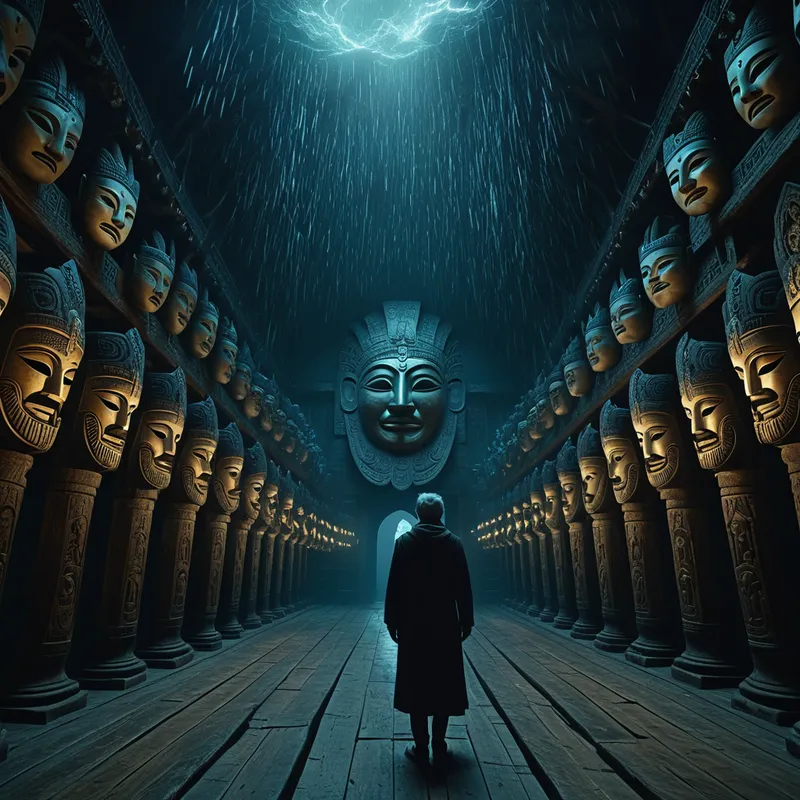
He descended into the true heart of the palace, the memory-well. Here, in the cool, earthy dark, lit by a single shaft of light from above, were the family mnemata: not just records, but vessels—an old, salt-crusted helm from a great-grandfather’s voyage; a shard of pottery from a failed colony; a lock of hair from a sister lost at sea. He did not merely catalog them. He listened. He began a silent ritual, touching each object at the same hour each day, reconstructing in his mind’s eye the full tapestry of his family’s fate—their triumphs, their follies, their recurring storms.
And [the shadow](/myths/the-shadow “Myth from Jungian culture.”/) in the house grew tangible. It was the collective, un-mourned loss, the unacknowledged pride, the hidden cowardice that every heroic lineage buries. It manifested as a cold draft that extinguished lamps, as the sound of muffled weeping in empty corridors. It was the family’s unintegrated past, and it threatened to consume the present, to make Odysseus’s return impossible, not physically, but psychically—there would be no true home to return to.
Mnemon’s resolution was not a battle, but a hosting. One night, as the shadow congealed into a palpable chill in the great hall, he did not flee. He brought the oldest relic—the helm—and sat within the gloom. He began to speak aloud the stories attached to it: not the sanitized, heroic version, but the true one—the fear, the navigational error, the moment of despair. One by one, he named the forgotten dead and their unfinished business. He gave the shadow its history. As he spoke, the cold lessened. The oppressive weight lifted, not into sunlight, but into a sober, integrated clarity. He had not defeated the past; he had remembered it into peace. When Odysseus finally did return, his [triumph](/myths/triumph “Myth from Roman culture.”/) over the suitors was but the final act. The stage had been set, the house made spiritually habitable again, by the one who stayed behind to reckon with the ghosts.
Cultural Origins & Context
The figure of “Odysseus’s uncle” is a powerful construct of the Global/Universal mythic imagination. He does not hail from a single scroll or epic but emerges from the interstices of all hero tales. He is the necessary counterpoint to the archetypal Hero’s Journey. While the hero ventures outward to conquer the external monster, the uncle remains to confront the internal, ancestral one.
This myth was passed down not by court bards, but by the keepers of family lore—the grandmothers, the retired sailors, the archivists, the ones who remember the cousins who “went away.” Its societal function was profound: to affirm that for every visible, celebrated action, there is an invisible, foundational work of memory. It served as a cultural check against the amnesia of glory, a reminder that the community’s health depends as much on those who tend the roots as on those who harvest the fruit. In oral traditions worldwide, this role is often embodied by the elder who stays at the village center while the warriors hunt, holding the spiritual and narrative continuity of the people.
Symbolic Architecture
Psychologically, the [uncle](/symbols/uncle “Symbol: An uncle in a dream often symbolizes masculine guidance, family dynamics, and the influence of male role models in one’s life.”/) represents the [collective unconscious](/symbols/collective-unconscious “Symbol: The Collective Unconscious refers to the part of the unconscious mind shared among beings of the same species, embodying universal experiences and archetypes.”/) of the [family](/symbols/family “Symbol: The symbol of ‘family’ represents foundational relationships and emotional connections that shape an individual’s identity and personal development.”/) or [lineage](/symbols/lineage “Symbol: Represents ancestral heritage, family connections, and the transmission of traits, values, and responsibilities across generations.”/). He is the embodied [memory](/symbols/memory “Symbol: Memory symbolizes the past, lessons learned, and the narratives we construct about our identities.”/), the keeper of the [pattern](/symbols/pattern “Symbol: A ‘Pattern’ in dreams often signifies the underlying structure of experiences and thoughts, representing both order and the repetitiveness of life’s situations.”/). Odysseus symbolizes the ego on its arduous [journey](/symbols/journey “Symbol: A journey in dreams typically signifies adventure, growth, or a significant life transition.”/) toward [consciousness](/symbols/consciousness “Symbol: Consciousness represents the state of awareness and perception, encompassing thoughts, feelings, and experiences.”/) (individuation). The [uncle](/symbols/uncle “Symbol: An uncle in a dream often symbolizes masculine guidance, family dynamics, and the influence of male role models in one’s life.”/)’s work in the [shadow](/symbols/shadow “Symbol: The ‘shadow’ embodies the unconscious, repressed aspects of the self and often represents fears or hidden emotions.”/)-infested [palace](/symbols/palace “Symbol: A palace symbolizes grandeur, authority, and the pursuit of one’s ambitions or dreams, often embodying a desire for stability and wealth.”/) is the critical, often overlooked process of relating [the ego](/myths/the-ego “Myth from Jungian culture.”/) to its deep, ancestral [foundation](/symbols/foundation “Symbol: A foundation symbolizes the underlying support systems, values, and beliefs that shape one’s life, serving as the bedrock for growth and development.”/).
The hero travels the world to find his treasure, but it is the sage at home who remembers what the treasure is for.
The palace under siege by suitors is the [psyche](/myths/psyche “Myth from Greek culture.”/) ([the Self](/myths/the-self “Myth from Jungian culture.”/)) corrupted by parasitic, unconscious complexes (greed, entitlement, forgetfulness). The uncle’s descent into the memory-well is a deliberate engagement with the shadow, not to fight it, but to understand its [origin](/symbols/origin “Symbol: The starting point of a journey, often representing one’s roots, source, or initial state before transformation.”/) and claim its [energy](/symbols/energy “Symbol: Energy symbolizes vitality, motivation, and the drive that fuels actions and ambitions.”/). Each relic he touches is a psychic complex, a [knot](/symbols/knot “Symbol: A knot symbolizes connections, commitments, complications, and the binding or untying of relationships and situations.”/) of [history](/symbols/history “Symbol: History in dreams often represents the dreamer’s past experiences, lessons learned, or unresolved issues that continue to influence their present.”/) and [emotion](/symbols/emotion “Symbol: Emotion symbolizes our inner feelings and responses to experiences, often guiding our actions and choices.”/). By speaking its full [truth](/symbols/truth “Symbol: Truth represents authenticity, honesty, and the quest for knowledge beyond mere appearances.”/), he performs an act of [integration](/symbols/integration “Symbol: The process of unifying disparate parts of the self or experience into a cohesive whole, often representing psychological wholeness or resolution of internal conflict.”/), transforming haunting ghosts into acknowledged ancestors.
The Dreamer’s Resonance
When this mythic pattern stirs in the modern dreamer, it often manifests as dreams of forgotten rooms in a childhood home, discovering hidden basements or attics filled with unfamiliar yet intimately familiar objects. One may dream of a silent, older relative who hands them a key, a book, or a faded photograph. The somatic experience is one of weight and then release—a pressure in the chest or a tightness in the gut that dissolves as the dream narrative unfolds.
Psychologically, this signals a process of confronting one’s psychic inheritance. The dreamer is being called to engage with their personal and familial history—not to blame or glorify, but to know. It is the psyche’s preparation for a major life transition, ensuring that the next step forward is not taken on the brittle ground of repression, but on the solid, reconciled ground of integrated memory. The “uncle” figure in the dream is the Self’s own guiding function, the inner sage that knows how to navigate the archives of the soul.

Alchemical Translation
The alchemical process mirrored here is [solutio](/myths/solutio “Myth from Alchemical culture.”/) followed by coagulatio—the dissolving of rigid, haunted forms (the unspoken family secrets, the frozen narratives) into their fluid, truthful components, and their subsequent re-solidification into a new, conscious whole. Mnemon’s work is the opus contra naturam—the work against the natural drift toward forgetfulness and fragmentation.
Individuation is not a journey away from home, but a journey into its deepest, most forgotten cellar, to reclaim the light buried there.
For the modern individual, the myth models the necessity of “staying home” psychologically. In an age obsessed with external seeking and self-invention, it prescribes a period of inward, historical contemplation. Before we can effectively wield our will (Odysseus’s bow), we must understand the weight and balance of the weapon, the history of its wood and string. The uncle’s triumph is the creation of a vessel—a conscious psyche—capable of holding the returning hero’s transformed spirit. Our own psychic transmutation requires that we become both the journeying hero and the remembering uncle, venturing out into life while simultaneously tending the sacred, shadowed hearth of our own origins. Only then does the circle close, and [the odyssey](/myths/the-odyssey “Myth from Greek culture.”/) find its true end in a home that is not just a place, but a state of wholeness.
Associated Symbols
Explore related symbols from the CaleaDream lexicon: